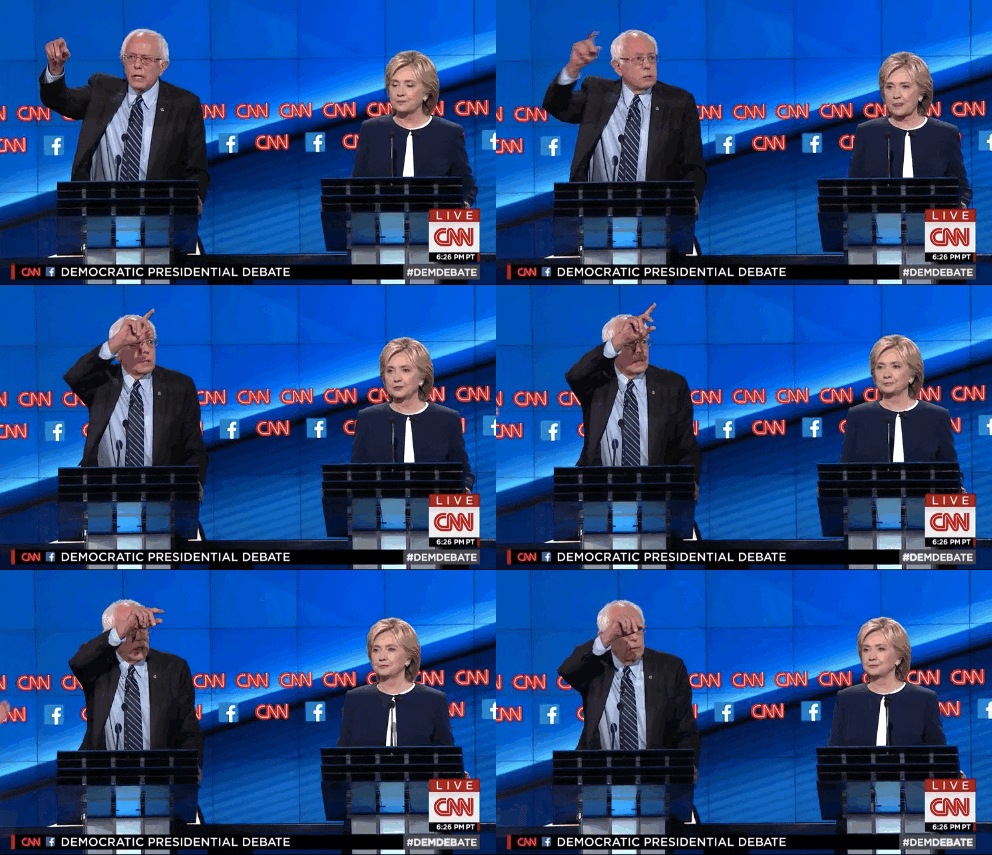
Bernie Sanders picked a weird time to start caring about Brazilian politics.

Sanders waited until Monday night—weeks after forfeiting his presidential campaign soapbox, and weeks after it could have made a difference, anyway—to release the following statement on Brazil’s slow-moving crisis of democracy:

I am deeply concerned by the current effort to remove Brazil’s democratically elected president, Dilma Rousseff. To many Brazilians and observers the controversial impeachment process more closely resembles a coup d’état.

After suspending Brazil’s first female president on dubious grounds, without a mandate to govern, the new interim government abolished the ministry of women, racial equality and human rights. They immediately replaced a diverse and representative administration with a cabinet made up entirely of white men. The new, unelected administration quickly announced plans to impose austerity, increase privatization and install a far right-wing social agenda.

The effort to remove President Rousseff is not a legal trial but rather a political one. The United States cannot sit silently while the democratic institutions of one of our most important allies are undermined. We must stand up for the working families of Brazil and demand that this dispute be settled with democratic elections.

Why now? Maybe Sanders got caught up on all the shady machinations afoot in the world’s fifth-largest country in his newfound downtime. The other possibility is that Sanders shied away from foreign policy during the campaign to avoid going full lefty. Many commentators—myself included—suspected as much, when he studiously avoided criticizing Hillary Clinton’s role in the 2010 overthrow of Honduran President Manuel Zelaya, a far more clear-cut coup than even the naked political power play taking place in Brasília. Just last month, at the start of the Democratic National Convention, 40 of his congressional colleagues signed a letter calling on Secretary of State John Kerry to do more on Rousseff’s behalf. Sander’s name wasn’t on it.

February 10, 2017

Mario Tama/Getty Images

Donald Trump can’t let go of his voter fraud fantasy.

Huddled with 10 senators on Thursday in a meeting that included former New Hampshire Senator Kelly Ayotte, Trump barely closed the door before continuing his conspiratorial talk about illegal ballots cast in last year’s presidential election.

Politico has the details:

The president claimed that he and Ayotte both would have been victorious in the Granite State if not for the “thousands” people who were “brought in on buses” from neighboring Massachusetts to “illegally” vote in New Hampshire.

According to one participant who described the meeting, “an uncomfortable silence” momentarily overtook the room.

Three months after his election—and almost a month into his presidency—he is still preoccupied with anxiety over his legitimacy, spouting paranoid delusions in closed-door meetings with the nation’s top elected officials. Trump’s insecurity has always been a driving force in his political life—it certainly affects how he works with those, like Ayotte, who have criticized him in the past—but Trump’s obsession with voter fraud is alarming because he sees it as a solution to the source of his insecurity, the widely held belief that he is not a legitimate president.

In addition to confirming that the president of the United States is clinging to conspiracy theories, Trump’s adamance about voter fraud undoubtedly will have concrete consequences for access to the ballot in America. He’s tasked Vice President Mike Pence with heading a commission on this imaginary problem, and a very real voter crackdown—possibly involving a national voter ID law—can’t be far behind.

Watch Jason Chaffetz get owned by his constituents over and over again.

Jason “Chart Guy” Chaffetz, who spent months hunting for fictional Hillary Clinton abuses of power but has done practically nothing to investigate Donald Trump’s many obvious ethics breaches, conflicts of interest, and abuses of power, went home to Utah earlier this week to hang out with his constituents. Chaffetz, who looks like if Tim Curry was a high school wrestling coach, must have known what he was walking into. After all, GOP town halls have been disrupted across the country by constituents who are demanding answers about the party’s plans for Obamacare. But Chaffetz still held his town hall, something that can’t be said for many of his colleagues. He got played. Per The Salt Lake Tribune:

The town-hall meeting was 75 minutes of tense exchanges between Chaffetz and residents from across the state. They were frustrated by the Utah Republican’s refusal to investigate President Donald Trump’s potential conflicts of interest. They doggedly pursued him for his initiatives to transfer or sell public lands. They questioned his position on immigration and refugees.

And that was only half of the largely liberal crowd.

About 1,500 people stood outside Brighton High School, too far back to make the cut, their signs reading, “Do your job” and “America is better than this.”

Or, much better, watch it:

Only Donald Trump deserves this more than Jason Chaffetz. (And maybe Sean Spicer.)

Donald Trump’s power handshakes are weird as hell.

Trump is a walking, talking airport business book—a semi-sentient Rich Dad, Poor Dad—so it should come as no surprise that he is absolutely obsessed with power handshakes, which he thinks communicate dominance. But in reality they’re just silly.

The first major power shake of Trump’s presidency was granted to Supreme Court nominee Neil Gorsuch.

And on Friday Trump struck again, this time shaking, gently patting, and violently pulling Shinzo Abe’s hand for several seconds, to the increasing consternation of the Japanese prime minister.

But as the great Dan Amira noted back in 2012, Trump has been dishing out weird-ass handshakes for years. There are some lessons you can take from looking at some of Trump’s great handshakes. From his weird shake with Mitt Romney, you learn that he refuses to be the first person to end a handshake. You also learn that the tug is the central motif of the Trump handshake—he pulls in Romney as if to say, “You are not the boss. I am the boss. Even if you become president, I am still boss.” Amira called this technique the “pull in,” which is both gross and accurate.

But Trump still hasn’t topped his weirdest handshake, which was given to Apprentice winner Bill Rancic. There’s still time though—Prince Philip better watch out.

Joe Raedle/Getty Images

Donald Trump does right thing, for wrong reason.

Elliott Abrams looked like he was in line for the position of deputy secretary of state. Abrams, a neo-conservative who has served in the administrations of Ronald Reagan and George W. Bush, enjoyed the support of Secretary of State Rex Tillerson. But his nomination was nixed by the president, seemingly because Abrams had criticized Trump during the campaign. As CNN reports:

President Donald Trump met with Abrams and the sources said that the meeting went well but when the President learned that Abrams had criticized him during the campaign, the President nixed Abrams as Deputy Secretary of State, according to the sources. ...

“This is a loss for the State Department and the country and for that matter for the President,” said one Republican source.

Another Republican source with knowledge of what happened said, “This was Donald Trump’s thin skin and nothing else.”

Whatever Trump’s motives, he made the right call. Abrams is completely unfit to serve in any public office. He was a central figure in the Iran-Contra scandal, where he repeatedly lied to Congress and eventually pled guilty to withholding information under testimony. In one of the most disgraceful episodes of modern American foreign policy, Abrams worked to help cover up the 1982 El Mozote Massacre in El Salvador, in which more than 500 civilians were killed. Abrams has an ample record as a hardline militarist with no regard for human rights. Whether Trump was acting out of spite or not, he did the world good.

Wikimedia Commons

The Trump era is turning out to be a golden age for esoteric fascist intellectuals.

Julius Evola (1898-1974) is hardly a household name. A monocle-wearing political thinker and painter whose ideas about a biologically superior caste influenced fascists like Mussolini, Evola was hitherto known largely to specialists in the Italian far right. But now, thanks to President Trump’s erudite righthand man Steve Bannon, Evola is earning posthumous attention from followers of American politics. Bannon cited Evola in a 2014 speech to the Vatican as an inspiration for the Traditionalist movement. The Times offers a useful gloss for those of us who haven’t heard of Evola:

Evola, who died in 1974, wrote on everything from Eastern religions to the metaphysics of sex to alchemy. But he is best known as a leading proponent of Traditionalism, a worldview popular in far-right and alternative religious circles that believes progress and equality are poisonous illusions.

Evola became a darling of Italian Fascists, and Italy’s post-Fascist terrorists of the 1960s and 1970s looked to him as a spiritual and intellectual godfather.

They called themselves Children of the Sun after Evola’s vision of a bourgeoisie-smashing new order that he called the Solar Civilization. Today, the Greek neo-Nazi party Golden Dawn includes his works on its suggested reading list, and the leader of Jobbik, the Hungarian nationalist party, admires Evola and wrote an introduction to his works. ...

The resurrection of Evola, whose acolytes include alt-right leaders like Richard Spencer, prompts the question: Which other hitherto arcane fascist or far-right thinker will be mainstreamed next? We know that Bannon is a fan of Curtis Yarvin. What about Aleksandr Dugin, known as Putin’s Rasputin? Alain de Benoist, the doyen of the French New Right? Ryszard Legutko, the anti-liberal philosophic inspiration for Poland’s right-wing populist government? Or, going back, we could see a revival of figures like Wyndham Lewis, Pierre Drieu la Rochelle, or Lawrence Dennis. These are names that are rarely discussed anymore. But in Trump’s America, everything old is becoming new again.

Jim Watson / Getty Images

Trump’s national security advisor Michael Flynn is being tossed under the bus.

The last time we checked in with Flynn, Trump was complaining that he was overbearing and talked too much. Now it appears he is in some serious trouble, with The Washington Post reporting that Flynn, despite his and the Trump administration’s denials, did in fact discuss U.S. sanctions against Russia with Russian Ambassador Sergey Kislyak last December, when Barack Obama was still in office. According to current and former American officials, Flynn’s communications were “inappropriate” and a “potentially illegal signal to the Kremlin that it could expect a reprieve from sanctions that were being imposed by the Obama administration in late December to punish Russia for its alleged interference in the 2016 election.”

Flynn is now backing away from his denials, telling the Post that “while he had no recollection of discussing sanctions, he couldn’t be certain that the topic never came up.” This puts him at odds with some members of the Trump administration, most notably Vice President Mike Pence, who publicly went to bat for Flynn. Last month, Pence denied that Flynn discussed sanctions with Russian officials. Now the White House is telling the Post that he “made his comments based on his conversation with Flynn.”

The White House’s relationship with Russia has been subject to scrutiny given President Trump’s (and Flynn’s) admiration for Vladimir Putin. The FBI is continuing to investigate the Flynn matter, and could even end up prosecuting him under the Logan Act, which forbids unauthorized civilians from messing with U.S. diplomacy. But before any of that happens, the administration is quickly separating itself from Flynn. He is on his own.

Alex Wong/Getty Images

Donald Trump is not going to take this judiciary slapping him around!

With its 3-0 ruling Thursday refusing to reinstate his ban on immigration from seven majority-Muslim countries, a panel of the Ninth Circuit Court of Appeals tore into the president’s executive order as overreaching and lacking legal justification. This would be a good time for the Trump administration to huddle and rethink their strategy. But that is not what Trump does.

“The Government has pointed to no evidence that any alien from any of the countries named in the Order has perpetrated a terrorist attack in the United States,” the judges wrote. “Rather than present evidence to explain the need for the Executive Order, the Government has taken the position that we must not review its decision at all.”

The judges further rejected Trump’s bogus claim that the order meant extra vetting for just 109 people: “The impact of the Executive Order was immediate and widespread. It was reported that thousands of visas were immediately canceled, hundreds of travelers with such visas were prevented from boarding airplanes bound for the United States or denied entry on arrival, and some travelers were detained.”

Trump took the ruling about as well as you’d expect.

This is actually a critical moment for the White House. As Mike Allen points out at Axios, Trump could respond to this rebuke by drafting a narrower immigration order—the kind legal scholars say might actually stand. While the appellate court’s ruling was emphatic, you can see the ways in which the judiciary would retreat to its traditional deference to the executive on matters of national security. For one, the administration could concede that the judiciary at least has oversight powers.

Or Trump could continue to stew, dig in his heels, and forge stubbornly ahead, risking further losses in the court system. Luckily for Trump’s opponents, one of those options seems more likely.

Giphy

Donald Trump’s White House is on the verge of a nervous breakdown.

One of Trump’s biggest selling points during the election was that he would run his government like a business. Aside from the fact that the whole premise makes no sense, the problem is that Trump is trying to run the government like his businesses—that is, badly. If Trump is America’s boss, the past three weeks have shown the depths of his inability to manage the country. And it’s starting to take a psychological toll on his administration.

Part of the problem is that Trump is not very smart. As reported by Politico, he is overwhelmed by even the most basic parts of his job. He is astounded by things that you learn in the 4th grade, like the fact that there is a separation of powers. He doesn’t understand why judges can overturn his executive orders and the Senate can delay his nominees. According to the article, Trump “often asks simple questions about policies, proposals, and personnel. And, when discussions get bogged down in details, the president has been known to quickly change the subject—to ‘seem in control at all times.’”

His staff is on a knife’s edge. National Security Council staffers are mad because of Steve Bannon’s appointment. No one quite knows what Jared Kushner does, but they “worry about running afoul” of him. Sean Spicer is miserably feeling the hot, hot breath of his boss over his shoulder at every moment (which he deserves). And the whole operation is leaking to the press like a sieve, prompting Trump to order internal investigations against his own people. Everyone is exhausted and demoralized. Some are starting to wonder if a “staff shake-up is in the works.” Apparently it’s so bad that even Chris Christie, a boy who thinks he deserves a balloon, believes he might get hired.

Trump is clearly getting frustrated by his job. If only he could quit.

February 09, 2017

Justin Sullivan/Getty

“Fake news” is definitely not the equivalent of the n-word, Chris Cuomo.

“Fake news” has currency among people of all political stripes. Donald Trump uses it to attack unfavorable reporting, and Donald Trump’s critics use it to explain why Trump won. “Fake news” has been used to describe legitimate reports, hoaxes, conspiracy theories, satire, and reporting errors. While it’s best used to describe a false story that becomes widely shared because it confirms deeply held biases, it has largely become a floating signifier.

But that doesn’t mean that people aren’t worked up about it. Archetypal CNN host Chris Cuomo went on archetypal CNN pundit Michael Smerconish’s radio show to discuss the human cost of being called “fake news.” It didn’t go well.

The only thing that’s bothersome about it, is that I see being called “fake news” as the equivalent of the n-word for journalists, the equivalent of calling an Italian any of the ugly words that people have for that ethnicity. That’s what fake news is to a journalist. It is an ugly insult and you better be right if you’re going to charge a journalist with lying on purpose and the president was not right here and he has not been right in the past.

This is so wrong and misguided that it’s pretty funny. Given the violence (often state-sanctioned) against the ethnic groups that Cuomo mentions—and the racial hierarchies that racial slurs often enforce—there is obviously no comparison here at all. Journalists, especially ones in privileged positions like Cuomo’s (it should be added that his father was governor of New York and his brother is governor of New York), face nothing even approximating the kinds of discrimination Cuomo is referring to here.

The point that Cuomo is trying to make is not a terrible one, but he made it in literally the worst way possible. Also, the Smerc-man either didn’t realize there was a problem with what Cuomo said or straight up ratted him out on Twitter for the retweets.

Chip Somodevilla/Getty

Donald Trump doesn’t know what the START treaty is, but he does know that it’s bad.

If there is a Trump doctrine, it’s that it’s totally cool to take positions on treaties and policies about which he knows nothing or next-to-nothing. Trump flummoxed Republicans by making statements that ran contrary to long-standing party orthodoxy, and his famously volatile call with the prime minister of Australia came only shortly after he learned of an agreement in which the United States agreed to take hundreds of refugees. On Thursday afternoon, Trump also reportedly told senators that he was open to the Gang of Eight immigration bill—which basically runs counter to every one of his stated immigration policies. The only explanation is that he has no freaking clue what it is.

On Thursday morning, the so-called New START treaty—which limits Russian and American deployment of nuclear warheads—came up in a call between Trump and his good buddy Vladimir Putin. According to Reuters, Trump had to be briefed on the treaty mid-call:

In his first call as president with Russian leader Vladimir Putin, Donald Trump denounced a treaty that caps U.S. and Russian deployment of nuclear warheads as a bad deal for the United States, according to two U.S. officials and one former U.S. official with knowledge of the call.

When Putin raised the possibility of extending the 2010 treaty, known as New START, Trump paused to ask his aides in an aside what the treaty was, these sources said.

Trump then told Putin the treaty was one of several bad deals negotiated by the Obama administration, saying that New START favored Russia. Trump also talked about his own popularity, the sources said.

Trump’s only guiding ethos seems to be that deals negotiated by Obama are bad because they were negotiated by Obama. Trump claims to be one of the world’s greatest negotiators and has said that he literally wrote the book on negotiating. (He didn’t.) But as president, Trump has yet to show his supposedly first-rate negotiation skills. Instead, he creates unnecessary diplomatic crisis after unnecessary diplomatic crisis, for no other reason than his persistent belief that Obama is bad and that he is good.