Breaking News
Breaking News
from Washington and beyond

Hakeem Jeffries Is “Looking Forward to Hearing From President Biden”

The House minority leader did not answer directly when asked whether President Biden was the Democratic Party’s best messenger.

Hakeem Jeffries, wearing a dark suit and a light purple tie, raises his hand as he walks in the Capitol.
Drew Angerer/Getty Images
House Minority Leader Hakeem Jeffries

Asked if Joe Biden was the Democratic Party’s most effective messenger following his disastrous performance in Thursday night’s debate, House Minority Leader Hakeem Jeffries sidestepped the question—and appeared to suggest an openness to replacing the president as the party’s nominee. 

“President Biden is scheduled to speak today around noon, as I understand it, in North Carolina,” Jeffries told AP reporter Farnoush Amiri Friday morning. “I’m looking forward to hearing from President Biden. And until he articulates a way forward in terms of his vision for America at this moment, I’m going to reserve comment about anything relative to where we are at this moment, other than to say I stand behind the ticket. 

“I stand behind the Senate Democratic majority. And of course, we’re going to do everything that we need to do as House Democrats to win,” Jeffries added. 

Earlier in the day, Jeffries said that Biden shouldn’t step aside as the party’s nominee. But his answer to Amiri’s question suggests reservations, at the very least. After all, the New York Democrat is a party leader and not known for going against the rest of the Democratic orthodoxy, and he didn’t give a full-throated defense of Biden. Given the outright panic in Democratic circles, it would be shocking if the party’s leaders weren’t at least weighing their options at the moment.

While some Democrats have made outlandish defenses of the president, others have openly discussed how to replace Biden before November, mentioning a brokered convention and alternative candidates like Vice President Kamala Harris, Michigan Governor Gretchen Whitmer, or California Governor Gavin Newsom.  

There is a clear consensus that Biden showed fatigue and a lack of mental sharpness at the debate, though there is no clear, obvious replacement waiting in the wings—and no easy way to sub Biden out. But there’s still time, as the Democratic National Convention isn’t until mid-August, and the calls will only grow louder if concerns go unresolved.  
Iowa Now Has One of the Most Restrictive Abortion Laws in the Nation

The state’s Supreme Court just approved a law that bans nearly all abortions at six weeks.

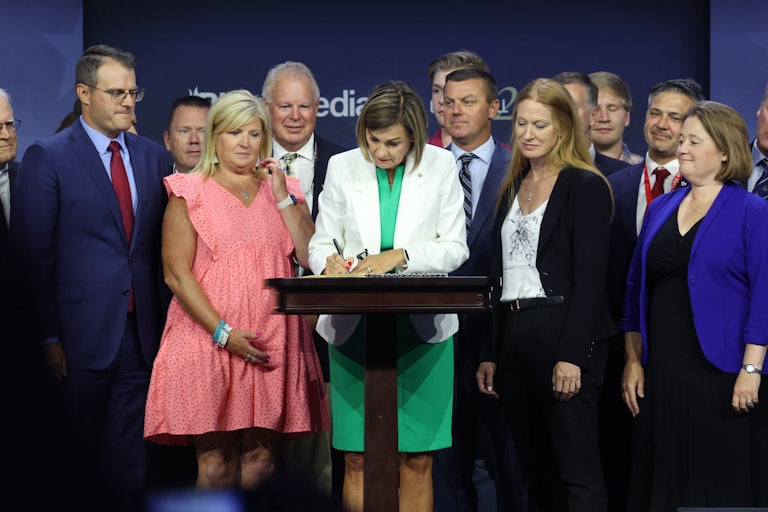
A woman wearing a white jacket and green dress signs a law on a lectern surrounded by white people.
Scott Olson/Getty Images)
Iowa Governor Kim Reynolds signing a six-week abortion ban last year.

The Iowa Supreme Court ruled Friday to allow a law that will ban abortions after a fetal heartbeat is detected, which can be as early as six weeks.

Governor Kim Reynolds signed the uber-restrictive heartbeat abortion ban into law in July 2023, carving out exceptions only in the case of incest or for the health of the mother. The law was challenged the next day by Planned Parenthood, which sought a temporary injunction. A district court quickly granted the injunction, which prevented the law from being enforced, but the decision was appealed by the state.

In a 4–3 ruling, Justice Matthew McDermott delivered the majority opinion, and was joined by Justices Christopher McDonald, David May, and Dana Oxley, who provided the tie-breaking vote after recusing herself from ruling on a previous version of the state’s so-called heartbeat ban.

The court’s majority determined that Planned Parenthood could not justify its request for a temporary injunction, because it was not likely to be successful in proving that the abortion ban was unconstitutional. Therefore, the court decided to dissolve the temporary injunction and remand the case back to district court.

“Our holding today—applying rational basis as the constitutional test—undermines the rationale for the district court’s ruling,” McDermott wrote.

Chief Justice Susan Christenson dissented, writing that the majority opinion “strips Iowa women of their bodily autonomy by holding that there is no fundamental right to terminate a pregnancy under our state constitution.” This ruling, she wrote, “relies heavily on the male-dominated history and traditions of the 1800s, all the while ignoring how far women’s rights have come since the Civil War era. It is a bold assumption to think that the drafters of our state constitution intended for their interpretation to stand still while we move forward as a society.”

Christenson argued that Iowa should have maintained its standard to bar abortion restrictions that placed an “undue burden” on pregnant women.

In Justice Edward Mansfield’s dissenting opinion, he wrote that “the decision not to have children is as fundamental as the decision to have children,” and that the law should protect both rights.

Governor Reynolds applauded the court’s decision in a post on X, formerly Twitter. “There is no right more sacred than life, and nothing more worthy of our strongest defense than the innocent unborn,” she wrote. “As the heartbeat bill finally becomes law, we are deeply committed to supporting women in planning for motherhood, and promoting fatherhood and its importance in parenting.”

This decision is just the latest in the erosion of abortion access after the repeal of Roe v. Wade two years ago, which granted states the right to determine abortion restrictions, a decision that has thrown the rights and well-being of Americans into a desperate and dangerous free fall.

Supreme Court Delivers Major Win to January 6 Rioters

The court just weakened the statute used to charge hundreds of Capitol rioters.

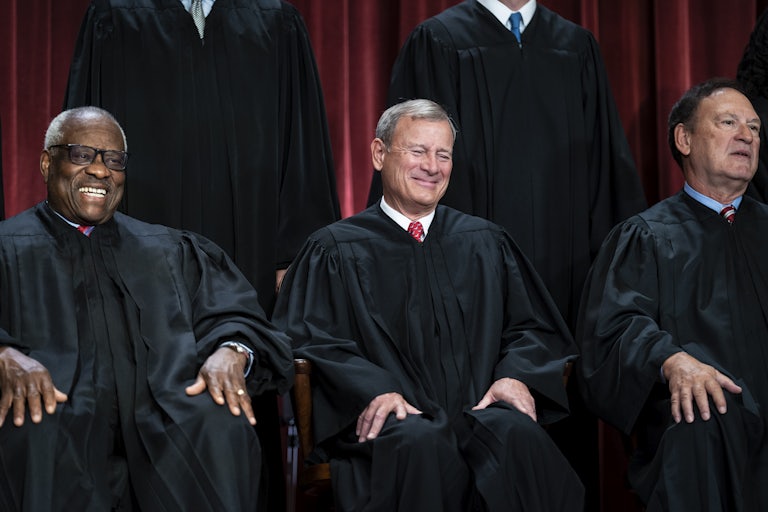
Supreme Court Justices Clarence Thomas and John Roberts smile, wearing their robes. Samuel Alito, sitting next to them, is zoning out.
Jabin Botsford/The Washington Post/Getty Images

The Supreme Court on Friday tossed some charges against Capitol rioter Joseph Fischer, “significantly weakening” the statute used to convict hundreds of rioters, according to Slate’s Mark Joseph Stern. The 6–3 decision on nonideological lines gives a boost to January 6 rioters and rests on the incredibly nitpicky interpretation of the order of words in criminal statutes.

The statute at the heart of the case, the Sarbanes-Oxley Act, includes two subsections that federal prosecutors have used in charging Capitol rioters:

Whoever corruptly (1) alters, destroys, mutilates, or conceals a record, document, or other object, or attempts to do so, with the intent to impair the object’s integrity or availability for use in an official proceeding; or (2) otherwise obstructs, influences, or impedes any official proceeding, or attempts to do so, shall be fined … or imprisoned not more than 20 years, or both.

The first portion of that law prohibits destroying or altering official documents or objects, while the second part is what federal prosecutors have used to charge Capitol rioters. The Supreme Court, led by Chief Justice John Roberts, tossed out the charge against Fischer on the basis that Fischer did not tamper with any physical evidence—wholly ignoring the second part of the statute.

In his opinion, Roberts provides an example to make his case likening Congress to zoo animals and Capitol rioters to visitors at the zoo: “A zoo might post a sign that reads, ‘do not pet, feed, yell or throw objects at the animals, or otherwise disturb them.’ If a visitor eats lunch in front of a hungry gorilla, or talks to a friend near its enclosure, has he obeyed the regulation? Surely yes.”

Liberal junior Justice Ketanji Brown Jackson joined conservative justices Roberts, Samuel Alito, Neil Gorsuch, Clarence Thomas, and Brett Kavanaugh in the 6–3 majority opinion—while conservative justice Amy Coney Barrett joined liberal justices Sonia Sotomayor and Elena Kagan in dissent.

Barrett’s dissent makes clear her view that the majority opinion is finding a question for a predetermined answer, claiming, “The Court … does textual backflips to find some way—any way—to narrow the reach of subsection.”

“The Court does not dispute that Congress’s joint session qualifies as an ‘official proceeding”’ that rioters delayed the proceeding; or even that Fischer’s alleged conduct (which includes trespassing and a physical confrontation with law enforcement) was part of a successful effort to forcibly halt the certification of the election results,” Barrett writes. “Given these premises, the case that Fischer can be tried for, ‘obstructing, influencing, or impeding an official proceeding’ seems open and shut. So why does the Court hold otherwise? Because it simply cannot believe that Congress meant what it said.”

Fischer’s case now returns to lower court for further consideration under the new interpretation of the statute—meaning hundreds of other January 6 rioters’ cases could be similarly relitigated.

More on the Supreme Court’s latest decisions:

Elena Kagan Torches Supreme Court for Overturning Chevron

Justice Kagan issued a scathing dissent of her conservative colleagues, who she claims are desperate for power.

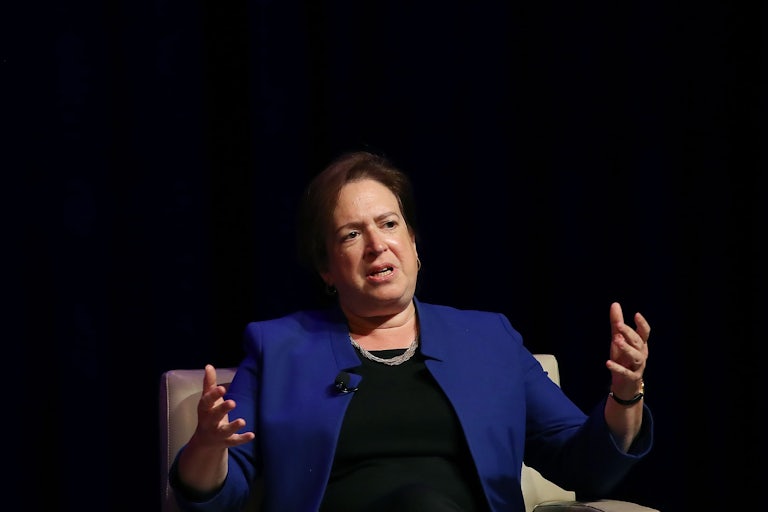
Supreme Court Justice Elena Kagan speaks and makes hand gestures
Mark Wilson/Getty Images

Justice Elena Kagan torched a Supreme Court ruling that single-handedly eliminated a legal precedent that courts defer to the expert opinions of federal agencies.

The court ruled 6–3 in Loper Bright v. Raimondo on Friday, overruling a landmark 1984 decision in Chevron v. Natural Resources Defense Council and shifting the balance of power toward courts rather than the executive branch when it comes to the interpretation of ambiguous rules.

That would effectively give any court and any judge veto power over all the decisions that any executive agency makes, from the Environmental Protection Agency to the Food and Drug Administration to the Education Department and beyond.

“In one fell swoop, the majority today gives itself exclusive power over every open issue—no matter how expertise-driven or policy-laden—involving the meaning of regulatory law,” Kagan wrote. “The majority turns itself into the country’s administrative czar.”

Kagan continued that the ruling would “produce large-scale disruption,” made a “laughing stock” of stare decisis (a legal principle necessitating the court rely on precedent), and made evident that the court’s supermajority “disdains restraint” and “grasps for power.”

“What actions can be taken to address climate change or other environmental challenges? What will the Nation’s health-care system look like in the coming decades? Or the financial or transportation systems? What rules are going to constrain the development of A.I.?” Kagan wrote. “In every sphere of current or future federal regulation, expect courts from now on to play a commanding role. It is not a role Congress has given to them, in the APA or any other statute. It is a role this Court has now claimed for itself, as well as for other judges.”

“All that backs today’s decision is the majority’s belief that Chevron was wrong—that it gave agencies too much power and courts not enough,” she added. “But shifting views about the worth of regulatory actors and their work do not justify overhauling a cornerstone of administrative law. In that sense too, today’s majority has lost sight of its proper role.”

Sotomayor Blasts Supreme Court for Devastating Homelessness Ruling

Supreme Court Justice Sonia Sotomayor is warning about the the court’s “unconscionable” Grants Pass decision.

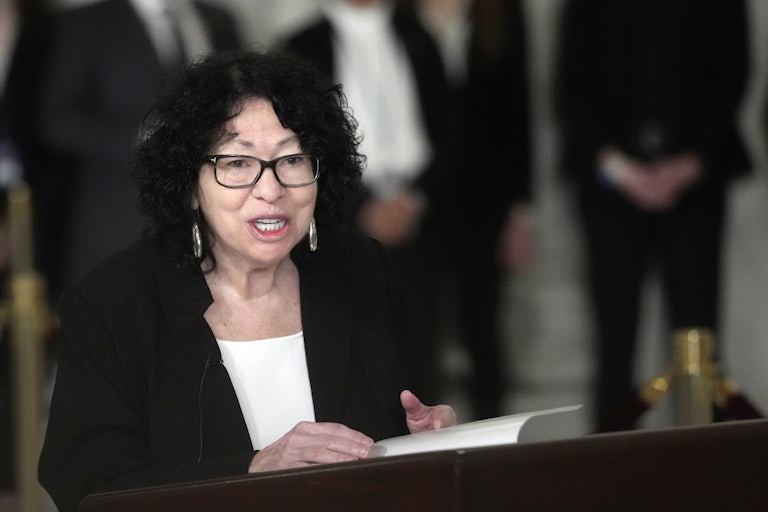
Supreme Court Justice Sonia Sotomayor
Jacquelyn Martin/Pool/Getty Images

Supreme Court Justice Sonia Sotomayor issued a scathing dissent Friday on her conservative colleagues’ decisions to essentially criminalize homelessness in its Grants Pass ruling. Sotomayor put the rest of the court on blast and layed out how the attack on the rights of homeless individuals is an attack on the rights of all Americans.

While the conservative majority argued that the high court must not impede local governments from criminalizing homelessness, Sotomayor wrote, “It is possible to acknowledge and balance the issues facing local governments, the humanity and dignity of homeless people, and our constitutional principles.”

“The City of Grants Pass jails and fines those people for sleeping anywhere in public at any time, including in their cars, if they use as little as a blanket to keep warm or a rolled-up shirt as a pillow,” Sotomayor wrote. “For people with no access to shelter, that punishes them for being homeless. That is unconscionable and unconstitutional. Punishing people for their status is ‘cruel and unusual’ under the Eighth Amendment.”

Going on to quote social science experts, Sotomayor explained how punishing people for sleeping outside without providing offers to housing and available beds is simply “a big game of whack-a-mole.”

While the conservative justices trumpeted tropes about unsheltered homeless people being service-resistant, or denying shelter when offered, Sotomayor noted studies have shown that “the vast majority of those who are unsheltered would move inside if safe and affordable options were available.” She went on to say that when people do resist being housed, it’s often because those beds that are available may have “restrictions based on gender, age, income, sexuality, religious practice, curfews that conflict with employment obligations, and time limits on stays.” For example, the only shelter in Grants Pass, which is charity-run, has strict religious and work requirements.

The Supreme Court’s ruling on this case will allow cities and states to avoid the offer of shelter entirely if they so choose and offers one solution to homelessness: punishment.

As Sotomayor wrote, imposing fines and jailing individuals is not a solution. In her dissent, which she read from the bench, the justice described a story of a homeless man in Nashville who was arrested 198 times and had over 250 citations, making it difficult for an outreach worker to find him housing. The outreach worker was eventually forced to make him a T-shirt that read, “Please do not arrest me, my outreach worker is working on my housing.” Once the man, who experienced homelessness for 20 years, was able to secure stable housing, he “had no further encounters with the police, no citations, and no arrests.”

If criminalizing someone for the mere act of sleeping outside with a blanket wasn’t frightening enough, as some experts feared, this case also opens up the door for justices to challenge a concurring opinion, Robinson v. California, which held it was unconstitutional to punish someone for being addicted to drugs—for their “status” of addiction. Justice Clarence Thomas’s entire concurring opinion lays the groundwork to overturn Robinson.

Despite the conservative majority disguising its stance as a “leave it to states” approach, this ruling, as Sotomayor laid out, is an infringement on homeless individuals’ constitutional rights, with troubling ripple effects for all of us. “This Court must safeguard those rights even when, and perhaps especially when, doing so is uncomfortable or unpopular,” wrote Sotomayor, Otherwise, “the words of the Constitution become little more than good advice.”

Sotomayor concluded her dissent by writing that she remains hopeful that we can address the crisis of homelessness through other means. “That responsibility is shared by those vulnerable populations, the States and cities in which they reside, and each and every one of us.”