Breaking News
Breaking News
from Washington and beyond

RFK Jr. Admits His Policies Are Hurting Children

The Health and Human Services chief shrugged as he admitted that we will see an increase in cavities if he succeeds in removing fluoride from drinking water.

Robert F. Kennedy Jr. smizes
Michael M. Santiago/Getty Images

On Thursday Health and Human Services Secretary Robert F. Kennedy Jr. is still set on removing fluoride from drinking water even after admitting that it did help prevent cavities and tooth decay in children. 

“What has been the response from dentists in America who may be concerned that some children in lower incomes in particular don’t get those regular dental, preventative-type situations where they can go in and get their teeth more indemnified and treated against cavities?” Fox News’s Harris Faulkner asked Kennedy Jr. as he sat next to Oklahoma Governor Kevin Stitt. 

“Well, people will still get indemnified for it to the extent that they’re already indemnified. But you know, it is an issue. It’s a balance. You’re gonna see, probably, slightly more cavities. Although in Europe where they banned fluoride they did not see an uptick in cavities. The issue is, parents need to decide. Science is very clear on fluoride.” 

Europe has not “banned” fluoride, they just don’t add it to their public water supplies like we do here. Europeans still receive fluoride at the dentist. Even still, Kennedy has had his mind set on this fluoride ban for some time now.  

“On January 20, the Trump White House will advise all U.S​. water systems to remove fluoride from public water,” he wrote in November. “Fluoride is an industrial waste associated with arthritis, bone fractures, bone cancer, IQ loss, neurodevelopmental disorders, and thyroid disease. President ​Donald Trump and First Lady Melania Trump want to Make America Healthy Again.​”

Dental professionals nationwide are troubled by this development.

“The growing distrust of credible, time-tested, evidence-based science is disheartening. The myths that fluoridated water is harmful and no longer necessary to prevent dental disease is troublesome and reminds me of fictional plots from old movies like Dr. Strangelove,” said American Dental Association President Brett Kessler. “When government officials, like Secretary Kennedy, stand behind the commentary of misinformation and distrust peer-reviewed research it is injurious to public health.” 
Trump’s Ugly Phone Scam Has Already Hit Some Major Snags

Donald Trump’s new mobile phone company is already backing down on some of its biggest promises.

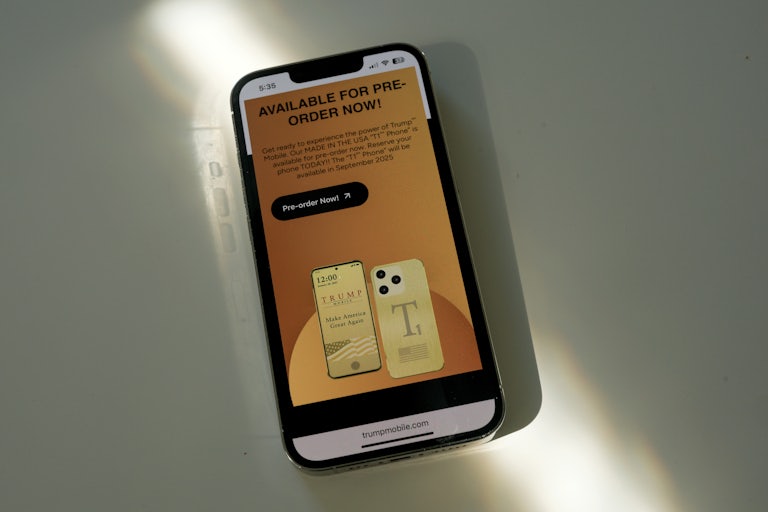
A phone screen shows the pre-order website for Trump Mobile phones
Joe Raedle/Getty Images

Forget “Make America Great Again”—Donald Trump won’t even manufacture his own phone in the United States.

The Trump-branded cell phone, which launched mere days ago, has already scrubbed all language from its website that indicates the product is made in America. Instead, the phone is “designed with American values in mind,” with strange marketing promises that there are “American hands behind every device,” per the Trump Mobile website. That could, of course, mean anything.

The website also features a poorly photoshopped mock-up of the new Trump phone, which looks not too dissimilar to an iPhone save for its three copy-pasted cameras. The cell has a matte gold finish, along with a laser-engraved American flag and “T1” on the back.

A review of the site by The Verge found that the move away from American production wasn’t the only change made since the phone previewed last week. The advertised screen size of the Trump phone has also dropped significantly, changing from a 6.78-inch screen to 6.25 inches.

The site used to list the phone as having 12 gigabytes of RAM—now there are no RAM specifications whatsoever.

Further, the site had previously promised that the gimmicky gadget would ship in September, but that language no longer exists in marketing materials. Instead, the company is offering that it will be available “later this year.”

The Verge reported that the differences could mean that the Trump Organization had switched suppliers for the T1 phone.

The cell phone appears to be just another example in a long line of money-grabbing grifts for the president. Trump’s long list of election-year hustles included launching a remarkably ugly sneaker and a limited-edition $60 God Bless the USA Bible co-promoted by “God Bless the USA” singer Lee Greenwood.

Trump also took the parent company of his social media platform Truth Social public and stamped his name on a new cryptocurrency platform headed by his two sons, Eric and Don Jr., that even the president’s allies have criticized as a “huge mistake.” He and his wife also started their own cryptocurrencies, which critics have accused of being a method for wealthy foreigners to buy time and influence with the president.

Ketanji Brown Jackson Rips Supreme Court for “Stymying” Civil Rights

The Court “will strip those South Carolinians—and countless other Medicaid recipients around the country—of a deeply personal freedom: the ‘ability to decide who treats us at our most vulnerable.’”

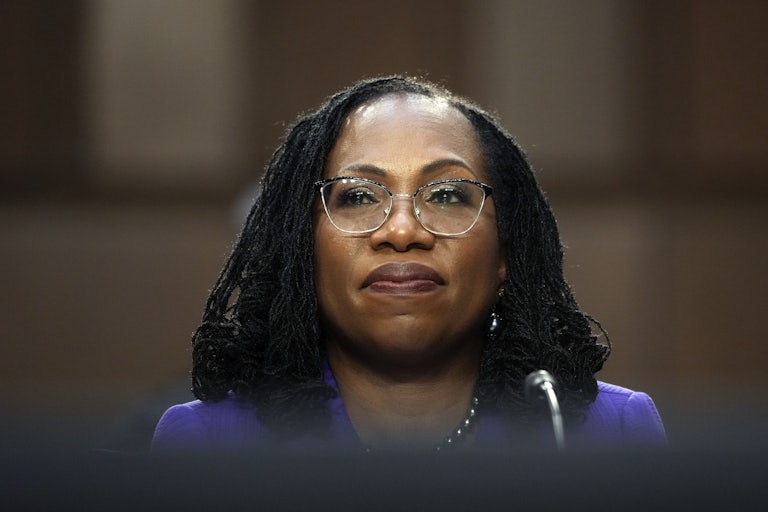
Ketanji Brown Jackson at her confirmation hearings in 2022.
Drew Angerer/Getty Images
Ketanji Brown Jackson at her confirmation hearings in 2022

Supreme Court Justice Ketanji Brown Jackson wrote that the Supreme Court was “stymying one of the country’s great civil rights laws” after it ruled 6–3 that states could defund Planned Parenthood on the grounds that Medicaid does not give patients a right to choose their provider.

Jackson offered a biting dissent, essentially calling the court’s decision a bastardization of the first section of the Civil Rights Act of 1871, also known as the Ku Klux Klan Act, which bolstered laws against white supremacist terrorism.

“A century and a half later, the project of stymying one of the country’s great civil rights laws continues. In this latest chapter, South Carolina urges our Court to adopt a narrow and ahistorical reading of the 1871 Act’s first section.… That venerable provision permits any citizen to obtain redress in federal court for ‘the deprivation of any rights, privileges, or immunities secured by the Constitution and laws of the United States,’” Jackson wrote. “South Carolina asks us to hollow out that provision so that the State can evade liability for violating the rights of its Medicaid recipients to choose their own doctors. The Court abides South Carolina’s request. I would not. For that reason, I respectfully dissent.”

This ruling makes Planned Parenthood incredibly vulnerable to conservative attacks, as states can now nakedly use anti-abortion activism to deprive it of funds. Though all they’re really attacking is the contraception, cancer screenings, pregnancy testing, and other basic medical care that Planned Parenthood provides as an organization that accepts publicly funded insurance, like Medicaid. The Hyde Amendment already restricts public funding from being used for abortions. And Planned Parenthood is the largest provider of contraceptives and birth control in the country. Its absence will almost certainly lead to more accidental pregnancies—and more abortions, legal or illegal.

“At a minimum, it will deprive Medicaid recipients in South Carolina of their only meaningful way of enforcing a right that Congress has expressly granted to them,” Jackson concluded in her dissent. “And, more concretely, it will strip those South Carolinians—and countless other Medicaid recipients around the country—of a deeply personal freedom: the ‘ability to decide who treats us at our most vulnerable.’”

Democrats Are Finally Working to Stop Trump’s Secret Police

A commonsense bill would ban ICE agents from covering their faces and force them to show identification when conducting raids. Republicans will almost certainly kill it.

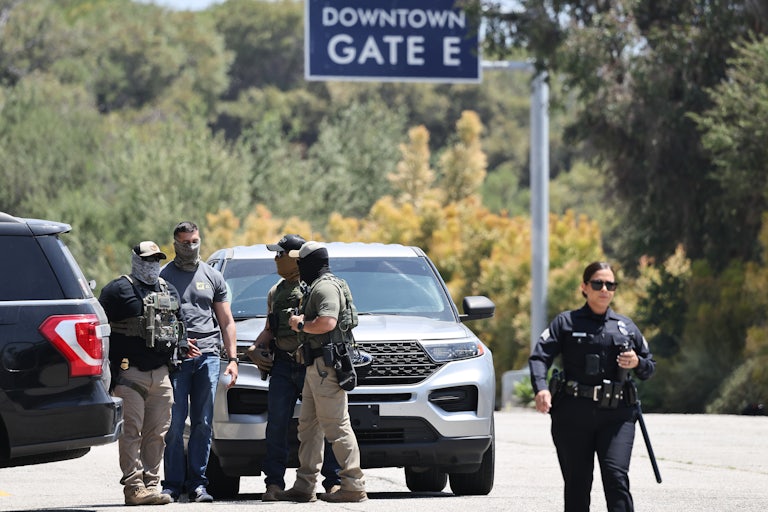
Masked federal agents stand in a parking lot
Mario Tama/Getty Images
Masked federal agents in Los Angeles earlier this month

A new bill introduced by U.S. Representatives Dan Goldman and Adriano Espaillat would seek to address the scourge of unidentified, masked and plainclothed agents abducting people off the streets in executing President Donald Trump’s deportation campaign.

The bill, dubbed “No Secret Police Act of 2025,” would amend the Homeland Security Act of 2022 to prohibit federal immigration from wearing masks. According to Goldman, it would “get rid of masks, would require all agents to show their identification and insignia, and ensure accountability for these horrible, horrible policies.”

The legislation comes as Trump administration officials defend Immigration and Customs Enforcement agents’ ability to act with anonymity. In a recent Washington Post letter to the editor, ICE acting Director Todd Lyons wrote that “officers wear masks for personal protection and to prevent doxing.”

But this purported right for agents of the state—who are empowered to use force in carrying out their duties—to shield their identities has, as Goldman put it, led to the use of “authoritarian tactics that resemble Soviet Russia more than they resemble a democratic United States.”

Indeed, one could be forgiven for mistaking footage of ICE arrests in recent months for kidnappings.

When a Tufts graduate student was seized by masked men in March (seemingly for merely having written a pro-Palestinian op-ed), a witness chided the agents, asking, “You want to take those masks off? Is this a kidnapping? Can I see some faces here? How do I know this is the police?”

In April, a woman who recorded ICE agents detaining three men outside of a Georgia courthouse (one of whom was reportedly released after proving he was a U.S. citizen), told a local news station, “I would have literally thought that they were kidnapping these three men.”

Goldman and Espaillat’s legislation resembles a bill introduced earlier this month by Representative Nydia Velázquez addressing the same issue, as well as state-level proposals like California’s recently introduced “No Secret Police Act” and “No Vigilantes Act.”

Supreme Court Makes It Harder for Immigrants to Challenge Deportations

The ruling could make it easier for Donald Trump to deport more people.

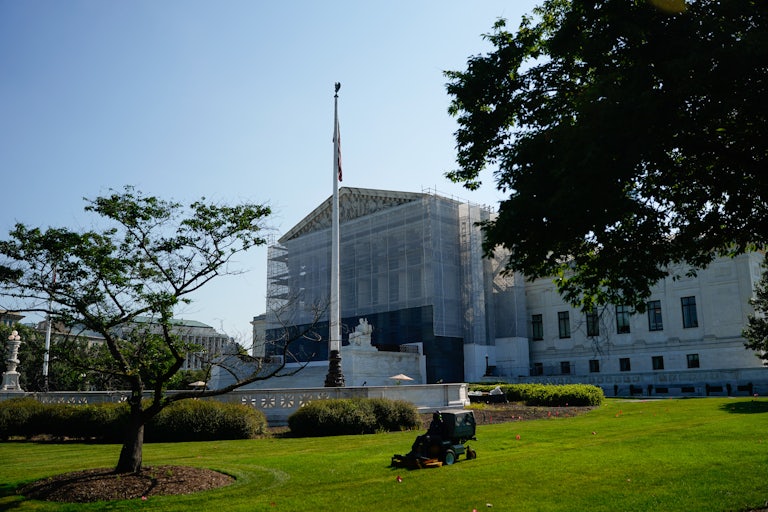
The Supreme Court building in Washington, D.C.
Kent Nishimura/Bloomberg/Getty Images

The Supreme Court just defined the tight window under which noncitizens can challenge their deportation for fear of torture.

The case of Riley v. Bondi began long before Donald Trump’s immigration crackdown. In January 2021, an immigration judge blocked the final administrative review order, or FARO, to remove Pierre Riley, a Jamaican immigrant who overstayed a tourist visa, on the grounds that he feared gang violence in Jamaica.

That judge then sent Riley to what’s known as a “withholding-only” proceeding, where the only issue is whether a noncitizen can be removed from the United States. At this proceeding, Riley’s removal was deferred under the U.N. Convention Against Torture, or CAT, which prevents immigrants from being removed to countries where they may be subjected to physical harm or imprisonment.

The DHS then appealed to the Board of Immigration Appeals, or BIA, which decided he could be removed and to enforce the FARO for his removal. Three days later, Riley filed a petition to appeal the FARO with the Fourth Circuit Court of Appeals, but the court found that he had failed to do so within the 30-day deadline after the FARO was first issued, dismissing his petition and claiming that the deadline was “jurisdictional,” meaning that it must be strictly enforced.

The Supreme Court was charged with determining whether Riley’s challenge came too late, and whether the deadline was “jurisdictional.”

In a 5–4 decision Thursday, the high court found that Riley had in fact missed his window to challenge his removal. In his majority opinion, Justice Samuel Alito held “that a BIA order in a withholding-only proceeding is not a ‘final order of removal,’ and therefore the 30-day filing deadline cannot be satisfied by filing a petition for review within 30 days of the BIA’s withholding-only order.”

The “FARO is the final order of removal in this case, and withholding-only proceedings do not disturb the finality of an otherwise final order of removal,” Alito wrote. He was joined in full by Chief Justice John Roberts and Justices Clarence Thomas, Amy Coney Barrett, and Brett Kavanaugh.

In a dissenting opinion, Justice Sonia Sotomayor, who was joined by fellow liberal Justices Elena Kagan and Ketanji Brown Jackson, challenged the majority’s logic, finding that the removal order only became final when the board denied his appeal under CAT.

“Should Riley have appealed the Board’s order denying deferral of removal before the Board issued it? The answer ought to be easy. Yet the majority today renders the statute incoherent, holding that Riley should have appealed the order one year and three months before the Board entered it,” she wrote.

“One should not be required to appeal an order before it exists,” she wrote. “Incomprehensibly, the Court disagrees.”

“Time will tell whether the Court will extend its illogic beyond politically disfavored noncitizens,” Sotomayor wrote, adding later, “Today’s decision is the rare holding that benefits no one.”

Conservative Justice Neil Gorsuch also joined the dissent, except for one section outlining the “untold damage to basic principles of finality and judicial review.”

The court also determined that the 30-day filing deadline was merely a mandatory claims-processing rule, not “jurisdictional,” and vacated the Fourth Circuit’s ruling and remanded it back to the lower court.

Thursday’s ruling could come in handy to Trump, who has worked to deport as many people as possible as fast as he can—regardless of what circumstances await them in their destination.

Read more about how the court has helped Trump: