Breaking News
Breaking News
from Washington and beyond

Trump Secretly Overhauled Citizenship Agency to Focus on Deportations

One new team is focused entirely on “denaturalization.”

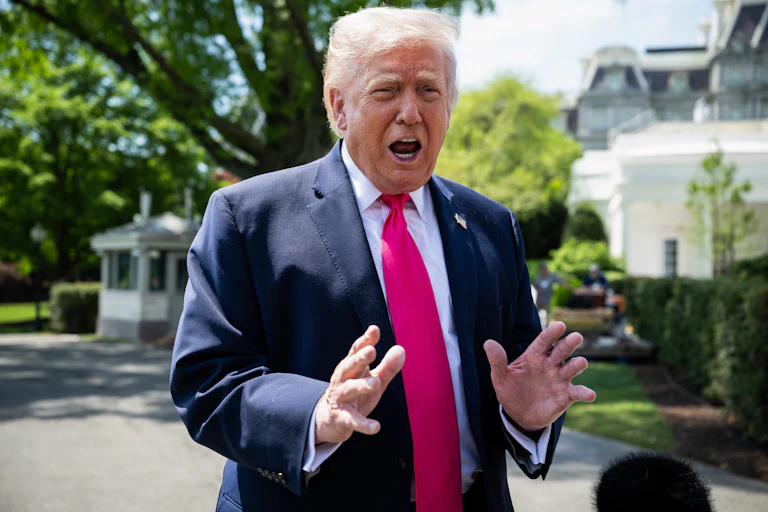
Donald Trump holds his arms out to the side and speaks while standing outside the White House
Matt McClain/Getty Images

Donald Trump’s administration has quietly transformed the agency overseeing legal immigration into yet another arm of the president’s mass deportation scheme.

An internal agency document reviewed by The New Yorker’s Jonathan Blitzer revealed that the U.S. Citizenship & Immigration Services (USCIS), the agency that manages visas, green cards, naturalizations, and other aspects of the legal immigration process, has created a new “Tactical Operations Division.”

The roughly 80-person division consists of teams focused on denaturalization, “refugee re-vetting,” fraud detection and national security, and LPR operations, where officials are tasked with finding cases where they can rescind legal permanent residency status, according to Blitzer.

The division is overseen by Danny Andrade, who was selected to run the newly opened USCIS field office in Nashville.

Sarah Pierce, a former policy analyst for USCIS, wrote on X Monday that the restructuring comes as the agency “lost thousands of employees last year.”

“Its application backlog is at a record high—nearly double its 2020 level. And its Fraud Detection division is larger than ever. Yet [USCIS Director Joseph Edlow] keeps finding new ways to shift agency resources from adjudication to deportation,” Pierce wrote.

UCIS’s workforce shrank 11 percent last year, as the agency has become a site for immigration arrests. In September, the Trump administration passed a new rule allowing USCIS to hire special agents for the purpose of making arrests. And the agency’s latest job listings are in search of so-called “Homeland Defenders.”

Trump Freaks Out Over Poll Numbers as Iran Tanks His Popularity

Donald Trump posted repeatedly on social media insisting he was actually super popular.

Donald Trump speaks to reporters outside the White House
Celal Gunes/Anadolu/Getty Images

Negotiations between the U.S. and Iran have hit more turbulence in the wake of a tense weekend that has apparently sent Donald Trump spiraling.

The two countries were close to brokering a new peace agreement late last week as the deadline on the two-week ceasefire drew closer. But that fell apart after the U.S. seized an Iranian cargo ship over the weekend. Trump, however, had other things on his mind.

The president was firmly cemented in la-la land by Monday morning, littering his Truth Social feed with surveys from pro-Trump pollsters that claimed Americans overwhelmingly supported the offensive (they don’t), and Newsmax stories that declared he had “already won the war.”

In at least one post, Trump decried widespread reports that Israel had convinced the White House to partake in its siege against Iran.

“Israel never talked me into the war with Iran, the results of Oct. 7th, added to my lifelong opinion that IRAN CAN NEVER HAVE A NUCLEAR WEAPON, did,” Trump wrote. “I watch and read the FAKE NEWS Pundits and Polls in total disbelief. 90 percent of what they say are lies and made up stories, and the polls are rigged, much as the 2020 Presidential Election was rigged. Just like the results in Venezuela, which the media doesn’t like talking about, the results in Iran will be amazing.”

“And if Iran’s new leaders (Regime Change!) are smart, Iran can have a great and prosperous future!” Trump added, openly boasting about influencing foreign governments.

U.S. involvement in the war was arranged following an auspicious February 11 meeting between Trump, Israeli Prime Minister Benjamin Netanyahu, and several U.S. and Israeli officials in the White House Situation Room, The New York Times reported earlier this month.

It was Netanyahu’s direct influence—and the ensuing pressure campaign—that thrust America into the war. U.S. military commanders advised Trump that components of Netanyahu’s plan to attack Iran were “farcical,” but by that point, Trump had already been inspired to overthrow Tehran’s theocratic regime.

It’s likely that Netanyahu continues to hold the reins. Last month, Trump told The Times of Israel that the decision to end the Iran war will be a “mutual” decision he makes with the Israeli leader.

It is not clear exactly what the war in Iran has accomplished. Together, the U.S. and Israel have killed thousands of Iranian civilians and obliterated Iranian civilian infrastructure. Meanwhile, 13 U.S. soldiers have died. The war also spiked the cost of living for people around the world, agitated international relations—particularly between the U.S. and longtime allies in the Western hemisphere—cost American taxpayers over $50 billion, and sparked a political rejection of MAGA ideology across the U.S.

Trump has previously stated that his primary objective in the war was to erase Iran’s nuclear capabilities, but his administration’s current battle assessments have stood in contrast to other attacks they boasted about as recently as last year.

Prior to the war—which never obtained congressional approval—Trump ordered strikes on three of Iran’s nuclear sites, hitting Fordo, Natanz, and Isfahan on June 22. At the time, the Trump administration claimed that the one-off air raid had set Iran’s program back by “years.”

Ex-National Counterterrorism Center Director Joe Kent sparked a maelstrom in Washington when he resigned over the issue last month. Kent argued in his resignation letter that he could not “in good conscience” support the war in Iran. “Iran posed no imminent threat to our nation, and it is clear that we started this war due to pressure from Israel and its powerful American lobby,” he wrote at the time.

“Absurd”: Michigan Flat-Out Rejects Trump Demand for Ballots

The Trump administration is escalating its quest for election records ahead of what’s expected to be a very tough midterm for Republicans.

Michigan Attorney General Dana Nessel speaks into a microphone
Bill Pugliano/Getty Images
Michigan Attorney General Dana Nessel in 2022

The Trump administration was rebuffed by the state of Michigan Sunday after it tried to demand Detroit-area ballots from the 2024 election.

Last week, the Department of Justice sent a letter, signed by Assistant Attorney General ⁠Harmeet Dhillon, to the clerk of Wayne County, where Detroit is located. The letter demanded election ballots, ballot receipts, and ballot envelopes from the last presidential election, according to Michigan Attorney General Dana Nessel.

In a joint statement with Governor Gretchen Whitmer and Secretary of State Jocelyn Benson, Nessel called the request “as absurd as it is baseless.”

“Once again, President Trump is weaponizing the Justice Department in an attempt to sabotage our democratic process and turn it into his own personal agency to interfere in state elections,” Nessel said in the statement. “If this administration ​wants to bring this circus to our state, my office is prepared to protect the people’s right to vote.”

It’s the latest of many attempts by the Trump administration to demand voter and election information from states across the country, ostensibly to look for evidence of fraud. Administration officials have sought election data from every state and Washington, D.C., suffering legal setbacks in Rhode Island, California, Massachusetts, and Oregon.

President Trump continues to insist that the 2020 election was stolen from him, despite a lack of evidence and multiple court losses. FBI Director Kash Patel claimed in a Fox News interview Sunday that arrests over the 2020 elections are coming “this week,” a sign that Trump’s underlings are trying to drum up a justification for him to mess with the midterms in November and possibly beyond that.

Kash Patel Sues Atlantic for Piece About How He’s Crashing Out at Work

A former official said Patel is “rightly paranoid” that he could lose his job at any minute—and the FBI director is furious that The Atlantic published a story about it.

FBI Director Kash Patel leans forward and puts his head in his hand during a congressional hearing.
Graeme Sloan/Bloomberg/Getty Images

FBI Director Kash Patel filed a $250 million defamation suit against The Atlantic Monday, after a sweeping report detailing his excessive drinking and unexplained absences.

In a 19-page filing, lawyers for Patel alleged that The Atlantic had published an “article replete with false and obviously fabricated allegations designed to destroy Director Patel’s reputation and drive him from office.”

The Atlantic’s Sarah Fitzpatrick reported over the weekend that Patel was known to drink in excess, routinely delayed meetings and time-sensitive operations, and was often unreachable, raising concerns about the potential for foreign coercion and other national security risks. His behavior had also grown increasingly erratic as he became worried he might lose his job.

The article referenced Patel’s “alcohol-fueled nights” in Washington and Las Vegas, which resulted in rescheduled meetings. The director’s “spotty attendance” in the office caused delays in time-sensitive decision-making. His “delays resulted in normally unflappable agents ‘losing their shit,’” Fitzpatrick wrote. Patel’s rather elusive behavior even prompted a request for actual “breaching equipment,” normally used by SWAT teams, because Patel had been unreachable behind locked doors.

The article also described a “freak out” earlier this month when, unable to log into his work computer in the morning, Patel made frantic phone calls claiming he’d been fired. In fact, it was a routine technical issue that was quickly resolved.

Patel had responded to the story by simply saying: “Print it, all false, I’ll see you in court—bring your checkbook.”

The lawsuit pointed to the reliance on anonymous sources who were merely “partisans with axes to grind,” as well as a lack of primary documentation, arguing that the article was “a deliberate and malicious smear.” Of course, the filing of his massive lawsuit now invites extensive discovery into Patel’s conduct.

In a statement Monday, The Atlantic said: “We stand by our reporting on Kash Patel, and we will vigorously defend The Atlantic and our journalists against this meritless lawsuit.”

This story has been updated.

Trump Blocked From Iran War Plans After Screaming at Aides for Hours

Military officials have sidelined Donald Trump from planning the war he started.

Donald Trump speaking outside the White House
Graeme Sloan/Sipa/Bloomberg/Getty Images

Donald Trump’s erratic behavior has gotten him exiled from critical peace negotiations with Iran.

The president was removed from such talks by his own aides last month, who feared that his unpredictable style could hamper the discussions, The Wall Street Journal reported Saturday.

The decision was informed by the president’s behavior during the search and rescue operation for the aircrew of the downed F-15 fighter jet late last month, when the president reportedly screamed at his aides for hours.* As a result, his aides “kept the president out of the room as they got minute-by-minute updates because they believed his impatience wouldn’t be helpful, instead updating him at meaningful moments,” a senior administration official told the Journal.

Shortly after the second airman was recovered, the president was back to beating his chest. In a rapid-fire series of hair-raising Truth Social posts on Easter morning, Trump pledged he would completely annihilate Iranian civilization within a couple of days. He was reportedly under the impression that appearing unstable would spur Tehran to negotiate, according to the Journal.

But it wasn’t the first time during the sustained military offensive that Trump’s entourage decided the president would be best kept out of the action.

Around the same time, White House chief of staff Susie Wiles forced a meeting of Trump’s most trusted advisers. The problem: No one was being honest with the president about the domestic impact of the war.

Privately, Wiles had expressed fears that the inner circle’s rose-tinted retelling of the conflict would leave Trump oblivious to the political reality of the war, just months ahead of a contentious midterm season, reported Time magazine earlier this month.

Up until that point, Trump had been spoon-fed daily video compilations of various battlefield successes, a senior administration official told the publication. Trump was under the impression that stripping nuclear capabilities from Iran could be one of his greatest legacies as America’s 47th president.

The current conflict has gone on for more than seven weeks, surpassing the administration’s six-week deadline. In that timespan, the U.S. has lost access to a critical oil tradeway in the Middle East, tanked global oil markets, spiked the cost of living for people around the world, and agitated international relations—particularly between the U.S. and longtime allies in the Western hemisphere. It has also cost American taxpayers over $50 billion, and sparked a political rejection of MAGA ideology across the U.S.

The war has killed more than 3,375 people in Iran, state media reported Monday, and more than 2,290 people in Lebanon. It has also claimed the lives of 13 U.S. service members throughout the region.

* This story originally misstated the type of fighter jet.