Breaking News
Breaking News
from Washington and beyond

DHS Secretary Warns They’re Close to Not Being Able to Pay Employees

New Secretary Markwayne Mullin tried to browbeat Democrats into ending the dragging Department of Homeland Security shutdown.

Homeland Security Secretary Markwayne Mullin sits in Donald Trump’s Cabinet meeting
Will Oliver/EPA/Bloomberg/Getty Images

Employees at the Department of Homeland Security are weeks away from losing their paychecks.

Homeland Security Secretary Markwayne Mullin told Fox News Tuesday that the agency’s funding has all but run dry, 66 days into the partial government shutdown.

Donald Trump signed a memorandum earlier this month that authorized the release of $10 billion in emergency funds from the 2025 One Big Beautiful Bill Act, but that money will be gone by the first week of May. Mullin noted that between DHS’s 22 agencies, the department spends roughly $1.6 billion on wages every two weeks.

“So the money is going extremely fast, and once that happens, there is no emergency funds after that,” the DHS chief told Fox. “After we get through April … I’ve got one payroll left and there is no more emergency funds, so the president can’t do another executive order for us to use money because there’s no more money there.”

The only solution, according to Mullin, is for Congress to pass another funding bill. Republicans and Democrats have been in a stalemate for months, unable to reach a bipartisan consensus on how to fund DHS without tackling the myriad recent abuses by two of the department’s subagencies: Immigration and Customs Enforcement and Customs and Border Protection.

Shortly after federal agents killed Alex Pretti and Renee Nicole Good in Minneapolis, Democrats demanded 10 reforms to the two agencies as a prerequisite for ongoing funding negotiations. Those demands included line items that required agents to identify themselves, take off their masks, and obtain judicial warrants before forcing their way onto private property. Republicans refused.

The conservative caucus, however, is attempting to put forward a new funding package that would address DHS’s financial straits without diverting additional funds toward ICE and CBP. Last year, the two agencies independently received a total of $170 billion in Trump’s “big, beautiful bill”—more than five times their 2024 allotment.

Trump Extends Iran Ceasefire as No One Shows Up to Peace Talks

No one showed up to the negotiations in Islamabad—leading Trump to make the big announcement.

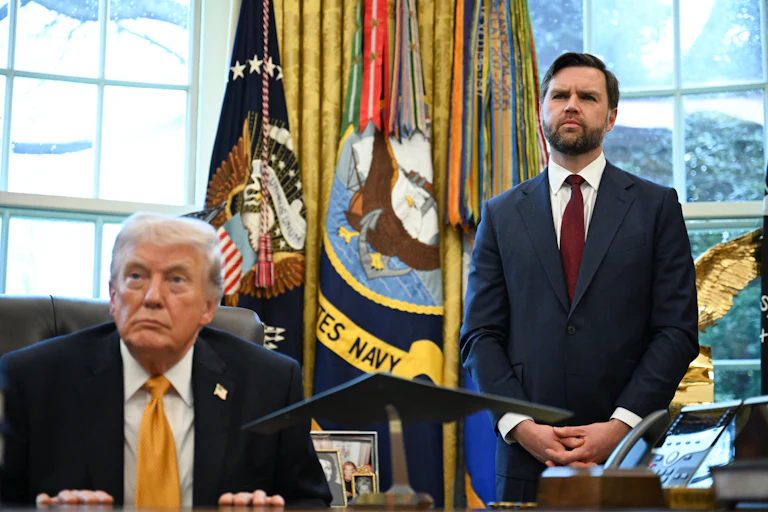
Donald Trump sits at his desk in the Oval Office of the White House as JD Vance stands next to him
ANNABELLE GORDON/AFP/Getty Images

President Trump announced an indefinite extension to his ceasefire with Iran Tuesday as it became evident that peace talks between the two countries were on the brink of collapse.

“Based on the fact that the Government of Iran is seriously fractured, not unexpectedly so and, upon the request of Field Marshal Asim Munir, and Prime Minister Shehbaz Sharif, of Pakistan, we have been asked to hold our Attack on the Country of Iran until such time as their leaders and representatives can come up with a unified proposal,” Trump wrote on Truth Social. “I have therefore directed our Military to continue the Blockade and, in all other respects, remain ready and able, and will therefore extend the Ceasefire until such time as their proposal is submitted, and discussions are concluded, one way or the other.”

The announcement came shortly after Vice President JD Vance suspended his travel plans to Islamabad Tuesday to represent the United States at the table. One source told The Wall Street Journal that Vance pulled out because Iranian negotiators hadn’t committed to showing up to the meeting. Iranian Foreign Ministry spokesman Esmail Baghaei confirmed as much, telling Iranian state broadcaster IRIB that the meeting was called off due to “contradictory messages, inconsistent behavior and unacceptable actions by the American side.”

Iranian Foreign Minister Abbas Araghchi added that the U.S. blockade of the Strait of Hormuz is an “act of war” and a violation of the ceasefire.

Trump has previously noted that the United States is prepared to simply continue bombing Iran again if no deal is reached, but his latest announcement shows he may be ready to admit he doesn’t hold all the cards here. Meanwhile, the U.S. has accomplished nothing since the war began, as the Strait of Hormuz remains closed and the Iranian government remains unwilling to concede on its enriched uranium.


This story has been updated.

Florida Criminally Investigating ChatGPT Over Role in School Shooting

The man accused of killing two people at Florida State University in 2025 allegedly exchanged messages with OpenAI’s chatbot before the attack.

People stand in front of a memorial for shooting victims at Florida State University
Miguel J. Rodriguez Carrillo/Getty Images
A memorial for shooting victims at Florida State University

Florida became the first state to criminally investigate an AI model on Tuesday, and Attorney General James Uthmeier’s charges could lead to big changes in how the technology is regulated.

Uthmeier, a Republican, launched a criminal probe into ChatGPT and its parent company, OpenAI, following a mass shooting at Florida State University that took place in April 2025.

Two people died, and six others were injured in the shooting, including at least one student. All of those injured have since been released from hospital, and the suspect, 20-year-old FSU student Phoenix Ikner, is in custody.

Prosecutors reviewed Ikner’s devices and claimed he spoke to the chatbot extensively. While Ikner does not appear to have been driven into “AI psychosis,” as some mentally unstable individuals have, he allegedly talked to the chatbot multiple times about the shooting.

ChatGPT “offered significant advice to the shooter before he committed such heinous crimes,” Uthmeier said. One message involved the suspect quizzing ChatGPT about a gun’s power at close range, and which ammunition was needed to load it.

On the day of the crime, Ikner allegedly asked the chatbot how America would react to a shooting at Florida State, and when the most crowded time was at the student union, the area of the campus where the shooting took place.

“If this were a person on the other end of the screen, we would be charging them with murder,” Uthmeier said at a press conference.

While Florida’s Republican Governor Ron DeSantis isn’t exactly a favorite of the left, he has been at the forefront of state AI regulation. DeSantis has asked the state legislature to come up with legal AI guardrails in a special session next week.

But the country’s executive branch has taken the opposite stance. President Donald Trump has pushed to deregulate AI and force states to comply with federal policy. We’ll see which GOP sect ends up victorious, but Florida’s leadership on the issue is a welcome development.

Military Is About to Run Out of Ammunition Thanks to Trump’s Iran War

The U.S. military has also used up almost all of its stockpile of key types of missile.

A THAAD missile defense system is displayed outside the White House
Xinhua//Getty Images
A THAAD missile defense system is displayed outside the White House during Donald Trump’s first term.

The U.S. has significantly depleted its missile reserve during its war with Iran, sparking concerns that the military could be caught empty-handed if another conflict arises in the next few years.

The Pentagon has used at least 45 percent of its Precision Strike Missile stockpile, at least half of its THAAD missiles, and nearly 50 percent of its Patriot air defense interceptor missiles, according to a report published Tuesday by the Center for Strategic and International Studies.

The number of missiles that remain are expected to be enough to continue the war in Iran, even if peace negotiations fall apart, but they are too diminished to thwart another major world power, such as China.

“The high munitions expenditures have created a window of increased vulnerability in the western Pacific,” Mark Cancian, a retired U.S. Marine Corps Colonel and a CSIS report author, told CNN. “It will take one to four years to replenish these inventories and several years after that to expand them to where they need to be.”

Chief Pentagon spokesman Sean Parnell told CNN that the military “has everything it needs to execute at the time and place of the President’s choosing.”

“Since President Trump took office, we have executed multiple successful operations across combatant commands while ensuring the U.S. military possesses a deep arsenal of capabilities to protect our people and our interests,” Parnell said.

The war with Iran is currently in its seventh week, but Defense Department officials first raised concerns about America’s missile supply more than a month ago. In a closed-door meeting with lawmakers on March 3, Defense Secretary Pete Hegseth and Chairman of the Joint Chiefs of Staff General Dan Caine reportedly said that Iran’s Shahed attack drones had proved a more difficult problem than initially predicted. One source told CNN in early March that the U.S. has been “burning” through long-range precision-guided missiles in order to fend off the drones.

Shortly afterward, European Union defense officials warned that the U.S. would no longer be capable of supplying missiles to its allies amid the war with Iran, stressing that the continent would need to develop its own missile manufacturing sector in order to adequately fill its supply without Washington’s help.

But the reality has not aligned with the White House’s rhetoric. Donald Trump has repeatedly claimed that the U.S. has a “virtually unlimited” supply of missiles, capable of attacking Iran “forever.” Nonetheless, his administration has placed orders with private contractors in order to replenish America’s stockpiles, though some weapons reserves are expected to take years before they return to prewar levels.

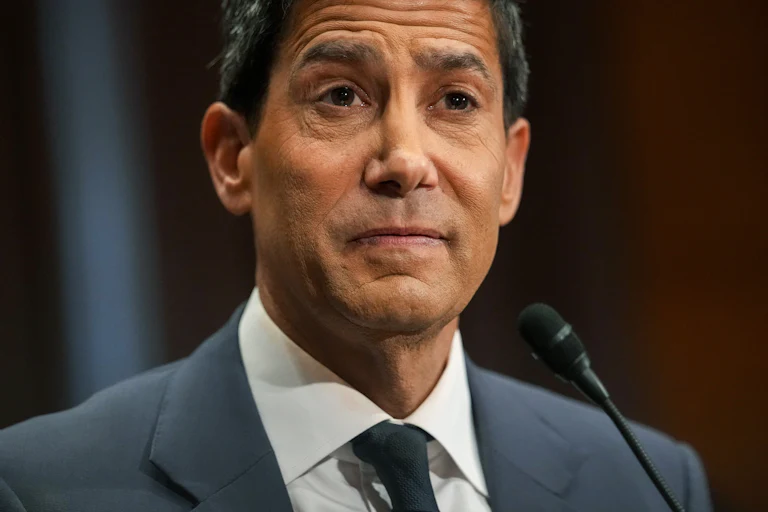
Fed Chair Nominee Caught in Massive Lie on What Trump Told Him

Kevin Warsh said he had not discussed cutting interest rates with Donald Trump.

Federal Reserve chair nominee Kevin Warsh raises his eyebrows during his Senate committee confirmation hearing
Andrew Harnik/Getty Images

Arizona Senator Ruben Gallego should be commended for some excellent fact-checking of Trump crony Kevin Warsh on Tuesday.

Warsh is Trump’s pick to be the next chair of the Federal Reserve after Jerome Powell’s term expires in May. During Warsh’s Senate committee confirmation hearing, Gallego tried to suss out whether Warsh was going to put the president’s political interests ahead of the country’s economic health.

“Earlier today, you said to Senator [John] Kennedy that President Trump never demanded you to cut interest rates in your job interview. Is that your sworn testimony?” Gallego asked.

“That is, Senator,” Warsh said.

“Well, someone here is lying, then,” Gallego replied. “It’s either you or President Trump. Because in an interview with The Wall Street Journal of December 12, President Trump confirmed he pressed you on your commitment to support interest rate cuts.”

Gallego helpfully cited the Journal article for Warsh: “During a 45-minute meeting … the president pressed Warsh on whether he could trust him to support interest-rate cuts if he were chosen to lead the central bank, according to people familiar with the meeting. Trump, in the Journal interview, confirmed that reporting.”

Warsh responded by claiming the reporters who wrote the story—Meridith McGraw, Nick Timiraos, and Brian Schwartz—were fibbing:

“Senator, there’s, of course, a third alternative. You cite a couple of reporters for a leading financial newspaper.… I think those reporters either need better sources, or better journalistic standards.”

Of course, the cited “source” here is Trump himself, which Gallego pointed out, asking if that meant Warsh thought Trump was lying. Warsh began to reply before Gallego unfortunately cut him off and moved on. Gallego did ask Warsh what he would say if the Journal verified all of its reporting, to which Warsh repeated the same unsatisfying point about journalists needing better sources and standards.

Warsh has previously worked on Wall Street, as an economic adviser in the George W. Bush administration, and as a Fed governor from 2006 to 2011. With a net worth in the hundreds of millions, he would be the richest Fed chair ever, which feels fitting for a presidency that seems to be about the rich laughing in the face of working Americans as much as possible.

Trump would love to see a Powell replacement as soon as possible. Trump appointed the mild-mannered, bespectacled Powell in 2017, but Powell has since drawn the president’s ire by being boringly responsible and refusing to cut interest rates. Trump has even weaponized the Department of Justice by subpoenaing Powell over a federal building renovation (a judge tossed the lawsuit out).

In the face of mounting pressure, Powell has not wavered. His quiet resistance to the president has made him something of a cult hero among Democrats, who have crafted a few social media fancams in his honor.