Breaking News
Breaking News
from Washington and beyond

Kash Patel’s Atlantic Lawsuit Is Already Backfiring

The reporter who wrote the story says she has gotten a host of new sources ready to dish dirt on Patel.

FBI Director Kash Patel stands during a press conference
Nathan Posner/Anadolu/Getty Images

It looks like Kash Patel’s major meltdown over The Atlantic’s humiliating report on his excessive drinking and unexplained absences has only made things worse for the embattled FBI director.

Last weekend, The Atlantic’s Sarah Fitzpatrick reported that Patel was known to drink in excess, routinely delayed meetings and time-sensitive operations, and was often unreachable, raising concerns about the potential for foreign coercion and other national security risks. His behavior had also grown increasingly erratic as he became worried he might lose his job.

In response, Patel filed a $250 million defamation lawsuit Monday alleging that the article was “replete with false and obviously fabricated allegations designed to destroy Director Patel’s reputation and drive him from office.” Within a day of filing, he already managed to undermine his own lawsuit.

While speaking to Radio Atlantic Thursday, Fitzpatrick was asked about Patel’s lawsuit. “I stand by every single word of this report,” she said, noting that aside from Patel, the response to the article has been overwhelmingly supportive.

“And I think one of the things that has been most gratifying, after—immediately after the story published was, I have been inundated by additional sourcing going up to the highest levels of the government, thanking us for doing the work, providing additional corroborating information,” Fitzpatrick said.

The sources Fitzpatrick spoke with to produce the original report were “people who felt that not only was this conduct embarrassing, unbecoming, but that it was a national security vulnerability, and that Americans were perhaps less safe as a result,” she said.


Kristi Noem Isn’t Moving Out After Being Fired

The former homeland security secretary has been forced to leave her job—but she isn’t leaving the home it came with.

Kristi Noem raises her hand as she swears an oath
Jim WATSON/AFP/Getty Images

Former Homeland Security Secretary Kristi Noem is still living in a waterfront home on a Washington, D.C., military base nearly two months after she was fired, according to reporting from The Wall Street Journal.

Noem moved into the home—usually reserved for the Coast Guard commandant— after the previous commandant, Linda Fagan, was fired. It is not typical for Cabinet members or civilians to live in military housing. While other Trump Cabinet members have opted for military housing in his second term, allegedly due to threats they received, Noem is no longer a Cabinet member and should be living in civilian housing. Markwayne Mullin was confirmed as the new homeland security secretary on March 23, over a month ago, and Noem was ousted before that.

Admiral Kevin Lunday, the current Coast Guard commandant, has plans to move into the home Noem is occupying very soon, according to sources close to the situation.

Corey Lewandowski, Noem’s former aide and alleged affair partner, has been spotted at the home multiple times, even as recently as this month. Neither Noem nor DHS has commented.

Trump DOJ Ends Revenge Investigation Into Fed Chair Powell

The Justice Department is finally dropping its criminal investigation into Federal Reserve Chair Jerome Powell.

Federal Reserve Chair Jerome Powell
Samuel Corum/Bloomberg/Getty Images
Federal Reserve Chair Jerome Powell

President Donald Trump is backing down from his vendetta against Jerome Powell.

The Justice Department announced Friday that it is dropping its criminal investigation into the Federal Reserve chief over the renovation of the central bank’s Washington, D.C., headquarters.

“This morning the Inspector General for the Federal Reserve has been asked to scrutinize the building costs overruns—in the billions of dollars—that have been borne by taxpayers,” U.S. Attorney for D.C. Jeanine Pirro posted on X. “Accordingly, I have directed my office to close our investigation as the IG undertakes this inquiry.”

“I will not hesitate to restart a criminal investigation should the facts warrant doing so,” Pirro added, appearing to suggest that there was not a factual basis for the previous investigation.

Powell’s term expires on May 15, and Trump’s nomination of Kevin Warsh to fill the position has faced roadblocks, with Republican Senator Thom Tillis threatening to hold up Warsh’s confirmation over the trumped-up investigation of Powell. Tillis’s vote against Warsh would have been enough to sink his nomination.

Trump has threatened to fire Powell for months, citing the made-up headquarters scandal and complaining about interest rates not being lowered enough. Earlier this month, Trump said he would fire Powell if he stayed past his term, even though Powell is legally allowed to remain as chair “pro tempore” until Congress confirms his replacement.

At his Senate confirmation hearings earlier this week, Warsh dodged questions about his financial ties to Jeffrey Epstein and whether Trump had discussed lowering interest rates with him. While a significant roadblock to his confirmation has just been lifted, those questions could still deter his appointment.

This story has been updated.

DeSantis Schemes to Sidestep Florida Constitution to Help Trump

Florida Governor Ron DeSantis plans to ignore Florida law in order to help Republicans win the redistricting wars.

Florida Governor Ron DeSantis
Joe Raedle/Getty Images
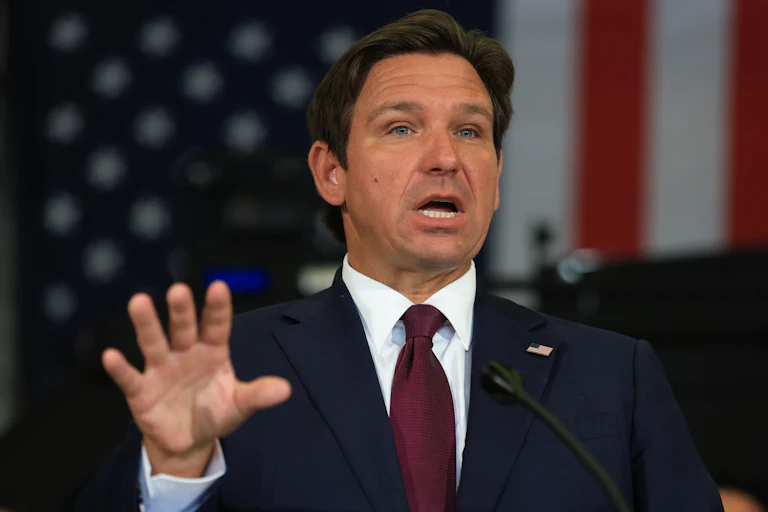
Florida Governor Ron DeSantis speaking

Florida Governor Ron DeSantis is hoping to get around Florida’s Constitution in order to redraw the state’s congressional map and give Republicans nationally a big advantage.

The Florida Constitution bans legislators from drawing districts with “the intent to favor or disfavor a political party or an incumbent.” DeSantis, who has called a special session of the state legislature to vote on the new maps on Tuesday, plans to get around that provision in three ways, Axios reports.

First, DeSantis’s office has redrawn the new congressional districts in secret, rejecting state legislators’ calls for an open process during their regular session in January. DeSantis is the first governor in state history to submit his own secretly drafted maps, and as of Thursday night, Florida lawmakers still haven’t seen them. The hidden process frustrates legal challenges, making it hard for plaintiffs to access records and prove intent.

Second, since DeSantis’s staff are the ones drawing the maps, he can claim executive privilege as a legal defense to court challenges. He did so in a 2022 court challenge to new legislative maps. In that case, he also invoked the “apex doctrine,” which requires plaintiffs to first depose low-level staff members before higher ones, to shield his staff from depositions. Ultimately, the maps were upheld in federal court.

That doctrine would waste time and help the Florida governor run out the clock on any court challenges to his districts, which is the third part of DeSantis’s plan. The U.S. Supreme Court generally abides by the “Purcell principle,” which limits lower courts from changing election laws too close to an election to protect voters. By running out the clock in court, DeSantis can then invoke that principle to force his maps through in time for November’s midterm elections, although this could backfire if the courts decide DeSantis’s changes are too close to the midterms.

Republicans hope Florida can offset a Democratic redistricting win in Virginia earlier this week, when voters passed a state constitutional amendment to temporarily allow the Democratic-run legislature to redraw the state’s maps. But even if DeSantis successfully gets his new maps approved, there’s no guarantee that Republicans will gain seats.

“The enemy gets a vote,” a Republican consultant involved in the redistricting process told Axios. “And in an environment like this, where independents are breaking hard against us and our people aren’t showing up and Democrats are pissed, we could wind up losing a net number of seats.”

Trump Claims SPLC Lawsuit Is a Sign He Actually Won the 2020 Election

Donald Trump seems to think that this lawsuit vindicates one of his longest-running conspiracies.

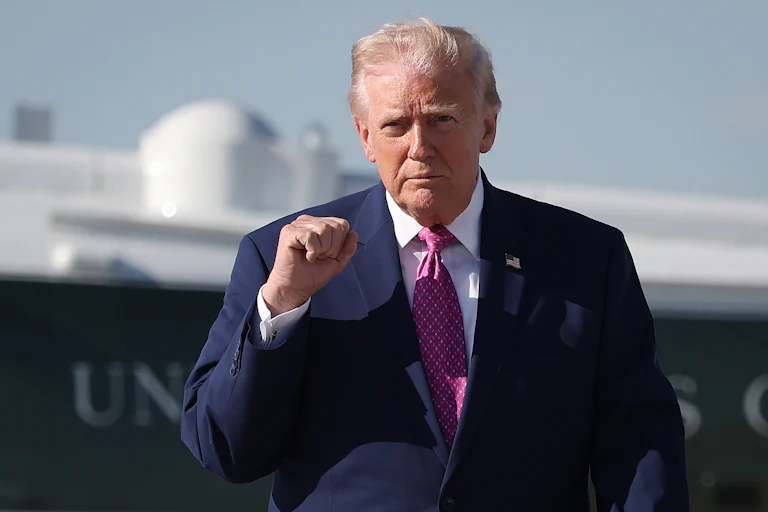
Donald Trump holds up a fist while walking
Win McNamee/Getty Images

Donald Trump appears to believe that his administration’s targeting of an anti-extremism civil rights organization can be leveraged to overturn the 2020 presidential election results.

“The Southern Poverty Law Center, one of the greatest political scams in American History, has been charged with FRAUD,” Trump wrote on Truth Social very early Friday.

“This is another Democrat Hoax, along with Act Blue, and many others,” he continued, referring to the Democratic campaign fundraising platform. “If it is true, the 2020 Presidential Election should be permanently wiped from the books and be of no further force or effect!”

It is unclear how this lawsuit could have any retroactive impact on an election that Trump unequivocally lost.

Acting Attorney General Todd Blanche gleefully announced the indictment against the Southern Poverty Law Center on Tuesday, claiming that the famed anti-racism group was “manufacturing the extremism it purports to oppose by paying sources to stoke racial hatred.”

The Montgomery-based SPLC was founded in 1971 in order to combat white supremacist groups after the Civil Rights Movement. Its activity was never a secret to the government—in fact, the SPLC frequently coordinated with local and federal law enforcement, sharing its findings in order to dismantle hateful institutions.

Yet in the decades since its founding, the nonprofit’s purview has been nationally perceived (at least on the right) as less and less acceptable. Conservative politicians and personalities have railed against the advocacy group, claiming that its work—which includes tracking extremist groups, promoting tolerance, and kneecapping bigotry through litigation—is inherently partisan and overly leftist.

Tuesday’s indictment includes 11 counts against the anti-extremism group related to its undercover activities. They include six counts of wire fraud, conspiracy to conceal money laundering, and charges related to allegedly falsified bank statements. (Observers have already noted that the charges appear, on their face, difficult to prove in court.)

In a statement released earlier this week, SPLC CEO Bryan Fair noted that while the SPLC had used informants to monitor the threat of violence inside extremist organizations, the information the public gleaned as a result was invaluable.

“When we began working with informants, we were living in the shadow of the height of the Civil Rights Movement, which had seen bombings at churches, state-sponsored violence against demonstrators, and the murders of activists that went unanswered by the justice system,” Fair said. “There is no question that what we learned from informants saved lives.”