Supreme Court Rules Fourth Amendment Covers Your Location Data
The Supreme Court is restricting the use of “geofence warrants.”

The Supreme Court ruled Monday that the Fourth Amendment protects an individual’s right to privacy when it comes to their phone location data.
The justices ruled 6–3 to send a Virginia bank robbery case back to the lower courts for review in light of its decision. In 2019, Okello Chatrie was convicted of robbing a credit union after police saw him using his phone in the security camera footage of the bank. They then used a “geofence warrant,” which compels tech companies to provide law enforcement with data from all devices at a specific place and time, to identify Chatrie.
Geofence warrants are regularly used, and let the government demand location data and records from anyone near a crime scene without needing to identify an individual target.
Government lawyers argued that Chatrie did not have a “reasonable expectation” of privacy, since he had willingly shared his location with Google.
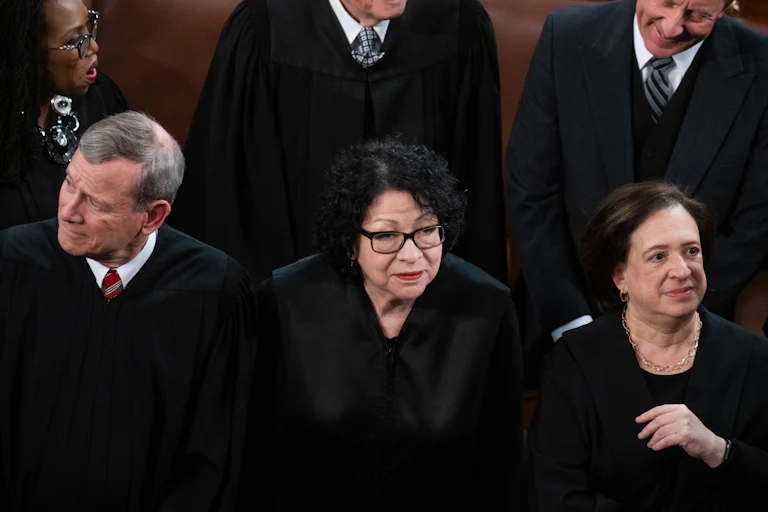
But the Supreme Court rejected that argument. Justice Elena Kagan wrote the opinion for the majority, with conservative Justice Brett Kavanaugh and Chief Justice John Roberts joining the court’s liberals.
“A cell-phone user is not to be viewed as sharing private information with third parties—which then can be freely passed on to the government—just by doing the ordinary things cell-phone users do,” Kagan wrote.
Justice Sonia Sotomayor concurred, writing, “even short-term monitoring” of a person’s physical movements can provide “a wealth of detail about [his] familial, political, professional, religious, and sexual associations.”
The ruling is a win for data privacy, and will make it harder for the federal government to access personal information stored in the cloud without getting a specific warrant.