Breaking News
Breaking News
from Washington and beyond

Former Wisconsin Judge Avoids Prison After Standing Up to ICE in Court

Republicans tried to make an example out of Hannah Dugan. It didn’t work.

Hannah Dugan walks into court
Scott Olson/Getty Images
Milwaukee County Circuit Judge Hannah Dugan walks into the Milwaukee Federal Courthouse on May 15, 2025.

A former judge was spared a prison sentence Wednesday after being convicted for helping an immigrant evade ICE agents in her Wisconsin courtroom.

U.S. District Judge Lynn Adelman only gave Hannah Dugan a $5,000 fine, saying, “I think this is a situation where an otherwise good person, upset by immigration policies in this country, made a bad decision in the moment.” Dugan faced up to five years in prison.

“This is a few minutes of conduct for someone who has dedicated her life to public service,” Adelman said. “It’s a marked deviation from an otherwise law-abiding life.”

Dugan was found guilty last December on two counts of federal obstruction, though jurors did not charge her with concealing an individual from arrest. The case followed an incident in which federal immigration agents entered the court in April 2025 to arrest Mexican immigrant Eduardo Flores-Ruiz. Dugan confronted the agents outside her courtroom and redirected them to the chief judge’s office on grounds that their warrant was insufficient. Flores-Ruiz was later arrested outside the court.

In his ruling, Adelman noted that Dugan had decades of public service, no pattern of criminal behavior, and an otherwise clean record. He added that the consequences of Dugan having a criminal record and losing her judicial position were enough, and that Flores-Ruiz was ultimately detained and deported anyway.

Before her sentencing, Dugan told the court that she meant to preserve “decorum and safety of the courtroom” by helping Flores-Ruiz.

“I have been cast as both a scofflaw and a hero. I am neither. I am a public servant who’s just trying to do my job,” Dugan said.

Six ICE agents showed up at Dugan’s Milwaukee courthouse in April last year, preparing to arrest and deport Flores-Ruiz, who was set to appear before Dugan in court over three misdemeanor counts of battery. According to prosecutors, Dugan led Flores-Ruiz out of a private door instead of the courtroom’s public exit, telling her court reporter she’d “get the heat” for her actions.

The FBI subsequently arrested Dugan, sparking a backlash from Democrats and even some conservatives. She later resigned from the Milwaukee County Circuit bench after Wisconsin Republican legislators threatened to impeach her.
Trump Secretary Says Bike Lanes Are DEI

Apparently the Trump administration is just calling anything it doesn’t like “DEI.”

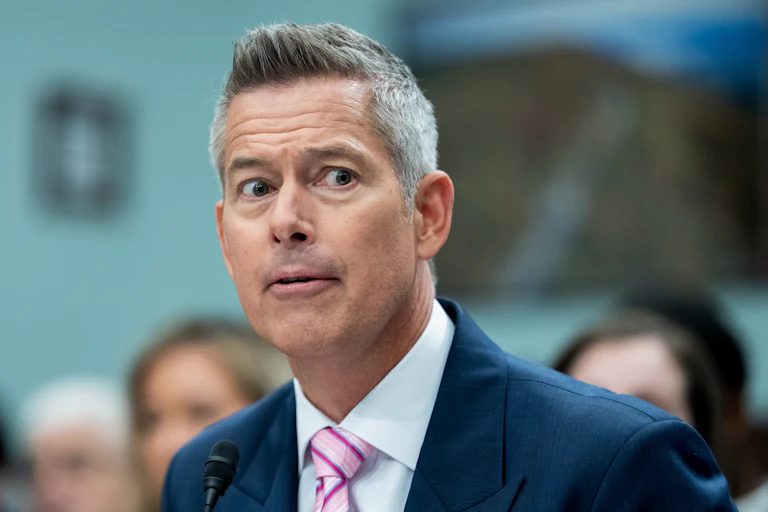
Transportation Secretary Sean Duffy looks to the side during a congressional hearing
Aaron Schwartz/Bloomberg/Getty Images

Transportation Secretary Sean Duffy announced Tuesday that his department would redirect $1.73 billion in Biden-era grants away from establishing “DEI bike lanes” to build roads and bridges instead.

So, what exactly is a “DEI bike lane?”

The Daily Wire pointed to former Transportation Secretary Pete Buttigieg’s claim that a series of 2021 grants funding bike lanes would serve to “improve infrastructure, strengthen supply chains, make us safer, advance equity, and combat climate change.”

Upon hearing “equity,” President Donald Trump’s goons can’t help but get triggered into attacking any federal spending that won’t benefit them directly. In reality, those Biden-era grants directed funds to build a new transit center in North Carolina, replace bridges in New Mexico, extend streets in New Hampshire, install traffic lights and crosswalks in Missouri, and install bike lanes in Seattle, among other projects. Now the financial status of these projects is unclear.

The Daily Wire also complained that when the Biden administration announced the availability of $1.5 billion in grants in 2023, applicants were encouraged “to consider how their projects can address climate change, ensure racial equity, and remove barriers to opportunity.” Those funds were already awarded to dozens of projects across the country—not just bike lanes—in both rural and urban areas.

The Trump administration has made extensive efforts to root out federal programs addressing racial discrimination. Now it seems that to even have considered racial inequality is grounds for losing millions of dollars.

“America is fortunate to have a Builder in the White House who knows America is only as great as our infrastructure,” Duffy told The Daily Wire. “That’s why this Department is investing in repairing critical roads and bridges that connect Americans to job opportunities, port infrastructure that bolsters our national security, and aviation and transit projects that move American families.”

But American families benefit from the presence of bike lanes, even if they don’t use them. Even the federal government acknowledges that bicycle lanes make roads a lot safer.

“To make bicycling safer and more comfortable for most types of bicyclists, State and local agencies should consider installing bicycle lanes,” said a statement from the Federal Highway Administration. “Providing bicycle facilities can mitigate or prevent interactions, conflicts, and crashes between bicyclists and motor vehicles, and create a network of safer roadways for bicycling.”

Rather, it seems likely that the Trump administration has chosen to zero in on bike lanes because they may be associated with urban areas that are led by Democrats and home to minority groups.

The move is simultaneously a blow to the diverse communities in American cities and a cheap culture-war win over the liberal urbanites. At the same time, the policy is in line with Trump’s efforts to boost gas-powered vehicles.

But American families will suffer from a lack of bike lanes too, especially with gas prices remaining high—and likely to stay that way.

U.S. Navy Commander Declared Dead as Trump Reignites Iran War

The president isn’t too worried about the cost of restarting his war with Iran.

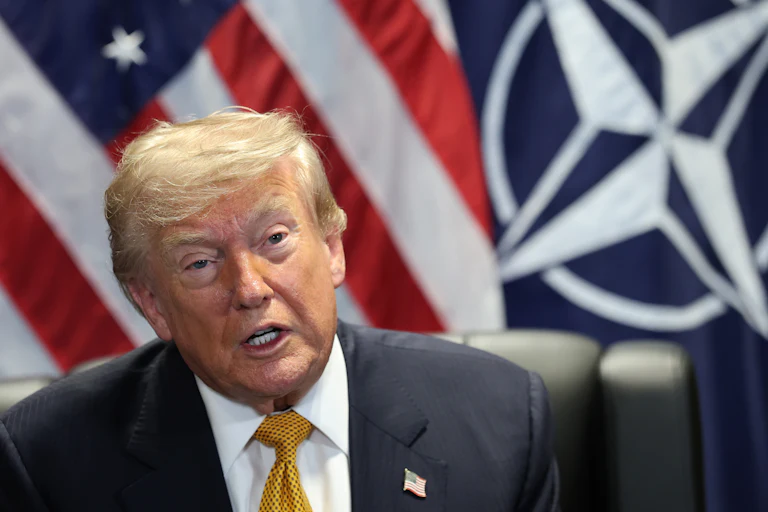
Donald Trump at the NATO summit in Ankara, Turkey
Win McNamee/Getty Images
President Trump at the NATO summit in Ankara, Turkey

A U.S. soldier who went missing in the Arabian Sea was declared dead just as Trump reignited his war on Iran.

The missing soldier was identified Tuesday as Helicopter Sea Combat Squadron 5 commanding officer Gabriel Edwards. He and three other soldiers were forced to emergency-land their helicopter in the Arabian Sea on July 1. While the others were rescued, Edwards was declared officially dead after 102 hours—over four days—of searching.

“Commander Gabe Edwards was the epitome of selfless leadership, who dedicated himself to service and sacrifice for the last 20 years,” Captain Matthew Lewis said in a statement on Tuesday. “Our deepest gratitude and sympathy go out to his family, who should know that Gabe led his squadron, the HSC-5 ‘Nightdippers,’ with integrity and fortitude.”

The cause of the incident remains under investigation, but the Navy insists that Edwards’s death was not caused by a hostile act.

Nevertheless, Edwards’s disappearance and death coincides with a once again active war between the U.S. and Iran. President Trump on Wednesday declared any deal with Iran null and void, following the worst exchange of fire between the two countries since the memorandum of understanding, or MOU, was signed. Iran targeted tankers in the Strait of Hormuz and U.S. bases, and the U.S. bombed several coastal cities in Iran.

“To me? I think it’s over,” Trump said of the MOU at the NATO summit in Turkey. “They’re scum. You know what scum is? They’re scum. They’re sick people. They’re led by sick people, and they’re vicious, violent people. And if they had a nuclear weapon, they’d use it. As far as I’m concerned, it’s over.”

Thirteen U.S soldiers have been confirmed to be killed in Iran, although that number has been alleged to be an underestimate.

Trump Denies Disaster Aid for Four States That Didn’t Vote for Him

The president is once again politicizing FEMA to hurt Democratic states.

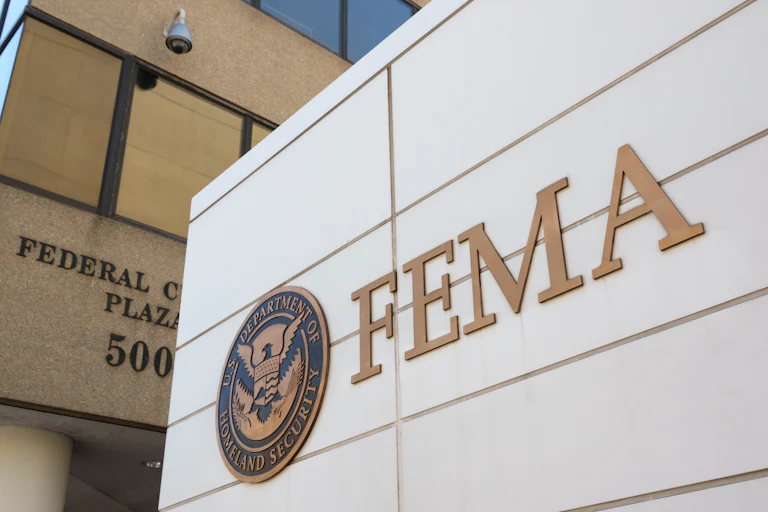
A FEMA sign on a federal building
Kevin Carter/Getty Images

President Trump rejected FEMA disaster aid requests from four blue states last Friday, after accepting the aid requests of six red states just two days before, according to Politico. This continues his blatant trend of prioritizing petty political beef over sorely needed FEMA funding—putting Americans at risk in the process.

New York, New Jersey, Massachusetts, and Rhode Island were all denied after requesting a total of $227 million in aid following the brutal blizzard in February. All four states were well past the damage threshold required to trigger aid consideration.

“After months of waiting, President Trump today denied our request for a Major Disaster Declaration following the blizzard that pummeled New York City, Long Island, and the Mid-Hudson in February of this year,” New York Governor Kathy Hochul said in a statement last week. “New York’s communities … deserve to have access to every resource available to recover and rebuild. Instead they have a President who is turning his back on his home state.… We will appeal to ensure New Yorkers receive the federal assistance they deserve.”

Rhode Island Senator Sheldon Whitehouse and the rest of the state’s congressional Democratic delegation similarly condemned Trump.

“After months of inaction, on July 2, President Trump denied Rhode Island’s request for a Major Disaster Declaration related to the record snowfall and cold temperatures,” the delegation wrote on Monday.

The letter also noted that Trump bragged about granting over $846 million in disaster relief funds to Republican states on Truth Social the same day he denied their request—further proof of Trump purposefully withholding funds from blue states.

“Rhode Island’s Congressional delegation believes the Trump Administration improperly rejected the Ocean State’s request, pointing out that President Trump has politicized disaster assistance for states over the last year and made it exponentially harder for so-called ‘blue states’ to get disaster funding under the highly partisan Trump Administration than it is for so-called ‘red states.’” They demanded he reverse the decision.

The president also denied disaster relief requests from Vermont, Illinois, and Maryland last year, and from Colorado and California around that same time—all while continuing to deliver aid to states where more people voted for him.

Trump Has Blown More Than $100 Billion on Iran War

That total is more than triple what federal officials had previously estimated.

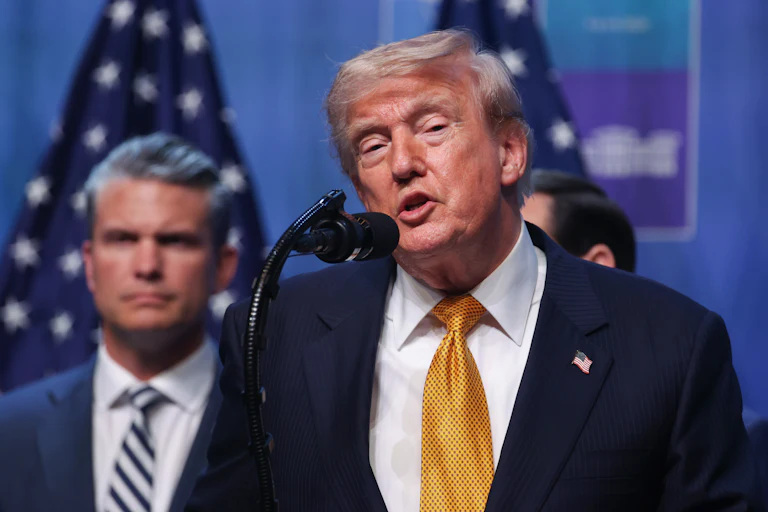
Donald Trump speaks at a podium during a NATO summit. Defense Secretary Pete Hegseth stands behind him.
Beata Zawrzel/NurPhoto/Getty Images
President Trump during the NATO summit in Ankara, Turkey

The U.S. president has indicated that he’s done negotiating with Tehran, that the ceasefire between Iran and the U.S. is over, and that the public can expect more strikes to be exchanged between the two nations—a decision that is bound to rack up some monumental costs.

A new analysis of U.S. expenses through the four-month war thus far, conducted by Popular Information’s Stephen Semler, found that Trump officials have dramatically lowballed Congress on the real cost of the conflict (Semler also co-founded the U.S. foreign policy think tank Security Policy Reform Institute).

Last week, Director of the Office of Management and Budget Russell Vought told the House Appropriations Committee that the U.S. had spent $30 billion on the Iran war. According to Semler’s estimates, the true cost is closer to $103 billion.

Semler argued that Vought himself must have been aware of the figure’s inaccuracy. Days before his House testimony, Vought wrote and signed a formal request “on behalf of the president” for $88 billion in supplemental funding from Congress, including a $72 billion increase for the war effort.

But even that $72 billion figure doesn’t offer a complete image of the war’s total price tag. Semler noted that Popular Information had previously calculated the war cost nearly that much—about $71.8 billion—during the first 60 days. The Trump administration is expected to ask for even more money to fund the conflict through upcoming reconciliation bills.

In order to build an independent analysis of the Pentagon’s expenditures, Semler analyzed procurement information, operating and support data, open-source intelligence, statements from U.S. officials, and media reports.

Over the first 120 days of the conflict, Semler tallied $28.5 billion in mobilization, administrative, and immediate combat costs; $46.7 billion spent on missiles, interceptors, and bombs; $20.3 billion on damaged or destroyed military assets; $2.9 billion spent on Israel’s bombs and interceptors; and an additional $4.8 billion on war costs to nonmilitary U.S. agencies.

Yet no one in charge of the government—from the White House to top congressional Republicans—has posited exactly how the U.S. will pay for the war. Whereas taxes were raised in previous wars (such as World War I, World War II, and the Korean War) in order to fund conflict, the current administration has so far offered no such solution.