Breaking News
Breaking News
from Washington and beyond

Republicans’ Criminal Referral of Jack Smith Exposed as Total Nonsense

House Republicans want to criminally charge former special counsel Jack Smith. Their claims are completely bogus.

Former special counsel Jack Smith testifies in Congress.
Al Drago/Getty Images
Former special counsel Jack Smith testifies in a House Judiciary hearing on January 22.

House Republicans are trying to file criminal charges against former special counsel Jack Smith.

Representative Jim Jordan, chair of the House Judiciary Committee, sent a criminal referral for Smith to the Department of Justice Wednesday, urging the department to investigate Smith for making false statements to Congress during congressional testimony in December.

At issue is a line of questioning in which Smith was asked whether he sought a search warrant for the content of text messages from members of Congress, to which Smith replied that he did not. Last week, Senator Chuck Grassley posted on X that he had “received records [from] DOJ confirming Jack Smith’s investigative team reviewed the contents of text msgs sent by 44 MEMBERS OF CONGRESS.”

But Grassley’s post and the questions Smith was asked were two different categories of documents, as legal experts such as Lawfare’s Anna Bower and Politico’s Kyle Cheney pointed out on X. Smith requested information from Congress on toll records, which concerned the time and date of text messages, not their content.

There was a separate instance in which Smith’s team gathered text messages from the National Archives from White House phones. Some of those records included exchanges with members of Congress. But Republicans never asked about that.

“[T]here’s zero ambiguity here,” Bower said. “Nothing in the Grassley docs raises any real question of perjury.”

House Democrats quickly responded to Jordan’s letter Wednesday. Representative Jamie Raskin called Jordan’s letter a “baseless and vindictive criminal referral” that “deliberately distorts and misstates the facts, including what questions the Republicans actually asked at Mr. Smith’s interview.”

Smith’s lawyers have also responded to Jordan’s letter with one of their own, saying his accusations are based on a “spurious claim.”

“The referral is made not because Mr. Smith made a false statement, which the letter concedes, but because he did not proactively disclose information that was not responsive to a question asked,” Smith’s lawyers wrote. “During his testimony, Mr. Smith provided truthful, responsive answers and candidly discussed his work.”
Trump Threatens to Blow Up Iran War Into Even Bigger Conflict

Donald Trump threatened strikes on Houthis in the Red Sea.

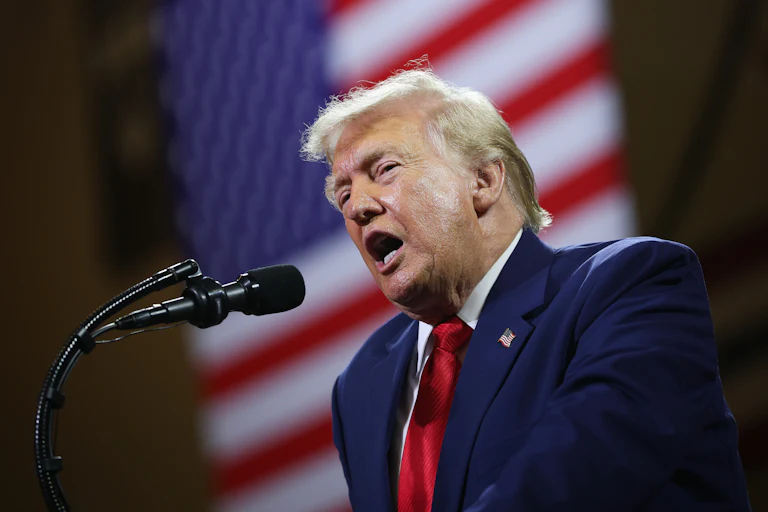
Donald Trump speaks into a microphone during an event.
Kevin Dietsch/Getty Images

The U.S. president issued another threat against Iran Thursday, pledging to hold the country “responsible” for attacks carried out by Houthis the night before against Saudi Arabian ships.

“A year ago the United States of America attacked, very powerfully, the Houthis, for their interference with commerce and trade, by shooting at ships. Since that time, and during our conflict with Iran, they have acted very responsibly,” Donald Trump posted on Truth Social, referring to an airstrike campaign the U.S. conducted against the Houthis from March to May 2025 after the group attacked commercial ships in the Red Sea and Gulf of Aden.

“Unfortunately, now they are starting up again, shooting at two Saudi Arabian ships last night,” he continued. “Please let this TRUTH serve to represent that if they do this again, the U.S. will hold Iran responsible, in that the Houthis are a Surrogate and/or Proxy of Iran, and major military punishment will be inflicted upon Iran and, of course, the Houthis, themselves, who I am very disappointed with in that they have, until now, acted very professionally and smart.”

Yemen’s Houthi militia claimed responsibility for overnight drone and missile strikes against Saudi oil tankers in the Red Sea. In a statement, the Iranian-backed group claimed that the two vessels, the ‌Encelia and Layla, had violated its naval blockade. The Houthis also claimed that the attacks on the two ships had forced about 10 other ships to retreat.

A Saudi Arabian news outlet, SPA, said that all crew members of the Encelia were safe, but that the attack had started a fire on the bow of the ship.

If acted upon, Trump’s warning could open up a new front in the already complicated Iran war. Since a preliminary peace deal crumbled earlier this month, the U.S. has struck Iran every day.

Meanwhile, the conflict has taken a serious toll on the American public, with the cost of the war estimated to be well above $100 billion.

Trump Secretary Puts Americans in Danger Over “DEI Bike Lanes”

Sean Duffy has derided bike lanes as too woke, and is now stripping mentions of them from federal websites.

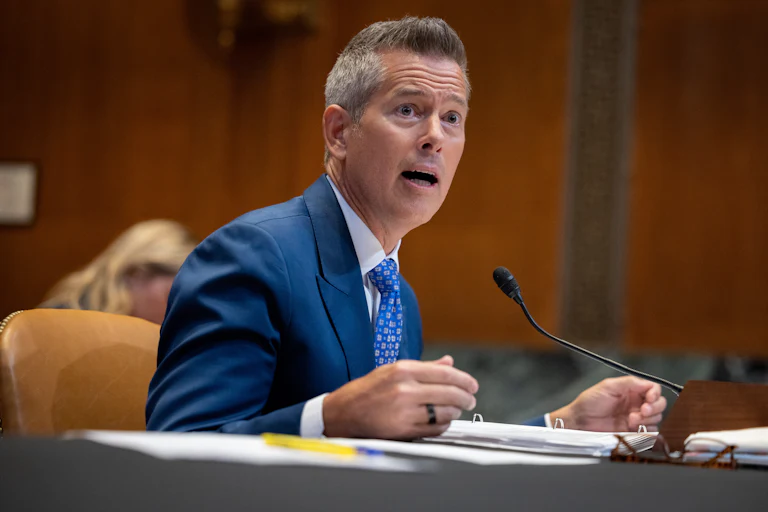
Transportation Secretary Sean Duffy speaks during a congressional hearing.
Nathan Posner/Anadolu/Getty Images
Transportation Secretary Sean Duffy at a congressional hearing

Transportation Secretary Sean Duffy is so afraid of seeming woke that he’s willing to make roadways more dangerous.

Earlier this month, Duffy announced that the Trump administration would gut funding for so-called “DEI bike lanes”—even though the Federal Highway Administration had previously urged agencies to consider installing lanes for bicyclists in order to make the road safer for everyone.

Two days later, a staffer at the Federal Highway Administration’s safety office directed staff to update the website to remove that suggestion from the agency’s website, NPR reported Thursday.

The agency, also known as FHWA, had previously advised that “providing bicycle facilities can mitigate or prevent interactions, conflicts, and crashes between bicyclists and motor vehicles, and create a network of safer roadways for bicycling.”

A person who works in web at the Department of Transportation told NPR that staff were left wondering why the changes were being made in the first place. “Why do you need to take down bicycle safety, of all things?” the person told NPR.

“We’re not making the sites better, faster, or quicker, you know, able to provide real information to the communities that use these resources,” they said. “It’s asinine.”

The removal of this guidance is part of a wider push to remove road safety materials from the department’s website—including guidance about bike lanes and speed cameras.

One of the safety tools that the FHWA removed was the Pedestrian and Bicycle Crash Analysis Tool, or PBCAT, which was designed to record detailed accounts of crashes involving bicycles, pedestrians, and motor vehicles, in order to help prevent them in the future.

David Harkey, who helped to develop the tool at the University of North Carolina’s Highway Safety Research Center, said the tool was important because it helped track pedestrian and bicyclist fatalities nationally.

“This is an agency that claims that safety is a priority for them,” he told NPR. “It’s important that proven tools and resources like PBCAT are there on their site and are available for safety professionals across the country.”

A Department of Transportation spokesperson defended the decision in a statement to NPR: “This is a common-sense approach, despite the Left’s belief that everyone should ride a bike to their shoebox-sized apartment to eat crickets to achieve a phony climate agenda.”

But what about those red-blooded all-American car owners who are less safe because there are more bikes on the road? What’s next, outlawing bikes or mandating that everyone buy a car?

Read what Duffy initially said:

Secret Service Agent Put on Leave for Alleged Leaks About JD Vance

Previous reports indicated that Vance’s Secret Service detail was fed up with his diva-like requests.

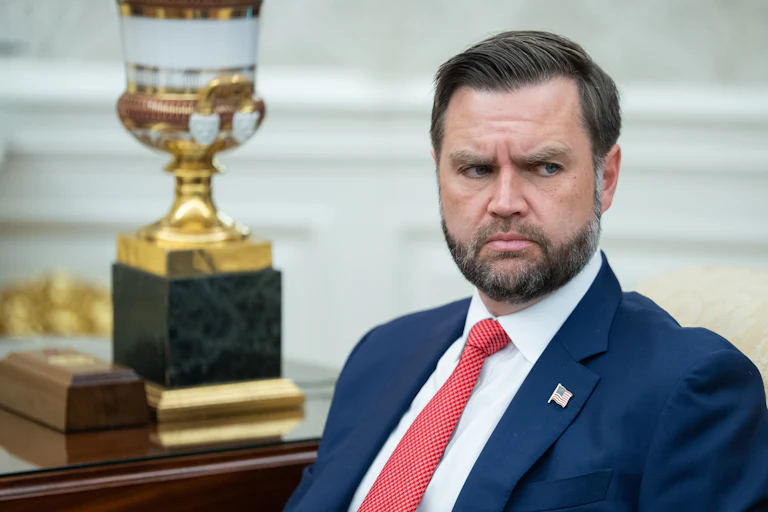
Vice President JD Vance frowns while sitting in the Oval Office.
Aaron Schwartz/CNP/Bloomberg/Getty Images
JD Vance in the Oval Office

The vice president is losing faith in his personal Secret Service detail.

One of the Secret Service agents assigned to protect JD Vance was placed on administrative leave over concerns that he was leaking information to the press, CNN reported late Wednesday.

The action followed an intimate recounting of Vance’s recent travel by MS NOW, in which the news outlet reported that Vance’s Secret Service agents “groused” and complained about the vice president’s decision to use a military helicopter to take his son to a golf lesson at Joint Base Andrews.

“Agents have shared concerns internally about Vance and his office pressing them for trips and assignments that some agents consider an inappropriate or even unprecedented use of government resources compared to prior vice presidents,” MS NOW reported on July 15.

The Secret Service’s internal affairs department is reviewing the agent’s conduct. It is currently unclear if the agent will face administrative consequences or criminal charges, according to an internal source that spoke to CNN.

Donald Trump has been so fixated on internal criticism and media leaks that some of his administration’s countermeasures have tested the boundaries of the First Amendment. During his first term, Trump considered wiretapping the Homeland Security Department to identify the source of his bad press.

That attitude has only escalated in the years since—aided by the sycophantic behaviors of Trump’s new government entourage. Earlier this month, CNN reported that FBI Director Kash Patel and White House chief of staff Susie Wiles were personally overseeing a crackdown at the White House to determine who leaked that the ultra-luxury jet gifted to Trump by Qatar lacked the security specs to be considered for use in Air Force One.

So far, Wiles and Patel’s probe has forced government officials to hand over their phones—causing some agencies to pit their own attorneys against the White House—and issued subpoenas to four New York Times journalists who reported the story.

Trump Scrambles to Sell Americans on Nuclear Deal With Saudi Arabia

Donald Trump struck a controversial deal for U.S. companies to build and run nuclear power plants in Saudi Arabia.

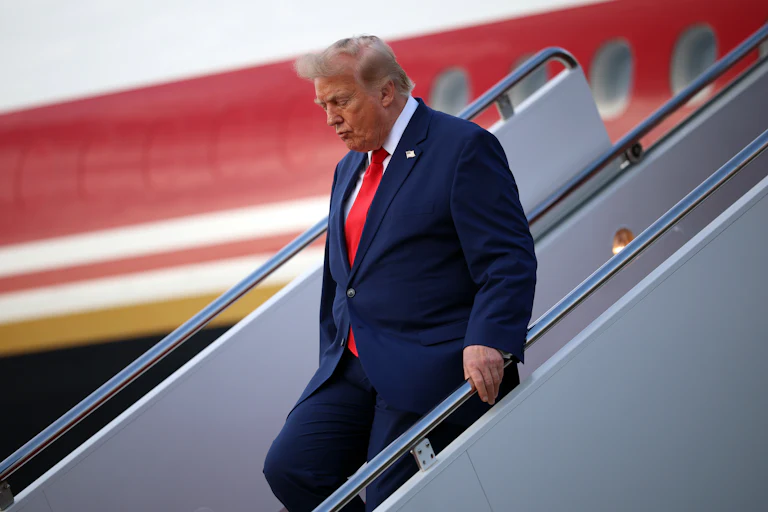
Donald Trump purses his lips and looks down while walking down the steps of Air Force One.
Kevin Dietsch/Getty Images
Donald Trump disembarks from Air Force One.

President Donald Trump is desperate to sell Americans on his landmark nuclear deal with Saudi Arabia that would loosen restrictions for the close U.S. partner.

In a post on Truth Social Thursday, Trump declared that there would be “no enrichment of material” as part of his nascent nuclear deal, which would allow U.S. companies to make billions building and running nuclear power plants in Saudi Arabia.

But surprise, surprise: That’s not the whole story.

The United States has offered Saudi Arabia a special deal that is reportedly far less restrictive than other agreements under Article 123 of the U.S. Atomic Energy Act of 1954—namely, this deal leaves the door open for enrichment down the line.

The Saudi agreement reportedly states that the two countries will conduct a two-year fuel-cycle study on the economic feasibility of domestic enrichment in Saudi Arabia. If, after the study, the two sides agree that it’s feasible, then the U.S. would build an enrichment facility in Saudi Arabia. If not, Saudi Arabia would not be allowed to build its own domestic enrichment for 10 years, while blocking Saudi access to sensitive technology. If approved, the decision on whether to build would be made in two years—when Trump is still president.

Trump also claimed in his post that the agreement would require Saudi Arabia to agree to join the Abraham Accords.

Initial reporting about the deal suggested that the agreement would not require Saudi Arabia to recognize Israel. Unsurprisingly, Israel has voiced strong concerns about its closest ally cutting a deal with its enemy.

There are other reasons to be concerned about Trump’s deal. The president’s mishandling of nuclear negotiations is well documented, including his decision to detonate the U.S.-Iran nuclear deal struck by President Barack Obama, and the careless wording of last month’s memorandum of understanding between the U.S. and Iran, which shortly afterward crumbled in the Strait of Hormuz.