Breaking News
Breaking News
from Washington and beyond

You Won’t Believe How Big Trump’s Pandemic Preparedness Team Is

Remember how the last pandemic went? And that was with a full team!

Donald Trump speaking in the Oval Office
Kevin Dietsch/Getty Images

Donald Trump’s administration only has one person working in its office of pandemic preparedness, and—you guessed it—she’s a vaccine skeptic.

The Office of Pandemic Preparedness and Response Policy had been empty since last summer, after all the Biden-era employees left and its head resigned. Now the office charged with coordinating cross-agency responses to pandemic risks has only one employee: Sara Brenner, a vaccine skeptic and self-described “MAHA mom.”

“That is a start, but it is not nearly enough,” a former White House official told NOTUS Monday. “You can’t run an Office of Pandemic Preparedness and Response Policy as an army of one.”

Brenner joined the Food and Drug Administration in 2019 as a midlevel scientist and was promoted to deputy commissioner after Trump’s inauguration in 2025—where she fully embraced Health Secretary Robert F. Kennedy Jr.’s ridiculous Make America Healthy Again movement. Brenner was appointed to the OPPR in July amid mounting concerns about global disease outbreaks.

Brenner has a history of publicly airing her concerns about vaccines, The New York Times reported. Speaking at a Make America Healthy Again event last year, she said she chose not to receive the Covid-19 vaccine when she was pregnant during the pandemic because she was concerned about the vaccine’s “biodistribution patterns.”

In May 2025, she co-wrote a memo saying there was no “no clear evidence” that the benefits of Covid vaccines for children under 18 outweighed the risk of harm, overlooking the hundreds of studies that suggested the exact opposite. In March 2025, she intervened in the FDA’s review of the Novavax’s Covid vaccine.

Another health official, Rachel Idowu, was appointed to the National Security Council as its director of bioresponse. Together with Brenner, she will manage the country’s response to pandemic threats.

One health official who spoke to NOTUS praised Idowu’s work, saying she was “truly the right person to have in that office. She can do the work of two or three.” Still, they said Idowu and Brenner would have to be “very selective in terms of what they prioritize.”

Byron Cohen, a former adviser to OPPR, told NOTUS that Idowu and Brenner were two “very experienced, capable people,” but there was still a “tremendous amount of work to be done.”

“Those two individuals only have so much time in the day, and they deserve a full staff to help them carry out their mission,” Cohen told NOTUS.

Clearly, the Trump administration is not prioritizing pandemic preparedness even as the Ebola outbreak in the Democratic Republic of Congo is shaping up to be the worst on record.
Yet Another Republican Congressman Is Under House Ethics Investigation

The House Ethics Committee is investigating Republican Representative Lance Gooden.

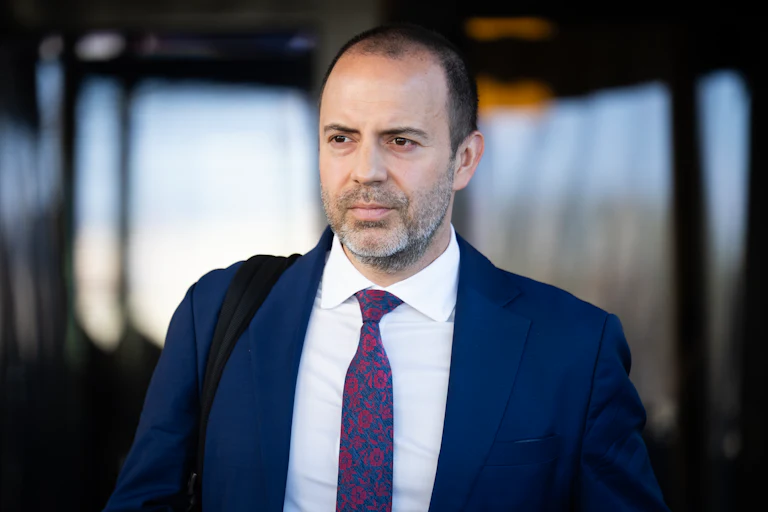
Representative Lance Gooden
Tom Williams/CQ-Roll Call, Inc/Getty Images
Representative Lance Gooden

The House Ethics Committee is investigating Texas Republican Representative Lance Gooden. The scope of the probe is unclear at this time.

The committee said it received a referral from the Office of Congressional Conduct last month.

“The Committee notes that the mere fact of a referral or an extension, and the mandatory disclosure of such an extension and the name of the subject of the matter, does not itself indicate that any violation has occurred, or reflect any judgment on behalf of the Committee,” the committee’s statement read.

Gooden has held office in Texas’s 5th district for seven years, and has been an ally to President Trump for all of them. In 2020, he joined 146 other Republicans in voting to overturn the presidential election results, and he voted against Trump’s impeachment after the January 6 insurrection.

“These are bogus spending allegations perpetrated by dishonest unelected OCC bureaucrats, and as the fifth Texas GOP ally of the President to endure one of these attacks,” Gooden told Fox News’s Liz Elkind. “I am confident the House Ethics Committee will confirm their baseless nature.”

A complaint against Gooden was filed to the Office of Congressional Ethics in 2021, alleging that he “purchased 12 assets with a total value ranging from approximately $60,019 and $376,000 without disclosing the transactions” in 2020. While notable, it may or may not be related to the current probe.

Gooden is the second Texas Republican to go under House Ethics investigation this year, following former Republican Representative Tony Gonzales, who was accused of having an affair with ex-staffer who set herself on fire after he ended it and hurt her career. Gonzales resigned in April.

This story has been updated.

Republicans Come Up With New Talking Points to Dodge Trump Questions

Senate GOP leadership sent out a memo on how to spin the growing divide between lawmakers and Donald Trump.

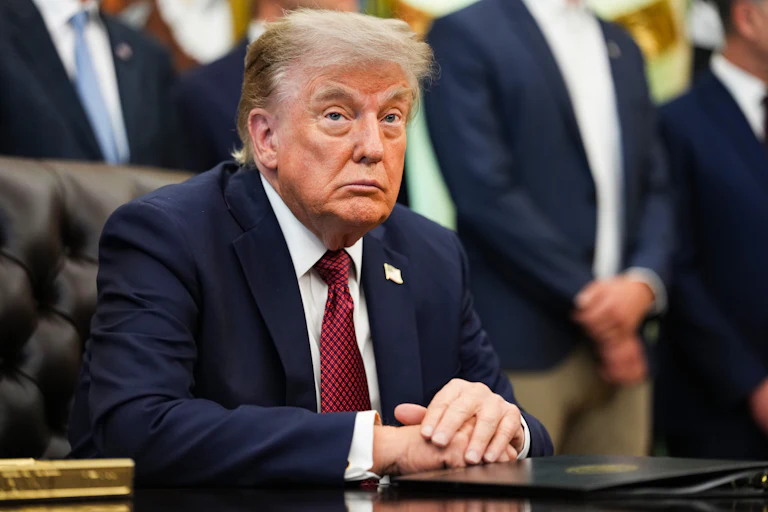
Donald Trump sits at his desk in the Oval Office.
Eric Lee/Getty Images

The Senate GOP is offering new guidance to party lawmakers on how to rhetorically juggle Donald Trump’s second term agenda with the public furor it has caused.

Internal party messaging reviewed Monday by Politico indicates that Republican leadership is still trying to salvage public perception of the president, on issues ranging from the Iran war to the SAVE America Act.

“On Iran, directly connect the President’s negotiations and strikes to keeping the Strait open and keeping prices low,” one line item read, according to Politico reporter Jordain Carney.

The internal memo also warned Republicans that the “media will try to divide Republicans by asking your boss to pick a ‘side’ in any given question.”

“It’s crucial to reject these false choices. Reject the false choice between the President and Senate leaders: Express support for both,” the memo reads.

The memo advised Republicans on how to handle the ongoing drama between Trump and Senate Majority Leader John Thune, who last week snapped at White House Press Secretary Karoline Leavitt for suggesting that the president was “running out” of patience with the conservative senator’s inability to force the SAVE Act through the upper chamber.

Offering potential responses to the press, the memo suggests that Republicans nonetheless claim that Trump and Thune are “united and doing an excellent job.” It also recommends that Republicans claim the duo have made American life “affordable,” and have worked together to make Americans “safer by closing our border, deporting violent criminals (Laken Riley Act), cracking down on fentanyl, and strengthening our military.”

“And we all agree that we have to defeat the radical Democrat socialists, who are threatening to undo our progress,” it added.

Meanwhile, the White House seems content with quietly advising midterm-bound Republicans to distance themselves from the president’s talking points as his popularity plummets.

“The understanding is pretty damn implicit: The president is going to say what the president is going to say,” a Republican operative working on the party’s midterm races told MS NOW Monday on the condition of anonymity. “You’re not going to have candidates or lawmakers running out to defend the president’s handling of the economy or the war—polling shows that most people don’t agree with his handling.”

Trump Prepares to Scrap 50-Year-Old Radiation Safety Rule

The Trump administration is ready to get rid of a key radiation safety standard.

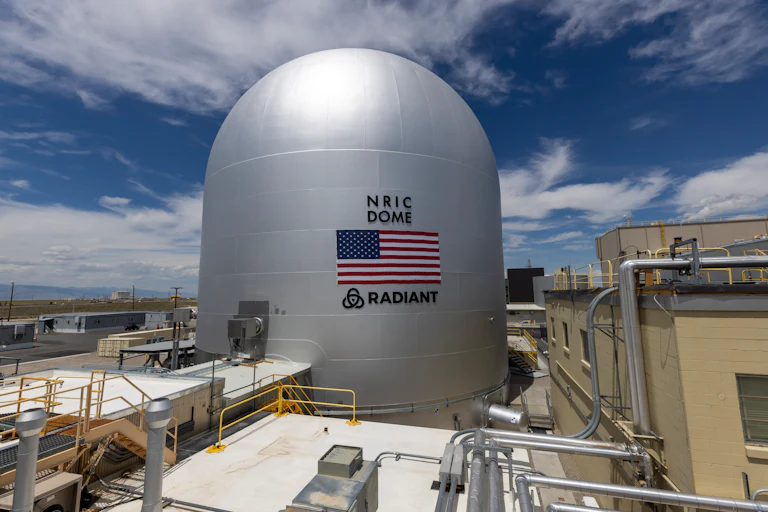
The Idaho National Laboratory DOME
Natalie Behring/Getty Images
The Idaho National Laboratory DOME, or Demonstration of Microreactor Experiments of the National Reactor Innovation Center, west of Idaho Falls, Idaho, on June 24

The White House wants to get rid of a radiation safety rule that is over 50 years old and has been adopted by other countries.

The Nuclear Regulatory Commission is looking at eliminating the “as low as reasonably achievable” principle, which mandates that hospitals, nuclear plants, and other facilities keep radiation levels at an absolute minimum, even when they are already below legal limits. The rule would be replaced with a “graded approach” that puts different safety measures in place based on expected radiation exposure levels.

The legal limits for workers and the public would stay the same, and the NRC said that the public would not be any less safe.

“We’re just removing the ambiguity,” NRC Chair Ho Nieh said. “But the standard for exposure to workers and the public, those are not changing. We’re just putting in place greater clarification.”

The nuclear industry is in favor of the move, with its main trade association, the Nuclear Energy Institute, claiming that safety is still a priority.

“We will always continue to look at what we can do to reduce the dose to workers, and maintain our doses to the off-site public as low as possible,” Doug True, chief nuclear officer at the NEI, said to the Associated Press. “It’s not like we’re just going to throw open the doors and let everything run up to the limits.”

But other experts are concerned about what will happen given that the new rule raises permissible radiation limits. Edwin Lyman, director of nuclear power safety at the Union of Concerned Scientists, told the AP that the new proposal could raise radiation doses.

President Trump wants four times as much domestic nuclear energy production to satisfy the growing electricity demand from new data centers powering artificial intelligence. He issued four executive orders in May last year to boost government funding for nuclear power and overhaul nuclear regulations. In doing so, though, the president may get rid of some guardrails that protect Americans from the downsides of nuclear energy.

Trump Confirms He’s Hoarding Billions From Venezuelan Oil

President Trump is refusing to say what happened to the billions his administration took from Venezuelan oil sales.

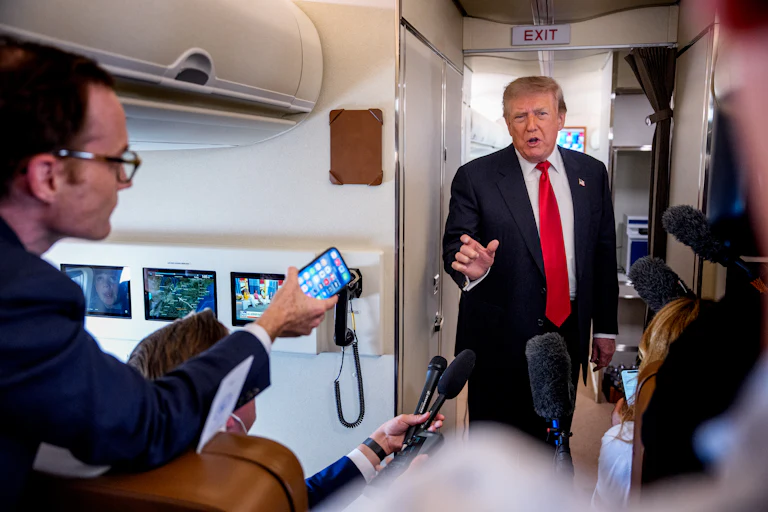
Donald Trump speaking to reporters aboard Air Force One
Andrew Harnik/Getty Images
President Donald Trump speaks to reporters on Air Force One during a trip to Michigan on July 27.

President Trump still won’t say where exactly the $13 billion of Venezuelan oil revenue that his administration collected has gone.

“There’s some reports that the United States has taken in $13 billion from Venezuela,” a reporter asked Trump at the Air Force One press gaggle on Monday afternoon. “Where is that money going?”

“Thirteen billion from Venezuela? I think even more than that,” Trump replied. “Venezuela, we paid for that war many times over. And that’ll happen with Iran also. We paid for the war many times over.”

“But where’s that money going?”

“No other president can say that for a long time,” Trump continued, ignoring the question. “We had a cost.... We paid for it many many times over. And now, as you know, we have a very good relationship with Venezuela.”

“But where is the money going?” the reporter asked yet again.

“It goes toward running the country.”

“No … the money that the U.S. is taking in, where is that money going?”

“From Venezuela?”

“Yes.”

“Towards running the country. It can go to the military. Congress has to approve it.... We’re taking in a lot of money. Billions and billions of dollars from Venezuela.”

The president couldn’t offer anything close to a straight answer on where those billions went. First, the story was that it’d go back to the Venezuelan people, whom Trump pretends to care about very much. But last week, the Financial Times reported that after six months and two devastating earthquakes, the money is still nowhere to be found. The publication reported that the Trump administration must have collected an estimated $13 billion, though Trump’s statement on Monday is the first hint at an actual number.

The last solid lead we had on that money was when Semafor reported that Trump would be keeping proceeds from the first sale in an offshore bank account based in Qatar. Maybe that has something to do with his nonanswer.