Trump Demanded to Personally Review Details in DOJ’s Comey Case
A new court filing in the Justice Department’s case against James Comey reveals how Trump is using federal law enforcement to go after his enemies.

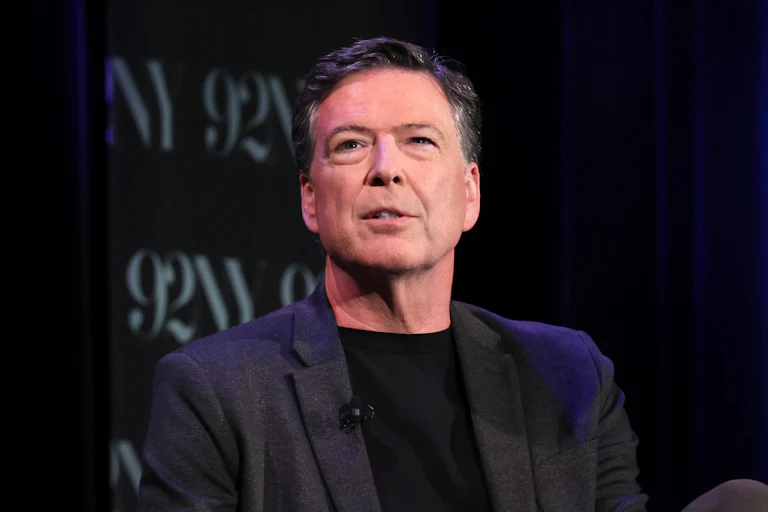
Donald Trump may have personally undone the criminal case against one of his political nemeses, former FBI Director James Comey, thanks to his deep involvement.
The Department of Justice accused Comey of threatening the president’s life when he posted a photo of seashells to his Instagram account last year, arguing that the message the shells spelled out—“86 47”—would be interpreted by any person “familiar with the circumstances” as a “serious expression of an intent to do harm to the president,” according to Comey’s indictment.
But on Tuesday, Comey’s lawyers argued that the entire case should be moot due to Trump’s personal involvement in Comey’s questioning, according to a motion to dismiss first reported on by The New York Times. According to government documents handed over to Comey’s team, Trump told Secret Service agents who interviewed the former FBI director to send their notes to Air Force One for Trump’s personal review.
The Secret Service questioned Comey by phone hours after he shared the protest message on Instagram on May 15. Despite being informed by a Secret Service agent that the telephone interview would likely suffice, Comey agreed to further questioning in Washington. “From that point forward, high-level DOJ and White House officials (including the President) involved themselves in the investigation,” stated Comey’s attorneys.
The Secret Service chose to monitor Comey the next day on his drive to Washington despite lacking a warrant—a decision that was noted by at least one agent as, legally, a “bad idea” since there was no “imminent danger to life” that could justify the warrantless surveillance.
They did so at the behest of the “number three” person at the DOJ, according to the legal document. That individual is not named in the memo, but the number three person at the DOJ is the associate attorney general, a position that was not filled by a Senate-confirmed official at the time of Comey’s surveillance. The agents tailed Comey and his wife even as they visited the grave of their deceased son, according to the filing.
A government document obtained by Comey’s team revealed that “POTUS was requesting a copy of the interview notes to use in his 6 p.m. press conference.” One Secret Service agent described the interview as “a hot topic on the plane,” noting that Trump was “very interested,” according to the Times.
Trump has been very public about his contempt for Comey since the FBI director led the investigation into Trump’s ties to Russia following the 2016 presidential election. Trump fired Comey in the midst of that probe, prompting a follow-up investigation by Comey’s predecessor, special counsel Robert Mueller, that determined that Russian influence in the 2016 election was “sweeping and systemic” and found substantial (if non-prosecutable) evidence that Trump had obstructed justice by firing Comey.
In another section of the legal filing, Comey’s attorneys revealed that the Trump administration attempted to prove the lethality behind Comey’s “86” post by questioning Sammy “The Bull” Gravano, a notorious gangster who was at one point the underboss in the Gambino crime family and was personally responsible for at least 19 murders. Gravano apparently confirmed the term’s violent definition, though he noted that a “gangster would never use that term” because it was too obvious to law enforcement.
In the hours following Comey’s post, the Secret Service instituted a new policy that redefined “86 47” as a formal threat to the president’s life. However, the agency rolled back the change by the day’s end and returned to “business as usual” as the policy shift resulted in an overwhelming number of potential leads that lacked “threatening language,” according to the filing.
Comey has denied the accusations, claiming that he was only familiar with the term via restaurant slang, where it contextually means to remove an item off the menu.