Boys, boys, boys. This year has been the year of the Crisis of Masculinity, or maybe the year of the Male Loneliness Epidemic, or maybe, if we’re getting spicy with it, the year of the Great Feminization. A fascination with the problems of boys and young men is nothing new. Men, as diagnosed in Richard Reeves’s 2022 bestseller, Of Boys and Men, are struggling, isolated and adrift, bereft of strong role models or a supportive culture. And the same period has seen the rise of figures like Jordan Peterson peddling a vision of masculinity based partly in self-discipline (with exhortations to clean one’s room and stand up straight) and partly in resentment and perceived threat.
But this year marked a turning point, not unrelated to the broader rightward lurch of pop culture covered by journalists like Ana Marie Cox and trumpeted by center-right public intellectuals like Ross Douthat. 2025 saw the rollout of Graham Platner’s beefcake leftism, Scott Galloway and the rise of the “centrist manosphere,” and bottomless encomia to Charlie Kirk’s debate stage masculinity. Just a few weeks ago, Rachel Cohen Booth published a deep dive on men’s feelings about their increasing share of domestic labor with the subtitle, “Men’s search for meaning is everyone’s problem.” And yeah, it really feels that way.
It’s certainly true on TV. The Chair Company, The Rehearsal, Long Story Short, Task, The Pitt—all of these shows are in my top 10 series of the year, and all of them are profitably understood as shows that peer inquisitively and perceptively into the minds of the aforementioned Men in Crisis. One of the best TV essays I read this year was Israel Daramola’s “Tim Robinson Understands What the Boys Are Going Through,” about The Chair Company. “It’s the neediness of it all,” he writes. “Robinson’s characters tend to be devoid of purpose and value in a world that increasingly needs less from them.” This insight alone outstrips any ideas proffered by Adolescence, the extremely loud and incredibly clunky melodrama that presented itself this spring as the show about What’s Going On with boys and men right now. Trying to methodically peel back the personal, social, cultural, and even technological layers of the masculinity crisis, Adolescence just ends up a big Bloomin’ Onion of troubled blokes.
So, honestly, enough about them. In the midst of this era of Lost Boys, the characters and the series I’ve been most grateful for are the ones that have found women grappling with otherwise unnoticed crises of their own. In a year defined by the newly lurid visibility of men’s problems, I was most moved by two series—FX’s Dying for Sex and Disney+’s Andor—that offered glimpses into the invisible pain of women. Invisible because discreetly hidden, because crudely ignored, because too tiresome or traumatic or seemingly trivial to attend to.
One must imagine Mon Mothma dancing.
When Andor debuted, one of the most frequent observations about it was its relative distance from most Star Wars lore and mythology. It is, ultimately, a crucial story that undergirds essentially everything that happens in the original trilogy, but, at the same time, it does not rely on those films for its effects. Produced in a moment defined by the tightening constraints of risk-averse streamers, within a system that requires all writers to build or adapt their own ideas within a space limned by priority televisual universes or at least existing I.P., Andor was a fleeting vision of creative survival. Unlike virtually any other TV series in the Marvel Cinematic Universe, or the DC Universe, or certainly the Star Wars franchise, Andor was the rare story that seemed as if it could easily exist in some other, nearer galaxy. Even our own.
Margaret Atwood famously said that, in writing her dystopian classic The Handmaid’s Tale, she tried only to include incidents that had happened before in history. And Andor seemed to hew to the same ethic: beholden to the world we live in less than the one George Lucas imagined. So the show featured only a scant few portentous cameos, rare reveals that drew significance from off-screen or off-world events elsewhere in the series, precious little fan service. Indeed, Andor’s biggest endeavor at sinking its teeth into the original trilogy was in turning to a character those films had only briefly sketched: Mon Mothma.
Mothma appears for less than a minute in The Return of the Jedi, the final film of the original trilogy. Played by Caroline Blakiston, she cuts quite an imperious figure in a long white gown and a pageboy haircut. We meet her as the leader of the Rebel Alliance. We’ve already spent two films watching Leia assert herself among the hotshot flyboys of the rebellion, so it’s striking to learn that the resistance in this galaxy apparently did not have a glass ceiling. But the trilogy did nothing with Mothma, and, while Lucas filmed numerous scenes with the character (recast, then, with Genevieve O’Reilly) for The Revenge of the Sith, most of those scenes were cut.
Creator Tony Gilroy resurrected Mothma for Andor, as one of the primary point-of-view characters in the show’s striated portrait of a growing revolution. We meet her as a senator for the wealthy planet Chandrilla, one small bubble in the cavernous hollow of the Galactic Senate. Mothma is our entry point into the decadence of imperial society, as well as a slow study of the maturation of a revolutionary leader. For much of the first season, we watch her merely keep secrets. A charming party hostess and picture of bourgeois glamour, she’s the last person anyone would suspect of being the primary conduit for funding the rebellion. And, across those episodes, we track the toll that secrecy takes on her, the bitter requirement that, despite her rage at the empire, she must well and truly be the vapid socialite she seems to be in order for the plan to work. No one suspects her because she’s just some frivolous woman.
If the first season is about Mothma reckoning with her strategic passivity—both the frustration of it and the seductive safety it brings—the second season watches as she begins to act. She finally breaks bad, as it were, in the third episode, “Harvest.” In the space of a few moments, Mothma essentially sells her daughter away in an arranged marriage to the son of a loan shark who’s helping launder her finances, and she tacitly gives the order to have her childhood friend killed. As she discusses whether that deed needs to be done, with her partner in undercover deception Luthen Rael, he says, definitively, “We’d be vulnerable forever. You need to be protected.” She replies, in a mix of indignation and desperation, “I’m not sure what you’re saying.” Luthen clicks his tongue and says, “How nice for you.”
It’s the moment Mon Mothma is well and truly in. Her eyes well up and she backs away—she’s no longer the passive medium of the revolution but one of its principal actors, and it’s required her to harm two people she loves. In that exact beat, a hypnotic club anthem begins to swell up behind her. The dance floor at her daughter’s wedding fills with partygoers. The episode then cuts to our hero, Cassian Andor, as he and his ragtag gang of working-class revolutionaries—who are, for the moment, illegal migrant workers on a farm planet—fight and die in an effort to escape the clutches of the empire.
For all of the remaining 16 minutes of the episode, Gilroy cuts back and forth between this dirty, bloody, on-the-ground battle between imperial guards and brave revolutionaries and Mon Mothma doing shots and dancing. A beloved hero of the first season dies on that farm planet, Bix—who was tortured in the first season—is nearly raped, and the revolutionaries are betrayed by very close friends and comrades before they narrowly escape. All the while, the music builds and intensifies as Mon Mothma disappears into an amber gold butterfly dance. It’s a scene, and a performance, of utter beatific despair—the kind of feat I associate, on TV, with contemporary greats like Carrie Coon and Michelle Williams (about whom, more below). Gilroy said it’s “dancing to stop from screaming,” but what O’Reilly does on-screen is more than just sublimation.
And that’s because, in cutting these familial and ancestral ties, Mothma is descending into something much larger than herself. Throughout the cross-cutting, the wedding music stays at the wedding. But then, just on the last shot of Andor and the remaining fighters flying away, the music stays. We cut back to Mothma, a blur of motion on the screen, and realize that it’s this moment when these plot arcs become one, when the disparate parts of the revolution that would grow to consume the galaxy begin to move with the same rhythm. These sacrifices are not being contrasted glibly with each other; they’re being shared.
Andor has plenty of things to say about masculinity. It thinks actively about the deranging pressure of societal narratives of manly heroism; about the mythology of the breadwinner; about the different ways boys and men process loss and grief; about male domination and oppression and religious extremism; about the corrosive power of patriarchal masculinity for everyone; about the seduction of violence and the kinds of male social bonds that amplify it; about the sort of adolescent isolation, insecurity, and entitlement that breeds fascists. But it’s also a story about a woman who has to carry all of that, to bear it silently, to transform the way she’s been overlooked, dismissed, and underestimated in order to be the one person to step in front of the whole galaxy and say the word “genocide” out loud.
Meanwhile, elsewhere in the televisual galaxy …
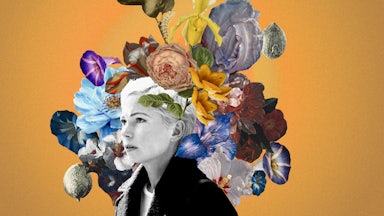
The very best shows of the year were filled with performances as crystalline in their power as O’Reilly’s and as quietly revealing. Michelle Williams gave a sizzling performance as Molly, a middle-aged millennial dying of cancer, in Dying for Sex. At the beginning of the show, Molly leaves her husband—a smotheringly obsequious Jay Duplass—in order to embark on a last-minute quest to have an orgasm with another person. She chooses as her partner on this journey her best friend, Nikki (played by an equally wonderful Jenny Slate). “I want to die with you,” she says to Nikki, who accepts this burden and gift. Much of Molly’s death march to ecstasy takes place behind closed doors, or in intimate whispers with Nikki. Her crisis is not everyone’s problem; it is uniquely hers.
In the penultimate episode of this marvelous series—not only the best show of the year but somehow also the funniest—Nikki spends a night in the hospital with a man only called Neighbor Guy (Rob Delaney). As the sun rises on their triumphantly postcoital bed, he offers to stay or come back to be with her again. But she says no. “I don’t want to die with you,” Molly whispers, “I want to get a dog with you.” It’s a line that’s stayed with me, both because of its woeful clarity but also because it tells us what this show is. It’s not a stealth marriage plot or a rom-com, nor is it a dour dirge. Neighbor Guy isn’t nameless here because he doesn’t matter or because, in an alternate universe, he mightn’t be the love of Molly’s life. He’s nameless because this is not a story about him. It’s a story about a different and less often portrayed intimacy than romantic love. Molly falls asleep, and when she wakes up, in the same frame where Neighbor Guy once was, there’s Nikki instead. To die with.
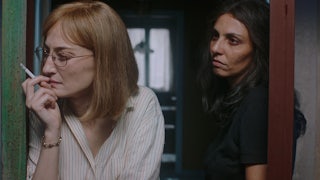
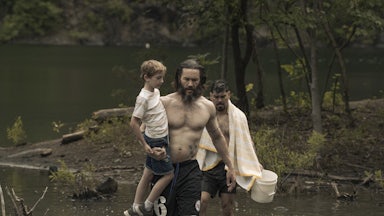
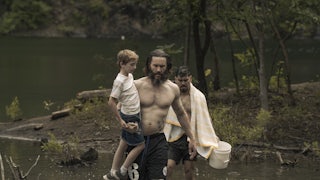
Beyond Mon Mothma and Molly and Nikki, there was Naomi Schwartz (voiced with titanic verve by Lisa Edelstein), the matriarch of the Schwooper family on Netflix’s Long Story Short, whose forgottenness is essentially the structuring spine of the time-jumping series. Then there was Yusra (Farah Bsieso), Mo’s mother on the titular Mo, who explains to her son that pride, self-knowledge, identity cannot be sourced from what other people think of you. And there was Maeve (Emilia Clarke) on Task, whose life is defined by the domestic duties and dangerous secrets thoughtlessly piled upon her by a series of men riding off into the sunset on self-destructive voyages of spiritual discovery. Then there was Katie, the young girl killed by the young boy on Adolescence—a girl we never meet, never see, never know at all except inasmuch as she remains a casualty of man’s search for meaning.
Mad Men recently began streaming on HBO Max. Lately, it was hidden away on the niche AMC+ streaming service, and it’s the first time I’ve rewatched it in several years. The thing that was always true about Mad Men was that Don Draper, its grey-flannel-suited protagonist, was never its most interesting character. The virtue of Don was that he gave us access to a murderers’ row of some of the most compelling characters and compelling performances to appear in the High Prestige period of cable television. And, not incidentally, many if not most of these were women: ambitious copywriter Peggy, tragically pragmatic Joan, angsty teenager Sally, radicalized housewife Betty.
The trick of that show’s first episode is that we watch Don pitch and womanize his way through Manhattan for most of its run time until it is revealed at the very end, as a plot twist, that he’s actually got a beautiful family and a stunning wife, Betty, hidden away in the suburbs. Betty, who barely speaks in the pilot, is our focus as the second episode begins. After a night out, Betty and Don return home and make love. But, as Don falls asleep in the dark, Betty sits up, nervous, smoking a cigarette, staring at him. Her glower is an unmissable, magnetic mixture of desire and disdain that actress January Jones would make Betty’s hallmark over seven seasons.
Then a weird thing happens. Her face loses that dark expression, she puts out her cigarette and slinks tentatively down close to Don. “Who’s in there,” she whispers as the scene fades out. It hits us as a strangely cloying line performed for who? For us? For herself? But we remember her look of a few moments earlier, and we know she knows. She knows exactly who Don is, even if she doesn’t realize it, and so do we. The idea that he’s more mysterious, more complex, more angst-filled, more traumatized, more embattled, more lost, more lonely, more in crisis than Betty is a fiction. The real question is: Who is she?