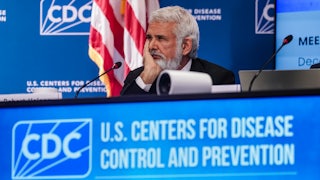
Trump gets a lot of things wrong when he talks about cognitive tests. He recently bragged to journalists that he “aced” one, and said the doctors at Walter Reed told him no president had taken a cognitive test before. That would be forgetting at least two other times Trump has taken cognitive tests, by his own account: once during his first term in 2018, and another earlier this year, in April. The White House said he scored 30 out of 30 on the April test.
He also consistently conflates cognitive exam performance with intelligence: “I said, ‘I won’t do poorly. I’m a smart person, not a stupid person,’” he told journalists.
These kinds of remarks get a lot of attention, in part because Trump is infamous for his meandering speeches, prompting questions about his mental acuity and memory. His physical health also seems to be deteriorating; the president has appeared frequently with bruises on his hand, and he sometimes has difficulty walking. The recent report that Trump had undergone imaging of his heart and abdomen—not a standard prevention procedure—left some doctors wondering if there is more to Trump’s health than the White House lets on.
But the president’s health isn’t the only concern here. Trump’s repeated mention of his cognitive feats politicizes an important issue facing a growing number of Americans—and it obscures what else is needed to measure and prevent cognitive decline. This is a conversation more patients, providers, and families will have as baby boomers age; by 2060, there will be more people who are 65-plus than there are children under 18 in the United States.
Between ages 55 and 90, people have a 42 percent chance of developing dementia, and most of that risk occurs after age 75, according to a study published in January. The most typical causes are conditions that are more common with age, like Alzheimer’s, Lewy body disease, limbic-predominant age-related TDP-43 encephalopathy, or LATE, vascular disease, and frontotemporal lobar degeneration. As more Americans age, researchers expect one million cases of dementia to be diagnosed every year—almost double the 514,000 cases diagnosed in 2020. “With people living past age 75 and a risk number like that, we have real reason to be concerned about dementia as a big problem, both for individuals and our country,” said Jason Karlawish, professor of medicine, medical ethics, and health policy at the University of Pennsylvania, and co-director of the Penn Memory Center.
The test Trump referred to is called the Montreal Cognitive Assessment, or MoCA, a 15-minute pencil-and-paper test designed to assess memory, language, attention, concentration, orientation, calculation skills, and executive functioning, used by clinicians to monitor cognitive ability among patients of all ages, if they demonstrate potential cognitive issues, since 2005. Those skills are essential for navigating daily life—remembering appointments and medications, recalling how to cook and handle finances, organizing the day, and solving problems.
Cognition tests are usually a part of every annual wellness visit for patients on Medicare, a provision included in the Affordable Care Act (also known as Obamacare). And the American Academy of Neurology recommends annual screenings after the age of 65. Otherwise, the test is given “only when you have expressed concern,” said Ziad Nasreddine, a cognitive neurologist, director of the MoCA clinic, and creator of the MoCA test. Taking a test more than once a year—which seems to be what Trump is saying he has done—would happen if the patient or provider has persistent concerns, which might include difficulty recalling certain words or remembering where they put their keys, families reporting that they sometimes retell stories or ask questions repeatedly, or their provider noticing fogginess or confusion during the visit.
“Unlike a math test or geography test, it’s not designed to measure something that you learned and accomplished,” Karlawish said. “It’s designed to measure your brain’s abilities and functions.” Saying someone “aced” a cognitive assessment can be harmful if people see it as a marker of intelligence or knowledge, he said.
The MoCA is a starting point—it bundles together mini-tests on several different areas of cognition, and if a patient has a lower score in certain areas, a provider might order more in-depth assessments on, for example, language or memory. But it’s dangerous to take it as a definitive diagnostic. While some patients may have test results that indicate clear loss of cognition, most of the time the test only shows the need for more testing. Sometimes, the additional testing reveals there are no issues after all; the test was designed not to miss anyone, so there’s a risk of people without cognitive impairments accidentally testing too low. That happens about 13 percent of the time, Nasreddine said. Patients might be distracted or tired or stressed that day; certain medications, like Benadryl, can also cause cognitive issues.
“If there’s a problem on the test, it doesn’t automatically mean that you have Alzheimer’s or a neurological condition,” Nasreddine said. That’s why it’s important for an experienced health care provider to administer the test and not overinterpret it, he said. Cognition also isn’t the same as ability, Karlawish said, so before concluding that a patient shouldn’t be driving or living alone, for example, providers would want to investigate further, just as they would before making any other diagnosis. “The echocardiogram tells you a lot about the heart, but it doesn’t alone diagnose heart failure,” he said.
At the same time, sometimes the tests don’t pick up people in the early stages of cognitive impairment, Karlawish said. “It’s not at all uncommon to have someone who has a score on the MoCA which is ‘normal,’ doesn’t indicate impairment, and yet when you test in greater detail on the various cognition measures, you pick up impairment,” he said. To return to the analogy of heart disease: A test might not pick up issues if the patient is walking across the room, but more testing might find they have trouble climbing the stairs.
There are other dangers too in misinterpreting what these tests do. Despite Trump’s insistence on the difficulty of the test, some people look at the MoCA and think it’s easy—and those misperceptions are felt deeply by people who are challenged by the test. Patients might look at the images of animals, used to test memory, and think it’s a kindergarten test—and then they feel humiliated if they don’t pass it, Nasreddine said. Framing the test in terms of easy or hard is “ultimately insulting for the patients who are actually undergoing these tests,” he said. He worries that political rhetoric on both sides affect the test’s reputation: “They might ridicule the test, or they might make it as a big IQ test; it’s those two extremes. The test is more in between.”
Trump’s rhetoric about tests in 2018 has already affected the cognitive testing world. The MoCA test is free for any medical providers to use—but after Trump bragged about passing it in 2018, a surge of interest from people wondering how they would fare on it led Nasreddine’s team to develop an online quiz, the MoCA XpressO, so that people could test their acuity without inadvertently memorizing the paper test.
The Lancet in 2024 published 14 modifiable risk factors that can decrease by 45 percent a person’s risk of cognitive decline. “These are things that you could do at home,” Nasreddine said. Eating healthy foods, exercising frequently, getting enough sleep—they play a major role in cognitive health. There’s also “compelling” data that the shingles vaccine reduces the risk of developing dementia, Karlawish said.
While they are pleased to talk about the importance of cognitive health, researchers and providers worry about the ways it is being politicized and misunderstood, and the ripple effects that has on the public. “I look forward to a time when we talk maturely about the tests that are being done,” and when dementia is no longer “a way to attack our opponents or otherwise campaign against them,” Karlawish said. “I look forward to a time when both sides of the aisle responsibly talk about brain health and aging.”