I initially assumed that kidnapping Venezuela’s president and imprisoning him in Brooklyn was Trump’s way of distracting us all from America’s affordability crisis. After all, it’s not unusual for an American president to invade another country when he’s worried about his domestic unpopularity; a 1997 movie called Wag the Dog dramatized that phenomenon, depicting a fictional but all-too-realistic president who starts a war to distract from a scandal. (Eerily, the movie came out a month before President Bill Clinton bombed South Sudan during a scandal of his own, and he began bombing Iraq later that year.)
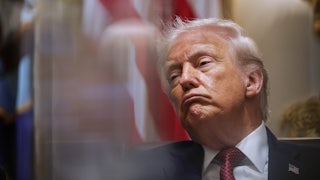
Or maybe Trump was just trying to wake himself up. It’s a repulsive thought—around 75 people were killed in the raid that Trump bragged about watching “literally like I was watching a television show.” But Trump keeps falling asleep during meetings, and maybe he thought a vigorous conflict could keep him engaged in the job of being president, given he’s obviously bored with the affordability crisis.
But a recent Politico report suggests the real rationale may be even more senseless. Trump, according to close allies, is arguing that invading Venezuela will help make Americans’ lives more affordable by bringing down gas prices. One Republican adviser emphasized, “Gas prices are going to come down, especially if Trump is brokering these oil deals.” The Republican argument, then, is that this bloodthirsty, illegal interference in the affairs of another country is not a distraction for a president who wants us all to stop talking about working-class issues. Rather, it will help Americans who are struggling to pay their bills.
It will not do that.
One reason why it will not help is that gas prices are a tiny fraction of the kitchen-table problems facing Americans. Gas isn’t even that expensive right now; prices at the pump have been declining steadily since last summer, and at no time during the Trump administration have they come close to the peak of $4.96/gallon that they hit under Biden in June 2022, which was the highest they’d been this century.
Americans are suffering an affordability crisis—it’s just not primarily caused by pain at the pump. In October, the Urban Institute found that over the last eight years, childcare costs, rents, home sales, health insurance premiums all outpaced the growth in American wages since 2017. The same research also showed that over the last six years, grocery prices too had outpaced earnings.
What’s more, Trump’s policies are exacerbating the problem. Last month, the Center on Budget and Policy Priorities found that his tariffs had raised grocery prices; his cuts to the programs that make health care more affordable will cause suffering for millions; his cuts to rental assistance will make it harder for many tenants to afford their homes; his tariffs on construction materials will increase costs for both homebuyers and renters; and his cuts to federal financial aid programs will make college less affordable. The CBPP found too that all these cost increases would hit low- and moderate-income Americans the hardest. Trump’s rollback of Biden’s energy investments—including his irrational war on renewable energy, especially wind—will also raise energy bills and leave many struggling with cold in the winter and heat in the summer.
Nor is there much evidence an imperialist occupation of Venezuela’s resources would even bring down oil prices for Americans. Experts say the amount of oil in question is too small to make a difference to the average consumer and that there is already too much oil flooding the global market. While some oil companies may indeed make a profit off ventures in Venezuela, the outlook for the industry in general is a little less clear: According to another Politico report, the biggest companies are also the most skeptical. Exxon’s CEO called Venezuela “uninvestable” in a meeting at the White House on Friday, to which Trump later responded with his characteristically constructive efforts at dialogue. (That is, he threatened to exclude the oil giant altogether: “I’d be inclined to keep Exxon out. I didn’t like their response.”) According to Reuters, boosting oil output in Venezuela could weaken the global oil market and hurt oil companies in the United States, which are already losing profits and laying off workers.
Trump’s rhetoric on gas prices—evoking Sarah Palin’s 2008 exhortation to “drill, baby, drill”—feels out of date and out of touch. Gas probably can’t get that much cheaper, and in any case, cheap gas is not the route to greater American ease and comfort. War for oil—like all forms of petromasculinity—is a shortsighted form of populism, given that climate risks and extreme weather caused by fossil fuel dependence will hammer the American working class and middle class. This time around, in classic Trump fashion, the war-for-oil strategy adds irrelevance to injury. Instead of addressing America’s affordability crisis with real solutions, the president is starting wars and lying about how they will help Americans pay their bills.
But again, he doesn’t really care. Venezuela is already starting to bore him almost as much as the troubles of working-class America: In the middle of Fridays’s briefing with oil executives on Venezuela last week, he interrupted the proceedings to have a look at his new ballroom. As always, the real topic of the day was himself. For Trump, that’s all that really matters.