Christin Crabtree lives just a few blocks from where an Immigration and Customs Enforcement agent shot Renee Nicole Macklin Good, on the south side of Minneapolis. A mother, like Good, Crabtree has been organizing with her neighbors against the invasion of ICE and Border Patrol in the Twin Cities, facing off with heavily armed agents at school pickup and drop-off. And that same day—January 7—Crabtree found herself face-to-face with now-infamous Border Patrol Commander-at-Large Gregory Bovino.
“He had walked onto the school grounds where I was doing patrol that day and was holding one of the silver chemical agent canisters that he has on his vest and had another agent with him,” she said. “I watched video afterwards, and you can hear that agent cocking his gun. In the moment, I did not perceive that at all. I just remember telling the students to get back because kids were literally still walking out of school, and the students were seeing these agents tackle their teachers.”
The ongoing violence that Minnesotans are facing during the so-called “Operation Metro Surge” has put thousands of ordinary people like Crabtree into extraordinary situations, day in and day out. Parents patrol their children’s schools; neighbors deliver groceries to their neighbors who are staying home in a perverse extension of Covid lockdown-era mutual aid networks; communities have signals and Signal threads so that people can run toward or away from a smash and grab, depending on their vulnerability.
“The way that the community showed up in that moment, neighbors coming out their doors,” Crabtree said, “was just profound. Our school community has felt really held by our neighbors. As terrifying as that was, to see folks show up in that way was really, really meaningful to me.”
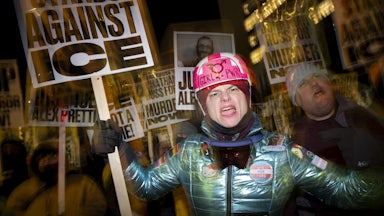
The Twin Cities have had plenty of opportunities to build up these networks of resistance, networks that have only grown larger in the wake of Good’s killing. Those networks have called for a day of action, under the name “ICE Out of MN: Day of Truth and Freedom,” today, January 23, which may be the closest thing to a general strike that the United States has seen in nearly a century.
General strikes are rare and something like lightning in a bottle: They tend to overspill their boundaries, becoming, in historically specific moments, something more than just the sum of their parts. As Rosa Luxemburg wrote in The Mass Strike, they combine political and economic struggle into one moment of near-revolutionary fervor. The post-2008 era has seen many calls for a general strike, but most have been from internet posters disconnected from organizing, hoping that existing momentum can be expanded via tweet and Instagram meme.
What’s happening in the Twin Cities is different. It is a call coming from the grassroots, from the ground, but one endorsed by dozens of labor and community organizations, including the Minneapolis and St. Paul Regional Labor Federations; the North East Area Labor Council; the Minneapolis Federation of Educators; the St. Paul Federation of Educators; the Centro de Trabajadores Unidos en Lucha, or CTUL; Amalgamated Transit Union Local 1005; SEIU Local 26; Inquilinxs Unidxs por Justicia, or United Renters for Justice (IX); the New Justice Project, or NJP; Unidos MN; and UNITE HERE Local 17. The day of action calls for “no work/no school/no shopping,” and includes planned direct actions and a massive march, going forward despite a forecast temperature of -10 degrees Fahrenheit—which doesn’t include the wind chill.
Some 80 different groups, according to Todd Dahlstrom, the director of organizing and growth at the Minnesota AFL-CIO, “have come together under the banner of the Democracy Defense Table.” They’ve been coordinating rapid-response teams and recruiting new people to the struggle, watching as those people deliver food to their neighbors or drive them to work or volunteer to track ICE vehicles throughout the city to raise the alarm. Dahlstrom admits that he was afraid the movement would stall after Good was killed; if anything, it added fuel to the fire: “Four times as many people signed up for these nonviolent direct action trainings here in the Twin Cities, in St. Cloud, up in Duluth. We’ve trained over 1,200 people over the past six weeks.”
These organizations are used to working together and responding quickly to crisis; they have built bonds of trust through tear gas before, and they have learned to align their goals without needing perfect agreement; to leverage their combined strength to change the political calculus in the state of Minnesota. Some call it the “Minnesota model,” as I’ve written elsewhere, measuring its gains in policy victories: “free school meals and driver’s licenses for undocumented immigrants; getting Amazon to negotiate with workers for the first time; a $15 minimum wage (with proposals to bring it up to $20); so many union contracts it’s hard to count, for janitors and tenants and teachers.”
In March 2024, several of those unions and community organizations lined up collective-bargaining contract expiration dates and other campaign deadlines in order to prepare a mass strike that would see public and private services, schools, and transit all shut down at once. This is a movement, in other words, that has already laid groundwork for a two-city-wide general strike. Brahim Kone, secretary-treasurer at SEIU Local 26 and an immigrant himself, told me in 2024, “We had the bus drivers involved, we have the teachers involved, we have security, janitorial. And so, imagine one day, for example, where there’s no bus that’s running in Minnesota, where the janitors are not going to work, the security guards are not going to work. The teachers saying, ‘No, we’re not working today.’”
Disruption, Kone said, was where the power lay, but there was also real power in understanding that workers’ problems do not end at the end of their shift. “We learn not to separate [issues] because our members are the ones who are struggling with housing, they are struggling with immigration, they are struggling with low incomes. So the thing that we do all the time is analyze who is in this fight with us. You’re going to always find somebody who is fighting for something that we care about.”
The Minnesota movement thinks, as political philosopher Rodrigo Nunes puts it in Neither Vertical Nor Horizontal, ecologically: It brings together different forms of action (strike, boycott, mutual aid, self-defense) and disparate organizational forms (unions, community groups, tenant organizations, text threads) with unaffiliated individuals who turn up to protests or just stop, like Renee Good did, while passing through, to protect members of their community and to document what was happening. This entails, in Nunes’s words, “privileging cooperation over competition, nurturing common resources and mutually beneficial relations, and strategizing with a broad field of other agents in mind.”
At the moment, all of those organizations and quite a few new allies are united behind a simple demand: ICE out of Minnesota. Beyond that, many of them have endorsed the call—now nationally popular—to abolish ICE entirely, and some have called for an eviction moratorium (again, mirroring Covid-related policies, this time to protect people from a threat entirely caused by the state). Organizers have targeted major corporations—CTUL is focusing on builder D.R. Horton; Unidos and others have held sit-ins and sing-ins in Target stores, as the corporation is headquartered in the Twin Cities—demanding that they protect employees from ICE. Some are using the language of general strike, while the unions, which have contracts that often prevent them from striking within the bounds of those agreements, are avoiding those words.
Crabtree’s organization, Minneapolis Families for Public Schools, has focused on the return of school sanctuary status, so that her experience with Bovino’s forces is not replicated. It has backed the eviction moratorium, and—in yet another Covid echo—remote learning access for students who risk being profiled by the federal troops. To her mind, remote learning also means ensuring that students have computers and internet access, as well as getting groceries so they are well fed before they try to learn in crisis conditions. “It’s not lost on me that our kids who are most likely to need to stay home are also coming from some of our families that are living in potentially some of the most precarious situations,” she said.
Minneapolis Families for Public Schools came together after the Minneapolis Federation of Educators strike of 2022. Initially, Crabtree explained, it was a grassroots group of parents who wanted to support the educators’ demands and to have a more tangible way to collaborate with the union. As it expanded, the group formalized and became a part of the community organization Take Action Minnesota.
Crabtree also found herself transformed by the movement for Black lives—the 2020 George Floyd uprising in the Twin Cities, but also thinking back to 2012, to the killing of Trayvon Martin and the first wave of what became known as Black Lives Matter. “My son was in middle school at that time,” she said. She recalled “seeing my son in that child and just seeing the need in Minneapolis to really go from polite to justice.” The term “Minnesota nice” gets tossed around a lot—not least, lately, in signs that say “Minnesota Nice Means Fuck ICE”—but to Crabtree, there are two possible valences to the phrase. “To me, Minnesota nice, we are people who love our neighbors and take care of each other,” she said. “And also, Minnesota nice can often be a construct of polite white supremacy, the liberal who maybe wants to stay comfortable.”
Successive waves of uprising in the Twin Cities, though, have shaken a lot of people out of that latter complacency. The George Floyd uprising was transformational for many, but it was merely the most recent wave. Many years ago, when she was part of Occupy Wall Street spin-off Occupy Homes, Minnesota organizer Cat Salonek—now with the Tending the Soil coalition—described Occupy to me as “a dandelion that got blown into the wind.” Those seeds took root, and grew, and then were blown out into the wind again—into unions and tenant organizations and mutual aid networks.
The George Floyd uprising gave Gayle Smaller the idea for the Community Safety Specialist, or CSS, program—specifically, the need for trained first responders who weren’t police, who would be part of the communities they worked in, who could respond on the ground to anything from a crisis call to an ongoing problem of speeding during school drop-off hours. Partnering with Local 26, Smaller helped build the program, which has enjoyed a lot of quiet success since it launched. “It was a nice little two-year coast until about two weeks ago,” he told me.
Since the beginning of Operation Metro Surge, his people have been involved in a new kind of safety work. “We got out pretty early, informed everyone about their rights, about how people needed to be having warrants,” he said. He too saw a lot of attempts to target schools and school bus stops to catch parents coming to meet their children, and so the CSS workers were posted at apartment buildings to be supportive. They were on the ground the night that ICE shot a second person, Julio Cesar Sosa Celis, working to defuse the situation after the agents let off smoke bombs and tear gas, trying to de-escalate the situation and prevent any further violence.
“Our goal as CSS is to keep our community safe,” Smaller said. “One of the things that we’ve been talking to our community about is really focusing on your block.” To him, it’s important for the community to be connected and to build trust and a sense of safety even in the crisis. That means making sure the information people are sharing about ICE presence is accurate and not exaggerated, when even elected officials like Minneapolis Mayor Jacob Frey and Minnesota Governor Tim Walz are on TV looking as scared as anyone. “You have to figure out a message to eliminate fear within the community.”
Todd Dahlstrom used to organize building security workers with Local 26, which gave him an orientation toward keeping people safe at protests and direct actions. That knowledge has come in handy with the return of mass protest: “We’ve trained over 350 marshals or what we call marshals and/or union peacekeepers,” he told me on Tuesday. “We train people; we’ve got a whole set of leads who get their team and they call through that list and make sure those people turn out. We’re doing advanced training and de-escalation. We’re going to train another hundred people this week for Friday. We’ve got two trainings set up for tomorrow night and Thursday night for Friday’s events.”
That training has been crucial because the threat is everywhere. “Any one of us just driving down the street could be surrounded, pulled out of our car,” Dahlstrom said. “What they do is they break your windows, cut your seatbelt, and drag you out the window. It’s not even like, ‘Hey, can you step out of the car? Can I see your identification?’” The past trainings that they’ve done, learning to de-escalate with local law enforcement or white supremacists—or even their own people when feelings run high—have had to be adapted to a force that, he said, “is not interested in peace.” Dahlstrom himself has been thrown to the ground by an ICE agent while trying to defuse a situation. “I had my back to him. I had my yellow vest on. I don’t yell or scream or call names. I’m very composed, and yet I was violently attacked.”
It has been ground-up demand from the members that led the Minnesota labor organizations to endorse the day of action despite the risk they face in what could be perceived as a call for a general strike. According to Greg Nammacher, president of Local 26, “Members started telling us in large numbers that they were going to honor that call of the 23rd. In fact, in just one meeting of over a hundred members, maybe 150 members, 95 percent of them said they were planning not to go to work.” He noted that each individual union will have to decide for itself what action to take, based on the specifics of its sectors, its contracts, and the law. But, he said, “Let us be very, very clear. We as unions will do everything in our power to protect the rights of all workers.”
Those unions have felt the impact of ICE’s violence deeply. Over 20 members of Local 26, along with over a dozen members of UNITE HERE Local 17 and untold others have been abducted by federal agents. At the airport, UNITE HERE’s Christa Sarrack said, those workers have not only been legal residents authorized to work in the country, but had gone through extensive background checks and were behind TSA security. “These workers are then being detained, and in several cases, they have been in custody, they have been handcuffed, they have been shackled, and they have been quickly moved out of Minnesota and are being detained in other states. Then they are being released because ICE is realizing that they have made a mistake.”
Some of those workers have been leaders in actions that, Nammacher noted, led to wage increases, back pay, and safer conditions for U.S.-born workers as well as immigrants. One janitor who’d spoken at a press conference a few months back was detained; a window cleaner who had led strikes that won a safety program was swept up from his immigration check-in and sent to Mexico before his family could speak with a lawyer. “His sacrifice made all window cleaners in the Twin Cities safer, no matter where they were born, no matter what their citizenship status,” Nammacher said. “If the declared purpose [of these deportations] is to help U.S.-born workers get higher wages, which is sometimes what we’re told, it has had the opposite effect.”
Chelsie Glaubitz Gabiou, the president of the Minneapolis Regional Labor Federation, added that when they have been in contact with people who have been removed from Minnesota, the conditions in the detention centers are abysmal and rapidly getting worse. “There are outbreaks of flu and Covid. They’re refusing to separate the folks who are sick from the folks who are healthy. They are putting extreme pressure on folks who have authorization to be in this country to voluntarily sign deportation orders to leave. These are people who are losing hope in these places because of the conditions.”
Not only are most of the people trapped in these conditions not “violent criminals,” most of the people who have been disappeared, according to Glaubitz Gabiou, have the legal right to live and work in the U.S. But this moment has reminded everyone watching that there is no distinction between “criminal” and “illegal” and otherwise that will satisfy a machine built to racially profile and purify. Nor is there any safety to be found in a better-trained deportation machine—after all, the man who shot Good was not merely well trained, he was in fact a trainer. “Working people cannot stand aside while our neighbors are terrorized and our families are fractured, because those are our families. Those are our neighbors. They are us,” said David Stiggers, president of ATU 1005.
No one is safe from ICE, whether we want to liken it to the Gestapo or slavecatchers or the Klan or a force that Minnesotans have deep experience in resisting, the modern militarized police. The only way to create safety is, as Smaller and Dahlstrom and the other organizers said, to keep one another safe. And that means, as the Minnesota movement is doing today, going on offense. “The labor movement exists to defend dignity, justice, and human worth,” Stiggers said. “This is a moment of conscience, of collective power. We recognize the seriousness of this action and the risks involved. We stand shoulder to shoulder with our members, for our labor allies, and with all who call for humane, just, and equitable treatment for every person in our communities.”
The day of action, like the Minnesota movement as a whole, will proceed ecologically. “People are going to be wearing certain colors, people aren’t going to be shopping. People who are able to stay home from work are going to stay home from work,” Glaubitz Gabiou said. “We’re going to be downtown. There’s creative ways to get around downtown through our Skyway system and things like that that might be used.” Unions are negotiating with employers to close entirely on January 23—some 200 businesses may be closed, according to Dahlstrom.
Those businesses have been struggling already during the ICE incursion, Glaubitz Gabiou noted. In some ways, the strike and boycott day is an extension of what is already happening, for good and for ill. The Los Angeles area, she said, saw a massive economic impact while that city was occupied—by fewer agents, for a shorter amount of time, in a much larger city. Workers stay home or are disappeared, businesses shutter or lose customers, people cannot pay rent. Christin Crabtree has been thinking a lot about those people who have been unable to work, and the movement itself as a method of care. “Ideally, I would love to see there be an eviction moratorium statewide, which is something the governor would have to lead on. But I think this moment on the 23rd is a way to show that we are going to look out for each other regardless of what our systems do or do not do. We are going to make sure we are OK and also encourage those in power to make those systems meet this moment.”
It is a hard truth about the Minnesota movement that it has gotten this good at organizing in conditions this bad because they have happened before. Still, it has been heartening to the people on the ground to watch the systems they built over the course of years not only operate smoothly but expand in a moment that feels like war. “I’m just amazed at the maturity of the organizations,” Glaubitz Gabiou said. “The ability to sort of manage a situation where the president is looking for a specific outcome has been just really, really phenomenal. It’s a little bit emotional how well everyone is doing together in this moment.”
The Minnesota organizers are aware that they are being targeted for political reasons. It felt to Gayle Smaller like immigration enforcement was simply the name pasted on an operation designed to sow fear, to attempt to cow a city and a state that has been a bastion of radical organizing and progressive policy. Yet on the ground, Crabtree said, the left-right divide faded away as neighbors reached across barriers that had once felt impassable. While there was fear that Trump would attempt to escalate his occupation—Smaller mentioned his threat to invoke the Insurrection Act—the organizers I spoke with echoed one another in their confidence and willingness to keep fighting. “The resilience of the community is very beautiful, and it is everywhere,” Glaubitz Gabiou said. “This is the largest grassroots mobilization I’ve ever seen.”
“I would never wish what we are dealing with on anyone,” Crabtree added. “But if I was going to be in this situation, I am so grateful that I’m in it with these people in this moment.”