When Will Democrats Decide to Join the Resistance?
The party needs to forge a closer connection with the people fighting for democracy in the streets. Here’s how to do it.

Lately I’ve been wondering what it might be like for the residents of the embattled Twin Cities to receive one of those trademark email solicitations from the Democratic Party. You know the ones: The sender is Chuck Schumer, the subject line reads “THIS IS THE END,” and the body of the email explains how the gyre is widening and the falcon can’t hear the falconer and it’s up to you to send $5 to hold back the blood-dimmed tide. These are annoying during whatever times we might have once considered to be “normal.” With federal agents wilding on the streets and kidnapping children, to hear our problems reframed as something that we can fix by handing the nearest Democrat the change in our couch cushions is anger-inducing.
I’ve heard and read enough accounts from Minneapolitans to know that they’re feeling little connection to Beltway lawmakers, and that by and large they feel abandoned by most Democrats in Washington. This can only go on so long before something breaks: Ordinary people are showing remarkable valor protecting their communities from a corrupt and violent federal presence, egged on by a senescent and (allegedly) incontinent president and his ghoulish hangers-on. Democrats have the power to recognize this effort to protect democracy, provide it with material support and media cover, and thus knit up the fabric between themselves and these brave Americans.
Let us acknowledge that the answer will not come with a legislative fix. Senate Democrats held the funding of several executive branch agencies hostage over demands to reform the Department of Homeland Security, precipitating a partial government shutdown, but earlier this week a deal was struck to fully fund those other agencies while only keeping the lights on at DHS for another two weeks as lawmakers negotiate reforms.
One Democratic lawmaker to whom Axios granted the veil of anonymity suggested that Democrats expect the base to “get upset” but believes the discontent will wash away because “then you’re going to have the real fight in two weeks.” Whether or not that period ends with any meaningful change in the status quo remains to be seen. Much of what Democrats seek would merely require various federal agents to obey rules and regulations that they’re already supposed to follow as a matter of agency directive—though enshrining these policies as laws would be a step in the right direction.
That said, there’s still the thorny matter of enforcing any new constraints that are imposed on ICE and Border Patrol. I hope I’m wrong about this, but by the time all is said and done, I don’t expect much in the way of material change where the president’s paramilitaries are concerned. At best, perhaps, people will see the faces of the thugs who are beating them—though not always, if Schumer has his way.
I think people, by and large, can accept that when it comes to enacting policies, Democrats have little room to maneuver given their minority power. Moreover, the revival of arguments over the party’s unwillingness to use what leverage it has out of fear that closing the government on a long-term basis will lead to larger downside liabilities is, by now, parlor-room talk. Looking toward the future, Democrats must pivot to combat an even greater danger, which Senator Chris Murphy articulated on the podcast of TNR’s Greg Sargent: “I think if people don’t see us fighting on something as existential as whether we condone the federal government murdering our own citizens, then there will be a mass withdrawal from politics altogether.”
Murphy continues:
I do think this is a critical moment. The whole country is seized by what they have seen—the statistics suggest that 80 to 90 percent of Americans have seen these videos—and they desperately want somebody to stand up for the rule of law. So, yes, if we do not make a fight right now, I think it could result in just a massive withdrawal of participation in our civic life.
And that is how democracies die. Democracies die not often simply by force—it would be totalitarian—but by citizens deciding that there’s no one that is willing to stand up and save them.
Democrats, stymied as they are on Capitol Hill, have a freer hand to act in other venues—to undertake the necessary work of standing up for the people and proving that they are all on the same team. They must fight on these remaining fronts with an eye toward forging a greater connection with the broader civil resistance, providing it with rhetorical and material support. There are a number of ways in which Democrats can interact with those fighting to protect their families and neighbors from Trump’s predations that aren’t subject to a presidential veto.
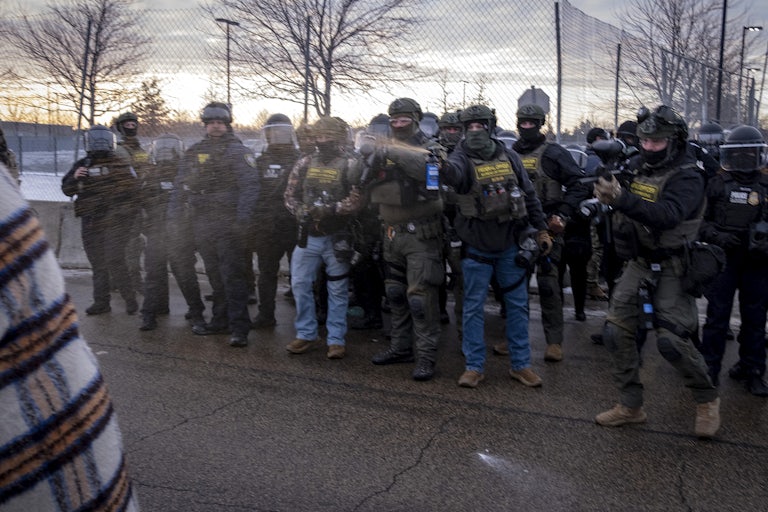
First and foremost, Democrats should play the leading role in waging a campaign for the truth. In the past two weeks, the media has been suckered into front-running for the Trump administration, presenting a favorable narrative that spins a gauzy story: Forces are being drawn down, and the temperature is being lowered in Minneapolis. None of this is true: Minneapolitans are still living with the same brutal fear they were experiencing before Border Patrol commander Greg Bovino was sent packing. People with legal citizenship are being abducted from the streets of the Twin Cities and sent to Texas, where they are released and abandoned without the means to get home. Democrats are uniquely positioned to echo and amplify the voices on the ground that are simply saying that the Trump administration is lying; that its abuses are escalating.
Democrats should ignore calls to keep their distance from the people who are impacted by Trump’s mayhem. That doesn’t mean we need every septuagenarian lawmaker in front of Border Patrol truncheons outside Minneapolis’s Seventh Street Entry, but being present and visible in any way makes a big difference. New York congressional candidate Brad Lander trekked to Minneapolis to help locals protect their neighbors in the same way he’s helped those in his home state. Joaquin Castro and Ilhan Omar made personal intercessions to return the abducted Liam Conejo Ramos home. Castro personally made the trip home with the 5-year-old; his efforts garnered a ton of well-deserved positive attention from the media.
Democrats have able-bodied staff, connections to important and influential people, and a bully pulpit. All of these resources can be mobilized to help embattled citizens survive Trump’s onslaught, whether it’s getting more media attention on the daily abrogations of our constitutional rights, helping organizers on the ground with logistical support, or kickstarting fundraising efforts to help the mutual aid organizations central to the fight. They can also bring these efforts home to their own districts: As TNR contributors Ana Marie Cox and Sarah Jaffe separately reported, Minneapolitans were well positioned to offer a stern resistance to ICE because they’d prepared for it in advance. Knowing that the president views any Democratic district as a potential venue for ICE violence, lawmakers should get their own communities prepared for the worst by building the necessary resilience now.
This is, of course, a midterm campaign season, and there’s no better way to reconnect with those suffering under Trump’s bootheel than to make the solemn promise to hold him and his cronies accountable; impeach them, remove them, forever discredit them, block their paths to power indefinitely. And look, if you’re a one-note Democratic lawmaker who feels like the only thing you can freely talk about is affordability, you too can suck it up and play a role: ICE violence is currently one of the primary drivers of the affordability crisis.
Recently, Indivisible’s Ezra Levin said something interesting about the kind of email missives I made fun of at the top of the piece. Today’s “political system,” Levin wrote, “largely treats people like small-dollar ATMs that vote every two years. Everybody gets deluged with emails asking for money. It feeds cynicism and burnout. Rarely do you get a ‘help me organize our community’ email.” To Levin’s reckoning, it may not be the case that Democrats are asking too much, it’s that they are asking for “too little.”
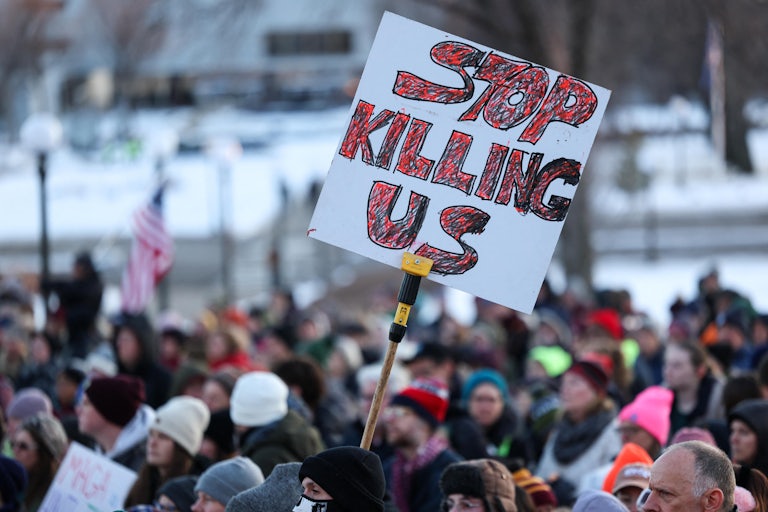
People under tremendous pressure and mortal fear have spontaneously spun up a vibrant civil resistance that puts the lie to so many of the assumptions upon which Trumpism was built. The democracy movement already has leaders. It would be to the benefit of all if Democrats find new and novel ways to join them.
This article first appeared in Power Mad, a weekly TNR newsletter authored by deputy editor Jason Linkins. Sign up here.