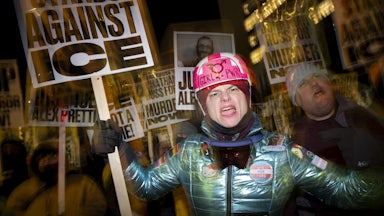
Don’t let the made-for-Fox News spectacle of the Minnesota Occupation distract you. The most important lesson the rest of us can learn from that state’s wide and deeply spread resistance is that Minnesotans’ solidarity didn’t just spring up when Trump’s goons came to town. It was forged in nature’s annual frigid grip and a bit of isolation; these connections are not the welcome-if-tenuous threads formed during a singular crisis, they’re the carbon-steel fibers wound together by generations of consistent, need-blind aid to anyone that happens to be close by.
When I saw videos of Minneapolitans pointing and laughing at ICE officers slipping and falling on glazed sidewalks and streets, I knew the city had taken some fundamental turn against the occupation. When I heard about people pouring water in front of ICE’s vehicles to encourage nature along in the destabilization, I knew it was war.
I spent 10 years in the Twin Cities before moving back to Texas, and nothing has gone quite like I thought it would: First, there have been two big freezes. (My Texas friends always joke that I brought the weather with me; they have no idea.) Among many other things, I now feel safer in Abbott’s Texas than in Walz’s Minnesota. After Trump’s election in 2024, I worried that creeping authoritarianism would come for me in the Lone Star State. Look where the jackbooted thugs actually wound up.
Today, I have a new appreciation for the guarded sociability of the northern Midwest compared to Texans’ twangy garrulousness. In much of the country, connection can be measured by how much you have in common and how often you exchange small talk. I believe that what we’re seeing in Minnesota stems from knowing that everyone is at risk—whether we know each other at all.
Bonds formed under the pressure of negative double-digit windchill are key to understanding what’s happening. It is impossible to get through a Minnesota winter without help, and only sometimes does that assistance come from your neighbors. The stories about people shoveling out or snowblowing an entire block’s driveways without being asked and with no compensation are true, but the real miracles (and just as common) are the times when strangers stop to help someone shovel out a car caught in a snowbank or bring out the kitty litter from their trunk put there just for this kind of emergency. I cannot tell you one story about that happening to me. I have at least three or four. The pun is irresistible: Minnesotans have always declared common cause against ice, they’ve just changed their focus to the ice that you can’t also use for hockey practice.
You can dismiss it as a joke until someone at a café gives you a spare scarf because you can’t find yours. People offer assistance without hesitation and without question; I don’t think I ever even heard someone dismiss thanks with, “Just pay it back someday.” Of course you will—everyone knows it. Some might find it remarkable that the generosity exists right alongside the stubborn interpersonal Midwestern microdistance that can take years to thaw. But the caution of their relationships speaks to the universality of the principle: You don’t help people out because you like them. You just do.
Someone once described that cushion of reserve as “Minnesota nice right up until the front door,” but I think that buffer of formality is another reason these normies have risen up with such ferocity against the federal occupation: On top of everything else, invasive operations to detain and arrest people without cause in their cars and homes violates cherished, sparingly offered intimacy. It sounds a little insane to put it this way, but a civil occupation? It’s rude.
So while the ground-level resistance, with widespread involvement of newly activated residents, to ICE’s occupation is remarkable, I’m not surprised. The mobilization has cut across class and racial lines even more deeply than the response to George Floyd’s murder; it’s more than eight minutes of murderous cruelty caught on a cell phone, it’s more than the assassination of Renee Nicole Good. ICE is an army of Derek Chauvins and Jonathan Rosses, released to wreak havoc on the city every day. The memory is keen, the trauma is immediate and sustained, and the strength underneath the response is the work of decades.
Prince once bragged that the Minnesota cold keeps the bad people out; the cold also brings the best out of the good. Their decency is mirrored in a dozen other Minnesota mutual-aid traditions: Lutheran churches seeded what has become the largest refugee population per capita in the United States. Minnesota has had a labor organizing movement since before it became a state. Minnesota created the first high-risk pool in the country to insure “the uninsurable” in 1976 (I was covered under it until the Affordable Care Act passed). Minnesota and the Twin Cities exist in the same web of white supremacy and capitalism as the rest of us do; I won’t claim it’s a perfect place. But it’s very good.
Crises prompt extraordinary sacrifice among people who suffer together. In the days after the Hill Country floods last year, aid groups had to close donation centers because there was too much to distribute at once. This impulsive desire to assist under stress is human nature, and it is a reason to have hope in dark times. But truly resilient communities don’t arise out of an emergency. They come together before that through a thousand little acts on a regular basis. Resilient communities have the pieces in place to stave off the worst an emergency can bring—chief among them, a belief that aid should have no strings attached. Just tire chains.
And brave, steadfast light shining out of the Twin Cities and beyond is probably inspiring you. Maybe you’ve already donated to a Minneapolis mutual aid group. But maybe you should pause and rethink that impulse. That is to say: Donate, but look around your own neck of the woods. Your own community might need you to help seed a little resilience—here, now, before a crisis arrives to consume you and even if it’s not in a sub-Arctic clime. This is not a bad time to take groceries to a free fridge in your city. Or maybe: Find a chore to do for a neighbor now, before they need it. Or maybe: Get trained on Naloxone administration. Volunteer to walk dogs. Start a tool library. Learn some names.
Most importantly: Sign up for the ICE watch that’s happening near you. Because almost certainly, ICE is already there. What is happening in Minneapolis might be the template for what the Trump administration wants to bring to your hometown next. How Minneapolis prepared for resistance should be your template too.