The Reverend Susie Hayward felt as if she had experienced the full spectrum of human emotion over the span of a week. As the minister of justice organizing at Creekside United Church of Christ in southern Minneapolis, Hayward has been deeply involved in organizing and participating in the community response to the presence of Immigration and Customs Enforcement officers.
“Myself and my community are feeling our nervous systems are all dysregulated, and we are feeling fear and we’re feeling grief and we’re feeling anger. So there is all of that, as we are being terrorized in our communities,” said Hayward. But, she continued, the current moment is also characterized by “a great deal of connection and courage and, just frankly, love that is also surging through this city among folks.”
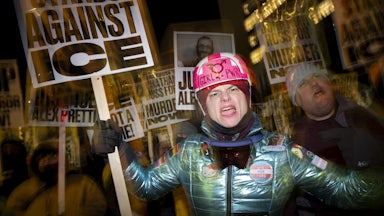
Although ICE has been present in large numbers in Minneapolis since late December, the deadly shooting of Renee Good by an ICE officer earlier this month has resulted in a surge of organizing and protests in the local community—and faith leaders are playing a key coordinating role. Minneapolis has a diverse population representing a number of different faiths, so the interfaith organizers represent a broad spectrum of religious affiliation.
Members of Hayward’s church are involved in such activities as patrolling outside schools and houses of worship to disrupt ICE activity, and assisting migrants who may be afraid to leave their homes by delivering groceries and offering rides. This has become a major priority for many in the local Minneapolis community—one Minneapolis church has delivered more than 12,000 boxes of food to families unable to leave their homes, according to MPR News.
For Reverend Kelly Sherman-Conroy, an associate pastor at All Nations Indian Church in Minneapolis, ensuring that local organizers are well trained is a deeply personal endeavor. Growing up in the Pine Ridge Indian Reservation in South Dakota, Sherman-Conroy saw members of wealthy, white congregations in the Twin Cities visit her community to undertake mission projects—without actually learning about the people they were ostensibly serving.
In the wake of George Floyd’s murder in 2020, Sherman-Conroy helped form an interfaith network of faith leaders known as Movement Chaplains, providing training on how to effectively engage in nonviolent protesting. The emphasis of these trainings is on “deescalation and cultural awareness and sensitivity,” she said, and teaching “what it means to be a guest in the space.”
“There’s been a big call for people of faith to show up more, especially clergy,” Sherman-Conroy explained. “I’m a big proponent of saying, like, ‘Don’t send somebody out and make that invitation if you don’t give them the tools to keep themselves safe and others safe.’” Twin Cities neighborhoods with large Somali populations have been disproportionately targeted by federal agents after a right-wing influencer peddled unsubstantiated claims of fraud occurring at daycare centers operated by Somali Minnesotans.
Hayward is also active in multifaith networks that have mobilized in the wake of Good’s death. She has tried to offer pastoral care to detained migrants, although she was blocked from doing so, and participated in an event calling on Target—which is based in Minnesota—to stop allowing ICE agents to operate on its premises.
Faith leaders have also organized virtual “nightly healing spaces,” offering pastoral and therapeutic care for Minneapolis residents “after they’ve been out all day long, facing harassment and intimidation by ICE, witnessing traumatic events,” Hayward said.
Hayward has found herself in need of some of these services. She was one of the clergy members who responded to the scene on the day of Good’s death, and was pepper-sprayed by ICE when she arrived at the location. She has been shoved and insulted by ICE officers.
“I’ve had ICE agents … flip me off and push me around and say harmful things to me, as they are to everybody here,” Hayward said. “If they’re doing this to a white clergywoman in a collar, what are they doing to my brown and Black immigrant neighbors when the videos aren’t rolling?”
Nationally, the events of the past month in Minneapolis have inspired multifaith leaders to respond on a larger scale. To Reverend Paul Brandeis Raushenbush, the president and CEO of the Interfaith Alliance, the countrywide mobilization is in keeping with the history of the nation. He pointed to the abolitionist movement and the Civil Rights Movement as times when religious leaders were active in pushing for progress.
“One of the great American traditions is religious leadership showing up and helping America to see a way forward,” Raushenbush said. Interfaith Alliance has hosted in-person and virtual trainings that educate people on the intersection between faith and current politics, as well as practical “essential knowledge” to help communities respond to federal law enforcement.
“How do you show up safely? How do you deescalate situations when they arrive? … If you’re going to show up on the streets, what is your spiritual reservoir that you will draw from in order to be in that moment and remain nonviolent?” Raushenbush said of the trainings. “People need training in order to make sure that they’re able to be as effective and centered and organized as possible.”
Sherman-Conroy said that Movement Chaplains only go where they are invited, wearing orange shirts to identify their presence. “When we go into these spaces, we don’t center ourselves, right? We center our community. So for us, the idea is that community is a spiritual practice,” she said.
There has been some tension in Minneapolis faith communities in recent days. On Sunday, protesters disrupted a worship service at a St. Paul church, where one of the pastors serves as the head of the local ICE field office. The Justice Department is now investigating the event. Nekima Levy Armstrong, a local civil rights activist and ordained reverend, argued in an interview with The Washington Post that the protest aligned with Christian principles, saying that “if you compare anyone’s actions and behaviors against that scripture, that will tell you who is on the right side of history and who is on the wrong side of history.”
Diverse communities across Minneapolis have been affected by the actions of federal law enforcement. Sherman-Conroy noted that Native Americans have been targeted by ICE officers, who arrest them on suspicion of being undocumented immigrants. The Bishop Henry Whipple Federal Building, which holds an ICE facility, was named after the first Episcopal bishop of Minnesota, who advocated for the rights of Dakota Indians in the nineteenth century. The Episcopal Church of Minnesota is among the organizations that want Whipple’s name removed from the building.
“Bishop Whipple himself would never have endorsed his name going on a building where so much fear and terror is manifested,” Daniel Romero, a volunteer leader of the Interfaith Coalition on Immigration and ministerial candidate with the United Church of Christ, told the Associated Press.
Other Christian leaders in the region have highlighted the connection between faith principles and political action. Episcopal Bishop Craig Loya said in a homily earlier this month that Christians should be inspired to “make like our ancient ancestors, and turn the world upside down by mobilizing for love.”
From Hayward’s perspective as a Christian, the level of community action is “manifesting as an embodied expression of the greatest command of all, which is to love God and love [your] neighbor.” She said she has been heartened by the community response, and the intertwining of faith and demonstration.
“I feel like I’m witnessing the great awakening of democracy here, from the ground up,” Hayward said.