The people patrolling the streets of the Twin Cities for Immigration and Customs Enforcement agents call themselves “commuters.” That just about captures the minute-to-minute experience of being with them. I rode along with these commuters for a day, and the story that no one sees is that it was really no more exciting than any drive to and fro in a medium-size city on an endless kaleidoscoping loop of surface streets. The differences between their old daily routines and their new ones only make these drives more stultifying, not less.
There’s an audio Signal chat happening in the background: alternating silence with strong Minnesota accents calling in the license plate numbers of SUVs. You can’t talk. You can’t listen to music. One veteran commuter tells me the experience is hell on his ADHD. “I can’t even listen to podcasts.”
Drawing from a spreadsheet amassed from eyewitnesses to ICE activity, the database operator on the call identifies most of the license plates called in as negative or suspected. Others are confirmed not affiliated with the agency. But the indicators of “friendlies” are no longer reliable. ICE agents have marked cars with student-driver stickers and SpongeBob decals. There are rumors that they’re also adding comically stereotypical bumper stickers for various liberal causes. In one chat, someone says they saw an ICE agent disembark from a Subaru with a sticker that just said “queer.” A person I’m driving with laughs. “Can you imagine? Just ‘queer’?”
I’ve only been granted access to these drives because friends from my old life here vouched for me. Others checked my social media history. One person consulted a mutual friend who happens to be a well-known science fiction author to make sure I was on the up-and-up.
The drivers don’t know how they’re connected to the broader effort except through the crowdsourced database. The Signal chat reorganizes daily. One of the people I drive with, a lawyer, uses his real first name because he suspects attempts at operational security are well meaning but ultimately futile. And indeed, commuters share stories of being approached by ICE agents and called by name, or of starting to follow a car only to be driven past their own homes.
Other volunteers say strangers have approached them as they watch over corners and schools—people dressed in liberal mufti rather than the drab ICE camo—saying they’re with Indivisible, or that they just want to help, asking who to talk to about getting involved. There’s now been news coverage of such infiltrations, apparently so easy someone at the Free Press managed to do it.
Of course, the commuters and corner watchers organizing this are not experts at subterfuge. As one person told me, “I think we’ve decided that between scale and perfect op-sec, we’ll go with volume.”
The code names are the only place where you find a thread of underplayed Midwest surrealism, which put a T-Rex sculpture in the background of the Renee Nicole Good murder footage. I cannot repeat those code names verbatim, but they included references to the state fair, Star Wars, Firefly, sports teams, and phrases that rhymed with Fuck ICE. I suppose it’s OK to reveal there were several variations on Mom.
We drove through Home Depot and Menards parking lots, passing businesses with signs indicating that ICE was not welcome, communicated on a politeness scale from “Customers only” to “Fuck off, ICE.” My chauffeurs pointed out the sites along the way.
“That’s where ICE dragged a pregnant woman through the snow.”
“That’s where ICE pulled two men out and handcuffed them face down in the parking lot.”
“That’s the apartment building where they busted down a door.”
I was on my way back to a friend’s house when a driver said, “And over there, that’s where they killed Renee Nicole Good. Do you want to drive by George Floyd Square? It’s only a couple blocks south from here.” ICE murdered Alex Pretti the morning I left town; that was a few minutes directly north.
Observers have transmitted so much violence from Minneapolis, so much horror flooding our phones. But driving through these now-quiet neighborhoods—my home for a decade—broke me as much as anything. The mundanity. The way life had to move on.
Crime scenes, every one of those places, but too many to tape off individually, too many to meaningfully count as crime scenes. A crime scene that’s a life-size map of the world.
Ask any survivor of domestic abuse: Physical violence is just the punctuation at the end of the sentence. What makes life unbearable is that it could happen at any moment. The thrum of expectant fear is what abusers are after. Hypervigilance is the real punishment. It exhausts the will.
Inside the car, the heater is running and the windshield wipers keep a metronome. It would lull you, except the ice turns the streets to cobblestones. You become very aware of how many dark SUVs there are in the world.
Once, a vehicle passing by us was confirmed. We do a gentle three-point turn to follow, losing it. Or, once, we spotted and confirmed an SUV that we followed only to get stuck behind a stoplight. A driver tells me that he once tailed a confirmed car for a few miles then it sped up and changed over three lanes of traffic to exit, “And I wasn’t going to do that.” Another commuter tells me later that reckless driving can be a way to distinguish ICE vehicles but that natives can be careless, too. With just a touch of the judgment that Minneapolians have shucked, she says, “Maybe this will inspire some of us to become better drivers ourselves.”
We hear whistles and shouts a block away and drive over. People in high-visibility vests are running toward the sound as well, and I put my phone to the cold glass to record. By the time we get to where the sound seemed to be coming from, people are walking away and there’s no obvious center of whatever happened.
There’s an illicit thrill to spotting a vehicle, because all that edginess might finally get some release. But at the same time, when one participant volunteered to go to a site where a confirmed ICE truck had been spotted and said, “Just let them try something, those fucks,” the person I was with looked over at me and raised his eyebrows. It would be very un-Minnesotan to scold. The point of the interventions is not confrontation.
Yes, these folks are willing to put their bodies on the line to save their neighbors. But they know they’re only in danger individually. As a crowd, they’re indestructible. You hear it almost constantly: “I don’t mean to be flip about this,” one commuter said, “but they can’t shoot us all.”
The instances of physical violence only goose the number of people willing to be targets. Says Chris, “Every time they attack us, another round of volunteers comes in. We refuse to be cowed.”
One of the chauffeurs I’m with had previously had a brush with real trouble: altercations in parking lots, ICE goons getting out and surrounding his car, everything just shy of cinematic action. He says, “It’s incredibly boring until someone points a gun at your face.”
I tell him I must be a good-luck charm. It’s been so quiet. He says, “Every hour we spend driving around, making them change course or drive away, it’s another hour they’re not dragging people out of their homes.”
The winters have taught Minnesotans to withstand the grind of watchfulness. That’s what it takes to make roads and sidewalks safe, even when they look OK. And the persistence of hockey moms undergirds it all: They are prepared with phone trees, scheduling, car pools.
So much of the resistance is either carried out by women or coded as women’s work—unheralded, boring, unglamorous, and mostly undocumented. “You’re in the middle of resisting fascism, and someone still needs to do laundry,” Chris points out. A single father and a Parent-Teacher Association president, he stepped forward early on to do admin and dispatch, sometimes pulling four-, five-, six-hour shifts.
“I was eating nothing but takeout. I said something, and now I’ve got a full fridge.” The grocery deliveries to immigrant families are vital. What keeps those deliveries happening are the deliveries to the people making deliveries. It’s mutual aid all the way down.
Someone even volunteered to do the other volunteers’ day jobs, the work-work—formatting spreadsheets, answering emails. She volunteered to sit at a desk; she has young kids and doesn’t want to leave them alone. So she offered what she could: clerical skills.
When I asked to talk to more of those folks—the ones doing the paperwork and laundry—I got polite refusals. Via Signal, someone apologized. “We’re all really scared right now.” Others were more self-effacing. Not sure if they’d make a good interview. Other people were doing so much more.
Women’s work. Lightly frustrating in its humility. Labor without spectacle, mostly unnoticed except to each other. Detection can only bring wrath. As my friend Dara pointed out, the people hiding Jews in Nazi Germany couldn’t risk even a hint of noncompliance in any other aspect of their lives. This is what it means to have an invisible job: You’ll only get noticed if you make a mistake.
According to the Unidos MN, tens of thousands in Minnesota have gone through constitutional observer training since the ICE occupation started. I know for sure there are people below the surface of that. “For every person you see out there, there are ten more you’ll never see,” one person told me.
Credit is due to those who organized after George Floyd, and to those who grieved political inaction after the Annunciation Catholic School shooting and the assassination of Melissa Hortman and her family. This scale of organization could not have happened without those infrastructures in place. One activist wondered if more people have flocked to the ICE resistance because it’s a task that feels—in spite of everything—like it might have an end. It resembles national disaster relief more than a political movement, in how visible the uppermost layers are and how everyone wants to contribute something, and how easy it is to do so.
You don’t have to reach out and sign up anywhere. It’s almost the opposite of recruitment, in the traditional sense. ICE is so pervasive, and the conflicts are happening in both the places you’d expect and the places you’d never guess, that the line between “activist” and “person who lives here” gets erased in real time. They’ve made it stupid-easy to get involved. Just wearing a whistle can put you in the middle of it.
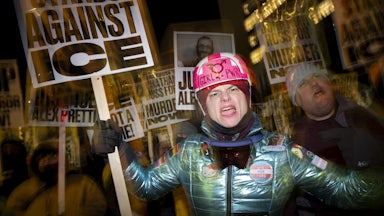
I was at the march downtown the day of the citywide strike. I made my way to the front, taking snaps of signs and getting in a question or two. It was loud and could have been louder but for everyone trying to talk and scream through their scarves. The scale of it became clear only from the skyway above the street. Dozens of us watched, rapt, as the frozen river of people oozed slowly through the streets. It was so cold that trees were in danger of exploding a little further north, but there were 50,000 people there.
It was a powerful message of resilience. But what I’m trying to tell you is that there are no ready-made visuals to represent the larger fight. A cell phone? A spreadsheet? The icon for the Signal app?
Movements have always been built on administration, on paperwork, on the jujitsu of competing legalese. The backbone of the Civil Rights Movement was SNCC, the Student Nonviolent Coordinating Committee. We remember the nonviolent part, but we forget the committee. There were a lot of mimeographs to be made between showdowns. There are always invisible gears in the machinery of justice; I just didn’t expect them to be so secret.
When I was being driven around the Cities in lightly falling, fluffy snow, the whole scene was rendered in real-life grayscale. I had a shameful, selfish thought: This is the opposite of a color lead. My editor sent me all the way out here for this?
I thought of all the useless video I had taken, and then of the terabytes more of data on a thousand other phones. All the interactions that didn’t escalate or even turn out to be ICE action. All those videos are evidence of the terror too—evidence of the wearying watchfulness that an occupation wrests from people. How occupations colonize memory as much as space.
The shots of ICE agents leaving a scene, of storefronts that aren’t blasted through, of apartments whose doors remain whole—all of that is abundant but unaccessible proof of what can be accomplished without leadership, just community and will.
I thought of all the people, recording all these uneventful videos. If the world is just, the videos will be deleted someday, making room for pictures of grandchildren and lakeside sunsets. And the commuters’ memories of this time will only make the images sweeter, because the person taking them will think of the moments just like those that the disappeared—and Renee Nicole Good, and now Alex Pretti—didn’t live to see.