Let us speak plainly about Trump v. Barbara, the Supreme Court’s upcoming case on birthright citizenship. Many of the high court’s cases are about arcane legal doctrines or complex federal statutes. Real-world effects can sometimes be difficult to discern through the time-consuming labyrinth of appellate review. Rarely does the court decide anything that immediately changes everything.
The birthright citizenship case is different. It is both more real and less abstract than any other case on the court’s docket, save perhaps for those involving capital punishment. It is about whether the president of the United States can denaturalize millions of U.S. citizens at a whim, deprive them of the Constitution’s full protections, and then subject them to deportation from the country where they were born—indeed, from the only country they have ever known.
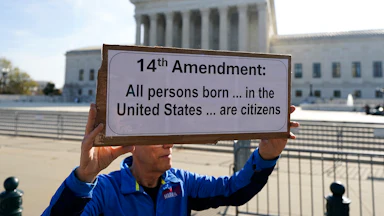
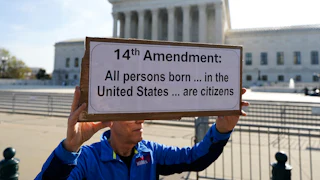
The Constitution says, quite emphatically, no. The Fourteenth Amendment says this in no uncertain terms: “All persons born or naturalized in the United States, and subject to the jurisdiction thereof, are citizens of the United States.” There is no hidden meaning to uncover here. When you are within America’s borders, you are subject to its jurisdiction. You have to pay U.S. taxes. You must abide by U.S. rules and regulations. You can be charged by U.S. officials for committing crimes. You can be sued in U.S. courts under the common law.
Earlier this month, the last wave of briefs were filed in the case ahead of oral arguments on, perhaps appropiately, April 1. Some of them are more notable than others; I’ll get to them later. But perhaps the most powerful one comes from the United States Conference of Catholic Bishops, the organization representing the Catholic hierarchy in the United States.
The USCCB is a frequent flier at the Supreme Court. Like the U.S. Chamber of Commerce and the American Civil Liberties Union, it often submits friend-of-the-court briefs for the justices to consider in major cases. The bishops’ interests are wide-ranging: Recent cases that have drawn the USCCB’s attention are ones involving public religious schools, death-row inmates’ access to clergy, Colorado’s ban on conversion therapy, and, on the immigration front, restrictions on spousal visas.
None of those briefs is as blunt and unsparing as the one submitted in Barbara. While the bishops make some legal arguments, they are ultimately secondary to the moral and spiritual ones contained in the text. “At its core, this case is not solely a question about citizenship status or the Fourteenth Amendment,” they argued. “It is a question of whether the law will affirm or deny the equal worth of those born within our common community—whether the law will protect the human dignity of all God’s children.”
This is not an unexpected argument from the church. Catholic leaders have often expressed support for immigrants, migrants, and asylum-seekers around the world, citing Scripture and Catholic teachings on human dignity and the family. This has brought some friction with the Trump administration. Vice President JD Vance, a Catholic convert, recently invited Pope Leo XIV, the first American pontiff, to the nation’s 250th anniversary celebrations in July. Leo opted to spend it with migrants instead.
Those priorities, both theological and practical, are reflected in the bishops’ brief. “Birthright citizenship accords with the Church’s teachings concerning the State’s obligation to uphold and protect human dignity because it treats birth within a community as a sufficient and objective basis for political belonging,” the conference wrote. “The Church teaches that equal human dignity is inherent in the mere fact of personhood and does not depend on citizenship, immigration status, or parentage.”
This case began with an executive order by President Donald Trump. Last spring, he instructed the executive branch to refuse to consider proof of citizenship materials for children born on U.S. soil after a certain date to parents of temporary visa holders or undocumented immigrants. Lower courts quickly blocked the order from taking effect. Those that have considered its constitutionality have uniformly ruled against it.
A core theme is the harm that the Trump administration will do to untold numbers of children. By its own terms, Trump’s executive order only applies to children born on or after a certain date in 2025. A Supreme Court ruling in Trump’s favor that narrows the citizenship clause would allow him to go much further, of course. But for now, the bishops warn, the priority is on those who would be harmed if the administration prevails.
“Children do nothing wrong by being born in the United States,” they warned. “Yet, this Executive Order renders them stateless. Depriving an innocent child of his citizenship based upon his parents’ immigration status would be an especially outrageous punishment—one that this Court has rejected as punishment even for people who have been proven guilty.”
Children born to undocumented immigrants, the bishops warned, would face an “impossible choice” if the court redefines citizenship: They could either live a diminished life in America, “forever being an underclass citizen, with limited access to the necessities of life, such as healthcare, education, housing, and the right to vote,” or, alternatively, they could be “forced to migrate to a country that they have never known and in which they may not be welcome.”
The Catholic Church’s brief is an important antidote to the Trump administration’s efforts to portray itself as the leader of “Western civilization,” which it often defines in racialized and ahistorical terms. “We are bound to one another by the deepest bonds that nations could share, forged by centuries of shared history, Christian faith, culture, heritage, language, ancestry, and the sacrifices our forefathers made together for the common civilization to which we have fallen heir,” Secretary of State Marco Rubio told a European security conference last month.
Other references are much cruder. Stephen Miller, Trump’s top domestic policy aide and the architect of his mass deportation campaign, has called on the conservative movement to “take all necessary and rational steps to save Western civilization.” Secretary of Defense Pete Hegseth has told supporters that “Western Christianity” is under siege by “dangerous and godless foreign ideologies that sow doubt, confusion and death.”
One cannot blame the Catholic Church, one of the principal forces in shaping Western civilization for the past two thousand years, for taking issue with these usurpations. It echoed the settled interpretation of birthright citizenship that flows from the citizenship clause’s plain text. “This history demonstrates that birthright citizenship is neither an innovation nor an aberration, but a deeply rooted principle of the Western legal tradition—one that the United States consciously embraced and constitutionalized in the wake of grave moral and legal failure,” the bishops explained, referring to slavery and the Dred Scott ruling.
To the extent that there is a legal dispute here, it is a wholly contrived one. Some lawyers and legal scholars have tried to bootstrap a justification for Trump’s executive order, almost exclusively after the fact. Among them are Ilan Wurman, a professor at the University of Minnesota who has made the audacious claim that the phrase “subject to the jurisdiction of the United States” excludes “illegally present aliens” and “temporary sojourners.” The Justice Department’s own brief largely borrows from his writings on the matter.
One problem for Wurman is that the drafters of the Fourteenth Amendment did not include these categories in the clause’s text when Congress and the states ratified it in 1871. There is no direct evidence that they shared Wurman’s convenient assumptions. As the court’s 1898 ruling in United States v. Wong Kim Ark recognized, the citizenship clause only excludes children born to foreign diplomats on U.S. soil, which is an exceedingly rare occurrence, and members of Native American tribes living outside U.S. control, which has since been superseded by the Indian Citizenship Act of 1924.
Not to worry, Wurman wrote in his brief, because the drafters were actually operating based on a long legal tradition that includes the Magna Carta, safe-conduct letters for German merchants in the Holy Roman Empire, various court rulings that predate the citizenship clause’s adoption, and other cherry-picked sources that indicate citizenship is actually based on “allegiance” and a sovereign monarch’s offer of protection. “Protection was essential to jurisdiction, and permission was necessary for protection,” Wurman claimed.
The Reconstruction-era Congress, for its part, did not see itself as a protection racket. Other legal scholars, including some originalists, have noted that none of this has any bearing on the citizenship clause’s meaning. Professors Evan Bernick and Jed Shugerman urged the court not to follow Wurman’s lead, which they said relied on medieval documents “too old for constitutional relevance,” or the Justice Department’s reliance on segregationists to understand the citizenship clause’s meaning. “Rather than look for what the Citizenship Clause meant to white supremacists in the 1880s, the Court should start with the common meaning of the words at ratification,” the two scholars wrote in their own brief.
I have little doubt that the Supreme Court is unafraid of committing constitutional heresies. Few could be greater than United States v. Trump, where they turned the presidency into a turnkey dictatorship without any basis in American law and tradition. Hopefully, the briefs submitted by the bishops, originalist legal scholars, and a small army of other law professors and organizations will save them from moral and human disaster, as well. Any other outcome would be an even greater crime than the case that required the Fourteenth Amendment in the first place. At least Roger Taney didn’t have Dred Scott to learn from.