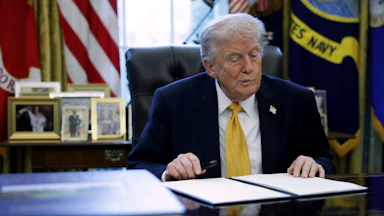
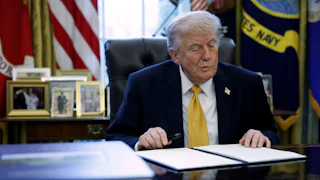
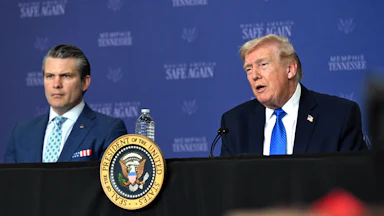
Iran, according to reports, has around 500 power plants. The vast majority run on natural gas, though a fairly impressive number are solar. Only one is nuclear. The country’s largest plant, called Damavand, is gas powered and sits about 30 miles southeast of Tehran. If Donald Trump decides to start bombing civilian power plants, as he threatened to do over the weekend if Iran does not reopen the Strait of Hormuz, it would seem likely that Damavand, which produces an output of around 2,900 megawatts (point of comparison: The largest gas-fired plant in the United States, the West County plant in Florida, has an output capacity of 3,750 MW), would be among the top targets.
Bombing it to the point of taking it offline would be a pretty large undertaking (go check it out on Google Maps—nothing is obscured, hidden, or pixelated). It would leave millions of Iranian people without power. It might also be a war crime.
Wait a minute, a real war crime? Well, as the United States Law of War Manual defines it, probably not. But under the Fourth Geneva Convention and the Law of Armed Conflict therein, probably yes. Article 147 prohibits acts by a military—and the U.S., of course, is a signatory to those conventions, as is Iran—that cause “extensive destruction and appropriation of property, not justified by military necessity and carried out unlawfully and wantonly.”
International law experts debated the question robustly in the earlier stages of Russia’s war on Ukraine, when the Red Army was trying to knock out Ukraine’s electrical grid. So, before we go any further, let’s just stop and dwell on that fact: What Trump wants to do to Iran was most recently done on a large scale by Vladimir Putin. Comforting, eh?
The broad point here is whether military necessity justifies such attacks on civilian targets. Thresholds in international law are higher than in the aforementioned Defense Department Law of War Manual, whose less stringent standard states: “Electric power stations are generally recognized to be of sufficient importance to a State’s capacity to meet its wartime needs of communication, transport, and industry so as usually to qualify as military objectives during armed conflicts.”
I wouldn’t suggest we get too hung up on the matter of whether such bombings constitute a war crime. It’s an interesting question to think about, but it’s murky. What isn’t murky is that it’s a significant escalation. And as we enter this war’s fourth week—and wasn’t it supposed to be winding down by now?—we need to start thinking about the ways in which this could escalate further and why it’s potentially dangerous with an impetuous man-child sitting in the Oval Office and a secretary of “war” who has already shown us that he lusts to inflict violence on noncombatants (the people on those boats in the Caribbean) and to thumb his nose at both international law and our own military’s rules of engagement while doing so.
This is how conflicts become, well, real wars. It always starts small. But history and current reality remind us of two truisms of war. The first is that unpredictable things always happen. I believe that we didn’t intend to bomb that girls’ school. But bomb it we did, and those 150 dead children are not something Iranians will soon forget.
The second is that wars escalate. The United States and Israel started this war. Iran ordered reciprocal strikes on Israel and some Gulf states. The United States and Israel stepped up their attacks. Iran closed the Strait of Hormuz, which led Trump to say what he said over the weekend about bombing civilian power plants. Iran countered that move by announcing that if Trump does that, it will launch strikes on the energy and water systems of Israel and some Gulf states.
What exactly is Iran’s capacity for doing this? We don’t know. But we did learn last week that Iran has missiles that can reach far beyond the previously known range of around 1,200 miles. A tit-for-tat battle of strikes on civilian infrastructure would at the very least rattle the markets and add to the growing economic uncertainty the war is causing.
And remember—Trump has not merely promised some strikes against Iran’s civilian power infrastructure. He said the U.S. would “obliterate” it. Yes, that’s how he always talks, so he probably doesn’t mean it. If he remains true to form, we’ll take out 5 or 10 percent, which will provide enough boom-boom video footage to make them happy at Fox and Newsmax, and he’ll say it was 90 percent destroyed, and the people who want to believe him will believe him.
But this brings us to what’s really dangerous about this situation. It’s the complete unpredictability of Donald Trump. It’s very easy to imagine him growing bored with this war, seeing a few more negative polls, declaring victory, and ending it this week. His friend Mr. Netanyahu will have a few things to say about that, we can be sure, but it does seem like Trump has thrown in the towel on regime change, which he expected to have happened by now.
It’s also easy to imagine him going in completely the opposite direction: Iran does something that surprises and irks him—that emasculates him personally—and he escalates with a ground invasion. Or even a “small” nuclear weapon. It was utterly unthinkable that any other American president in the nuclear age would use a tactical nuclear weapon against a nonnuclear nation. But with Trump? Nothing is impossible.
I’d still bet more on the former than the latter. Trump wants everything to be fast and easy because everything in his life has been fast and easy for him. That’s how life tends to go when you have a father who drops into your struggling casino and buys $3.5 million worth of chips.
What’s terrifying about this situation is that we have to reckon psychically with the fact that the worst-case scenario can never be ruled out. A draft dodger and scam artist who can gloat about the death of a war hero (Robert Mueller took a bullet in the leg in Vietnam) and career public servant before his body is even cold has no moral compass and is capable of anything.
The mullahs are evil tyrants, and that man in Tel Aviv is a thug. But in terms of ability to inflict pain on the world? The scariest one of the bunch is sitting in the Oval Office.