Last month, congressional Republicans introduced legislation to shield Big Oil companies from liability for their role in the climate crisis. This was just the latest in the fossil fuel industry’s efforts to escape accountability for delaying our clean energy transition through decades of climate deception.
Meanwhile, millions of Americans are already experiencing climate-related heat waves, fires, floods, and droughts—disasters that Big Oil companies were predicting decades ago, with internal warnings of “globally catastrophic” climate harms that would threaten “man’s comfort and survival,” create “more storms, more droughts, more deluges,” and cause “death due to thermal extremes.”

In his most recent novel, Vigil, George Saunders grapples with these questions of climate denial and accountability through the story of K.J. Boone, a dying Big Oil executive who is visited in his final hours by Jill, a spirit whose task is to comfort people transitioning to the afterlife.
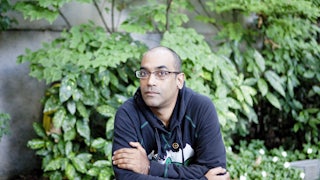
It’s a supernatural premise, but the question at the heart of the novel is a pressing one: How should we balance accountability and mercy, even in cases—like Big Oil’s climate deception—where profound evil has been committed? It’s a markedly different question from those I’ve focused on in my career working to make fossil fuel companies pay for their climate crimes. In my conversation with Saunders, which has been edited for length and clarity, we discussed this tension, as well as the value of empathy in organizing, the role of art in social change, and what comfort looks like on a planet that’s already locked into severe climate catastrophe.
Aaron Regunberg: Vigil takes us inside the head of a climate-denying Big Oil executive at the end of his life. Did you have hopes for what effect the novel might have on readers?
George Saunders: When I started, there was an overlay of, “Well, I’m 67, what’s the most urgent thing happening in the universe? Climate change.” But I realized that while climate change is in this book, it’s not about climate change. The goal, I guess, is really just to wake a reader up a little bit—to make a person more aware of the world around them, to maybe feel a little more fond of the world.
Now that I’m done with it, I can see that it’s an agitating book for a lot of people. Some people really loved it, some hated it. And that’s kind of a first for me. That’s sort of a nice accomplishment, at this late stage—to do something slightly new, even if it’s annoying.
A.R.: There was so much I loved about this book. But I was really upset by the ending.
G.S.: I think a lot of people either thought, “Oh it’s the most beautiful ending” or, “I hate it.” Tell me what got under your skin.
A.R.: We live in a world that has been so corroded by elite impunity. So to watch K.J. Boone, who during his lifetime took no responsibility for Big Oil’s climate denial, finally face the prospect of punishment in the afterlife, only to then see Jill swoop in and save him at the last minute—it’s kind of like my favorite writer looked into my brain and conjured up my literal worst nightmare.
G.S.: But can I say … you’re missing a step. Because yes, in life, he couldn’t make any repentance, and he dies a dick. But then when he’s free of his body, suddenly he sees the horror that he’s done. So given that in the fictional world this transformation happens, now the question is, do you still want to kick that guy? I would argue I don’t want to kick him anymore.
A.R.: I think there still needs to be punishment.
G.S.: In the real world I agree with you—if you could rouse him up and put him on his feet and march him to jail, I’m all for that.
A.R.: Jill has this extreme perspective on moral responsibility, that we are all “inevitable occurrences”—products of our birth and environment—and that therefore to pass judgment on someone for doing anything is absurd. Another character, the Frenchman, asks, “Do you really believe it? That bad and good are the same?” I’ve heard you say that both Jill and the Frenchman’s perspectives are true, despite being at odds.
G.S.: I think that idea of an “inevitable occurrence” is probably demonstrably true by logic, if you look at eternity. But it’s very uncomfortable. And you can’t live like that. I think basically we all live with both those ideas alive in us all the time. So for example, when somebody offends you, part of your mind goes, “Well, that sucks, but you know, given who he is, I get it,” and you move slightly in the direction of mercy. And at the same time, when somebody rears back their fist to hit you, if you can get a quick left hook in, you do that. So I think the book is uncomfortable because it’s kind of making it a binary. And the reason it’s a binary is because … she’s dead.
A.R.: Dying kind of fucks with your head a bit, huh?
G.S.: Yeah, it does. At least the people in these bardo realms, they are in extremity. But for me, Jill’s idea is correct, and the other idea is correct, and we’re always negotiating between the two. Because otherwise, why mercy? Why try to understand somebody? If everybody is infinitely malleable and can completely fix their shit, why don’t they? And therefore you don’t have to be merciful, you just call them on it.
A.R.: You’ve talked about how empathy does not dull our action against bad actors, but in fact can sharpen it. I’m skeptical that this idea applies when it comes to a K.J. Boone–type figure, like the executives at ExxonMobil. Because these companies are not going to be persuaded to do the right thing—they need to be forced.
G.S.: I agree. But I would say you are doing the Jill thing in your climate accountability work, because you’re looking at the problem, you’re looking at the villain, with curiosity, and you’re saying, “That approach doesn’t work, but this one might.”
What I would argue for is “Know thy enemy”—and nothing’s off the table at that point. So it’s not about kid gloves but about informing oneself and not impeding your understanding with some preexisting agenda. For example, if you are an activist and you say, “This Big Oil CEO is Satan embodied, and he’s in the back room eating human flesh,” well, you’ve imagined the enemy incorrectly, and I would imagine then your actions would be inefficient. Whereas if you have a complete understanding of who that person is, with empathy underneath it, you’re going to have a sharper idea of what must be done.
A.R.: I guess my perspective is we already know what must be done. I think most of our problems are not technical in nature, they’re political—we know the solutions, it’s just a question of overcoming the interests opposed to them. From that perspective, there can be utility in caricature—and even, I’d argue, truth to it, because a lot of these guys do, by any reasonable approximation, look a lot like Satan eating human flesh.
G.S.: I defer to you on that because you’re the one who’s active in this. For me, if you took that approach in fiction, I think what would happen is somebody would get about five pages in and go, “Oh, Saunders, he’s pedantically putting his liberal beliefs into the story, I don’t want to read anymore.”
Now, in some of my stories I do take a caricature approach and nail the evil guys. And that’s really satisfying to do. That can be done depending on the point of view you’re telling the story with. If I’m narrating a guy from inside, I can’t exactly say, “I’m Satan incarnate.” Every book has a problem, and this book’s “problem”—its dominant feature—was point of view.
It’s funny, because as we were going back and forth over email I thought, “Oh, you were actually in my book!” There was a scene where somebody came to K.J. Boone’s house who had your deep understanding of the issues and your political viewpoint, and at one point Jill came into his mind and we got the whole story. That was very satisfying because I could say to the reader, “Dear reader, here’s what I think. I’m on your side.” But the bottom dropped out of the book at that point. It felt like an authorial trick. Because it was.
A.R.: You’ve said before that moralizing can make the bottom drop out of literature. But where’s the line? There are works of great literature, like, say, The Grapes of Wrath, that I would describe as moralizing, but they’re still incredible art. I would describe some of your work that way. I can’t help but read “Escape From Spiderhead” as moralizing against our carceral system, or Pastoralia as moralizing against capitalist exploitation. But they’re also perfect works of literature.
G.S.: The best answer to your question would be to read In Dubious Battle, the book Steinbeck wrote before The Grapes of Wrath. That book is full of convenient situations that prove the viewpoint of the writer. It’s so inflamed with Steinbeck’s political views that you don’t buy it. Steinbeck learned from that, and so in The Grapes of Wrath you imbibe the socialism from within because it’s completely sensible in that world he created.
It doesn’t mean that fiction can’t have a moral position and produce feeling, but it has to be done honestly. For me it has a little bit to do with not trying too hard, or not being too sure of what you’re trying to say.
A.R.: So when you were writing Pastoralia, you didn’t have it in your head from the beginning that it was going to be about capitalist exploitation?
G.S.: No, no, it literally was a dream I had that I was back at my old job, with my office mate, and we were in caveman suits. That was it. But that theme is so much a part of who I am. Like, at rest, I’m a socialist—I’ve been deeply wounded by a lot of stuff I’ve seen in my life and if I don’t block that out it just manifests.
A.R.: What should be the role of literature and art in sparking social change?
G.S.: Well, my honest answer—that I don’t always live by—is that I don’t think an artist should think about that intention directly. Let the art do what it wants to do. But a beautiful work of art will sometimes spark change, just because the primary ingredient of a work of art is truth. Like Chekhov said, “If you show a man how he really is, he will change.” Likewise a culture. But the work has to be truthful.
A.R.: Right now across the country there are organizers working to make polluters pay for climate costs; there are lawsuits targeting Big Oil for their deception. My day job is advocating for prosecution of these bad actors. Do you think Vigil has lessons for those of us pursuing climate accountability in the real world?
G.S.: Honestly, I don’t think so. I think you don’t need a lesson from me on that. You know what you’re doing, and it’s righteous, and so I don’t think you need a lesson from me on that. I really don’t.
A.R.: Jill’s role is to comfort people at the end. Thanks to the real-life K.J. Boones, humanity is in a perilous position when it comes to climate—we are closing in on tipping points that already lock us into some truly world-shattering nightmares. I’m curious what you think the role of comfort is in that context?
G.S.: That’s the question of the book. My answer, as a person and a citizen is, “Raise hell, and don’t deny anything.” If the wolf’s outside the door and you go, “Oh, it’s probably a poodle,” that’s not comfort. I think comfort and radical action are the same thing at this point. That’s the only source of comfort there could possibly be, and everything else is just placating.