The Supreme Court’s ruling this week on birthright citizenship in Trump v. Barbara totaled approximately 194 pages. I wrote earlier this week about the various positions that each of the justices took. But it is worth dwelling for an extra moment on the unusual position taken by Justice Brett Kavanaugh in just 10 strange pages.
Unlike the rest of his colleagues, Kavanaugh took the position that Trump’s executive order was constitutionally permissible but statutorily illegal. In other words, the Fourteenth Amendment’s citizenship clause did not block Trump’s effort to curtail birthright citizenship, but an act of Congress that used identical language did.
At a very superficial level, this might sound sensible and moderate by implicitly inviting Congress to address the situation. Kavanaugh certainly positions the opinion—and himself—as such. On closer inspection, it might be the most dangerous and extreme view of U.S. citizenship to be articulated by the justices this week.
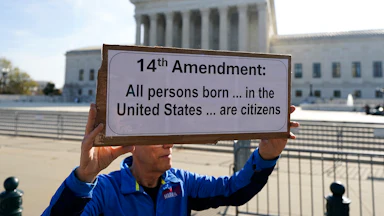
To understand Kavanaugh’s position, a brief sketch of the other justices’ views is necessary. Last January, Trump issued an executive order that instructed federal agencies to not recognize the U.S. citizenship of children whose parents were undocumented immigrants or living in the United States on temporary visas. A group of plaintiffs sued, arguing that this violated the Fourteenth Amendment’s citizenship clause.
That clause reads as follows: “All persons born or naturalized in the United States, and subject to the jurisdiction thereof, are citizens of the United States.” In the 1898 case United States v. Wong Kim Ark, the Supreme Court ruled that the son of two Chinese immigrants in San Francisco had acquired U.S. citizenship at birth solely by virtue of being born on American soil. The “subject to the jurisdiction” exception was narrowed to a handful of situations that rarely apply today.
In Tuesday’s ruling in Barbara, the justices essentially took four separate positions. Five of them took what can be described as the consensus view. Americans had inherited the rule of birthright citizenship from the English common law, Chief Justice John Roberts explained in his majority opinion. Dred Scott v. Sandford’s holding that people of African descent were ineligible for U.S. citizenship was a violation of that rule, and the Fourteenth Amendment’s citizenship clause restored and entrenched the original understanding.
Two of Roberts’s fellow conservatives, Justices Clarence Thomas and Neil Gorsuch, took a different view. Thomas affirmed Wong Kim Ark as correct but argued a person’s domicile status—or, more specifically, that of their parents—also determined whether that person had U.S. citizenship at birth. Since Trump’s executive order was lawful in at least some circumstances, like birth tourism, the two justices rejected the facial challenge to its constitutionality.
At the same time, both justices signaled that even if their domicile-focused view had prevailed, it would not grant total victory to the Trump administration. Thomas and Gorsuch concluded that children of temporary visa holders would not be eligible, and their respective dissents largely focused on that aspect of the order. But both justices wrote that they would not necessarily reach the same conclusion for children of undocumented immigrants, especially if they had lived long-term in the U.S.
The third position was adopted solely by Justice Samuel Alito, who argued that the clause “confers citizenship on only those children who, at birth, owe allegiance solely to this country.” He argued that Wong Kim Ark should be read much more narrowly by the court since, in his view, it showed “little respect for precedent.” Instead, Alito leaned heavily on phrasing in the Civil Rights Act of 1866, which only extended U.S. citizenship to those “not subject to any foreign power,” a narrower phrasing than the clause that was ratified three years later.
Even then, Alito ultimately concluded that Wong Kim Ark was correctly decided. The Chinese Exclusion Acts had made it impossible for Chinese immigrants to be naturalized, so Wong’s parents faced a different threshold under the clause. “By establishing domicile, they had done everything within their power to express their desire and intent to become Americans,” Alito explained.
“Wong Kim Ark is therefore best understood as holding that people who are lawfully present here, establish the United States as their intended permanent home, and do everything within their power to become United States citizens can be seen as no longer subject to any foreign power,” Alito argued.
That brings us, at last, to Kavanaugh. He voted with the majority to strike down the order on different grounds from those of Roberts and the other four justices in the majority. Kavanaugh said that he found the constitutional issue to be “far more complicated” than the statutory one. In particular, he nodded to the “detailed account of history and precedent” laid out by Roberts, as well as the “weighty and thoughtful dissents” by the other three conservatives.
This indulgent phrasing gave the impression of a justice trying to strike a narrower, more moderate position. “The constitutional issue is not straightforward, much as we might want it to be,” he wrote. “That is another reason why, in my respectful view, the court should have decided the case on the narrow and straightforward statutory ground.”
What does that ground look like? Kavanaugh noted that the Nationality Act of 1940 had incorporated the citizenship clause’s exact text into federal immigration law. He concluded that the president’s executive order was illegal as a matter of statutory interpretation. Courts sometimes rely on a principle known as “constitutional avoidance,” where judges avoid answering constitutional questions if they can decide a case on other grounds.
If avoidance was Kavanaugh’s intent, he failed miserably. It is not possible to disentangle the statutory text from the constitutional text this time. The citizenship clause and the Nationality Act both use identical phrasing, including the “subject to the jurisdiction” exception. All sides in this litigation, including the Trump Justice Department, also stipulated to the justices that there is no daylight between the two versions.
To explain why they mean different things, one must explain what they actually mean. Kavanaugh argued that they could be distinguished because Congress passed the Nationality Act roughly 42 years after Wong Kim Ark. He suggested that what Congress had actually done was incorporate Wong Kim Ark’s interpretation of the citizenship clause into federal immigration law, including the four recognized exceptions that flow from “subject to the jurisdiction.”
This meant, in Kavanaugh’s eyes, that Congress could lawfully do what the president could not. “If Congress amends [the Nationality Act] or otherwise enacts a statute creating new exceptions along the lines of the Executive Order for children born to foreign citizens unlawfully or temporarily in the country, such a statute, as I see it, would pass constitutional muster,” he wrote.
This view is substantially more extreme than those of Roberts, Thomas, or Gorsuch. In a footnote, he assured readers that he agreed with Alito’s position that the “result in Wong Kim Ark was correct given the facts and circumstances in that case.” Even so, he claimed that the Wong Kim Ark exceptions were not a “closed set,” and additional ones could be discerned even if undreamt by the Fourteenth Amendment’s drafters.
“Considering the four exceptions as a permanently frozen or closed set as of the Fourteenth Amendment’s ratification in 1868—such that there can be no subsequent exceptions recognized based on new developments after 1868—is inconsistent with the Court’s longstanding approach to constitutional interpretation in a variety of areas,” Kavanaugh claimed.
If this sounds a little un-originalist, that’s because it is. Originalists tend to hold that the Constitution’s meaning is fixed, in contrast to the theories of living constitutionalism that originalism was created to refute. That fixed meaning is typically discerned by the text’s original public meaning when it was ratified or amended. Kavanaugh would take a different approach by adapting the citizenship clause to new situations rather than applying it as written.
To be fair to Kavanaugh, he is hardly the first or only originalist to stray from the faith in this case. Solicitor General D. John Sauer also claimed at oral arguments in Barbara that the president was responding to situations that the clause’s drafters did not anticipate. Roberts gave an originalist quip in response: “It’s a new world. It’s the same Constitution.”
Kavanaugh, perhaps anticipating this critique, argued that all of this is just normal constitutional interpretation. (Which, again, he claimed to not be doing at the outset.) “The Constitution is an enduring document, and its principles were designed to, and do, apply to modern conditions and developments,” he assured readers, before adding that it must be “faithfully applied” to “modern situations that were unknown or unanticipated by the Constitution’s Framers.”
“Therefore,” Kavanaugh concluded, “under basic tenets of constitutional interpretation, other exceptions can be recognized when the new exceptions (i) are based on subsequent developments or circumstances that are new, i.e., largely unknown or unanticipated by the Framers of the Fourteenth Amendment, and (ii) are relevantly similar to the four previously recognized Wong Kim Ark exceptions.”
One could easily apply this reasoning to uphold an assault-weapons ban, for example, by arguing that the Second Amendment’s drafters could not anticipate such an efficient killing machine in the age of muskets and cannons. If past exceptions could be found, so could new ones, as well. It will be interesting to see if Kavanaugh takes this approach next term when the court hears cases on exactly that subject.
All the same, this is not a particularly laudable constitutional interpretation. By striking down Trump’s executive order on the grounds that Congress said otherwise, he essentially transforms the citizenship clause into an Article 1 legislative power. If Congress can grant or deny exemptions to the clause, then it does not really protect a constitutional right or rule of citizenship at all. Then again, most of Kavanaugh’s opinion dwells on judicial interpretation of these exemptions, so maybe it would all be up to the Supreme Court to ultimately decide.
Kavanaugh also fundamentally misunderstood why the citizenship clause exists. Both the Roberts majority and the other three conservative dissenters agree that its purpose was to constitutionalize a rule for American citizenship. They only part ways with one another on the origins, scope, and basis of the rule that the citizenship clause defines.
All three positions also recognized that U.S. citizenship carries special significance. Roberts described it as the “right to have rights.” Thomas and Gorsuch complained that the majority’s sweeping ruling “devalue[s]” American citizenship, while Alito said that citizenship was “precious.” They also seem to implicitly understand that the clause sought to place citizenship itself beyond ordinary political debate by emphasizing the case’s high stakes.
Kavanaugh’s position, by contrast, would greatly diminish the security and integrity of citizenship for everyone. Americans’ rights to participate in their political community would be fungible, partible, and malleable depending on what Congress (and, in all likelihood, the courts) decide. Even Kavanaugh himself may not agree with the logical outcome of his reasoning, since he still presumes that birthright citizenship is the norm, even as he rejects Wong Kim Ark.
I also cannot stress enough again how strange it is, almost to the point of concern, that Kavanaugh thinks that all of this isn’t constitutional interpretation. Indeed, his opinion is at war with itself: In the concluding paragraph, he states outright that Trump’s executive order “does not violate the Fourteenth Amendment” without elaboration, as if he simply started writing the opinion and stumbled upon the conclusion along the way.
It is hard to avoid the impression that Kavanaugh wanted to join Alito’s opinion but could not bring himself to do it because of public perception. In his desire to present himself as a middle-of-the-road guy on this issue, Kavanaugh adopted a nonsensical view of the entire case and fell backward into extreme propositions that go beyond anything laid out by his colleagues. Even Alito, for example, does not propose that Congress can lay out “exceptions” to the citizenship clause.
“Nothing in this opinion is intended to suggest how birthright citizenship should be addressed as a policy matter,” Kavanaugh affirmed in a final footnote. This is likely meant to assure readers that his concurring opinion was the product of carefully considered legal reasoning. In this case, it would be more comforting if the opposite were true.