Newsletter
Power Mad
A weekly review of the rogues and scoundrels of American politics

SCOTUS’s Anti-Constitutional Crusade to Create Second-Class Citizens

The conservative legal movement lost its bid to eradicate birthright citizenship, but its war on the Reconstruction Amendments is going to continue.

A demonstrator outside the U.S. Supreme Court on April 1, in Washington, D.C.
Al Drago/Getty Images
A demonstrator outside the U.S. Supreme Court on April 1, in Washington, D.C.

Another Supreme Court term has come and gone, and civil society is once again licking its wounds. President Donald Trump has obtained new power, the lives of trans people have gotten worse, and the high court is basically winging it when it comes to its ill-fated new “history and tradition” test on guns. At the same time, things could have gone worse—at least for all of you who work at the Federal Reserve.

The biggest bullet dodged was this week’s decision in Trump v. Barbara, in which the court ruled against Trump’s executive order attempting to nullify the birthright citizenship rights explicitly granted by the Constitution. One of the grand plans of this administration has been to ethnically cleanse the United States, and had the court gone along with Trump and his aide-de-camp, Stephen Miller, millions of Americans might now be facing the end of their citizenship—including the U.S. World Cup team’s current leading scorer, Folarin Balogun. Despite this rare victory of reason over right-wing nuttery, I think we should be concerned that the conservative legal movement still has its eye on waging war on the so-called Reconstruction Amendments—especially the one that grants birthright citizenship in the first place: the Fourteenth Amendment.

I raised an alarm last year about the far right’s desire to delete the Fourteenth. The amendment is a substantial target for the MAGA movement because of the unique way it enables and extols the promise of a multiracial democracy, something that Trump and his minions have sworn to destroy. And the way the Supreme Court overrode the disqualification clause, granting Trump the right to run for office again without any concern for the Constitution’s explicit admonitions against insurrectionists holding high office, gave abundant hope to those who’d like to see the Fourteenth Amendment dismantled.

Do the court’s conservatives disdain the Reconstruction Amendments? “They definitely do, to a certain extent,” says TNR’s Matt Ford. “They’ve largely read the Fifteenth Amendment out of the Constitution, in Brnovich and Callais, by making it impossible to properly enforce the Voting Rights Act, and they more or less nullified the disqualification clause in Trump v. Anderson. There are parts they’re fine with, like the equal protection clause in some circumstances, but they’ll never interpret it as broadly as the liberals.”

Ford says that the most charitable read is along the lines of what Justice Clarence Thomas said in his dissent in Trump v. Barbara. “They generally think the Reconstruction Amendments were designed to address the specific circumstances and exigencies of the post–Civil War era,” he says, “and that while they can have plenty of applications beyond that, they aren’t meant to be used to (in their view) fundamentally restructure American society anymore or provide special treatment for anyone.”

Here’s where the biggest conflict lies, as the liberal position is generally that the Reconstruction Amendments were a second founding, not a postbellum clean-up. “In this view,” says Ford, “Congress has broad powers to ensure that there is no American underclass or subaltern population, which Jim Crow nonetheless managed to create for about 90 years.”

Justice Ketanji Brown Jackson got at this in her concurring opinion, in which she took issue with Thomas’s dissent on these lines. Thomas’s “narrow vision of the Fourteenth Amendment bears little relationship to the history of its ratification,” she wrote, adding that his take on the matter “elides the entire point of the Second Founding: The Reconstruction Amendments were an anticaste, antisubordination reset for the Nation, not a mere spot treatment for the dark stain of slavery.”

Thomas didn’t win the argument this week. But the fact that these matters are being argued in the first place is cause for serious alarm, according to former Massachusetts Senate candidate Alex Rikleen. “By even considering the legitimacy of birthright citizenship, the Roberts Court, stacked with jurists ready and willing to make anti-constitutional rulings time and again, has helped transform a fringe white supremacist attack on the 14th Amendment into a question that millions of people now understand as up for debate.”

This is hardly a new or novel fear. The Supreme Court’s ruling in Trump v. Anderson—in which they essentially deleted the disqualification clause from the Constitution—was enabled by the fact that too many were willing to countenance the idea that the plain English language of the Fourteenth Amendment was, in fact, open to interpretation. I am still angry that The New York Times in 2023 referred to the disqualification clause as “an obscure clause of a constitutional amendment enacted after the Civil War,” thus injecting a derogatory bit of editorializing into what purported to be a straight news piece.

In light of the tête-à-tête between Thomas and Jackson, I’m disturbed anew by the way the Times casually denigrated the amendments “enacted after the Civil War,” as if they were some stitched-on appendage and not language that carries the same force and lawfulness as the founding-era amendments. If the paper of record is skeptical that the Reconstruction Amendments are legitimate (and they, like the court’s conservatives, do seem interested in creating a subaltern class beyond the Constitution’s protections, for what it’s worth), this will only further the right-wing project to tear those amendments out of the Constitution and undo the nation’s second founding. So be glad that the worst didn’t happen, but stay on guard—we are not out of danger yet.
America’s 250th Celebration Is Donald Trump’s Lost Cause

Trump’s desperation to leave his mark on the country is consuming our nation’s semiquincentennial.

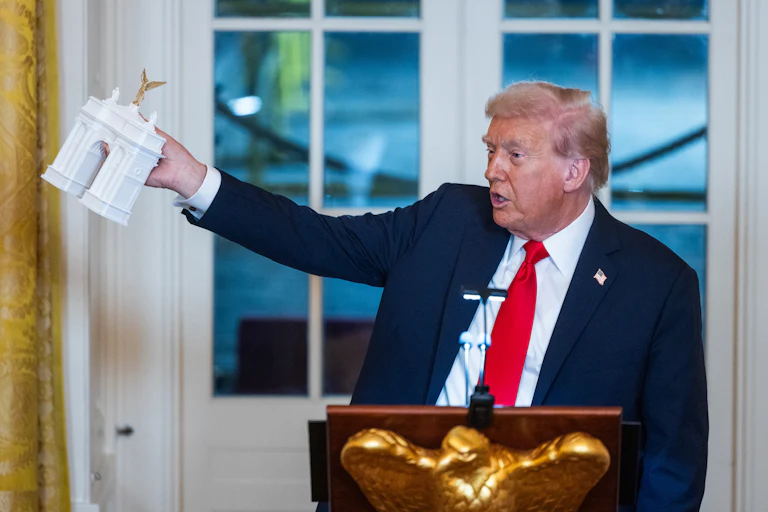
Donald Trump holds a model of the planned Triumph Arch during a dinner in the East Room of the White House.
Jim Lo Scalzo/Getty Images
Donald Trump holds a model of the planned Triumph Arch during a dinner in the East Room of the White House.

We’re closing in on July Fourth and the nation’s 250th birthday, and right on time, the all-knowing digital algorithm deposited a memory from 2015 on my screen: That year, burning the Confederate flag on Independence Day was in vogue, sparked by the mass shooting at the Emanuel African Methodist Episcopal Church in South Carolina. My fondness for desecrating rebel iconography is not restricted to either a national holiday or a national tragedy—we should have fully conquered the Confederacy when we had the chance, instead of allowing them to commemorate their traitorousness. Maybe those nine parishioners would be alive today if we’d done a better job discrediting that toxic ideology.

That’s some food for thought here in 2026, as an ailing, flailing President Donald Trump sets his sight on being the ringmaster of the clown show he has planned for the Fourth. When Trump’s not losing wars or setting the economy on fire, he’s busy turning the nation’s capital into an orgy of self-aggrandizement ahead of next week’s semiquincentennial celebration. At Wednesday’s kick-off event for his “Great American State Fair,” Trump announced that “America is back.” Where had it gone? The president proclaimed that “a short time ago we were a dead country. We were dead. Now we’re the hottest country anywhere in the world. We’re respected by everybody. Nobody’s laughing at us anymore.”

As a thin crowd made for the exits, he also touched on the matter of state that’s consumed most of his time lately: “The Reflecting Pool that you’ve heard so much about, which is so incredible, it’s been gruesomely vandalized by thugs, bad people, but soon will be looking as beautiful as it looked just two weeks ago,” Trump said. “In fact, I looked at it just a little while ago. It looks perfect already, but we’re fixing it.” As it happens, the Reflecting Pool is still green, still peeling, and half-assedly stashed behind some chain-link fence. It may be a federal crime for me to report this, it’s not really clear.

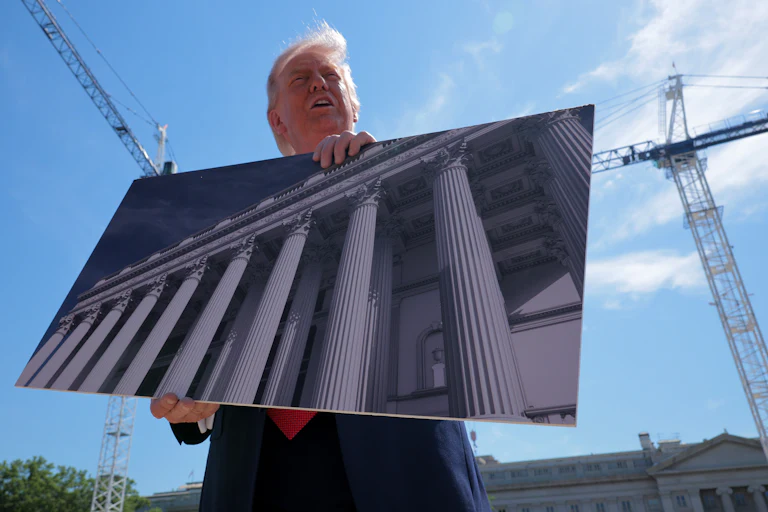
All of this is definitely a product of ego, but it’s also highly reminiscent of Confederate kitsch. Trump’s drive to commemorate himself, which has even run afoul of some of his fellow Republicans, is animated by the same idea as the Lost Cause: to lend legitimacy to a period of betrayal and to ensure this malevolent force lives on. Allowing the Confederacy to commemorate itself was a profound failure on our part, and it seeded the earth for the weakening of our democracy. As Trump plans to sully the District of Columbia’s skyline with his triumphal arch (now with more fist!), I can see history repeating: Trumpism as the new Lost Cause.

I am hardly the first to evoke this comparison. As The Atlantic’s David Graham wrote back in 2020, Trump spent his Independence Day marinating in a variety of Lost Cause grievances: the decision to remove the Confederate iconography from the Mississippi state flag and NASCAR events, the renaming of the Washington Redskins and Cleveland Indians, along with the usual suspects (“the radical left, the Marxists, the anarchists, the agitators, the looters, and people who, in many instances, have absolutely no clue what they are doing”).

As Graham noted at the time, Trump’s Lost Cause fetish was his campaign schtick, the red meat he used to rally his base. In 2020, that playbook failed, in no small part because the Covid-19 pandemic was foremost on the minds of voters. But Trump played the same game in 2024 and won back the White House. And as the Southern Poverty Law Center’s Rivka Maizlish wrote last year, the “unrelenting propaganda of the Lost Cause” returned with a vengeance. The names of Confederacy luminaries stricken from U.S. military bases were restored, there was a renewed push to whitewash the sins of slavery, and the Civil War era’s insurrectionists were conflated with the nations’ Founders. It’s no accident that Trump believes our latter-day insurrectionists should be the ones to get government reparations.

As Maizlish noted, ’twas ever thus:

Lost Cause mythology is central to Trump’s movement. He romanticizes the gender and racial hierarchies of the Old South, valorizes Confederate leaders and symbols, and demonizes those who would remove Confederate memorials as “angry mobs” trying to “wipe out our history.” The Confederate anthem “Dixie” played at Trump’s Madison Square Garden rally on Oct. 27, 2024, an event filled with racist harangues and ridicule.

Trump is now deep into his dotage (and perhaps his inexorable decline). He has no campaigns left to run and no further need to worry about uniting the American people to build some kind of sustainable electoral coalition. These days, the president is motivated entirely by thoughts of his legacy. But the Lost Cause schtick remains the same—only now it’s manifesting itself in his relentless pursuit of various vanity projects and alterations to Washington, D.C.

The possibility that he might not be remembered seems to vex Trump, whose administration moved with the same sort of alacrity to forestall the removal of his name from the Kennedy Center as it did in fighting its inane war with Iran. As Brian Beutler reported in his Off Message newsletter, Trump’s name only came off the building because Ohio Democrat Joyce Beatty, as an ex-officio member of the center’s board, had the standing to sue over the matter and she took the opportunity. Some other Democrats who had standing for the same reason decided to pass, including House Speaker Hakeem Jeffries and outgoing D.C. Mayor Muriel Bowser.

Beutler hails Beatty as a model for other Democrats to follow, given what can happen to a country when a traitor to the Constitution is allowed to remain commemorated. Every lasting monument to Trump is really a monument to accommodating his misrule, celebrating his corruption, and a signal to the public that it’s OK to forget his criminal legacy and accept the Trump era as legitimate. “It will be much easier to arrest the normal process of forgetting,” writes Beutler, “if Democrats embrace the goal of Trump humiliation now. If peeling Trump’s name off the Kennedy Center is just a taste of what’s to come.”

Tearing Trump’s various architectural vanities down isn’t what I’d call a top priority. Like TNR’s editor, Michael Tomasky, I think Democrats need to commit themselves to freeing us from the iron grip of oligarchy and radically reshaping the Supreme Court. Still, as Tomasky wrote earlier this week, we should look to future Democratic presidential candidates to follow in the footsteps of Beatty and commit to a cosmetic de-Trumpification. It would send a strong signal that the party will brook no attempts to commemorate a discredited president—and that it has the stomach for the civic deworming this nation needs to kick off its next century.

This article first appeared in Power Mad, a weekly TNR newsletter authored by deputy editor Jason Linkins. Sign up here.

Trump Is a Hot Mess—and He’s Cooking His Party

Republicans are rotting from the top, following the president down the path of crashing out and complaining instead of governing.

Donald Trump holds artists renderings as he talks to reporters about his proposed White House ballroom.
Chip Somodevilla/Getty Images
Donald Trump holds artists’ renderings as he talks to reporters about his proposed White House ballroom.

Did you land here looking for an account of the Republican Party’s latest angry crashouts and epic meltdowns? Well, you’ve come to the right place. From Truth Social to Capitol Hill, Donald Trump and his merry band of hangers-on are in incredible disarray. Led by a corrupt idiot, they are mired in a dumb war they can’t win, overseeing an economy that’s eating the livelihoods of ordinary Americans, and even facing some internal blowback as Trump’s demands for an increasingly varied array of vanity projects and a slush fund to reward his criminal goons are getting spiked by his GOP allies.

Trump isn’t capable of sorting out any of the nation’s myriad problems—dilemmas mostly spawned by his relentless pressing of the “cause another problem” button. So he’s up late, whining to anyone who will listen that this is all everyone else’s fault. This week, he spent the wee hours angry at the Michael Smerconish podcast for hosting Trump’s former consigliere, Michael Cohen, who claimed he was “coerced into testifying against Trump.” The president made one of his trademark staggered-caps replies: “Michael Cohen has come out and unequivocally stated that the Radical Left Prosecutors, Tish James and Alvin Bragg, pressured and coerced him to testify against your favorite President, ME, when they made him the key player in their Political Witch Hunts.”

Trump has also been monomaniacally preoccupied with the crashing and burning of the concert he’d planned for America’s semiquincentennial, a word that I’m looking forward to forgetting how to spell. Some weeks ago, it was announced that an array of aggressively tertiary-to-pop-culture performers had been lined up to play for the president’s pleasure. That bill has since dwindled to Vanilla Ice, who says that he would be willing to perform for Vladimir Putin and the Iranian mullahs, and Flo Rida, whose absolute commitment to getting that bag—any bag—would have a Saudi royal exclaiming, “Have some shame, habibi!”

We know that this was a humiliating moment for Trump because he once again went on Truth Social to tell everyone about it. “We should have a giant MAKE AMERICA GREAT AGAIN RALLY, for 250, instead of having overpriced singers, who nobody wants to hear, whose music is boring, and yet who do nothing but complain,” he wrote.

That’s all pretty rich coming from someone whose every online utterance is a tantrum laced with either petty complaints or high-test AI slop. Past targets of his ire include “Dumocrats and RINOs” (with Thomas Massie, Thom Tillis, and Bill Cassidy coming in for specific scorn), the Supreme Court (this time spurning Neil Gorsuch and Amy Coney Barrett), critics of his Iran war blundering, the judge who ordered his name be stricken from the Kennedy Center facade, and, of course, the Iranian people, against whom he routinely threatens war crimes. Pope Leo, in particular, seems to be living rent-free in Trump’s head at all times.

The fact that Trump has chosen a midterm election year to become ungovernable is piling increasing pressure on those few Republicans who want to appear to be capable of governing. Senate Majority Leader John Thune, who like Mitch McConnell before him seems to be hyperaware that allowing his GOP colleagues to go as feral as they’d like to would hurt their reelection chances—has reached a “breaking point” with Trump over several matters, including the nomination of Bill Pulte to be the director of national intelligence and the proposed “Anti-Weaponization Fund”—which seems to have been shoved back into some sort of procedural limbo after Democrats successfully raised a hue and cry over it.

Republicans like Thune have a hard row to hoe right now. I’ve spent no small amount of time trying to figure out if there is any problem the GOP can solve in timely enough fashion to save their bacon for the midterms, and the conclusion I keep reaching is that this is simply a physiological impossibility for a party that seems to only have whining and trolling in its locker. This week, we saw some excellent examples of what Republicans are capable of doing: In Tennessee, Governor Bill Lee, in an effort to stick it to the LGBTQ community, declared it “Nuclear Family Month” (with no evident concern for the affordability crisis affecting those families). Meanwhile, in Minnesota, the state Republican Party made news for holding a moment of silence for the corrupt cop who killed George Floyd.

Sorry to throw the thesaurus at this, but this is all stupid, puerile, insipid pissbaby nonsense. But it’s also the ne plus ultra of Republican ideas—right now and for the foreseeable future. Trump may still hold sway over his party, but the main evidence of his influence increasingly just seems like rot. The only real question now, as Trump mashes “send” on another hundred inscrutable Truth Social posts, is how much of that rot creeps into our lives—and how quickly we can evict these crashout kings from power.

This article first appeared in Power Mad, a weekly TNR newsletter authored by deputy editor Jason Linkins. Sign up here.

Trump Is Now a World-Class Kleptocrat

The president’s demand for a slush fund to pay billions of dollars to his cronies places him among the planet’s most infamous political criminals.

Donald Trump talks to reporters about his proposed White House ballroom next to the worksite.
Chip Somodevilla/Getty Images

Donald Trump last year amassed one big beautiful rap sheet of scandal and criminality, with multiple instances of corruption that made Teapot Dome look quaint. But the president’s bogus new “settlement” with his own administration’s IRS, which he had sued in January for $10 billion over the leak of his tax returns in 2020, hits scorching new heights of depravity. The deal’s contours were bad enough when it looked like Trump was simply going to take a small fortune of taxpayer money and line his own pockets. But that was last week: The new plan is for $1.776 billion in taxpayer money to be set aside as a slush fund, which Trump will effectively control, to pay out to January 6 insurrectionists and political cronies that he believes were wronged back when the Department of Justice wasn’t his mobbed-up plaything. Some of the worst people in America are already lining up for payouts.

There are plenty of ways to describe this arrangement. Call it cartoon villainy. Call it criminal. For certain, call this an utterly impeachable offense. Also call this very worrisome: There is a non-zero chance that Trump will simply get away with it, now that corrupt elites dominate American life with absolute impunity. For those with any vested interest in restoring democracy and clearing out the Augean stables of Trumpism, how we respond to this is very important.

The Trump White House is a kleptocratic organ, pure and simple—one that increasingly resembles authoritarian regimes around the world. “This new slush fund is no different than what we see in other kleptocracies,” Casey Michel, frequent TNR contributor and author of the forthcoming book United States of Oligarchy, told me. “It’s a ruling figure creating a new pot of wealth that they can use for whatever they want—in this case, paying off a bunch of insurrectionists who Trump can now transform into his own personal paramilitary, without any oversight or checks whatsoever. It’s something we’ve never seen in U.S. history—but is perfectly familiar to those who study autocracy around the world.”

There is, however, a key distinction between Trump and the scores of foreign kleptocrats that Michel has spent years studying: “The only difference here is that most foreign kleptocrats at least try to hide their tracks—instead of broadcasting them to the world, like we’re seeing with Trump.” While most criminals endeavor to keep the newspapers from finding out about their intention to commit crimes, Trump does it in plain sight—either because he’s incredibly stupid or because the Supreme Court has told him he’s wholly immune from prosecution. (It’s probably both.)

But the newspapers’ early coverage of the so-called Anti-Weaponization Fund is troubling. If sanewashing was last year’s problem in the political press, sinwashing might be the au courant media malady. The initial coverage from The New York Times suggested that the scheme merely “could funnel money to Trump allies,” even though this was its expressed purpose. The news department also couldn’t bring itself to call it a slush fund, instead drafting “critics” to say what is plainly and objectively true (the paper’s editorial board at least named it appropriately). Elsewhere, The Washington Post and The Wall Street Journal found a useful euphemism, referring to the settlement’s arrangement as merely “unusual” instead of nakedly criminal. (TNR’s headline, if you’re keeping score, nailed it: “Trump Just Launched a Taxpayer-Funded $1.8 Billion MAGA Slush Fund.”) 

So I’m concerned that when Democrats return to power, the media will either be an impediment or an enemy to any effort to put things right. But at least that effort is kicking off right away. Representative Jamie Raskin told TNR’s Greg Sargent he is planning to “introduce a bill that would block the fund and other future efforts like it.” He’ll be doing so with the full support of party leadership, who will seek to bring the vote to the House floor over the Republican majority’s objections via a discharge petition. While such a maneuver will require some GOP support, Republicans in the House have in recent weeks broken ranks on the disclosure of the Epstein files—and a few have defected from the party line on funding Trump’s grifty ballroom, as well, likely killing the $1 billion that Republicans had planned to allocate to it in their ICE-funding reconciliation bill. 

Meanwhile, HuffPost’s Jen Bendery reports that Senator Chris Van Hollen will be launching a similar effort in the Senate, amending the reconciliation bill to prevent January 6ers—some of whom assaulted the Capitol Police officers who protect these politicians, Democrats and Republicans alike—from obtaining money through this slush fund. 

Taken as a whole, these efforts tick a lot of boxes for those, like me, who bemoan Democrats’ institutional timidity. If successful, this will force Republicans to take a hard vote and sign their name to this calumny. And regardless of success, it provides fodder for a massive media campaign to wreck the GOP in a midterm election year, creating a savage contrast between the president’s inattention to ordinary Americans’ financial struggles and his desire to enrich criminals with those Americans’ tax dollars.  

As Sargent noted, “Independents famously react badly to corruption.” According to a 2025 battleground survey conducted by End Citizens United, “Democrats’ journey to the majority begins with showing voters the consequences of Republican Corruption” because the topic was extremely animating for both independent voters and turnout voters. “Democrats should focus on telling the story of how honest Americans are losing their shot at the American Dream because of the corruption wealthy insiders have unleashed,” the study affirms, reaching the same conclusion that most of the political media had after the defeat of Hungary’s Viktor Orbán.

What can I say? It turns out that accountability really matters. Trump and his inner circle have been like the raptors testing the bars at Jurassic Park: They’ve found weaknesses in the system, exploited them for criminal ends, and when they skate, they only redouble their efforts to find more flamboyant crimes to commit. That we’re now living with the prospect of a corrupt president cutting checks to his favorite thugs and miscreants is a humbling low for this nation.

Anyone out there treating this as normal or permissible business—or who believes that once this president is ousted from power we should overlook his sins in the name of “looking forward”—is just as guilty as anyone else interconnected with this web of sleaze.

This article first appeared in Power Mad, a weekly TNR newsletter authored by deputy editor Jason Linkins. Sign up here.

The Democrats Just Laid Down Their Arms. Again.

Abigail Spanberger’s response to the court decision that overthrew the will of voters on redistricting is a worrying sign of surrender.

Then–Democratic gubernatorial candidate Abigail Spanberger on September 19, 2025, in Virginia
Chip Somodevilla/Getty Images
Then–Democratic gubernatorial candidate Abigail Spanberger on September 19, 2025, in Virginia

Last week, I wrote about how the far right’s capture of governing institutions like the Supreme Court has put Democrats in the jackpot, forcing them to make some hard choices. Indeed, the decision laid before Democrats is one of the most famous choices ever laid out in the English language: whether ’tis nobler in the mind to suffer the slings and arrows of outrageous fortune, or to take up arms against a sea of troubles—and by opposing, end them. In a troubling sign for Democrats, Virginia Governor Abigail Spanberger has chosen the former.

At issue is the Virginia state Supreme Court’s decision to throw out the amended congressional district maps that voters just approved—in a referendum that cost the Democrats some $70 million, as they painstakingly played by all the rules to get it over the line. In the immediate aftermath of the ruling, Spanberger offered a limp proclamation, saying that she was “disappointed” by it but that her “focus as Governor will be on ensuring that all voters have the information necessary to make their voices heard this November.”

But it turns out that Spanberger was missing some vital information of her own: a lawful solution that could save the day and uphold the will of Virginia voters. As Quinn Yeargain at The Downballot reported, the state constitution includes a provision that allows lawmakers to change the mandatory retirement age of state Supreme Court justices. The idea Yeargain poses would be to lower the official retirement age to 54 by placing a modification in the annual budget bill that’s due by June 30, pass the legislation, and replace the hack justices—all of whom are older than 54—with seven new ones picked by Spanberger.

“Democrats might prefer other solutions,” Yeargain concluded, “but if they want to see the will of the voters respected in time for the November elections, there are virtually no other options—and none with as good a chance of success as this one.”

Spanberger isn’t going for it. In fairness, as Greg Sargent reported this week, Virginia Democrats like Senate Majority Leader Scott Surovell have cited some logistical impediments to the plan, namely a May 12 deadline to finalize the maps in time for early voting.

Yet, wherever the GOP holds the whip hand in the redistricting wars, they are sallying forth without either seeking the assent of voters or showing much concern for procedural deadlines—in some cases, like Louisiana, Republicans are changing the maps right in the middle of ongoing elections. Which makes Surovell’s diffident attitude especially risible: “Wiping out the entire Supreme Court is an incredibly extreme step to take over a decision you don’t like.” This is a hard thing to hear when Republicans are engineering—at warp speed—the wholesale extermination of Black political power in the South.

It’s unsustainable for our democracy to have one party that’s terrified of hypothetical blowback they might receive for violating a norm and one party vandalizing the Constitution with freedom and glee, knowing their political opponents will never force them to incur a similar cost. Democrats spend so much effort on mitigating the hypothetical radical step the right might take in the future that they’re failing to respond to the radical things they’re doing at this moment—to say nothing of the things they’re already speeding to do next. One of those things, by the way, is using the Callais decision to potentially eliminate majority-minority districts in blue states like California—or to potentially create a postelection coup in Congress.

Regardless of whether retiring the current Virginia Supreme Court would result in the electoral maps that voters approved, there are a number of good reasons why state Democrats should do it anyway. Do it because replacing the Supreme Court with one more aligned with Virginia voters will be a gift that keeps on giving. Do it because it will raise the salience of the GOP’s rush to undo civil rights gains. Do it because if the shoe were on the GOP’s foot, they would not hesitate to forcibly retire a Democratic-majority court. Do it because, as Brian Beutler writes, you cannot simply not “respond to an element of a Republican coup d’etat.”

But the biggest reason is that Democrats need to develop an appetite for the kind of hardball politics that the GOP plays. The enormity of the tasks in front of them—reversing a slew of U.S. Supreme Court decisions, rebuilding the federal government, putting Trump and his inner circle in jail—requires leaders who understand the dogmas of the quiet past are inadequate to the stormy present.

For all the grim news about the redistricting wars, the grimmer failures of Trumpism keep the prospects of winning elections in reach. We should remember that the GOP’s race to create new districts is a product of their failures and unpopularity. And who knows? For all their cracking and packing, Republicans may pay a price for making their own red districts more vulnerable should Trump’s daily misdeeds and the worsening economy touch off a wave election. But those voters—who include suburban moms at No Kings rallies calling for Nuremberg 2.0 and neighborhoods full of ordinary people who’ve put their lives on the line protecting each other from Trump’s ICE goons—will expect their elected officials to take up arms (figuratively!) against this sea of troubles the GOP has unleashed, and bring it to a swift end.

This article first appeared in Power Mad, a weekly TNR newsletter authored by deputy editor Jason Linkins. Sign up here.