It’s hard to remember it now, now that Donald Trump’s dominance over a supine and gutless Republican Party has extended for more than a decade and still shows few signs of abating, but when he first entered politics, Trump did encounter some opposition within the GOP. After all, he had 15 opponents for the Republican nomination for president. One of those, then–Texas Governor Rick Perry, gave a tough speech in Washington about a month after Trump descended his escalator that included the following words and phrases: “barking carnival act”; “cancer on conservatism”; “toxic mix of demagoguery, mean-spiritedness, and nonsense”; “the modern-day incarnation of the know-nothing movement.”
John McCain, then in the twilight of his career but still a commanding voice in the party, said that Trump had “fired up the crazies” with the way he spoke about immigrants. This led to Trump’s infamous attack on McCain at an Iowa candidate forum when he said McCain was no hero: “I like people who weren’t captured.”
This comment in turn invited criticism from some who’d been mostly silent to that point, including the current secretary of state (“It’s not just absurd, it’s offensive, it’s ridiculous,” said Marco Rubio). But no one hit Trump harder than McCain’s great pal Lindsey Graham. The South Carolina senator, who died over the weekend at age 71 of “a brief and sudden” illness, went on CBS This Morning on July 21, 2015, and said: “I don’t care if he drops out. Stay in the race, just stop being a jackass.… I’m looking for him to be a responsible member of the 16-person primary and stop saying stuff like this. The world is falling apart. We’re becoming Greece. The Ayatollah’s on the verge of having a nuclear weapon, and you’re slandering anybody and everybody to stay in the news. You know, run for president, but don’t be the world’s biggest jackass.”
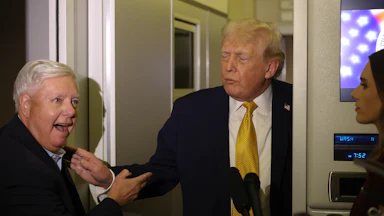
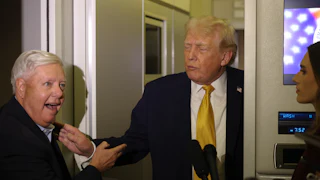
Trump responded—remember this?—by reading out Graham’s private cell phone number during a speech.
Matters escalated. Trump announced his “Muslim ban” that December 7. The very next day on CNN, Graham laid into him:
“Trump’s a race-baiting, xenophobic, religious bigot. He doesn’t represent my party. He doesn’t represent the values that the men and women who wear the uniform are fighting for.… He’s the ISIL man of year, by the way. I just got back from Iraq a week ago this Monday.… Now we have young men and women in harm’s way all over the world, particularly in the Middle East. They were concerned about this rhetoric because the enemy will use it against us. What was a concern last week has to be DEFCON 4 this week. Because what Mr. Trump is doing, and I don’t think he has a clue about anything ... he’s putting our soldiers and diplomats at risk, he’s empowering the enemy; and this ban, if it’s actually enacted, would take people who have been interpreters, who came to our side in Iraq and Afghanistan and who are under siege in their own countries, it basically becomes a death sentence for them.… You know how to make America great again? Tell Donald Trump to go to hell.”
Graham so wanted the world to know that he spoke these words that his office put out a press release drawing attention to them. He never endorsed Trump in 2016, even announcing that he wrote in a third-party candidate when he voted. But the next year, once Trump was president, Graham began to accept a reality quite contrary to the one his remarks to CNN attempted to conjure in December 2015—namely, that Trump not only represented his party but in effect was his party.
The two started talking. Trump took him on golf outings. By October 2017, Graham was insisting that Trump was “growing into the job.” This, by the way, was a couple weeks after Trump expanded the Muslim travel ban that an earlier Graham had so thoroughly excoriated.
If there were any remaining questions about the relationship, Graham settled them in April 2018, when he announced that “the Trump movement is real ... he will be our nominee, I’m confident of that, and I will support him.” Four months later, eulogizing his dear friend McCain on the Senate floor, Graham said: “He taught me that honor and imperfection are always in competition.”
True to his word, Graham backed Trump in 2020. But in the wake of the January 6, 2021 insurrection, he said he was done: “All I can say is count me out. Enough is enough. I’ve tried to be helpful.” Those words had the ring of finality about them, and I recall that some in the media believed him at the time.
And yet, a mere six weeks later, where was Graham? Back down at Mar-a-Lago, golfing and hanging out. The Washington Post reported that Graham had spoken with Trump “nearly daily” since January 6; that he served Trump’s legal team as an “informal adviser” during the second impeachment trial (back in the 1990s, when he was in the House, Graham was one of the lead House managers for the impeachment trial of Bill Clinton); and that, even though Graham had known Joe Biden far longer than he’d known Donald Trump, he hadn’t had one conversation with the new president during his first month in office.
There are moments in the lives of public figures when everything about them is distilled down to a choice they must make, and those moments rightly guide us toward our historical judgments. There is a lot not to like about a blustery racist imperialist conservative like Winston Churchill. But he seized that moment in the spring of 1940 when he first became prime minister, and his vow that “we will never surrender” to fascism commands our respect. He made his choice with moral clarity.
Lindsey Graham’s fateful moment of choosing arrived during that winter of 2021. At that point, he and probably he alone had the moral authority within the Republican Party to try to guide it away from the man who led a coup d’état against the United States government and incited a mob to kill his own vice president. Through this odd Washington alchemy that I’ve always found a bit mysterious, some of McCain’s moral authority transferred over to Graham after McCain passed. So Graham could have made a Churchillian determination that winter: Win or lose, I will make my stand against this. He could have chosen courage. Instead, he chose cowardice—and a few rounds of golf.
Graham served his country in uniform as a judge advocate. I’m sure he was dedicated to his state and its people. He fought for what he believed in, which most of the time happened to be war and more war. But in at least one case, it landed him unambiguously on the right side of history, with his admirable support of Ukraine from the day Vladimir Putin started that war. He had just returned from a trip to Ukraine when he perished.
His career was not without honor. But when his country needed him most, he failed it. In the competition between honor and imperfection that played out within Graham’s soul, it’s pretty clear which side won.