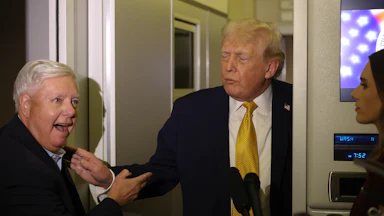
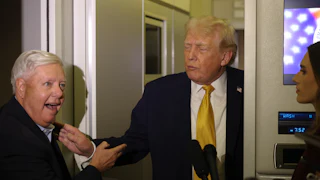
“Donald J. Trump saved the world from real chaos,” Senator Lindsey Graham told Fox Business’s Maria Bartiromo on Sunday. “Thank God Trump did this.”
What did Trump do? Graham and Bartiromo were only taking up half of the screen, so you could see for yourself: smoke rising from a bombed oil refinery and a compound of some sort being targeted—and taken out—by an airstrike. If you were to expand your search slightly outside the confines of Fox News, you would find other images of what Trump is doing. A New York Times forensic analysis found that a U.S. airstrike hit a girls’ school, killing more than 200—many of them children. Tehran, Iran’s capital, has been shrouded in toxic black smoke and rain for over a day, a result of the Israeli attacks on oil refineries. “Something like a black monster has swallowed the sky over Tehran,” a 27-year-old told Time. “It’s as if all the cars and the street pavement have been coated in black paint.” The air, she continued, was “unbreathable.”
Those airstrikes have killed thousands of civilians, but there are no signs that the regime is on the verge of toppling, let alone giving in to Trump’s demand of an “unconditional surrender.” Iran has lashed out against at least a dozen states in the region and has closed the Strait of Hormuz for the first time in history—triggering the largest increase in oil prices ever. If Trump saved the world from real chaos, what do you call this? Fake chaos?
Graham: Donald J. Trump saved the world from real chaos. Thank God Trump did this. pic.twitter.com/8J98hZY6P0
— Acyn (@Acyn) March 8, 2026
Graham, for his part, does seems to be vaguely aware that all of this devastation is ostensibly working toward something. Posting on X on Saturday morning, he shared an Axios report about America’s “dismayed” response to the Israeli strikes on oil refineries that were leading to the toxic rain in Tehran.
The South Carolina senator insists “our goal is to liberate the Iranian people in a fashion that does not cripple their chance to start a new and better life when this regime collapses.” But there’s not much sign that anyone who is actually overseeing this war, either in Israel or the United States, shares this goal. All parties seem to be content with devastation and chaos.
Naturally, Graham is one of the architects of this war. He advised the Israeli government on how best to lobby Trump to try to topple the Iranian regime. He did his own part too, playing a word association game with the president in the weeks leading up to the conflict. “I say Franklin Roosevelt, what do you say?” Graham asked. The correct answer: “You have nothing to fear but fear itself.”
Massive destruction, an entrenched regime, bombs flying across the Middle East, oil prices over $100 a barrel—presumably that is the kind of stuff Trump was fearing. For Graham, it didn’t matter. This was a war of liberation, one that Israel and the United States could bring to an Iranian people who were ready to rise up against their rulers. (They might have overlooked that the Iranian regime massacred thousands of protesters well in advance of Operation Epic Fury.) It has apparently now dawned on Graham—thanks to that toxic cloud hovering over Tehran—that the way the war is being conducted may not actually be conducive to liberation or uprising. The Iranian people may look outside their window at the black toxic goo covering their windows and cars and reasonably conclude that the people responsible for it don’t really care about their well-being.
Nor is it clear that Graham understands that the Israeli and American officials overseeing the war may not hold the Iranian people in particularly high regard. But Graham did his part: He got Trump into a war from which he cannot easily extract himself. And that’s really all that Graham is good for. All this talk about caution is clearly falling on deaf ears. The goal is to tip Iran into chaos—not to liberate it.
But Graham may already be moving on to the next chaotic proposal—and in doing so, he sums up the entire neoconservative approach. He concluded his interview with Bartiromo with a fashion show. He dutifully held up one hat emblazoned with the slogan “Make Iran Great Again”—an absurdity given what Trump is actually doing to the country. Then he held up another that read “Free Cuba.”
Over a week in, one could not reasonably conclude that the United States and Israel are on the verge of accomplishing their goals, vague and shifting as they are. But Graham doesn’t mind—he’s high on his own supply and ready to move to regime change in Cuba. This is U.S. foreign policy now: maximal devastation and chaos, minimal planning and goals, and a dose of haberdashery. We’re just leapfrogging from slogan to slogan, from war to war. Graham will be there, every time, to cheer it on.