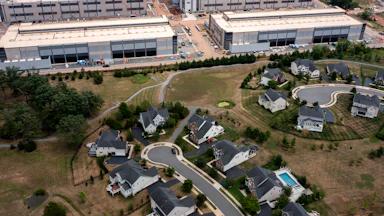
There are few political topics that Governors Kathy Hochul and Greg Abbott would likely agree on. But data centers might be one of them. On August 3, Texas Governor Greg Abbott announced a moratorium on Texas data centers (which had been growing at breakneck pace) until they could be effectively audited by the state’s energy regulators. Just over a fortnight beforehand, New York Governor Kathy Hochul signed a statewide moratorium on new hyperscale data centers, partially to build a framework that ensured new developments did not drive up electricity costs for ratepayers and that benefits could be better negotiated with local communities.
There are some significant contrasts between the two governors’ moves. New York’s moratorium lasts for a full year, whereas Texas’s will only last as long as it takes regulators to “conduct a comprehensive verification and audit of all data centers.” But the wider signal both show is clear: Across party lines, Americans really, really do not like data centers, and leaders—whether at the state, local, or federal level—are rushing to introduce regulation that controls their growth.
The artificial intelligence industry now finds itself in a bind. By continuing to build out data centers, it risks exacerbating a growing populist anger, spurred in no small part by the incredibly tone-deaf nature of the AI industry’s early marketing. This populist anger is now reflected in legislation being introduced, such as a federal data center moratorium bill introduced by Senator Bernie Sanders and Representative Alexandria Ocasio-Cortez, or Senator Josh Hawley co-sponsoring a bill designed to prevent data centers from driving up electricity costs. It’s also reflected in the rhetoric of political candidates such as Michigan Democratic Senate hopeful Abdul El-Sayed, who is both angry and suspicious about the opaque way in which the AI industry has approached the data center buildout.
“There’s been so little transparency on the part of the [Big Tech] corporations themselves,” El-Sayed said in July. “It has raised the hackles of folks who’ve learned not to trust a lot of these bigger corporations when they tell them everything’s going to be OK.”
At the same time, AI already exists and has demonstrated significant capability, whether by solving decades-old math problems or (more worryingly), hacking into an AI model repository of its own accord. If you restrict the data center buildout, you restrict the computing power behind this technology, artificially choking the supply and driving up the price so that the only people who can afford it would be major technology firms and corporations. This, ironically, could lead to the same sort of social stratification that Sanders has repeatedly warned about—a world in which billionaires and tech oligarchs have access to revolutionary technology the rest simply can’t afford.
The AI industry may look at this bind and be tempted to solve it with a tried-and-tested tactic used by previous industries to great success: offshoring.
In order to function effectively, data centers need a few key things from a location: land, access to power, proximity to users, latency, and—ideally—a politically pliant local environment. And there is one region near the U.S. that offers this in abundance.
Latin America draws more than half of its electricity from renewables. Land is cheap and plentiful. The proximity to U.S. borders gives Mexican data centers competitive levels of latency, and for countries further afield, a new series of undersea cables is adding further connectivity. Finally, the region’s political tailwinds increasingly favor right-leaning, deregulation-friendly leaders such as Chile’s José Antonio Kast (inaugurated March 2026) and Colombia’s Abelardo de la Espriella (inaugurated August 2026).
The numbers indicate that U.S. Big Tech companies see the potential here. Brazil’s hyperscale data center market is expected to double to $6.46 billion from 2025 to 2030. In 2024, Google announced a new data center in Uruguay worth approximately $850 million. According to Mexico Business News, installed data center capacity increased 142 percent between 2024 and 2026 (primarily in the central region of Querétaro) with major U.S. hyperscale operators like Microsoft, AWS, and CloudHQ—which announced a new data center campus in the region worth $4.8 billion last September—all investing heavily. It’s unrealistic to expect all of America’s data centers to pack up and move south of the border. But the above examples show that this offshoring clearly represents at least a partial escape from the populist anger that has been brewing in the United States.
For Latin America, this investment is a double-edged sword. Barring a few bespoke, small-scale projects, the region has minimal homegrown frontier AI capability, meaning it needs to attract the investment of U.S. Big Tech companies—primarily via data centers—in order to keep pace with the AI boom. Alternative partners are limited: Doing business with Chinese AI firms is possible in theory, but geopolitically fraught given Washington’s posture toward the region. This leaves U.S. firms as the most viable near-term option. But that lack of alternatives means that countries in the region cannot afford to question the corporate opacity which has, in the U.S., been the focus of so much local ire.
This opacity is already partially on display in Querétaro, Mexico, where residents and local reporting have linked data center growth to increased blackouts and water restrictions. Whether data centers are the sole driver of these maladies or merely exacerbating aging infrastructure remains contested. What is not in dispute is the information gap: While data center operators claim that new technology has significantly reduced water usage, they are not obligated to publish publicly verifiable information about water or electricity use. According to a 2025 report from the International Energy Agency, Mexico currently does not have reporting requirements for data center emissions, electricity consumption, or power usage and water usage effectiveness.
A similar opacity is present in the social sustainability programs launched by some U.S. tech companies. For instance, between 2021 and 2022, Microsoft partnered with the United Nations Human Settlements Programme, or UN-Habitat, to figure out how to improve conditions for rural communities in Querétaro, but further media reporting found those projects were left incomplete with no explanation.
There have also been repeated incidents of data centers being planned and built without the Free, Prior, and Informed Consent, or FPIC, of Indigenous communities whose land is impacted by the development, a right guaranteed under international law. This led to significant backlash in Chile in 2024, where Indigenous leaders likened the construction of a new Google facility to a “saqueo,” a plunder. A similar case is also currently underway in Brazil, where Indigenous leaders from the northwestern state of Ceará say they were not consulted before construction of a data center on their land.
Finally, there is the issue of outsourcing AI infrastructure. Data centers are usually classified as either hyperscalers or co-locators. The former owns both the building and the computing, while the latter leases out just the building. This is an important distinction: While hyperscalers are actively building in Latin America, there are also a host of co-locator companies like Equinix and Digital Realty, who lease the facility, insulating the U.S. tech company from complaints about water, electricity, and land. This mirrors issues we see regularly in our work on global supply chains at the New York University Stern Center for Business and Human Rights: Outsourced projects that do not include concrete human rights safeguards, including guarantees of transparency and effective monitoring structures, can result in both serious harms and the disruption of supply.
This dynamic, in which a U.S. company makes grand promises alongside a level of corporate opaqueness, is not an unfamiliar one in Latin America. From the 1960s and accelerating through to the 1980s, U.S. manufacturers built cheap assembly lines along the border (commonly referred to as “maquiladoras”), where Mexico supplied the raw labor but the profits flowed north. An offshoring of U.S. data centers to Latin America risks repeating a version of this dynamic across the region for the digital age, swapping the extraction of cheap labor for the extraction of land, water, and electricity.
There have been attempts by regional governments to regulate the growth of data centers. Brazil’s REDATA program, for instance, aims to tie tax incentives to clean energy commitments and allocate 10 percent of each center’s processing capacity to the domestic market. But regulation is only half the battle. By its very nature, it is slow—REDATA was introduced last September and is still under debate. The aforementioned technological asymmetry between U.S. tech firms and Latin American countries, coupled with the footloose nature of the industry, means that it would be easy to pit rival countries against each other for data center investment.
The responsibility then falls on U.S. tech firms to look at the backlash they’ve received domestically, take those lessons, and apply them to all their data center infrastructure projects globally, not just the ones that receive the most eyeballs at home. The tools already exist. In January 2026, for instance, Microsoft launched its Community-First AI Infrastructure Plan, promising to pay full power costs—so its data centers wouldn’t raise local electricity bills—and to train local workers. In March, it went further, announcing that it would stop default use of nondisclosure agreements that kept communities in the dark over data center proposals.
These plans are good starts, but if companies like Microsoft truly believe that AI is a tool for all humanity and that the global south should share in the AI dividends, then they need to apply their data center lessons globally and not just locally. If that were the case, AI could be a technology that has a genuinely globally transformative capacity. Otherwise, these companies would simply be repeating the colonialist, extractivist business dynamics of the last century, just with a new digital branding.