Charlie Kirk’s assassination—and the days immediately following it—saw the ultraconservative agitator go from a tertiary character in MAGA’s youth culture war to an avatar for the right’s ultimate vision for America. He became a patron saint for persecuted patriots everywhere, his name invoked as a zealous call to arms before his body was even buried in the ground.
“Let me tell you something I’ve not shared with anybody. The last message that Charlie Kirk gave to me before he joined his creator in heaven … he said that we have to dismantle and take on the radical left organizations in this country that are fomenting violence. That was the last message that he sent me, before that assassin stole him from all of us,” White House adviser Stephen Miller hollered on Fox News two days after Kirk was shot. “I don’t care how.… We are going to do what it takes to dismantle the organizations and the entities that … are trying to inspire terrorism.”
“You want us to live in fear? We will not live in fear. But you will live in exile,” Miller concluded.
This threat became the right’s rhetorical marching order for the next year. What followed was a frantic, McCarthyist campaign that led to hundreds of people getting fired or disciplined for expressing their First Amendment right, a renewed federal attack on the so-called “radical left,” and the whitewashing of Kirk as a normal guy who just wanted to talk tough subjects with everyday Americans with civility and in good faith—all of which looks funny in the light, 365 days later.
In just the two months following Kirk’s death last September, more than 600 people were punished in some way by their employers for their online comments about Kirk. Florida Fish and Wildlife Conservation Commission biologist Brittney Brown was fired after the conservative Libs of TikTok X account sent a mere repost of hers to her boss. It read, “They care exactly as much [about the shooting of Kirk] as charlie kirk cared about children being shot in their classrooms, which is to say, not at all.” Austin Peay State University professor Darren Michael was fired after posting an old article on something Kirk himself said: “Charlie Kirk Says Gun Deaths ‘Unfortunately’ Worth it to Keep 2nd Amendment.” The Washington Post’s Karen Attiah was fired for criticizing gun violence and posting a racist quote of Kirk’s, and retired Tennessee police officer Larry Bushart was actually thrown in jail for reposting a quote from Trump saying America needed to “get over” the 2024 Perry High School mass shooting. “Seems relevant today …” Bushart commented.
Each of these cases failed to hold up to legal scrutiny. Brown was awarded $485,000 in a settlement; Michael got $500,000. A private arbitrator last month ordered the Post to rehire Attiah, who was also awarded back pay dating back to her termination, and Bushart got $835,000. According to Forbes, the victims of this witch hunt have been awarded a total of at least $2 million as of May.
This was perhaps the most vexing outcome of Kirk’s assassination. Lawmakers and pseudo-intellectuals targeted their fellow Americans for expressing their opinions about a man who—at least on paper—championed the First Amendment at any and all cost. And while not everyone who was punished got hundreds of thousands of dollars of vindication (sorry to MSNBC’s Matthew Dowd), the numerous legal rejections of the witch hunt revealed just how toothless the whole thing was to begin with.
Then there was the Miller narrative, the notion that the radical left of America was directly responsible for Kirk’s death and should be hunted down and rooted out of society.
“There is nothing left to talk about with the left. They hate us. They assassinated our nice guy who actually talked to them peacefully debating ideas,” then-Representative Marjorie Taylor Greene posted, five days after Kirk’s assassination. “Then millions on the left celebrated and made clear they want all of us dead. To be honest, I want a peaceful national divorce. Our country is too far gone and too far divided, and it’s no longer safe for any of us. What will come from Charlie Kirk being martyred is already happening.”
This ominous sentiment spurred actual policy proposals to target the left. Representative Nancy Mace urged the Department of Education to “cut off federal funding from any elementary, secondary, and post-secondary educational institution refusing to hold teachers or administrators accountable for celebrating the murder of Charlie Kirk.” Representative Anna Paulina Luna called for the Trump administration to go after longtime boogeyman and liberal donor George Soros because that was “exactly what Charlie Kirk dedicated his life to fighting.”
Democratic Senator Chris Murphy called it then.
“The murder of Charlie Kirk could have united Americans to confront political violence. Instead, Trump and his anti-democratic radicals look to be readying a campaign to destroy dissent.… The right has been looking for a pretext to destroy their opposition for a long time,” he warned, four days after Kirk’s assassination. “That’s why it was so important for Trump sycophants to take over the DoJ and FBI, so that if a pretext arose, Trump could orchestrate a dizzying campaign to shut down political opposition groups and lock up or harass its leaders. This is what could be coming.”
While everything on the Republicans’ wish list didn’t come true, some of it did. Less than three weeks after Kirk’s death, Trump, in Kirk’s name, signed the National Security Presidential Memorandum 7, or NSPM-7, a chilling executive order that directed federal intelligence and law enforcement agencies to go after antifa, defined as anyone with opinions “associated with anti-Americanism, anti-capitalism, and anti-Christianity … and hostility towards those who hold traditional American views on family, religion, and morality.” Even if the plans for such a sweeping order were in place before Kirk’s death, his killing was most certainly used to further justify it.
“Even in the aftermath of the horrifying assassination of Charlie Kirk, some individuals who adhered to the alleged shooter’s ideology embraced and cheered this evil murder while actively encouraging more political violence,” the second sentence of the memorandum reads. “Charlie Kirk’s alleged assassin engraved the bullets used in the murder with so-called ‘anti-fascist’ rhetoric.”
The hunt for leftists quickly became global, with Secretary of State Marco Rubio spearheading an international crackdown on leftist organizations, referring to them as “far-left terrorists” and “enemies of civilization.” The State Department put targets on just about everyone—including the Democratic Socialists of America, Twitch streamer Hasan Piker, Amazon union leader Christian Smalls, and environmental activist Isra Hirsi, the daughter of Representative Ilhan Omar—all of whom are overwhelmingly peaceful.
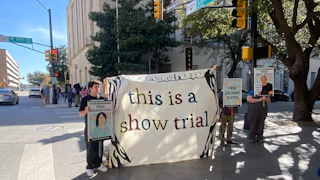
Unlike the social media witch hunt, this fallout from Kirk’s assassination has resulted in lasting, top-down consequences that we are still just beginning to witness. Most pertinent is the case of anti-ICE protesters in Prairieland, Texas, who were given extreme federal sentences that collectively amounted to hundreds of years in prison, including 30 years for someone who simply moved a box of zines. This is the dangerous radical left that the right is fighting in Kirk’s name.
It doesn’t matter that antifa isn’t really a thing, or that most leftist groups lack any kind of real institutional power, especially compared to that of the MAGA movement. In death, Kirk has been most effective as an excuse to reaffirm the Trump administration’s greater aim of casting as wide a net as possible to wipe out any kind of left-leaning opposition, wherever it may be—a far cry from Kirk’s insistence on free speech.
The right’s biggest failure in its response to Kirk’s assassination was its attempt to lionize him, to recast him as a sort of political Johnny Appleseed who traveled the country spreading reasonable conservative ideals to campuses dominated by the left’s all-powerful “cultural Marxism.” That narrative fell apart with each of Kirk’s resurfaced debate clips, along with the pomp and circumstance that accompanied the public grieving of his widowed wife, Erika Kirk.
Instead, Kirk’s death has been memed even more than George Floyd’s (whom he called a “scumbag”). There’s the “We Are Charlie Kirk” AI song that has gone number one on Spotify (not in a good way) and there’s the “kirkification” of various individuals, real or fictional—superimposing Kirk’s face onto Robert Downey Jr.’s Iron Man or the Silver Surfer, among many others. Then there’s the absurd true-crime narrative that has been placed on his death by former friend and collaborator Candace Owens, who has spent the past year pushing conspiracy theories about Kirk’s death—and Erika’s supposed role in it.
Kirk’s killing sorely lacks the gravity or solemnity of other prominent assassinations, instead becoming completely consumed by the dry nihilism of the internet. But the right only has itself to blame. Frenzied purge aside, it’s almost like they didn’t care, either—from FBI Director Kash Patel’s Valhalla comment, to Erika Kirk’s WWE entrance at her husband’s memorial, to Trump brushing off his death to talk about his ballroom.
“All that Charlie ever did was have conversations with people. He didn’t insult anyone. He made arguments. He debated. He wasn’t an extremist in any way,” The Daily Wire’s Matt Walsh wrote, the day of Kirk’s assassination. “Everyone who knew Charlie personally loved him. That’s the kind of guy he was. And they still killed him.”
There will be versions of this quote going around forever. They’ll never be true. Kirk was an extremist. He despised Martin Luther King Jr. and thought being gay was an “error.” He’s quoted saying, “If I see a Black pilot, I’m gonna be like, ‘Boy, I hope he’s qualified.’” He called for a “Nuremberg-style trial for every gender-affirming clinic doctor” and called Islam “the sword the left is using to slit the throat of America.” He was no William F. Buckley, a bona fide intellectual debating the likes of James Baldwin and Gore Vidal. He was one of many right-wing commentators who, for most young Americans, existed entirely on the internet—on Jubilee videos and YouTube shorts debating Zoomers about abortion, gender roles, and affirmative action. He was not “practicing politics in exactly the right way,” as The New York Times’ Ezra Klein claimed. He was a bigot till his last breath, and one year later, his death has only begotten firings, suppression of free speech, countless memes, and even more bigotry.