Life in a Warming World
A weekly reckoning with our heated planet—and the fight to save it

The COP28 Climate Deal Is Lipstick on a Pig

The UN process for averting planetary collapse is broken. Here are some ideas for fixing it.

Activists hold signs reading "End Fossil Fuels."
Giuseppe Cacace/Getty Images
Climate activists during the United Nations climate change conference COP28

Mona Ainu’u is the minister of natural resources for Niue, an island nation of about 1,600 people in the South Pacific. On Monday, she was reportedly in tears as she reacted to the latest draft produced by the U.N. climate conference, which omitted the words “fossil fuel phaseout.” “My 12-year-old, what am I going to say to her when I come back?” Ainu’u asked. Niue is particularly vulnerable to sea-level rise, which could easily jeopardize its fresh water supplies.

That same day, another 12-year-old named Licypriya Kangujam stormed the COP28 stage bearing a sign calling for an end to fossil fuels. “Millions of children like me are losing their lives, losing their parents, and losing their homes due to climate disasters,” shouted Kangujam, who lives with her family in Noida, a city about 12 miles southeast of the Indian capital of New Delhi.

“We’re very proud of the enthusiasm of the young people who have joined us at COP28, and let’s give her another round of applause,” said COP28 director general Majid Al Suwaidi, after Kangujam was hauled out. Then, according to Kangujam’s social media feed, her COP28 badge was revoked and she was kicked out of the conference.

On Wednesday, headlines trumpeted the “historic” and “unprecedented” deal that negotiators at COP28 reached after working throughout the night, finally agreeing on a text that calls for “transitioning away from fossil fuels.” It didn’t say “phaseout,” as many vulnerable nations wanted, nor is the agreement binding, but it was the first time ever that a U.N. climate agreement has explicitly called for a decrease in fossil fuels. As such, it will be perceived in many quarters as a victory. Yet veterans on this topic know that this outcome isn’t enough: “Overall, I think this is a stronger text than the prior versions we have seen,” the U.N. Foundation’s senior adaptation adviser, Cristina Rumbaitis del Rio, told Al Jazeera. “But it falls short in mobilising the financing needed to meet those targets.”

In the past week, a lot of ink has been spilled on how the U.N. climate conferences got this bad and whether there’s any way to make them better. But it’s hard to think of a better encapsulation of what’s wrong with the conferences than this tale of two 12-year-olds against the backdrop of 2,400 COP28 badges awarded to participants from the fossil fuel industry.

The first Conference of the Parties, or COP, held in 1995, involved a few thousand “diplomats and scientists,” The Washington Post reported this week. In recent years, that has ballooned to an 84,000-person traveling circus that business lobbyists now see as a prime networking opportunity. “The negotiations, we’re not really part of that,” Chamber of Commerce senior vice president for policy Marty Durbin told the Post. “But we do have the opportunity to meet with officials and other companies and dig into these critical issues.”

How best to kick these grifters out is the subject of some debate. Ideally, as a starting step, the conference would ban absolutely all representatives of fossil fuel companies. But that’s hard to do when some may be part of official national delegations.

Michael Mann and Susan Joy Hassol, writing in the Los Angeles Times, demand an “overhaul of the COP rules and processes. It’s almost embarrassing to have to explicitly state, for example, that petro-states—those whose economies heavily depend on the extraction and export of oil and gas—should not be allowed to host the meeting. Given the enormous conflict of interest, oil industry executives should not be allowed to heavily influence, much less preside over, the summit.”

That is hard to argue with, although, as TNR’s Kate Aronoff recently argued, the United States should probably be considered a petrostate too: It’s the top producer of oil and gas in the world. And while the U.S. economy may be more diversified than that of some petrostates, the sector still accounts for 8 percent of the nation’s gross domestic product. It’s unlikely that the U.S. is going to throw its weight behind any reform that tells states like itself to sit down and shut up. (If Donald Trump wins reelection, that may be a moot point, as he’ll probably withdraw the country from the conferences entirely.)

There are other, more procedural ideas for how to improve these meetings. Former U.N. Framework Convention on Climate Change executive secretary Christiana Figueres said earlier this year that while “multilateral engagement” was the point of the original COPs, it’s now “distracting governments from doing their homework at home.” Experts surveyed by Grist’s Tik Root suggested smaller “working groups” or “sectoral agreements”—like one regulating methane—in lieu of big conferences on total emissions targets.

Subash Pandey, writing in The Kathmandu Post, suggested taking the entire group of nonstate actors and giving them their own event at a different time and place—still “under the UNFCCC’s purview”—so that the state negotiators can do their work in relative peace. Although this would kick out a lot of NGOs and activists as well, there might be an added benefit. “Smaller COPs,” Pandey wrote, “would make hosting these events more accessible to smaller and less affluent nations. Consider countries like Nepal, which currently may struggle to organize COPs that attract tens of thousands of participants. Small COPs would provide a unique opportunity to host COPs, showcasing the real and immediate impacts of climate change, particularly in regions like the Himalaya.”

None of these reform ideas are perfect. Kicking out all nonstate actors, for example, would leave a lot of state actors with personal or professional ties to industry, while excluding climate justice advocates and others seeking to amplify more vulnerable voices. But a policy that cuts attendance drastically so that less wealthy nations have a chance of hosting would make voices like Ainu’u’s and Kangujam’s harder to ignore.

Who knows whether, reform or no, it’s possible for the assembled states at these meetings to agree on anything substantive and binding, or for the lumbering and unjust political structure of the U.S. to pass a law enacting it. But at a bare minimum, delegates should probably be forced to confront the consequences of their inaction in the airports they fly into, the streets they traverse on the way to the conference center. They should be deliberating surrounded by reminders of fossil fuels’ destruction, rather than monuments to the immense wealth these fuels have created for a select circle. People condemning their more vulnerable brethren, as well as subsequent generations, to danger, hunger, instability, sickness, exile, or death shouldn’t be “comfy” while they’re doing it. And they shouldn’t be able to dismiss the vulnerable with a round of applause and a revoked badge.

Good News/Bad News

The EPA’s “Good Neighbor” rule, which requires industry to reduce nitrogen oxide emissions, was quite effective at reducing smog this past summer. It hasn’t been fully implemented, though, because fossil fuel groups, utilities, and Republican governments in 12 states have chosen to challenge it in court instead. Reducing smog costs too much, they say.

The Arctic is in serious trouble, according to an annual “report card” from the National Oceanic and Atmospheric Administration, which noted the region is warming faster than the global average and recently experienced its warmest summer since 1900.

Stat of the Week
1/4

That’s the proportion of the world’s freshwater fish at risk of extinction due to climate change and other human-caused disruptions, according to a new report.

What I’m Reading

Biden Should Abolish Secretive Corporate Tribunals that Bypass the Law

Investor-state dispute settlements, or ISDS, allow corporations to essentially sue a government for “policies that reduce their profits,” Molly Taft writes. These processes take place in private and then the corporations are compensated with taxpayer money. And if governments, including the U.S., are serious about fighting climate change, Taft argues, these settlements should be scrapped:

Giving powerful corporations the ability to leapfrog international judicial systems and keep major rulings secret in pursuit of profits may be a fair trade-off to the Journal’s editorial page. But activists warn that the potential applications of ISDS are especially dire when it comes to the climate crisis. A 2021 analysis by the International Institute of Sustainable Development of more than 1,200 publicly available ISDS cases dating as far back as the 1970s found that the fossil fuel industry used the ISDS process more than any other industry, bringing around 20 percent of all cases, and that the majority of these cases were decided in favor of investors.

Read the rest of Molly Taft’s piece in The Nation.

This article first appeared in Life in a Warming World, a weekly TNR newsletter authored by deputy editor Heather Souvaine Horn. Sign up here.

A Grumpy Guide to a Sustainable Christmas

Here are the most ridiculous suggestions for celebrating this season without trashing the planet—plus a few ideas that won’t devour your time or money.

Two horses tow a carriage bearing people in top hats and a Christmas tree.
Alex Wong/Getty Images
The White House Christmas tree delivered on a horse-drawn carriage in 2019

You know what I really love reading while plutocrats turn the U.N. climate conference into meaningless blather? The onslaught of seasonal service pieces about how to make my Christmas tree more sustainable. They’re completely unhinged.

Let’s start with the central question driving these stories: Should you buy a real or artificial tree? Most people want a simple answer—and for what it’s worth, most experts say the more sustainable option is a real tree, unless you reuse your artificial one for decades. But it won’t take long perusing the Google hits before you conclude that, whatever you pick, you’ll need a horticultural degree and a lot of time if you want to celebrate Christmas without feeling like a planet-destroying little shit.

CBS ran a piece this year suggesting people buy tree species native to their region—for example, a Douglas fir if you live in the Pacific Northwest—and “look for local nurseries that protect their soils from erosion and minimize harm to surface and groundwater from runoff.” This on its own may be tough, since the nursery industry is now dizzyingly complex and not particularly local.

And once the holiday season is over, you’re supposed to dispose of the tree responsibly so it doesn’t end up in a landfill and produce methane as it decomposes. If your municipality doesn’t offer tree-chipping services, and you don’t have a yard in which to compost your tree, CBS adds that “trees can be used as an erosion barrier for sand or soil or as fish habitat in lakes. They can even be donated whole to zoos, where the trees provide entertainment for animals … or they can be tossed into a bio-burner to provide heating for buildings. Some people even feed trees to goats.”

Now, you might balk at sourcing local goats to eat your Christmas tree. But that’s only because you haven’t read how complicated it is to turn your tree into a fish habitat. Per the story linked above: “As an avid angler, your boat likely has an electronic fishfinder with GPS capabilities. You can use your fishfinder to scan the bottom for the best areas lacking any cover. Take into consideration seasonal fish transitions, relation to deeper water and close proximity to a main river channel.” Once you’ve heaved your tree into the inky depths below, “keep it a secret and mark the location with a GPS waypoint.” That way you can return to slay the little fishies attracted to your tree and eat them for dinner without any fear that other anglers will steal your catch. The spirit of Christmas, folks!

I’m cherry-picking the most ludicrous suggestions here, but only a little. A WBUR item last year urged people to buy an organic tree or keep their artificial tree “well-dusted and vacuumed around regularly so their PVC materials don’t shed heavy metal dust.” This admittedly sounds like a good tip. But having read that their tree is poisoning them, people might be reluctant to follow the next suggestion: “Try to keep your [artificial] tree as long as possible to avoid waste.” Salon says that in order to calculate whether a real tree or artificial one is better, you should factor in the distance you are driving to the Christmas tree farm. Sentient Media, a nonprofit focusing on factory farming, suggests the best option is specifically “an artificial tree purchased second-hand” or “a potted live tree that can be replanted outside after the holidays.”

The Washington Post this year endorsed potted trees as well, disdaining cut conifers because even if your municipality shreds them into mulch, the wood chipper is powered by fossil fuels. The proposed solution is mind-bending:

This year, consider rethinking the Yule tradition by opting for a young potted tree instead.… Many of these Tannenbaums—ranging from tabletop-sized to seven feet tall—can work well in smaller living spaces. And after Santa has visited, they can be planted outside to extend (hopefully) fond memories of the holidays. All it takes is a smidgen of planning, a touch of maintenance, a well-executed exit plan and the right tree.

I see versions of this “plant your Christmas tree” a lot, and find it perennially confusing. Even if you suppose The Washington Post is read solely by homeowners, what percentage of them have the kind of yard that could absorb a Christmas tree being planted outside year after year? Are these people living on multi-acre estates? And if so, why are they also in “smaller living spaces”? If the idea is to dig the tree up again the next year, do people understand how hard that is? Do they have backhoes?

That’s before we get to the “smidgen of planning,” which involves a “two-inch layer of pebbles” to foil bathroom-seeking house cats, pre-digging a hole outside before the ground freezes, moving the tree after Christmas to an unheated garage for a week to “acclimate,” moving the tree—still in its pot—back to the hole in the ground, and then in spring taking it out of the pot and planting it in “dirt and compost,” mulching the top, and watering it.

So basically, in order to have a sustainably decorated living room this holiday season, you need to start your own Christmas tree farm.

What makes this all so maddening is that sustainability around this time of year is a real problem. American households generate an estimated 25 percent more trash between Thanksgiving and New Year’s than they otherwise would, resulting in one million extra tons of junk each week. But here’s the thing: If you celebrate Christmas, all you really need to do to make it more sustainable is buy less stuff.

Do that however you like. Repurpose items you already have—ladders, Christmas cards, books—into gorgeous tree-like installations. Reduce the gift-wrapped goods (and wrap the gifts you do buy with paper from your recycling bin). Whether you’re religious or secular, there are many customs and traditions that don’t require consumerism. Some surely have universal appeal: Bake cinnamon rolls or some other indulgence, spend an evening by candlelight, volunteer at your local food bank, host a soup potluck. For the die-hard “my Christmas must look like a Dickens adaptation!” folks, add a Smoking Bishop or a Yule log.

Some environmental activists would argue that all this “sustainable Christmas” talk is a dangerous distraction anyway, since households—particularly lower-income ones—aren’t the biggest problem when it comes to either emissions or trash; fixating on Christmas sustainability is exactly what fossil fuel executives want and exactly the kind of stuff that makes people think environmentalism is no fun. There’s an element of truth to that.

But a lot of people, me included, want to live their values. For the sake of those people, let’s not make sustainability sound like it takes weeks of research, specialized manual labor, and thousands of dollars. It’s quite easy, more fun, and even a bit radical to spend your holiday on things—and with people—you actually enjoy. But whatever you do, please don’t get yourself arrested dumping a tree in the lake as part of some well-intentioned clandestine op.

Good News/Bad News

The Environmental Protection Agency has proposed stricter limits on lead in drinking water, with utilities required to remove almost all lead water pipes across the country by 2033—10 percent of pipes each year for 10 years. Probably shouldn’t have taken the richest nation on earth this long to decide to stop poisoning children, but there you go.

Limiting global warming to 1.5 degrees Celsius above preindustrial levels probably won’t happen at this point. Limiting it to two degrees will be hard enough. Bill Gates, unhelpfully, has already given up on that too, and thinks as long as we stay below three degrees it won’t be too bad. A lot of research suggests he’s wrong about that. “Every tenth of a degree matters,” a report from the Intergovernmental Panel on Climate Change insisted earlier this year.

Stat of the Week

375 million

That’s the number of electric vehicle batteries the Salton Sea in Southern California could produce, according to recent analysis, if extracting lithium from the “geothermal brine” currently used to power turbines becomes cost effective. Read more at the Nevada Current.

Elsewhere in the Ecosystem

As mentioned last week, Pope Francis has been way more willing than any leader of a rich nation to denounce fossil fuels and capitalism as the cause of climate change. He had to skip attending COP28 in person due to illness, but he sent a speech to be read aloud by Vatican Secretary of State Cardinal Pietro Parolin.

It has now become clear that the climate change presently taking place stems from the overheating of the planet, caused chiefly by the increase of greenhouse gases in the atmosphere due to human activity, which in recent decades has proved unsustainable for the ecosystem.… We find ourselves facing firm and even inflexible positions calculated to protect income and business interests, at times justifying this on the basis of what was done in the past, and periodically shifting the responsibility to others. Yet the task to which we are called today is not about yesterday, but about tomorrow: a tomorrow that, whether we like it or not, will belong to everyone or else to no one.

Particularly striking in this regard are the attempts made to shift the blame onto the poor and high birth rates. These are falsities that must be firmly dispelled. It is not the fault of the poor, since the almost half of our world that is more needy is responsible for scarcely 10% of toxic emissions, while the gap between the opulent few and the masses of the poor has never been so abysmal. The poor are the real victims of what is happening: we need think only of the plight of indigenous peoples, deforestation, the tragedies of hunger, water and food insecurity, and forced migration.

Read the full address on The Vatican’s website.

This article first appeared in Life in a Warming World, a weekly TNR newsletter authored by deputy editor Heather Souvaine Horn. Sign up here.

Taylor Swift Has Nothing on Pope Francis

The pontiff still believes that pulpits can be used to shift political culture. The pop star mostly hasn’t used hers.

Taylor Swift sings into a microphone while gesturing with one arm.
Buda Mendes/TAS23/Getty Images
Taylor Swift performs onstage as part of her "Eras" tour on November 24 in Sao Paulo.

I was disappointed when news broke Tuesday that Pope Francis was canceling his appearance at the U.N. climate conference this week due to illness. First, because I wanted to hear what he might say; the Vatican’s prior climate communications have been pretty spicy, and his insistence Sunday that he would fly to Dubai for the conference—intravenous antibiotics or no—seemed to suggest the pontiff might open up a nice big can of liberation theology on COP28’s fossil fuel shills. And second, because I was really hoping to write a newsletter about the pope showing Taylor Swift how it’s done.

Swift has been criticized both for her relative political timidity and her personal carbon footprint. In 2022, she received the top spot on a list of “Celebs With the Worst Private Jet CO2 Emissions.” Then, on Friday, November 17, 23-year-old Ana Clara Benevides collapsed at a Swift concert in Rio de Janeiro, during a heat wave that shattered all-time records for Brazil and contributed to a brief first-ever rise in average global surface temperatures by more than two degrees Celsius (3.6 degrees Fahrenheit) above preindustrial levels. Benevides died later that day at the hospital.

“What does Taylor Swift owe the planet?” Emily Atkin and Arielle Samuelson asked in the Heated newsletter. The star posted a message to Instagram on Saturday, the day after Benevides’s death, explaining that that evening’s show had been postponed to keep “fans, fellow performers, and crew” safe. It did not mention the broader context of this extreme heat. And as Atkin and Samuelson persuasively argued, it probably should have.

“Extreme heat experts say Taylor Swift’s deadly concert and the Earth’s grim temperature milestone are in fact part of the same narrative,” Atkin and Samuelson wrote. “They each illustrate the consequences of ignoring scientists’ warnings about the deadly risks of climate change.” Not only do pop stars need to start factoring extreme heat into their tour plans ahead of time, but it’s increasingly clear that Swift has tremendous cultural power and ability to shift political opinion. “At some point,” climate writer and Swift fan Jeff Goodell told Atkin and Samuelson, “if she wants to be a force for good in the world, she needs to use her voice at moments like this.”

Of course, there’s a reasonable case to be made that Benevides’s death would have been a tough time for Taylor Swift to talk about climate change: Would it have come across as deflecting from the fact that the fan died at her concert? Would it have come across as hypocritical given her own oversize carbon footprint?

At the same time, Swift is a savvy communicator, and there are ways to navigate these potholes that could make her potential leadership on climate change more compelling, rather than less—especially since this isn’t about her emissions just as a pop star with a private plane but as the head of a massive international business. As a blueprint, imagine something like this:

All of us working within organizations, businesses, and governments need to think about how to adapt our processes to keep people safe in this new normal. So last night I asked the managing staff of the Eras tour to start coming up with a plan to address extreme heat and other weather events at our concerts, in order to keep both fans and staff safe as these once-unthinkable weather events become more common.

I’ve also been thinking about modifications I can make to reduce the emissions contributing to the problem. Going forward, I will be reviewing how both I and the Eras tour conduct business so that we can align our actions and the example we set with our values. I don’t know yet what that will look like. But I know we’re all up against a very scary problem right now, and I want to be part of the solution.

Pope Francis offers an interesting point of contrast here. He too risks losing fans when he gets political. In fact, instead of risking album or concert sales, he risks the unity of the Catholic Church, which is central to his mission and legacy. (Taylor Swift’s legacy as a top-selling pop star, I would argue, is already cemented.) He too travels with an entourage, albeit on a chartered plane rather than a private jet.

Yet Francis clearly thinks it’s worth speaking out about climate change. He seems to believe we’re at a crucial moment where those who have the power to speak publicly have a moral duty to do so.

So anyway, I was putting the finishing touches on this inspiring example when news of his trip cancellation broke. The pope has a very good excuse: He is quite sick, in addition to being nearly 87 years old and missing part of his lung from a teenage illness.

But the trip cancellation further lowers expectations that were already abysmally low for this summit. Joe Biden is missing the gathering for the first time of his presidency; his administration recently held the first of several oil and drilling rights sales that will proceed while COP28 is underway. Internal documents from the United Arab Emirates, reported this week by The New York Times, show that COP28 president (and head of the state-owned oil company) Sultan Al Jaber plans to use the conference to bolster oil and gas deals for the UAE. A different set of documents leaked to The Guardian shows that the meat industry intends to use the summit to promote the idea that meat is good for the environment (it isn’tnot even close).

The pope wasn’t going to single-handedly turn this pablum-and-disinformation factory of a conference into a productive meeting. But a voice like his—the papacy has traditionally been an “establishment” position perceived as speaking from the global north—calling bullshit on rich nations and their corporations would, at the very least, have been a refreshing break with COP tradition. The pope still believes a pulpit can be used to sound the alarm, shift the culture just a fraction of an inch, and make political change more likely. Imagine what it might look like if more global figures with a pulpit—like Taylor Swift—believed similarly.

Good News/Bad News

Programs designed to help coal workers transition to good jobs that are more sustainable are getting a fresh infusion of cash, the Energy Department announced this week.

It’s looking like 2023 may be the first year when average global temperatures rise to 1.5 degrees Celsius above preindustrial temperatures. This was the original limit set in the Paris Agreement, the level of warming countries would strive to keep the world below. A single year beyond 1.5 degrees, a new Vox piece points out, doesn’t mean that limit has been crossed definitively. But it’s a milestone that many will rightly interpret as an urgent call to action.

Stat of the Week

12.9 million barrels

That’s how much crude oil the United States is on track to produce by the end of the year—“more than double what was produced a decade ago,” The Guardian points out—as the country’s representatives head to the U.N. climate conference this week. The U.S. is set to break records for both oil and gas production.

What I’m Reading

The libertarian developer looming over West Maui’s water conflict
Invasive grasses like the ones growing on land belonging to Christian real estate developer Peter Martin may have played a role in Maui’s recent, devastating wildfires. Amazingly, that’s not the most striking detail in this piece, which explores the battle between Martin and Native Hawaiians like Ku’uleialoha Palakiko, as the latter fight to maintain access to water while Martin’s developments drain the land dry. Who knows why people like Martin talk to reporters if they can’t refrain from ridiculous statements like, “I’m not comparing these people to Hitler; I’m just saying.…” But talk he did. And the results are something else.

Martin says he didn’t set out to make Launiupoko a luxury development, but that its value spiked after Maui County imposed rules that limited large-scale residential development on agricultural land. Martin’s development was grandfathered in under those restrictions, and demand for large homes drove up prices in the area. He says criticism of swimming pools and landscaped driveways is rooted in envy.

“People come over and make their land beautiful by using water,” he said.

Martin also maintains that there’s more than enough water for everyone, but that doesn’t seem to be the case. Annual precipitation around Lāhainā declined by about 10 percent between 1990 and 2009, drying out the streams near Launiupoko, and now Martin sometimes can’t provide water to all his customers during dry periods.

Read Anita Hofschneider’s and Jake Bittle’s article at Grist.

This article first appeared in Life in a Warming World, a weekly TNR newsletter authored by deputy editor Heather Souvaine Horn. Sign up here.

Reconsidering the American Fridge

Sure, it’s big enough to fit your Thanksgiving turkey—but that makes it a magnet for food waste too.

Jamie Kelter Davis/The Washington Post/Getty Images

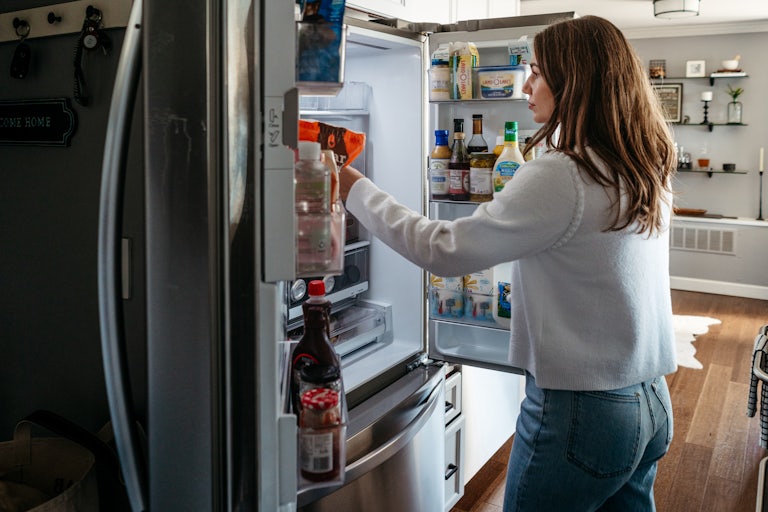
Is there any day of the year that tests the capacities of affluent Americans’ French-door refrigerators as much as Thanksgiving? When else do you need to stuff a giant bird carcass, cranberries, pie crust, a wide array of vegetables, and more into a fridge already containing regular groceries? Then there’s the matter of storing the leftovers.

In the past century, artificial refrigeration has completely transformed the American food system. Home refrigerators allow people to keep perishables for longer, and the artificial “cold chain”—meaning the use of refrigeration for processing, transporting, and holding items in the store prior to sale—has allowed food to be transported farther than ever before. As a result, refrigeration has often been praised—particularly by refrigerator manufacturers—for reducing food waste.

Food waste is a huge problem not just for food security but for climate change. By some estimates, the emissions from food waste—not just the wasted inputs from growing, processing, and transporting, but also the methane as food decomposes in landfills—are triple those from aviation. And almost 15 percent of food-related emissions, according to the U.N. Environment Program, come from transport problems like inefficient refrigeration.

But figuring out whether refrigerators are good or bad for the climate is surprisingly tricky. Aside from the energy the devices require, the hydrofluorocarbons used in refrigerators are far more powerful in the short term than carbon dioxide when it comes to global warming. One 2018 study out of the University of Michigan modeled the effects of establishing a refrigerated supply chain where none currently exists, for example in sub-Saharan Africa, and found that the savings in food waste were overwhelmed by the emissions from the chain itself, resulting in a 10 percent jump in emissions overall. That’s not a reason not to establish that chain, of course—reducing food waste and enhancing food security are objectively worthy goals, and cold chains are also vital for some medications and vaccines—but it complicates the story of refrigerators’ beneficence a bit.

And the picture is particularly complicated when it comes to home refrigerators in affluent societies. Somewhere between 30 and 40 percent of all food in the U.S., which has a relatively robust cold chain, is still wasted, and home waste accounts for nearly 40 percent of that—a problem that’s getting worse, not better. Some research in the United Kingdom has suggested lowering the temperature of home refrigerators from the national average of 45 degrees Fahrenheit to about 39 degrees Fahrenheit, so items don’t spoil as quickly, would save 300,000 tons of CO2 emissions from food waste. But in the U.S., the FDA already recommends keeping the temperature below 40 degrees, so that wouldn’t help much over here.

Meanwhile, other papers have suggested that refrigerators themselves increase food waste among affluent consumers by encouraging them to buy more than they can actually consume in time and leading them to put off using an item until it inevitably spoils.

The Washington Post this week ran an informative piece about how to “feng shui your fridge,” interviewing behavioral scientist Jiaying Zhao for tips to cut down on food waste. Solutions involve putting your fruits and vegetables at the front, rather than hidden in drawers that theoretically keep them fresh but where you can’t see them. “It’s a trade-off,” reporter Nicolás Rivero wrote, “between extending the life of your perishable items or boosting the chances that you’ll remember to eat them.” Or consumers could organize their fridges by “first in, first out” principles, ensuring that the oldest items are in the front.

These are good suggestions, although they also require people to make an extra effort to counteract the behavioral promptings of an industry-designed device—a problem that is common to a lot of advice on sustainable living. Another way to do it would be to design fridges better—or, if not better, smaller. As with another emissions-heavy device Americans love (cars), the size is part of the issue: If it’s possible to lose something in your refrigerator, maybe the device is just too big.

Smaller refrigerators could save people money while simultaneously reducing food waste. It would, of course, be tricky to fit a giant turkey or a Christmas roast into a smaller fridge. But then again, that might have the effect of reducing consumption of another big emissions driver in the American diet: meat.

Good News/Bad News

The European Parliament this week voted for their delegates at next week’s U.N. climate talks to support ending all fossil fuel subsidies at “national, EU and global levels,” in addition to tripling renewable energy and doubling energy efficiency by 2030. The vote on its own doesn’t do much, but it’s noteworthy because sometimes governments focus on that last part—increasing renewables—while shrinking from direct discussion of fossil fuels.

Brazil recorded its hottest-ever temperature on Sunday (two days after a 23-year-old Taylor Swift fan died at a concert in Rio de Janeiro, where the heat index hit nearly 140 degrees).

Stat of the Week

2.9 degrees Celsius

Even if countries completely follow through on their current pledges (a big “if”), the planet would currently be on track to warm by 2.9 degrees Celsius (5.2 degrees Fahrenheit), a new report from the U.N. Environment Program warns. For context, climate experts have previously urged nations to limit warming to 1.5 degrees Celsius. With considerable angst and regret, many have now admitted that hitting that target is unlikely. But limiting warming to two degrees—which would still cause severe and deadly disruptions—is considered an urgent priority.

Elsewhere in the Ecosystem

The EPA considers approving fruit pesticide despite risks to children, records show. Most people know, in theory, that lobbying is a force in government. But it’s a different thing to see the details. Environmental Protection Agency emails acquired by the Center for Biological Diversity show that lobbying and political pressure may have led the agency to go easy on Aldicarb, a pesticide that poses risk to children’s developing brains and has been banned in over 100 other countries. The Guardian reports:

The U.S. Environmental Protection Agency is considering approving a pesticide for use on Florida oranges and grapefruits despite the fact that agency scientists have repeatedly found the chemical does not meet safety standards designed to protect children’s health, internal agency records show.

EPA emails indicate how, for years, agency scientists have wanted to deny new uses of aldicarb, but appear to have not done so because of persistent pressure from chemical industry lobbyists, politicians, and political appointees.

The records indicate how, during the Trump administration, the agency’s Office of Pesticide Programs approved the pesticide, moving from a position favoring public health to one that critics say prioritized the interests of a North Carolina-based company called AgLogic that is seeking to expand sales of the insecticide. The EPA’s approval was later rejected by the state of Florida and a federal appeals court. Aldicarb is still, however, being considered for approval by the Biden-era EPA.

Read Nat Lash’s and Janet Wilson’s report at The Guardian.

This article first appeared in Life in a Warming World, a weekly TNR newsletter authored by deputy editor Heather Souvaine Horn. Sign up here.
Plastics Are Poisoning Both Our Bodies and Our Politics

The petrochemical industry is obstructing a global treaty to reduce plastic pollution.

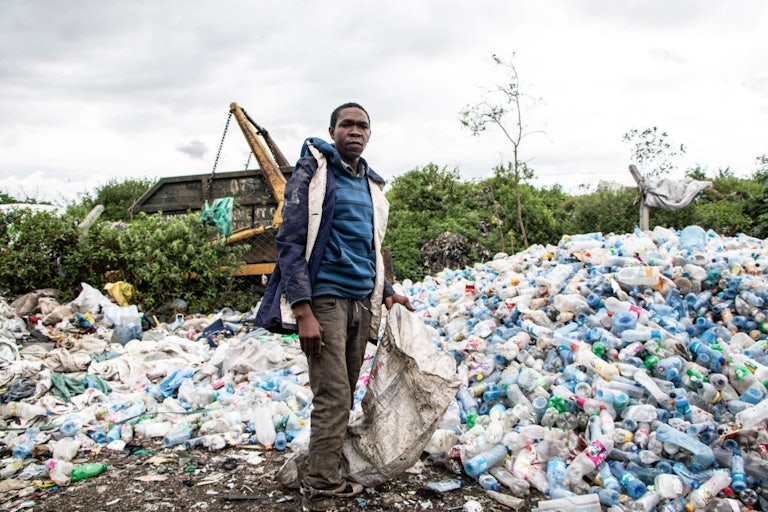
A man holding a bag stands in front of a large mound of plastic trash.
SOPA Images/Getty
Amos Mwangi, Nakuru County Waste Pickers Association secretary, at a dumping site in Kenya

If the definition of insanity is doing the same thing over and over and expecting a different result, the definition of obstruction is knowing exactly how to fix a problem and pursuing everything but the obvious solution. The U.N. Environment Program’s attempts to negotiate a global plastic treaty is suffering from both of these afflictions at once.

Negotiators are gathered in Nairobi this week for the third of five meetings to broker a treaty to reduce plastic pollution. The past two meetings didn’t go great. The first, in Uruguay, ended with parties “split on whether goals and efforts should be global and mandatory, or voluntary and country-led,” according to Al Jazeera. Given that voluntary, country-led goals are completely ineffective at actually curbing plastic pollution, this is a bit like saying the meeting ended with parties split on whether to have a meeting. The second, in Paris, ended with parties agreeing to write a draft treaty. Given that the whole point of these conferences was to draft a treaty, this is a bit like saying the meeting ended with the parties agreeing to have a meeting.

This large-scale bureaucratic performance art would be funny were it not for the deadly seriousness of the crisis. Once upon a time in the 1980s and ’90s, many people thought of plastic pollution mostly as a problem for dolphins and sea turtles, and one that could be solved by snipping the rings on six-packs of soda. Since then, a barrage of studies and reports have made clear that both oceans and land are in fact drowning in plastic trash that, even before it becomes trash, is poisoning us. It poisons the environment as it’s being made, it poisons us as we use it, it poisons the environment after we throw it out, and then it poisons us again when we eat animals and plants from that environment. Microplastics can now be found everywhere from human breast milk to the clouds above Mount Fuji. The plankton that were supposed to break down this stuff are actually pooping out more of it. Plastic production is predicted to triple by 2060, part of a well-documented petrochemical strategy by Big Oil to prop up business as the energy transition robs them of opportunities to profit off knowingly poisoning the world with their other product: fossil fuels.

Sure, plastics have some important uses—which the industry takes every available opportunity to advertise. But take a moment to try to count all the pieces of plastic you touch per day. What proportion of those are artificial heart valves? And what proportion are, by contrast, things that are convenient and cheap—because a vast industrial system has evolved to make them so—but could be replaced just as effectively by a different material, or eliminated entirely with little difference?

This week’s UNEP talks in Nairobi are fracturing along predictable lines. A “High Ambition Coalition” of countries in the global south, EU member states, Canada, and others continues to push for binding restrictions on plastics production. Countries with big petrochemical industries, including Saudi Arabia, Russia, and China, want to focus on plastics recycling. The United States, possessed of both a big petrochemical industry and a political system religiously opposed to binding agreements about anything, favors a compromise of nothing in particular. Per Reuters:

The United States, which initially wanted a treaty comprised of national plans to control plastics, has revised its stance in recent months. It now argues that, while the treaty should still be based on national plans, those plans should reflect globally agreed goals to reduce plastic pollution that are “meaningful and feasible,” a U.S. State Department spokesperson said in a statement to Reuters.

Whatever that means. Meanwhile, the U.N. still hasn’t taken action to exclude industry representatives from these talks, despite an international group of scientists last week condemning this conflict of interest. At least 143 fossil fuel and petrochemical industry lobbyists have registered to attend the latest meeting—more representatives, according to the Center for International Environmental Law, than those of the 70 smallest members combined. Six member states have even included industry representatives in their official delegations.

But let’s return to the obstruction part of the talks: the focus on plastics recycling. First off, of course the petrochemical industry wants to make this a recycling issue, since that means avoiding tackling the actual problem of excessive plastics production. But second, increased plastic recycling comes with its own set of problems. For a study released last month, researchers from Sweden, Germany, and Denmark purchased recycled plastic samples from a variety of regions and found them laced with an array of toxic chemicals, including pesticides and pharmaceuticals. This is not an isolated finding. “A recent analysis from [the International Pollutants Elimination Network],” Joseph Winters wrote for Grist in May, “found a hazardous plastic additive in every recycled plastic children’s toy and hair accessory it examined. Other research suggests that the recycling process itself can generate benzene, a human carcinogen.” And then there’s the research suggesting plastics recycling actually exacerbates microplastic pollution, with recycling facilities releasing a significant portion of the plastic material they’re trying to recycle as microplastics. That’s if it’s even correct to call such things recycling facilities, given that, according to one report, no plastic meets the reusability rate (30 percent) needed to be deemed recyclable.

Obstruction is proposing a solution you know full well doesn’t address the problem. Big oil has been pursuing this for decades, NPR and PBS Frontline reported in 2020 after reviewing internal documents: “The industry sold the public on an idea it knew wouldn’t work—that the majority of plastic could be, and would be, recycled—all while making billions of dollars selling the world new plastic.” 

This is the industry that knew about climate change in the ’70s. The industry that exploited a lethal pandemic—and understandable human fear—to try to force single-use plastic bags back into the very few jurisdictions and stores that were trying to discourage them. The industry that encouraged people to think that if they didn’t take the time to decode teeny tiny numbers on the bottom of pieces of plastic and sort them  into recyclable and nonrecyclable piles bearing little correspondence to actual recyclability, then those dead dolphins and sea turtles would be their fault. 

Why is anyone letting these obstructionists anywhere near the drafting process and expecting a productive result?

Good News, Bad News

About a year after President Jair Bolsonaro’s departure from office and the succession of the more openly environmentalist administration of Luiz Inácio Lula da Silva, deforestation in Brazil of the Amazon rainforest has reached a five-year low.

Ice in Greenland is melting increasingly fast, with troubling implications for sea level rise.

Stat of the Week

Drilling sites in Texas are apparently leaking twice as much methane as similar sites in neighboring New Mexico, which has better regulations. (This is the kind of thing that doesn’t require fancy carbon sequestration solutions. You can just fix it, now.)

Elsewhere in the Ecosystem

The 20 Farming Families Who Use More Water From the Colorado River Than Some Western States

Absolutely do not miss this wild ProPublica and Desert Sun collaboration on the worsening Western water crisis. When these reporters requested records from California’s Imperial Irrigation District to figure out where the water allocated to the area was going, the request was denied. So they used satellite data and ownership records to figure out that most of the district’s water use came down to 20 families.

Farmers in one family, the Abattis, used an estimated 260,000 acre-feet, more water than the entire Las Vegas metropolitan area uses.… The district and its farmers emphasize that they keep a steady stream of broccoli, lettuce, onions and other produce on American dinner tables, including in the dead of winter. But only a few families used a majority of the water they got to grow food that people eat. Instead, we found that most use the bulk of their water growing hay to feed livestock.

Read Nat Lash’s and Janet Wilson’s report from ProPublica and The Desert Sun.

This article first appeared in Life in a Warming World, a weekly TNR newsletter authored by deputy editor Heather Souvaine Horn. Sign up here