Newsletter
Fighting Words
What got me steamed up this week

We Have to Beat Donald Trump. Clearly, the Broken Legal System Won’t.

How the law warps and harms our democracy

Shannon Stapleton/Pool/Getty Images

Judge Scott McAfee has ruled that Fulton County District Attorney Fani Willis can stay on the case against Donald Trump in that jurisdiction, provided that Nathan Wade, the prosecutor on the case with whom she had a relationship, withdraws. I guess we count that a win, although to be honest, Willis has so damaged herself by her colossally terrible judgment that it probably would have been better if she were out of the picture.

The other problem with Willis’s scandal is how it slowed the case down, giving Trump’s lawyers a chance to make this not about the defendant but about her—and another chance to delay, delay, delay.

Meanwhile, Thursday, down in Florida, we saw Trumpy Judge Aileen Cannon issue yet another ruling in the classified documents case that helps Trump. She didn’t support Trump’s lawyers’ motion to dismiss the case, but she kicked the can down the road in a way that’s very helpful to Trump. MSNBC analyst Andrew Weissmann even called it the “worst possible outcome” for the government. “If the judge had simply said, ‘I agree with Donald Trump, and I find that this is vague, and I’m dismissing it,’ the government could have appealed it to the Court of Appeals for the Eleventh Circuit, as they have done twice before and won twice before,” Weissmann said. “But she also did not want to rule in favor of the government. So what she did is said, ‘Why don’t you bring this up later? I think there’s some real issues here.’”

Also this week, in the Stormy Daniels hush-money case against Trump, Manhattan District Attorney Alvin Bragg shocked us all by asking for a 30-day delay in the trial, which was scheduled to start March 25. Trump’s lawyers had requested a 90-day delay. Bragg conceded that some delay was appropriate.

Why? It looks like it’s the fault of federal prosecutors. Bragg’s office requested certain documents a while ago from the Southern District of New York, and it shared them with Trump’s lawyers during the discovery process. Trump’s lawyers suspected there was more, especially relating to Trump’s former lawyer Michael Cohen, so they subpoenaed the SDNY. That happened in January. It was only earlier this month that the Southern District turned over all the documents.

Bragg’s filing to the court on Thursday included this fascinating sentence, a clear swipe at the SDNY (in this sentence, “the People” equals Bragg’s office): “Based on our initial review of yesterday’s production, those records appear to contain materials related to the subject matter of this case, including materials that the People requested from the USAO more than a year ago and that the USAO previously declined to provide.”

Wait. What?

It’s more than fair to ask: Why did the Southern District take so long to produce these documents? And we must also ask this: Did Merrick Garland know his prosecutors were taking so long to hand over documents, and thus playing into Trump’s hands? And if he knew, did he do anything about it?

Finally, let’s recall the status of the fourth criminal case against Trump, the biggest one, at least to my mind—the January 6 insurrection case. On that one, we’re basically waiting on the Supreme Court, which announced on February 28 that it would hear arguments in Trump’s claim of complete immunity but set the argument date for April 25. The high court could easily take another month—or even two—to hand down its decision after that, meaning that this crucial trial, about whether a sitting president initiated an insurrection against the government of the United States, may not happen before Election Day.

How in the world did all this happen? A few weeks ago, it looked like the wheels of justice were finally turning, catching up on a man who has flouted and broken laws not only during his presidency but for his entire adult life, going back to when he and his father wouldn’t rent apartments to Black people in Queens. There was the judgment in the E. Jean Carroll case. And then the whopping penalty in the New York attorney general’s case against the Trump Organization.

But this week, it looks like everything is falling apart.

When we talk about what’s wrong with our democracy, we talk about our political structures and processes. We talk about the Senate. We talk about the Electoral College. We talk about gerrymandering. And of course all these problems are real.

We don’t talk about our legal system. We should. The American legal system doesn’t uphold the values of democratic rule like equality. It far more often corrupts and perverts them. Rich people like Trump twist the system into a pretzel and win delay after delay after delay. Corporations pay fines, usually not that large when considered against their bottom line, and they admit no wrongdoing, even after their practices have killed people. Poor people, meanwhile, get pushed around by the system constantly.

There is no such thing in this country as equality before the law, and everyone knows it. And I would argue that this legal inequality does more damage to democracy than all the political inequities for the simple reason that they’re more visible. And they’ve never been more visible than they are now with Trump. If he is able to push all these cases back past November, or at least three of them (the Bragg case should proceed this summer), and then especially if he wins the White House and pardons himself, that will constitute the biggest failure of the rule of law in the history of the country.

The lesson? We can’t count on the legal system to stop Trump. We have to stop him ourselves. One conviction would be nice; two would probably be quite helpful. But we can’t count on the broken legal system to do a job that we ourselves have to do at the polls.
This article first appeared in Fighting Words, a weekly TNR newsletter authored by editor Michael Tomasky. Sign up here.

Forget Biden’s SOTU Performance, and Focus on Tiny, Weak Mike Johnson

The House speaker lived down to the moment at the State of the Union on Thursday night.

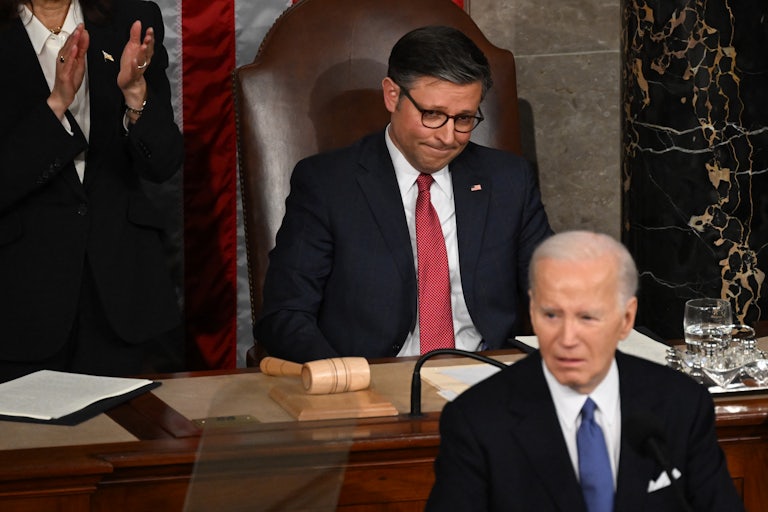
House Speaker Mike Johnson at the State of the Union
SAUL LOEB/AFP/Getty Images
House Speaker Mike Johnson at the State of the Union on Thursday night

Joe Biden more than made it through Thursday night’s State of the Union address. That moment that his supporters always fear—the major brain fart, the confusing of Nikki Haley with Nancy Pelosi (oh wait, that was someone else)—never came. Not only did it not come, but most of the energy was dramatically positive. As is the morning-after conventional wisdom. Politico’s Playbook called it the “turn-the-tables SOTU,” reporting that the Biden campaign’s best two hours of fundraising in this cycle were from 9 to 11 p.m. last night. A CNN flash poll found that 62 percent thought the policies Biden laid out would move the country in the right direction.

He had his stumbles, and that Laken Riley moment was pretty cringey. But mostly he threw punches—and he landed almost all of them. As TNR’s Osita Nwanevu wrote: “That overall impression—of a vigorous president, strong enough to take the fight to his detractors⁠—will linger more deeply in the minds of most who watched than the substance of anything he said.”

But let’s not talk about Biden. Let’s talk instead about that little guy in the chair over the president’s left shoulder. House Speaker Mike Johnson showed, in his histrionic facial expressions, everything that’s wrong and idiotic and dangerous and even treasonous about the Republican Party.

Johnson was ridiculous. He was small. Granted it’s not always easy for an opposition party leader to figure out how to comport him or herself during a State of the Union. The camera is on you for an hour or more, yet you can’t speak. You’re not going to join in on the frequent applauses, except rarely. Johnson did applaud Biden’s call for aid to Ukraine early in the speech, which he does seem to support personally, even though he’s too afraid of his wingnut caucus to allow a straight-up vote and thus may go down in history as the one person more than any other who handed Vladimir Putin the keys to Kyiv. So you sit there awkwardly.

Johnson decided that the State of the Union was the right time to mug for the camera. And he laid it on like a silent-movie actor, so thick that you could practically see the girl tied on the railroad tracks and hear the piano music. He nodded and nodded—you know, that solemn, “more in anger than in sorrow” nod. And those eye rolls! He rolled his eyes more than a teenage girl listening to her father’s jokes (that’s an eye roll I know rather well).

And the things he rolled his eyes at! Most conspicuously, January 6. Here’s what Biden said: “We must be honest. The threat to democracy must be defended. My predecessor and some of you here seek to bury the truth about Jan. 6. I will not do that.” That drew a sustained eye roll. So did a mention of abortion rights and freedom. So did the border bill, which Johnson helped kill because Donald Trump would rather have border chaos.

Actually that one was more of a head shake, which went on a few seconds longer than it had any justification to. Mind you, he did that even as GOP Senator James Lankford, the chief negotiator on the border bill, listened to Biden lay out its provisions and nodded, clearly saying, “That’s true.” They’ll be coming for him today, the sellout. Johnson also shook his head at “buy American.” Seriously?!

And even this relatively nonpartisan sentiment drew an eye roll: “The very idea of America is that we are all created equal, deserve to be treated equally throughout our lives. We’ve never fully lived up to that idea, but we’ve never walked away from it either.”

Once upon a time, those sentences would have elicited more than a smattering of bipartisan applause. There were plenty of Republicans who understood the nation as aspiring to its stated ideals. Even Ronald Reagan renewed the Voting Rights Act back in 1982, saying at the signing ceremony: “As I’ve said before, the right to vote is the crown jewel of American liberties, and we will not see its luster diminished.”

But today? This Republican Party doesn’t believe we’re all equal. This Republican Party, and specifically this speaker, thinks that if you’re not a right-wing Christian, you are not on some level a good American. Exaggeration? Johnson is tight with something called the National Association of Christian Lawmakers. Go inform yourself about some of what they’re up to.

It wasn’t just Johnson. It was Marjorie Taylor Greene in that ridiculous getup and MAGA hat, which was in apparent violation of House rules. It was Lindsey Graham sitting there with that embarrassed smile pasted on his face. It was the MAGA screamer in the gallery. It was Alabama Senator Katie Britt’s lame and all-over-the-place response—the only person who was popping champagne over that speech was Bobby Jindal, because it arguably moved him from worst State of the Union response of all time to second worst. It was the Republicans en masse sitting there dumbstruck time after time after time as this man who, according to the news channel they watch, can’t string two sentences together or remember his own middle name delivered zinger after zinger that laid bare to Americans the Republican Party’s extremism.

And that, in the end, is what was deft and unexpected about this speech. Biden drew contrasts on substance that showed how radical the Trump GOP has become on virtually every issue. November 5 is a long way away, and there will be bad days. But this night showed us something we haven’t seen hard evidence of in a while: how Joe Biden can win this election, and how the party and the speaker on the wrong side of history can lose it.

This article first appeared in Fighting Words, a weekly TNR newsletter authored by editor Michael Tomasky. Sign up here.

A Post–Labor Day Trump Insurrection Trial? Great, Bring It On.

Why it’s good if Trump is on trial come Election Day

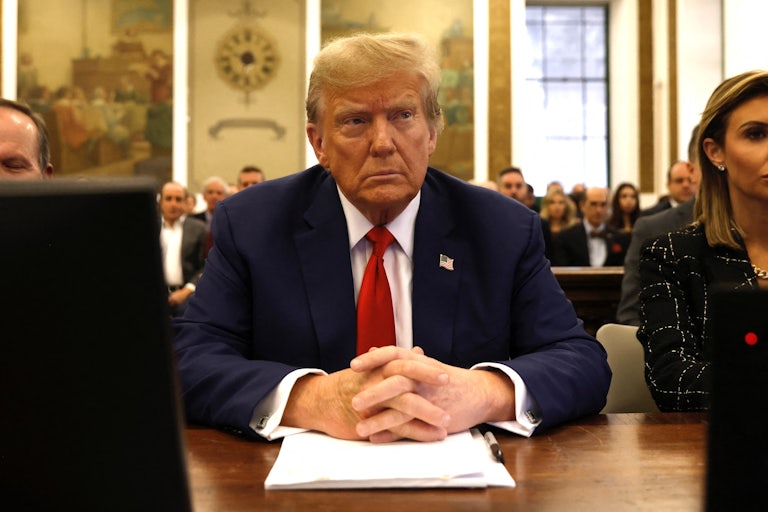
Trump at the New York state Supreme Court
PETER FOLEY/POOL/AFP/Getty Images
Trump at the New York state Supreme Court on January 11

I’ve had a few conversations with fellow liberals over the last two days that went something like this: I can’t believe the Supreme Court did that. Although I guess, you know, of course they did. But I still can’t quite believe it. I just didn’t think they’d be quite this corrupt about Donald Trump returning to the White House.

If nothing else, the court’s announcement Wednesday that it will hear the Trump immunity case seven weeks from now should tell us once and for all—yep, don’t put anything past these people. Anything. They are as capital-P Political and Partisan as we suspect at our most cynical. More so.

Now, the quickly formed conventional wisdom after the announcement is that while the court’s six conservatives are obviously trying to help Donald Trump by slow-walking the process here, surely they won’t all accept the facially absurd and unconstitutional arguments of Trump’s attorneys. I tend to go along with this. It’s hard to imagine judges of any sort ruling that our laws don’t apply to an ex-president.

And yet … I opened this piece saying that they keep surprising us. They keep Lucying the ideological football on us, and we keep falling for it. So what if—nah, it can’t be. No way five justices could really grant Trump immunity. Right?

Well, two probably will, and we know which two. Clarence Thomas and Samuel Alito are totally ready for authoritarian America. And from there, who knows? I mean, I’d like to have a dollar for every time I’ve heard someone say, Ah, they’d never stop a state recount. Oh, come on, are you kidding? They’ll never completely overturn Roe.

So count me unconvinced. I guess with a gun to my head I’d say it’s 60–40 they’ll reject Trump’s claims. But 40 is damn high.

Now. A late-June decision by the court against Trump would mean a late-September trial date in Judge Tanya Chutkan’s courtroom. She gave Trump’s lawyers 88 days to prepare for trial, and that clock starts ticking when the Supreme Court rules, so a June 30 decision, say, would mean (I think) a September 26 trial date. Here, the liberal impulse will be the fretful one: Oh no! That’s too close to the election! We can’t do that! It wouldn’t be fair!

Pardon me, but: bullshit.

First of all: If you’re thinking—worrying—that this is in Merrick Garland’s hands, exhale. It apparently is not. Yes, the Justice Department has a rule about not interfering in the political process in the fall of an election year. But that has only to do with charging people with crimes. It stems from Reagan-era Iran-Contra special prosecutor Lawrence Walsh’s decision to charge former Reagan official Caspar Weinberger four days before the 1992 election. It was after that that the department agreed upon an unwritten rule about not bringing those kinds of charges within roughly 60 days of a general election.

So that rule is only about charging. It’s not about when trials should be held. Here’s a good primer on the whole matter, debunking a recent Trump lie about it.

Also, Garland was asked this very question in January by CNN’s Evan Perez:

PEREZ: The department has policies about steering clear of elections. Is there a date in your mind where it might be too late to bring these trials to fruition? Again, to stay out of the way of the elections as the department policies?

GARLAND: Well, I just say what I said, which is that the cases were brought last year. [The] prosecutor has urged speedy trials, with which I agree. And it’s now in the hands of the judicial system, not in our hands.

So the feckless Garland, who has striven so hard to be apolitical that he’s actually become political in the other (pro-Trump) direction, has nothing to do with this.

With that out of the way, are there other objections to a late-September trial? Trump and MAGA world will howl. I’ve been told that we can expect this trial to last six to 10 weeks. That would mean that it won’t be over before Election Day.

Is there a political risk there? That Trump’s base will be ultra-energized? Sure. But why shouldn’t it also ultra-energize the pro-democracy base? It certainly should.

And more than that: It will make the election about Trump, not Joe Biden. If Trump is literally sitting in a courtroom on Election Day—or even if he’s not sitting there but, say, Cassidy Hutchinson is on the stand describing that steering wheel incident, or Mark Meadows is on the stand squirming and sweating—the election is about him, the insurrection, the future of democracy. Your typical swing voter in Oakland County, Michigan, is going to be walking into the voting booth thinking about that, not Biden’s age or gait.

That’s what liberals should want the election to be about. There are two warring explanations afoot in our land about Trump’s legal trials. One, his own, is that all these indictments constitute election interference—the deep state trying to stop him from rightfully recapturing that which was stolen from him in 2020. The other, the planet Earth explanation, is that he’s a uniquely corrupt sociopath who thinks the law doesn’t apply to him and wants to get back into the White House for two simple reasons: to absolve himself of all crimes and to illiberalize our institutions and wreck the democracy to the point that he can do anything he wants—including, probably, be president for life.

If that’s the debate the nation is having on election eve, if that’s what neighbors are discussing across the fence post as they prepare to go vote—I’m good with that, and you should be too. And if those corrupt bastards on the Supreme Court inadvertently helped make that happen, so much the better.

This article first appeared in Fighting Words, a weekly TNR newsletter authored by editor Michael Tomasky. Sign up here.

Imagine a President Trump Who Owes Saudi Arabia $540 Million

Who’s going to pay Trump’s legal penalty?

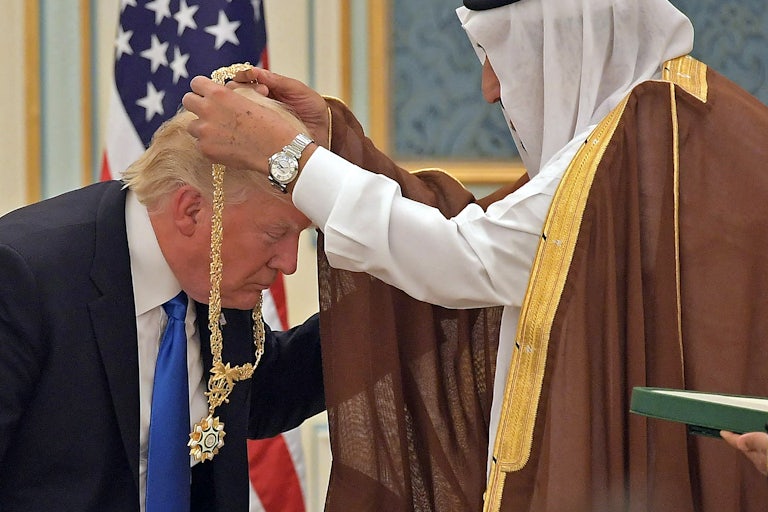
Trump receiving the Order of Abdulaziz al-Saud medal
MANDEL NGAN/AFP/Getty Images
Trump received the Order of Abdulaziz Al Saud medal from Saudi Arabia’s King Salman bin Abdulaziz Al Saud at the Saudi Royal Court in Riyadh in 2017.

Donald Trump is attempting to appeal and delay having to pay that whopping fine that New York Judge Arthur Engoron laid on him earlier this month in the Trump Organization fraud suit brought by state Attorney General Letitia James. As we’ve all heard, to do so, he has to secure a bond.

NBC News did some cipherin’ Wednesday and reported that he’ll need a bond of about $540 million. It is widely assumed he doesn’t have the liquid cash. He has some buildings, notably 40 Wall Street, but many experts are saying that the government doesn’t like to take real estate as collateral. “Whoever is going to bond [Trump] is committing that they’re going to make good on that judgment,” New York business attorney David Slarskey told NBC. “Who’s going to do that?”

Indeed. That is the question. And the possible answer is chilling, if we imagine Trump back in the White House next year.

In sum: He could borrow this money from just about anybody. Or not even borrow it. Someone might just give it to him. Incredibly, as Neal Katyal said on MSNBC Wednesday night, there is apparently no law that prohibits someone in Trump’s position from securing the collateral from anyone. It’s another one of those laws that I suppose no one ever even thought to write because the system has never encountered a Donald Trump before. But now it has.

“There are potential sanctions prohibitions and campaign finance prohibitions. And of course potential tax issues,” MSNBC analyst Andrew Weissmann told me via email Thursday. “But apart from those, a third party can give a gift or loan to post the federal or state bonds.”

Ponder with me the possible dangers here. Let’s imagine a roster of actors who might have the resources and motive to stake Trump to half a billion dollars, either as a loan or a gift. There’s Russia, first of all. Russia—and Vladimir Putin personally, because he’s apparently stolen so much over the years that he might be the world’s richest man—may be out of the question because of the sanctions. But of course, that’s just the law, which Trump spits at.

Imagine a President Trump in hock to Russia or Putin to the tune of a half-billion dollars. Sure, Trump is inclined to give Putin half of Eastern Europe anyway. But money like that would turn a mere ideological sentiment into ironclad fealty, since money means a lot more to Trump than ideas. Well, Poland, you didn’t exist from 1795 to 1918; you can get used to it again.

Or let’s say it came from Saudi Arabia. Remember, it was during this very trial that Trump bragged that the Saudis, or at least some individual Saudi, would willingly pay inflated prices for Trump properties. This was a justification he used for inflating the prices in the first place. Engoron wrote in his ruling: “He also seems to imply that the numbers cannot be inflated because he could find a ‘buyer from Saudi Arabia’ to pay any price he suggests.”

So imagine now that a “buyer” or buyers from the kingdom secretly put up Trump’s collateral. And then Trump won the election. The United States would do whatever Mohammed bin Salman wanted it to do. On the surface, Saudi Arabia is committed to its Vision 2030 plan that proclaims a desire to normalize relations with Iran (this has started) and move away from the current reliance on oil revenues and toward a knowledge economy. That’s all very nice. But conflict will arise in that region, as it always does, and when it does, Trump will serve the master who bailed him out of legal hot water.

Or suppose the Netanyahu government put up the dough. People are plenty critical of Joe Biden now, and rightly so, over the money we’re giving to Israel and the absence of conditions imposed on that money so that Israel can commit atrocities on a massive scale. But if you think it can’t get worse, think again. Trust hard-right Israeli Security Minister Itamar Ben Gvir, who said earlier this month: “Instead of giving us his full backing, Biden is busy with giving humanitarian aid and fuel, which goes to Hamas. If Trump was in power, the U.S. conduct would be completely different.”

Of course, Trump’s benefactor need not be a foreign nation. What if, as Weissman posited to Lawrence O’Donnell Thursday night, it was Elon Musk who ponied up the dough? Or Peter Thiel? Or a consortium of Texas oilmen? Or the Mafia? Obviously, Trump would willingly accept the money from any and all of those sources. How nice would that be, to have a president who hardly made a move without anticipating their reaction?

Lara Trump argues that rank-and-file Republicans will be perfectly happy for their donations to the Republican National Committee to go to paying Trump’s legal bills, and the Trump-era Republican Party is such a warped, freakish imitation of a normal political party, so smothered in cult-worship, that she’s probably right. But even so, rank-and-file Republicans can’t begin to cover more than a fraction of this.

The other hypothetical to consider here is of course that it’s entirely possible that Trump won’t pay at all. After all, as we know all too well, if there’s a law or rule to flout, Trump is there to flout it and dare the system to catch up with him. So this all might be moot, which speaks only to how brazenly lawless the man is.

But if he decides to post the bond, and if all this reporting is correct that he doesn’t have the money himself, he’s going to have to get it from someone. And whoever that someone is will claim a mighty stake on what remains of the mind of the man who might be the president of the United States.

This article first appeared in Fighting Words, a weekly TNR newsletter authored by editor Michael Tomasky. Sign up here.

How Jack Smith Became the Worst Part of Trump’s Historically Lousy Week

The former president’s legal woes have packed headlines, but the special counsel’s filing in the January 6 case has somehow flown under the radar.

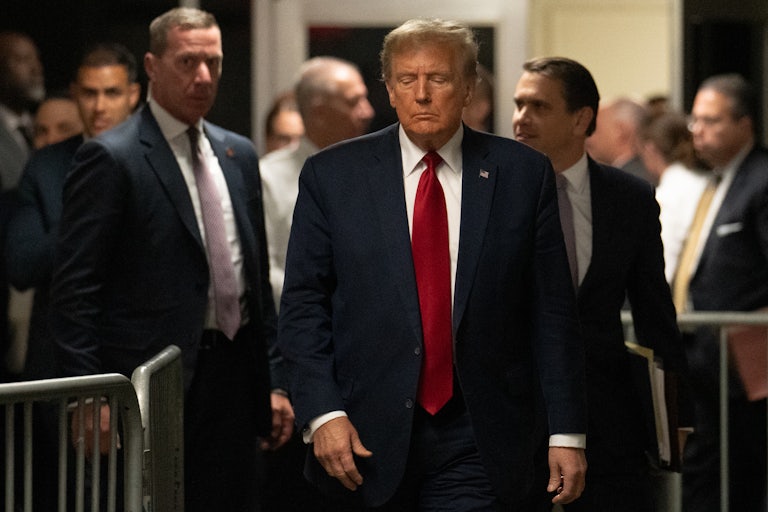
Donald Trump exits New York State Supreme Court on Thursday, Feb. 15, 2024.
Jeenah Moon/Getty Images
Donald Trump exits New York State Supreme Court on February 15.

The big headlines Friday morning concerned Fulton County District Attorney Fani Willis and the combative testimony Thursday she offered concerning her affair with Nathan Wade. But that wasn’t the big story of the week on the Donald Trump legal front. In fact, it may have been about fifth.

What’s bigger? Let’s start with Judge Aileen Cannon’s decision to deny Trump’s attorneys’ bid to delay pretrial motions in the case she’s hearing, about Trump’s removal of classified documents from the White House. Cannon, you’ll recall, was appointed by Trump.  After the documents case landed so unserendipitously in her lap, she made a series of nakedly pro-Trump rulings; the 11th Circuit vacated one order of hers that would have helped Trump delay the proceedings. She also blocked federal investigators from examining the material seized by the FBI, a decision eviscerated by legal experts. So maybe she’s gotten the message that she’d better be a real judge, not a sycophant.

Trump also was dealt a blow this week when Juan Merchan, the judge in the Stormy Daniels hush-money trial, dismissed another attempt at delay by Trump’s lawyers. That trial will start, as scheduled, on March 25.

And—no, it doesn’t stop!—another judge, Arthur Engoron, is supposed to hand down his decision in the penalty phase of the civil suit brought by the New York attorney general against the Trump Organization. AG Letitia James is seeking $370 million. There are reasons to think that that number may be on the low end of where Engoron will land.

But for my money, the worst part of Trump’s week came in the filing by special counsel Jack Smith to the Supreme Court in response to the Trump team’s request for a stay on that trial, which is the January 6 insurrection case. In a 40-page filing, Smith and his attorneys dismantled Trump’s arguments one by one. Smith had until February 20 to file this response, but he did it eight days early and he means business: “The charged crimes strike at the heart of our democracy.  A President’s alleged criminal scheme to overturn an election and thwart the peaceful transfer of power to his successor should be the last place to recognize a novel form of absolute immunity from federal criminal law.  Applicant seeks a stay to prevent proceedings in the district court from moving towards trial, which the district court had scheduled to begin on March 4, 2024, before applicant’s interlocutory appeal necessitated postponement of that date.  Applicant cannot show, as he must to merit a stay, a fair prospect of success in this Court.”

Why is this filing so important? Three reasons. First, Smith urges the Court to act quickly. He still wants the trial to start in March. If the Court agrees, picture it: Trump on trial in two separate courtrooms, on charges that strike precisely at the heart of the two biggest manifestations of his moral turpitude: In New York, as a private citizen, as a man, who treats women like garbage; in Washington, as a public, um, servant who mocks the Constitution and believes that no law applies to him. It will be perfect stereo spectacle for Americans to spend the spring observing.

Second, while it’s true that we’re dealing with a very politicized Supreme Court here, and it’s obvious that at least two justices (Samuel Alito and Clarence Thomas) will rule for Trump on just about anything, Smith’s response makes a very strong set of arguments that should appeal to at least some of the Court’s conservative originalists. “The Framers,” Smith writes, “did not provide any explicit textual source of immunity to the President.”

And third: The Smith case is the most important of all, for the simple reason that inciting the January 6 insurrection is the worst thing Trump has done. Granted there is stiff competition for his most mortal sin. But egging on a crowd to overthrow the government and hang your own vice president still takes the cake. If Smith succeeds in convincing the Supremes to expedite this case and goes on to win a pre-election conviction, that ought to seal Trump’s fate. Some recent polls have shown that swing state swing voters would be highly disinclined to vote for Trump if convicted of a crime.

We’ve seen the conventional wisdom turning on this question in recent weeks. Last year, the standard media line was to say that all the indictments were helping Trump, which was true if you were talking only about Republican primary voters. But now the attention of the media and of pollsters is turning toward general election voters, and they see matters differently.

Every one of these cases is important because each one points to a grotesque deficiency of character that demonstrates why Trump should never be president again. But the insurrection case is the first among equals. A conviction in this case before November 5 really should be the end of the road for Trump. It all depends on the Supreme Court agreeing with Smith’s motion this week. He made as strong a case as could be made.

This article first appeared in Fighting Words, a weekly TNR newsletter authored by editor Michael Tomasky. Sign up here.