Breaking News
Breaking News
from Washington and beyond

Here’s What Alarms National Security Experts About Trump’s Next Steps

Constitutional crisis? Yeah, that’s definitely on the table.

Donald Trump speaks in the Oval Office. (His spray tan looks especially bad.)
Anna Moneymaker/Getty Images

Some of the country’s foremost national security experts are just as alarmed by Trump’s potential disregard for the judiciary branch as we are. 

During The New Republic’s “America in Crisis” event on Wednesday evening, a panel of experts raised their biggest concern about the direction in which the Trump administration is headed: No one knows what happens next. 

“From the prosecutorial perspective, what’s the worst case scenario? What could [the Trump administration] do if they really decided to go for it, as it were?” New Republic staff writer Greg Sargent asked. “What should people do, what recourse do they have?”

“Particularly one thing that concerns me … the next step when the Trump administration refuses to abide by a federal court order,” said Mark Zaid, a national security attorney famous for defending whistleblowers. “I have strength right now as a lawyer, and we are winning in the legal battles, but if that happens, I’m not sure what we’re supposed to do.”

Olivia Troye, a former Homeland Security official in the Trump administration, echoed those sentiments. 

“I would say that that’s my biggest fear, is what Mark Zaid just said.… I’m under no illusions that that is something that could happen when they show plain disregard for that.” Troye urged citizens to speak up in the face of this looming threat. “Make your voices heard. Write letters to the editor, follow your investigative journalist.… Call your members of Congress. Our voices as people still matter. They make us feel like they don’t, but they do matter.”

The fact that these specialists shared the same fear of an impending constitutional crisis was sobering. Those fears were compounded on Monday, when a Rhode Island judge found that the Trump administration had violated a court order to unfreeze some federal funds. The courts have been long viewed as the final line of defense against Trump’s most authoritarian tendencies. But even if Democrats and NGOs sue Trump and win, who’s to say that he’ll undo the policies he already put in place? 

Vice President JD Vance, a Yale law school graduate, offered his own reinterpretation of the Constitution just days before Monday’s court ruling. “If a judge tried to tell a general how to conduct a military operation, that would be illegal,” he wrote on X. “If a judge tried to command the attorney general in how to use her discretion as a prosecutor, that’s also illegal.  Judges aren’t allowed to control the executive’s legitimate power.”

You can watch a full recording of The New Republic’s event, “America in Crisis: Navigating the Dark Road Ahead.” This event was produced in partnership with Americans United for Separation of Church and State and the Rachel Carson Council.
House GOP Reveals Plan to Devastate Medicaid and Food Stamp Programs

House Republicans have a released a budget plan that would take a wrecking ball to the welfare programs used by millions of Americans.

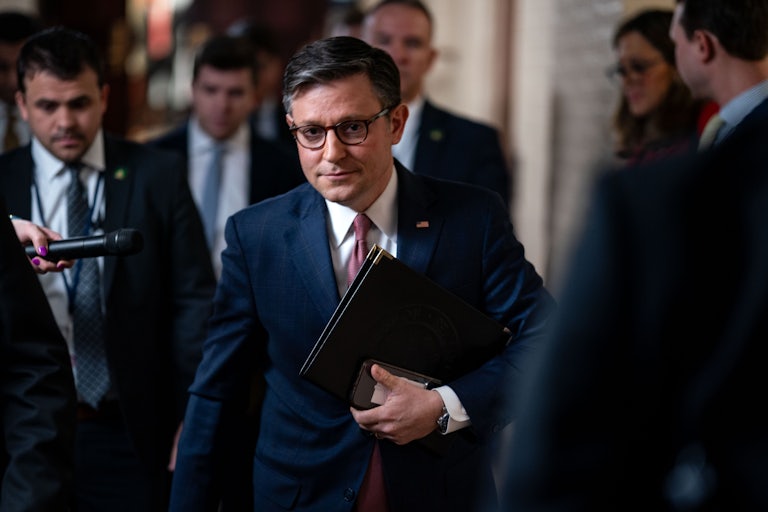
House Speaker Mike Johnson walks down a crowded corridor in the Capitol.
Kent Nishimura/Getty Images

House Republicans have released their budget plan, and in order to pay for massive tax cuts for the wealthy, they are planning to slash funding for Medicaid and food stamps.

The early budget includes a statement where representatives on the House Budget Committee pledge to cut a whopping $2 trillion in mandatory spending. While the text doesn’t mention Medicaid by name, it directs the Energy and Commerce Committee to cut $880 billion in its budget, which is near impossible to do without touching the health care program.

The budget plan also directs the Agriculture Committee to find $230 billion in cuts, which seems to indicate that SNAP (the food stamp program) will be cut by at least 20 percent. This would devastate the lives of millions of Americans who depend on the welfare programs. Other committees have also been given cuts that will hurt less wealthy Americans: The Education and Workforce Committee has been allocated $330 billion in cuts, which is expected to come from student loan programs.

These reductions won’t even pay for the tax cuts the GOP is proposing, which amount to a whopping $4.5 trillion and require the debt ceiling to be raised by $4 trillion. Keep in mind that President Trump has also promised to eliminate taxes on tips, overtime, and Social Security benefits, which combined with these cuts will balloon the budget deficit.

Many of the programs on the chopping block are popular with the American people, and won’t reflect well on Donald Trump and the GOP, especially with correct framing from Democrats. Pushback is also coming from other Republicans who think the cuts don’t go far enough or are concerned with a backlash from constituents. One thing is for sure: There’s about to be a big budget fight on Capitol Hill, and Trump won’t make it easy.

Tesla Is About to Get a Nice Big Handout as Musk Takes Over Government

Elon Musk is cashing in on Donald Trump’s presidency.

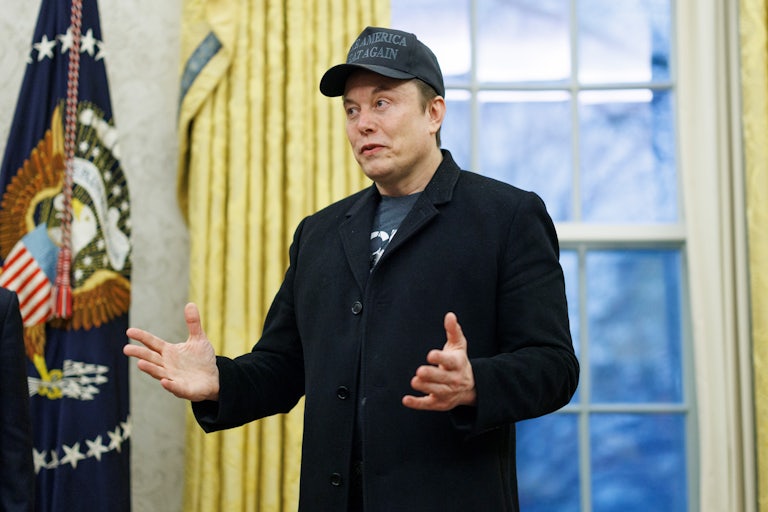
Elon Musk gestures while speaking during a press conference in the Oval Office
Aaron Schwartz/CNP/Bloomberg/Getty Images

Elon Musk’s Tesla will receive one of the largest government contracts in 2025 to produce armored vehicles. 

Drop Site first reported Wednesday on the latest filing of the Department of State’s Procurement Forecast for the fiscal year 2025, which was revised as recently as December 23. 

The filing includes a massive contract for hundreds of millions of dollars to the Department of Government Efficiency czar’s automobile company for “Armored Tesla (production units).” The contract is worth more than $100 million and has a cap of $500 million, according to the filing. 

By comparison, a contract for armored sedans was capped at $100 million, and contracts for armored BMW and armored electric vehicles were capped at $50 million. The office handling the award was the Defensive Equipment and Armored Vehicle Division, and it was targeted for Q4. 

The Procurement Forecast shows projected federal contracts for the purpose of publishing “contracting opportunities small and small disadvantaged firms may be able to perform,” according to its website. 

Tesla has been the subject of an investigation by the National Labor Relations Board, as well as the subject of a lawsuit by the Equal Employment Opportunity Commission and hundreds of complaints by the Consumer Financial Protection Bureau, according to The New York Times. In his position as the leader of DOGE, Musk’s house-cleaning has affected each one of these agencies. 

Tesla’s contracts with the U.S. government over the last decade were worth roughly $700,000 in total

Since Donald Trump entered office, Musk has been flexing an unchecked power as the head of DOGE, sending his employees into the records of federal agencies, intent on shrinking or shutting them down by uncovering supposed massive fraud. 

On Tuesday, Musk touted the transparency of his organization in an attempt to sidestep a question about potential conflicts of interest.  

“All of our actions are fully public,” Musk said, according to CNN. “So if you see anything like, ‘Elon, there may be a conflict there,’ it’s not like people are going to be shy about it. They are going to say it immediately.”

Trump and the White House have both downplayed concerns about Musk’s oversight on issues where he stands to make money. 

It seems that Musk’s hefty payouts from his cozy relationship with the president are fully public too. 

Mike Johnson’s Disastrous Budget Bill Is Already in Trouble

Mike Johnson has failed to unite his party behind the bill.

House Speaker Mike Johnson touches his tie while listening to a press conference by Donald Trump
Aaron Schwartz/CNP/Bloomberg/Getty Images

House Republicans aren’t quite falling into line behind their leadership’s plans to advance Donald Trump’s sweeping legislative agenda, which is set to be presented to the committee Thursday.

House Budget Committee Chairman Jodey Arrington’s nascent budget reconciliation plan has been stalled in committee for weeks, and has faced tough opposition from his Republican colleagues—but the embattled Texas Republican said Tuesday that the panel would take up the massive border, tax, and energy resolution in two days, giving it just hours left to manifest into an agreeable existence.

Arrington’s plan, presented in a private panel meeting on Tuesday, calls for a massive target of $2 trillion in cuts on mandatory spending, with a $1.5 trillion floor, two sources and Representative Ralph Norman told The Hill.

According to one of the sources, a White House official, a handful of House members are asking Trump to bless Medicaid cuts as a way to help pay for reconciliation, but the official said that lawmakers wouldn’t actually lay out what the Medicaid cuts would be.

“We’re not just going to agree to some number in cuts to please a score,” the official told NOTUS. “Stop being constrained by [the Congressional Budget Office].”

Arrington’s plan also included a $4.5 trillion cap on new deficits, to offset an extension of Trump’s 2017 tax cuts. Representative Jason Smith, who chairs the Ways and Means Committee, which oversees tax policy, said that a $4.5 trillion cap was “a good starting point,” but he had pushed—unsuccessfully—to expand the scale of the tax cuts.

Smith seemed frustrated afterward, and he told reporters that Arrington’s plan wouldn’t allow for a permanent extension of Trump’s 2017 tax cuts, as well as other priorities from the president’s campaign. “Anything less would be saying that President Trump is wrong on tax policy,” Smith groused.

Arrington’s plan had reportedly received approval from House Speaker Mike Johnson, who was allegedly “snatching the pen” from Arrington to shop around his own deal on Monday, though Arrington later pushed back on this report at a closed-door GOP conference meeting, according to Politico.

It was then that Arrington called for a meeting of the House Budget Committee to be scheduled for Thursday, to attempt to reconcile differences and advance the bill, giving him just hours to put together all the pieces into a coherent deal. It’s not even clear whether it will be the same deal he presented on Tuesday.

“We’ll soon find out if Jodey is in over his head,” one GOP lawmaker, who was granted anonymity, told Politico Tuesday.

But it’s not looking good.

Representative Eric Burlison, of the House Freedom Caucus, which released its own budget resolution on Monday, was less than thrilled by Arrington’s plan.

“It’s pathetic,” Burlison said, according to NOTUS’s Reese Gorman.

Representative Chip Roy had worked with Arrington to go against Smith in determining the parameters of the sweeping bill, according to Politico.

But Roy remained a holdout on supporting the resolution Wednesday, according to Bloomberg News’s Erik Wasson. Representative Thomas Massie of Kentucky also was reportedly not fully on board.

Trump’s Anti-DEI Crusade Has a New Target: Comcast

The FCC has ordered an investigation into Comcast amid its growing war on diversity, equity, and inclusion.

Several people are seated at a long table. A sign in front indicates that this is a Comcast office.
Cindy Ord/Getty Images for Comcast

Donald Trump’s Federal Communications Commission is taking aim at broadcast outlets for promoting diversity, equity, and inclusion programs, with Comcast, the parent company of NBC and Universal, being the first target.

In a letter sent to Comcast CEO Brian Roberts on Tuesday, FCC Chair Brendan Carr said that the agency is investigating the company’s DEI practices.

“The FCC will be taking fresh action to ensure that every entity the FCC regulates complies with the civil rights protections enshrined in the Communications Act ... including by shutting down any programs that promote invidious forms of DEI discrimination,” the letter states, according to Reuters, which obtained a copy.

Comcast confirmed it received the letter and would cooperate with the FCC’s investigation, issuing a statement saying that “for decades, our company has been built on a foundation of integrity and respect for all of our employees and customers.”

Carr said the FCC was starting out with Comcast because of “substantial evidence that your companies are still engaging in the promotion of DEI,” noting that the company has cable, high-speed internet, broadcast TV stations, and wireless divisions covered by the agency.

Democratic FCC Commissioner Anna Gomez said Carr’s investigation went against the FCC’s actual purpose.

“Stoking partisan culture wars is not the FCC’s job. It is time we return to our core mission—closing the digital divide, fostering innovation, and protecting consumers,” she said.

That’s not likely to happen under the Trump administration. The FCC has already turned its sights on media outlets for reasons besides DEI—last week, Carr announced an investigation into San Francisco radio station KCBS for its coverage of immigration enforcement.

This followed an announcement from Carr that the FCC was investigating NPR and PBS for allegedly “violating federal law by airing commercials.” And don’t forget the FCC’s battle with CBS over a Kamala Harris interview that Trump falsely claimed was edited.

It seems that aside from regulating America’s communications and broadcasts, the Trump administration will be using the FCC as a political tool to go after media that he doesn’t like, or that goes against the right wing, blatantly violating the Constitution’s First Amendment right to a free press.

More on the war on DEI: