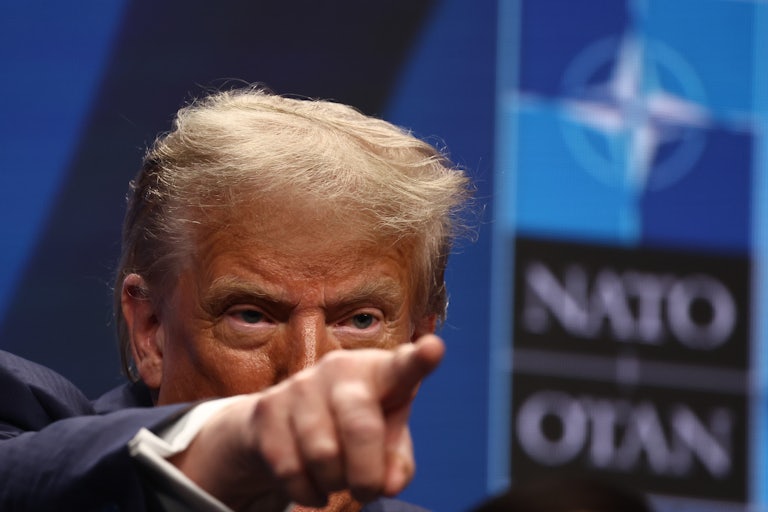
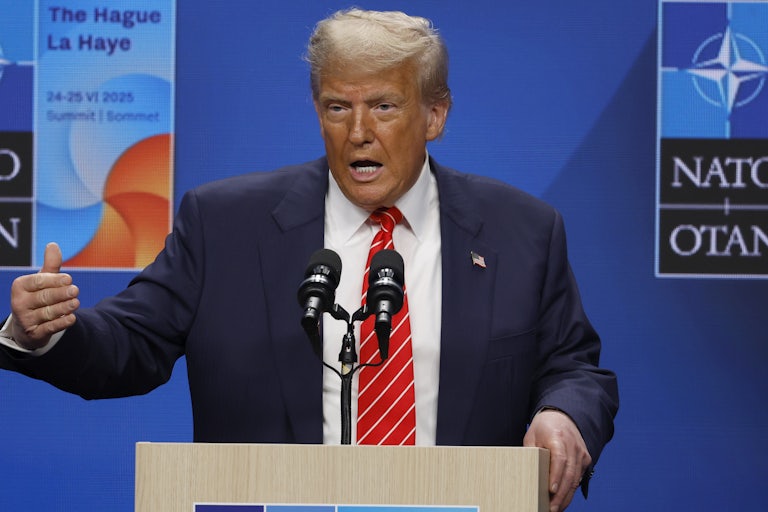
Breaking News
Breaking News
from Washington and beyond

Despite Trump’s Boasts, We Still Don’t Know If The Iran Strikes Worked

The U.S. intelligence community is still assessing the effectiveness of strikes meant to cripple an Iranian nuclear program that may not have existed in the first place.

Donald Trump walks outside the White House
Chip Somodevilla/Getty Images

Reporting by Jennifer Griffin, Fox News’s chief national security correspondent, underscores that the effectiveness of Trump’s strikes against Iran’s nuclear facilities on Saturday remains unclear.

A classified early report by the Defense Intelligence Agency made headlines on Wednesday, with one source telling CNN the assessment suggests the strike set Iran’s nuclear program “back maybe a few months, tops.”

Such reporting put a damper on Trump’s grandiose claims that the U.S. had “completely and totally obliterated” its targets in “one of the most successful military strikes in history.” The White House recognized the DIA report’s existence, but told CNN it was “flat-out wrong.”

On Wednesday, Trump argued that the available intelligence report was “very inconclusive,” but at the same time went so far as to compare the strikes to the atomic bombings of Hiroshima and Nagasaki in 1945.

You may be surprised to hear that, of those two claims, the “inconclusive” remark is, for the time being, more on the mark.

Citing a “source familiar with the classified DIA intelligence report,” Griffin wrote on X that the preliminary report was issued with “low confidence,” and is based on just a “day’s worth of intelligence” that was available as of 9 p.m. EDT the day after the bombing.

Reportedly, the assessment was not conducted in coordination with other U.S. intelligence agencies, and it notes that it will take “days to weeks to accumulate necessary data” to compile a full battle damage assessment.
Pete Hegseth Spirals Over Damning Leaked Report on Trump Iran Strikes

Defense Secretary Pete Hegseth accused the leakers of being politically motivated.

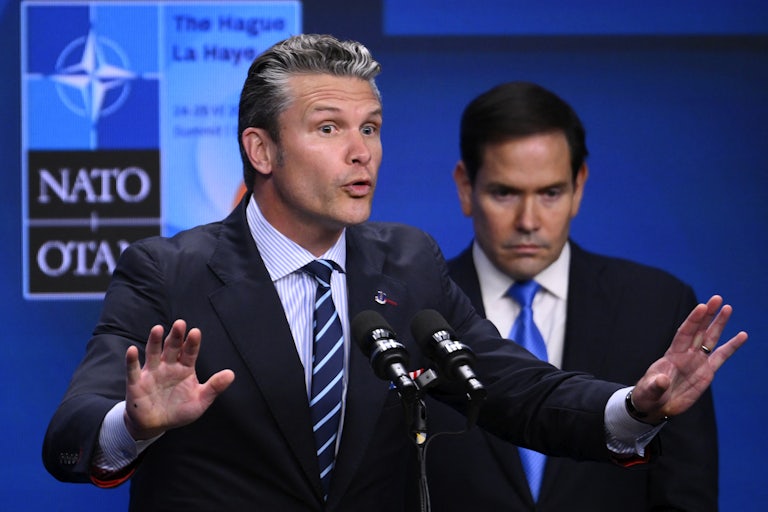
Defense Secretary Pete Hegseth gestures while speaking at a podium during the NATO summit at The Hague. State Secretary Marco Rubio stands behind him
John Thys/AFP/Getty Images

Defense Secretary Pete Hegseth was once again chasing leaks out of the Pentagon Wednesday, after a leaked intelligence report disputed Donald Trump’s claim that his strike on three Iranian nuclear facilities had “completely and fully obliterated” them.

At a NATO summit in The Hague Wednesday, Hegseth fumed at the media after multiple outlets reported on an early assessment from the Defense Intelligence Agency that found Trump’s strike had only delayed Iran’s nuclear program by a few months.

“The instinct of CNN, the instinct of The New York Times, is to try to find a way to spin it for their own political reasons, to try to hurt President Trump or our country. They don’t care what the troops think, they don’t care what the world thinks, they want to spin it, to try and make him look bad, based on a leak,” Hegseth said.

“Of course, we’ve all seen plenty of leakers, and what do leakers do? They have agendas,” he continued. “And what do they do—do they share the whole information? Or just the part that they want to introduce?”

The Pentagon has descended into utter chaos under Hegseth, who reportedly spends half of his time investigating leaks, according to one former official who was fired as part of one of those investigations.

The secretary dismissed the report as “low assessment,” meaning there was low confidence in the data. Trump, who had also taken shots at the media over the report, said the intelligence had been “very inconclusive.”

Hegseth appeared furious at the suggestion that the strikes could’ve been anything other than a success, and went so far as to suggest that it would be impossible to actually determine the damage to nuclear enrichment facilities like Fordo, which is located deep inside of a mountain.

“So, if you want to make an assessment of what happened at Fordo, you better get a big shovel, and go really deep. Because Iran’s nuclear program is obliterated,” he told reporters Wednesday.

Hegseth announced that the Department of Defense would be coordinating on an investigation with the FBI to discover the mole, claiming that the report had been intended for “internal purposes, battle damage assessments.”

Trump: I Could Have Taken Iran’s Oil if I Wanted To

The president suggested he had done Iran a favor by not plundering the nation and merely bombing it.

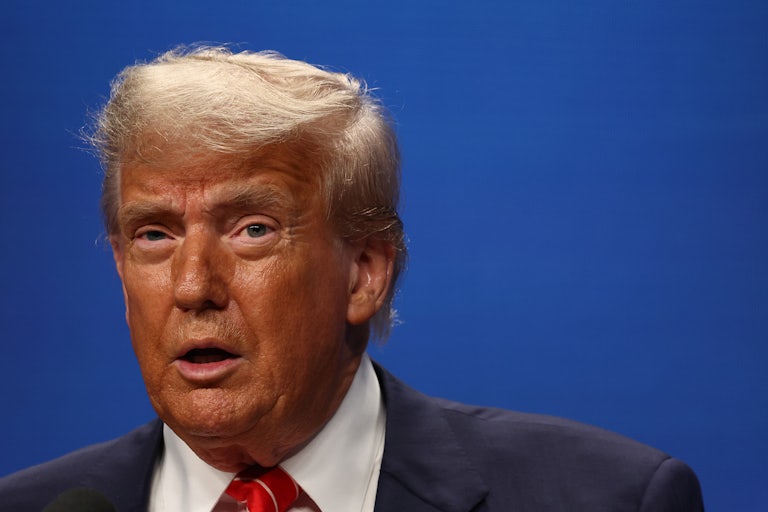
Trump's mouth is open
Jakub Porzycki/NurPhoto/Getty Images
Donald Trump at the NATO conference at The Hague on June 25

In response to a reporter seeking to demystify the status of Iranian oil sanctions under Trump, the president clarified little—instead opting to casually mention that he could have plundered Iran’s oil but opted not to.

Just days after Trump’s unilateral decision to bomb Iran in hopes of dealing a blow to its nuclear program, the president posted on Truth Social that “China can now continue to purchase Oil from Iran. Hopefully, they will be purchasing plenty from the U.S., also. It was my Great Honor to make this happen!”

Few were sure how to interpret the announcement, which seemed to many to suggest that Trump was lifting sanctions on Iran, thus departing from Washington’s long-standing policy against such trade and terminating the president’s “maximum pressure” campaign on the country.

A White House official sought to correct the record Tuesday evening, saying that Trump’s post did not indicate such an about-face. Per the Financial Times, the official said the U.S. stance remains that China and all countries should stick with U.S. oil “rather than import Iranian oil in violation of US sanctions.”

Trump’s Truth Social post, the official claimed, “was simply calling attention to the fact that, because of his decisive actions to obliterate Iran’s nuclear facilities and broker a ceasefire between Israel and Iran, the Strait of Hormuz”—a key shipping route for oil—“will not be impacted, which would have been devastating for China.”

At a press conference Tuesday morning, Trump was asked to clarify whether his Truth Social post had marked a reversal in his “maximum pressure campaign” on Iran. The president gave a response that was far from clear: “Look, they just had a war. The war was fought. They fought it bravely. I’m not giving up. They’re in the oil business. I mean, I could stop it, if I wanted. I could sell China the oil myself. I don’t want to do that. They’re going to need money to put that country back into shape. We want to see that happen.”

Trump then mused that the U.S. could have seized Iran’s oil, continuing, “If they’re going to sell oil, they’re going to sell oil. We’re not taking over the oil. We could’ve, you know? I used to say with Iraq, ‘Keep the oil.’ I could say it here too. We could’ve kept the oil.”

Indeed, going back to 2011, Donald Trump’s position on the Iraq War was that the U.S. should loot the country’s oil, which many observed would constitute a war crime.

Trump Admits It’s Actually Really Hard to End the War in Ukraine

He had previously promised to stop it within “24 hours” of being sworn in to a second term.

Trump points while conducting a press conference at the NATO smmit
Jakub Porzycki/NurPhoto/Getty Images
Donald Trump at the NATO summit at The Hague on June 25

Trump gave more noncommittal responses when asked about his current view on Russia’s war against Ukraine at Tuesday’s NATO Summit at The Hague.

“You once said that you would end the Ukraine war in 24 hours. You later said you said that sarcastically,” said Austrian reporter Johannes Petrov.

“Of course I said that sarcastically,” Trump replied.

“But you’ve been in office for five months and five days, why have you not been able to end the Ukraine war?”

“Because it’s more difficult than people would have any idea. Vladimir Putin has been more difficult. Frankly, I had some problems with Zelenskiy, you may have read about them. And it’s been more difficult than other wars,” Trump said, before listing the various wars he’s had an easier time “ending.”

“Will the United States contribute any more money to Ukraine’s defense this year, to the $5 billion that allies are giving?” Trump was asked next.

“As far as money going, we’ll see what happens. There’s a lot of spirit. Look, Vladimir Putin really has to end that war. People are dying at levels that people haven’t seen before in a long time.”

Trump was then questioned by a Ukrainian BBC News reporter whose husband is currently on the front lines fighting against the Russian invasion. The president took a clear interest in this reporter, asking her a laundry list of questions about where she was from and where her husband was. She then pivoted to ask Trump about Patriot missiles.

“My question to you is whether or not the U.S. is ready to sell Patriot missiles to Ukraine. We know that Russia has been pounding Ukraine really heavily right now.”

“Are you living yourself now in Ukraine?” Trump asked.

“My husband is there … and me with the kids, I’m in Warsaw actually.”

“Is your husband a soldier, no?”

“He is.”

“He’s there now?”

“Yeah.”

“Wow, that’s rough stuff, right?”

Trump eventually got to the question.

“So, let me just tell you, they do want to have the antimissile missiles, as they call them, the Patriots. And we’re gonna see if we can make some available, you know? They’re very hard to get; we need them too. We were supplying them to Israel, and they’re very effective. One-hundred-percent effective, hard to believe how effective,” he replied. “And they do want that more than any other thing.… I wish you a lot of luck; I can see it’s very upsetting to you. Say hello to your husband, OK?”

Trump finally seems to be realizing what the entire world knew months ago: Putin has no interest in ending the war on Ukraine, and the U.S. has much less leverage against him than Trump may have previously thought. Only time will tell if this minor change in tune will be enough to make a meaningful difference in Ukraine.

Trump Issues Insane Warning About Israel and Iran Conflict

Donald Trump appeared to pour cold water on the ceasefire he bragged about.

Donald Trump gestures while speaking at a podium during the NATO summit at The Hague
Omar Havana/Getty Images

In the midst of celebrating a quick resolution to the Iran-Israel conflict, Donald Trump casually mentioned that the fighting could start up again “soon.”

“You just said that you believe the conflict with Israel and Iran is over. What makes you so confident it is, and what do you do if it isn’t?” a reporter prompted Wednesday at the NATO conference in The Hague.

Trump said he believed that the ceasefire was legitimate because he had “dealt with both” sides and knew that they were “both tired, exhausted.”

“They fought very, very hard and very viciously,” Trump explained—“and they were both satisfied to go home and get out.” But the president had a wildly alarming answer as to whether or not the bloody conflict could start up again.

“Can it start again? I guess someday it can, maybe it could start soon,” Trump said.

An early U.S. intelligence assessment leaked Tuesday determined that Trump’s airstrikes on three Iranian nuclear bases failed to destroy core components of the nation’s nuclear program.

The president’s attack, conducted Saturday without the express approval of Congress, damaged facilities in Fordo, Natanz, and Isfahan. But a battle damage assessment by the Pentagon’s intelligence arm determined that the missile barrage only set Iran’s nuclear program back by a few months, rather than the “years” that Trump had advertised, CNN reported.

The White House rejected the report, rebuffing the whistleblower as a “low-level loser,” though they still acknowledged that the report had been classified as “top secret.” On Wednesday, the administration had apparently thrown the U.S. intelligence out the window, siding instead with a narrative pushed by the Israeli Atomic Energy Commission that the site of the attacks had “rendered the enrichment facility inoperable.”

The U.S. president’s messaging on the Iran-Israel conflict has been all over the place. On Monday, Trump told NBC News that he expected the ceasefire to last “forever,” and that he didn’t believe Israel and Iran would “ever be shooting at each other again.” That was before the two sides had come to a formal, mutual ceasefire agreement; hours after the ceasefire deadline had passed, the two nations continued lobbing missiles at one another.

At least 610 people have been killed in Iran since Israel first attacked on June 13, according to Iran’s health ministry. Approximately 107 people died on Monday alone, making it the deadliest single day of the conflict.