Breaking News
Breaking News
from Washington and beyond

Democrats Are Finally Working to Stop Trump’s Secret Police

A commonsense bill would ban ICE agents from covering their faces and force them to show identification when conducting raids. Republicans will almost certainly kill it.

Masked federal agents stand in a parking lot
Mario Tama/Getty Images
Masked federal agents in Los Angeles earlier this month

A new bill introduced by U.S. Representatives Dan Goldman and Adriano Espaillat would seek to address the scourge of unidentified, masked and plainclothed agents abducting people off the streets in executing President Donald Trump’s deportation campaign.

The bill, dubbed “No Secret Police Act of 2025,” would amend the Homeland Security Act of 2022 to prohibit federal immigration from wearing masks. According to Goldman, it would “get rid of masks, would require all agents to show their identification and insignia, and ensure accountability for these horrible, horrible policies.”

The legislation comes as Trump administration officials defend Immigration and Customs Enforcement agents’ ability to act with anonymity. In a recent Washington Post letter to the editor, ICE acting Director Todd Lyons wrote that “officers wear masks for personal protection and to prevent doxing.”

But this purported right for agents of the state—who are empowered to use force in carrying out their duties—to shield their identities has, as Goldman put it, led to the use of “authoritarian tactics that resemble Soviet Russia more than they resemble a democratic United States.”

Indeed, one could be forgiven for mistaking footage of ICE arrests in recent months for kidnappings.

When a Tufts graduate student was seized by masked men in March (seemingly for merely having written a pro-Palestinian op-ed), a witness chided the agents, asking, “You want to take those masks off? Is this a kidnapping? Can I see some faces here? How do I know this is the police?”

In April, a woman who recorded ICE agents detaining three men outside of a Georgia courthouse (one of whom was reportedly released after proving he was a U.S. citizen), told a local news station, “I would have literally thought that they were kidnapping these three men.”

Goldman and Espaillat’s legislation resembles a bill introduced earlier this month by Representative Nydia Velázquez addressing the same issue, as well as state-level proposals like California’s recently introduced “No Secret Police Act” and “No Vigilantes Act.”

Supreme Court Makes It Harder for Immigrants to Challenge Deportations

The ruling could make it easier for Donald Trump to deport more people.

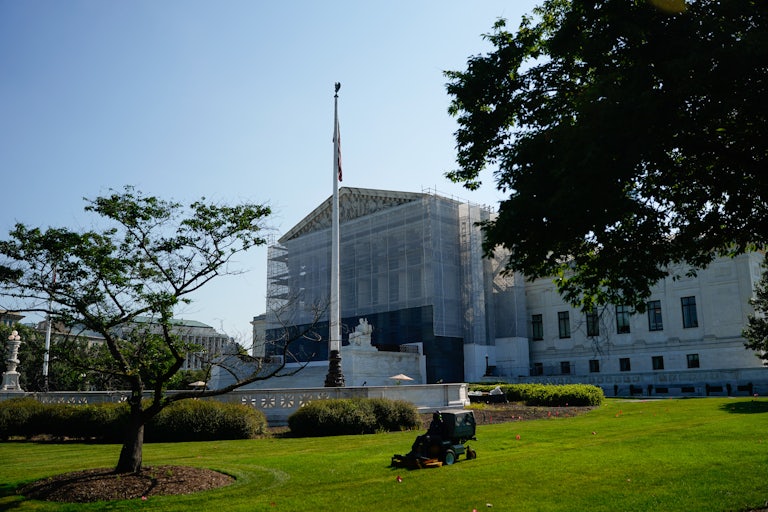
The Supreme Court building in Washington, D.C.
Kent Nishimura/Bloomberg/Getty Images

The Supreme Court just defined the tight window under which noncitizens can challenge their deportation for fear of torture.

The case of Riley v. Bondi began long before Donald Trump’s immigration crackdown. In January 2021, an immigration judge blocked the final administrative review order, or FARO, to remove Pierre Riley, a Jamaican immigrant who overstayed a tourist visa, on the grounds that he feared gang violence in Jamaica.

That judge then sent Riley to what’s known as a “withholding-only” proceeding, where the only issue is whether a noncitizen can be removed from the United States. At this proceeding, Riley’s removal was deferred under the U.N. Convention Against Torture, or CAT, which prevents immigrants from being removed to countries where they may be subjected to physical harm or imprisonment.

The DHS then appealed to the Board of Immigration Appeals, or BIA, which decided he could be removed and to enforce the FARO for his removal. Three days later, Riley filed a petition to appeal the FARO with the Fourth Circuit Court of Appeals, but the court found that he had failed to do so within the 30-day deadline after the FARO was first issued, dismissing his petition and claiming that the deadline was “jurisdictional,” meaning that it must be strictly enforced.

The Supreme Court was charged with determining whether Riley’s challenge came too late, and whether the deadline was “jurisdictional.”

In a 5–4 decision Thursday, the high court found that Riley had in fact missed his window to challenge his removal. In his majority opinion, Justice Samuel Alito held “that a BIA order in a withholding-only proceeding is not a ‘final order of removal,’ and therefore the 30-day filing deadline cannot be satisfied by filing a petition for review within 30 days of the BIA’s withholding-only order.”

The “FARO is the final order of removal in this case, and withholding-only proceedings do not disturb the finality of an otherwise final order of removal,” Alito wrote. He was joined in full by Chief Justice John Roberts and Justices Clarence Thomas, Amy Coney Barrett, and Brett Kavanaugh.

In a dissenting opinion, Justice Sonia Sotomayor, who was joined by fellow liberal Justices Elena Kagan and Ketanji Brown Jackson, challenged the majority’s logic, finding that the removal order only became final when the board denied his appeal under CAT.

“Should Riley have appealed the Board’s order denying deferral of removal before the Board issued it? The answer ought to be easy. Yet the majority today renders the statute incoherent, holding that Riley should have appealed the order one year and three months before the Board entered it,” she wrote.

“One should not be required to appeal an order before it exists,” she wrote. “Incomprehensibly, the Court disagrees.”

“Time will tell whether the Court will extend its illogic beyond politically disfavored noncitizens,” Sotomayor wrote, adding later, “Today’s decision is the rare holding that benefits no one.”

Conservative Justice Neil Gorsuch also joined the dissent, except for one section outlining the “untold damage to basic principles of finality and judicial review.”

The court also determined that the 30-day filing deadline was merely a mandatory claims-processing rule, not “jurisdictional,” and vacated the Fourth Circuit’s ruling and remanded it back to the lower court.

Thursday’s ruling could come in handy to Trump, who has worked to deport as many people as possible as fast as he can—regardless of what circumstances await them in their destination.

Read more about how the court has helped Trump:

Republicans Now Want to Track Immigrants Wherever They Go

The draconian measure from an authoritarian administration: forcing migrants to wear GPS tracking devices at all times.

Stephen Miller holds his hand next to his face
Kent Nishimura/Bloomberg/Getty Images
White House deputy chief of staff Stephen Miller

The GOP’s new Homeland Security funding bill would require “all non-detained migrants” to wear GPS tracking devices, a demoralizing “alternative to detention” that is part of the Trump administration’s continuing immigration crackdown, according to Migrant Insider.

“Non-detained” includes asylum-seekers and even students. Tracking millions of innocent people like endangered animals will be a tall task, a challenge that will likely go to another seedy private surveillance corporation.

This is not the first time DHS and ICE have used tracking devices on nondetained immigrants. Last year, ICE issued 3,000 wrist-worn “Veri-Watches” to keep constant tabs on asylum-seekers.

“These wrist-worn GPS monitoring devices would supplement existing [alternative-to-detention] capabilities for noncitizens who qualify for the non-detained docket in a less obtrusive manner, increasing compliance for participants moving through the immigration process,” ICE Enforcement and Removal Operations executive associate director Corey Price said in 2023 when announcing the tracking program.

Those wrist-worn trackers resembled smart watches without any personal use capabilities. ICE agents could perform live location monitoring, facial recognition, and messaging. It’s likely that this most recent development will use similar technologies, if not the same.

This draconian, dehumanizing invasion of privacy isn’t the only alarming development in this funding cycle. The appropriations bill will also include yet another ban on diversity, equity, and inclusion funding at DHS and $4.4 billion for ICE custody operations, and it bans local law enforcement from decreasing their 287(g) agreements with ICE. This bill is a dream come true for the likes of White House deputy chief of staff Stephen Miller and border czar Tom Homan. It is expected to pass through the House and the Senate.

The Supreme Court Just Gutted Planned Parenthood Funding

The Supreme Court’s decision could empower multiple states to slash funding to the crucial health services provider.

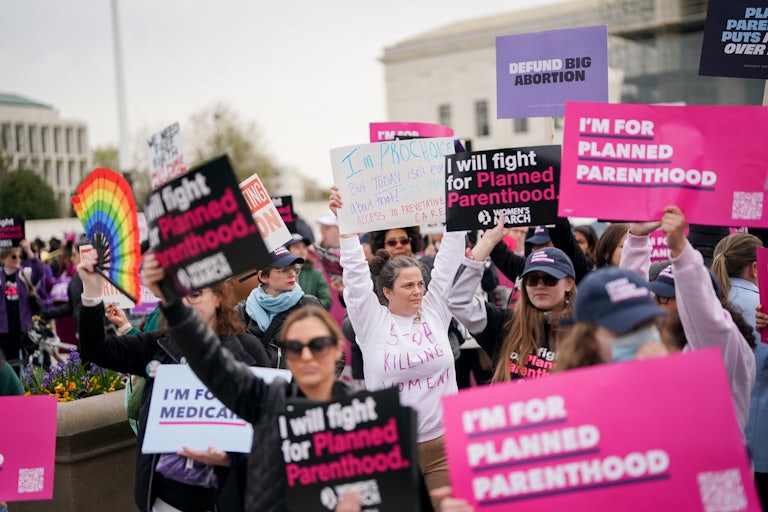
People protest in support of Planned Parenthood outside the Supreme Court in Washington, D.C.
Al Drago/Bloomberg/Getty Images
The Supreme Court just issued its worst ruling for women since Dobbs.
In a 6-3 decision Thursday, the nation’s highest judiciary ruled against Planned Parenthood, deciding that the health care organization could not sue South Carolina over the state’s defunding effort.
The court ruled that Medicaid recipients effectively do not have the right to choose their health care provider, granting states the ability to refuse to cover Medicaid expenses at Planned Parenthood sites.
The ruling in Medina v. Planned Parenthood South Atlantic spells certain disaster for the national organization, setting a precedent for states across the country to strip funding from a nonprofit that does not use public funds to provide abortion care, and provides many other critical services such as physicals, cancer screenings, STI testing, and birth control access.
Justice Neil Gorsuch wrote the majority opinion, arguing that the law does not include the “rights-creating language” that would allow patients to sue states when their provider choice is restricted.
It’s the third time that South Carolina’s defunding case has reached the Supreme Court. The state initially moved to cut Planned Parenthood off of Medicaid funding in 2018. In 2020, the court rejected the state’s appeal. Three years later, the justices intervened in a lower court’s ruling, ordering it to reconsider the case after a relevant ruling had been issued by the nine-judge bench.
South Carolina has one of the most prohibitive abortion policies in the nation, restricting access after just six weeks, before most individuals know they’re pregnant and just one week before drug store pregnancy tests can detect pregnancy hormones in their earliest, and least reliable, window.
Planned Parenthood has said it gets less than $100,000 per year in South Carolina, and that Medicaid does not pay for abortions except in emergency events that compromise a pregnant person’s life or if the pregnancy is the result of rape or incest.
The court’s three progressive justices dissented, with Justice Ketanji Brown Jackson arguing that the court was effectively unravelling a landmark Reconstruction-era civil rights law.
Section 1983 of the United States Code, enacted in 1871, enabled Americans to bring suits in federal court to enforce their rights under the Fourteenth Amendment, which prohibits states from depriving persons of due process and equal protection of the law.
After a 1961 case leveraged the code to charge Chicago police officers with violating a family’s constitutional rights, “Section 1983 became the primary vehicle for enforcing constitutional rights in the United States,” former Senator and Judge Lynn Adelman wrote for Dissent Magazine in 2018, noting that the impact of the code’s interpretation by the Warren Court has been a central pillar of constitutional enforcement around the country: “Private litigants file more than 15,000 Section 1983 actions every year and prisoners file more than 30,000,” he wrote.
The code has been utilized to fight against excessive force, racial profiling, wrongful convictions, and other instances in which officials violate an individual’s constitutional rights. But as of Thursday, the code may no longer apply to Americans’ ability to choose their healthcare provider.
In her dissenting opinion, Jackson wrote that the ruling “is likely to result in tangible harm to real people.”
“It will strip South Carolinians—and countless other Medicaid recipients around the country—of a deeply personal freedom: the ability to decide who treats us at our most vulnerable,” she said. “The Court today disregards Congress’s express desire to prevent that very outcome.”
This story has been updated.

Trump’s “Big Beautiful Bill” Is in Big Trouble

With a self-imposed deadline fast approaching, the GOP’s plan to slash health care funding to hand a massive tax cut to the rich has hit yet another snag.

Donald Trump squints angrily
Beata Zawrzel/NurPhoto/Getty Images
Donald Trump at the NATO Summit at The Hague on June 25

Just eight days out from the Senate GOP’s self-imposed (read: Donald Trump–imposed) July 4 deadline to pass the president’s One Big Beautiful Bill Act, the Senate parliamentarian has dealt a blow to the sweeping plan, which cuts taxes for corporations and the rich and pays for it with massive slashes to entitlement programs, most notably Medicaid.

As Parliamentarian Elizabeth MacDonough gives the proposed budget reconciliation a “Byrd bath”—so called because it winnows out nonbudgetary provisions, under what’s known as the Byrd Rule—she has scrubbed the bill of some of its grime.

According to a Thursday morning press release from the Senate Budget Committee ranking member and Democratic Senator Jeff Merkley, the Senate parliamentarian has spiked numerous provisions, which will now have to surmount a 60-vote hurdle in order to remain in the bill as written—something that has zero chance of happening.

These nixed provisions would have significantly restricted health care access for individuals who are not citizens and limited states’ ability to administer Medicaid. They included bans on federal funding for Medicaid for certain groups—such as for those whose citizenship status was not immediately verified and people seeking gender-affirming care. Others would have limited states’ ability to tax health care providers to fund Medicaid and revoked Medicare eligibility for refugees, asylum-seekers, and people with temporary protected status.

With these provisions and others having gotten the chopping block—and more potentially on the way—Republican lawmakers are none too pleased.

“How is it that an unelected swamp bureaucrat, who was appointed by Harry Reid over a decade ago, gets to decide what can and cannot go in President Trump’s One Big Beautiful Bill?” tweeted Representative Greg Steube, who advocated for Vice President JD Vance to overrule MacDonough in a message retweeted by fellow GOP Representative Andy Biggs. Alabama Senator Tommy Tuberville decried “the WOKE Senate Parliamentarian” along similar lines.

Yesterday, Republican Representative Jeff Van Drew, lamenting that MacDonough “has already blocked major parts of House Republicans’ One Big Beautiful Bill,” tweeted, “It doesn’t have to be this way. The Republicans senators are not required to adhere to anything she says.”

Democrats, on the other hand, are applauding the setback to Trump’s agenda. “Republicans are scrambling to rewrite parts of this bill to continue advancing their families lose, and billionaires win agenda,” said Merkley, “but Democrats stand ready to fully scrutinize any changes and ensure the Byrd Rule is enforced.”