Breaking News
Breaking News
from Washington and beyond

“Total Loser”: Sleepless Trump Slams Indiana Republicans

The president is enraged that GOP members didn’t respond to his pressure campaign.

Donald Trump speaks in a meeting at the Oval Office.
Chip Somodevilla/Getty Images

In the wee hours of Saturday morning, the president laid into Republicans who voted against his gerrymandering campaign in Indiana. Perhaps unable to sleep due to the crushing sting of defeat, Donald Trump took to Truth Social close to 1 a.m. to mock and threaten the state’s legislators.

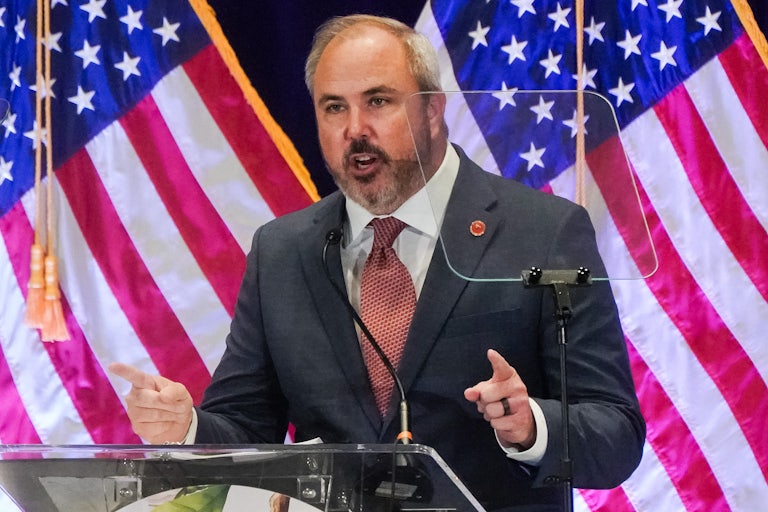
“Republicans in the Indiana State Senate, who voted against a Majority in the U.S. House of Representatives, should be ashamed of themselves,” Trump wrote. “Headed by a total loser named Rod Bray, every one of these people should be “primaried,” and I will be there to help! Indiana, which I won big, is the only state in the Union to do this!”

On Thursday, Indiana lawmakers voted down Trump’s midcycle redistricting push, choosing to keep election maps the same rather than gerrymander them to Republicans’ advantage. For weeks leading up to the vote, the president had been bullying the Hoosier state’s lawmakers in an attempt to shore up support.

After the vote, Trump turned his fury on state Senate President Pro Tempore Rodric Bray, the main opponent to redistricting. Bray believes the state should instead work on flipping a preexisting district rather than blowing up the whole map—a risky move that would narrow Republicans’ margins in the new districts, and could even result in a loss of seats, he told Politico.

Trump has made it clear that if a Republican is unwilling to follow his agenda to the letter, he’ll put his weight behind a primary challenger. Hours before the vote Thursday, he posted, “Rod Bray and his friends won’t be in Politics for long, and I will do everything within my power to make sure that they will not hurt the Republican Party, and our Country, again.”
Read more about Trump’s redistricting fight:

Trump’s DOJ Sues Fulton County and Four States to Seize Voter Ballots

The Justice Department is expanding its effort to gain access to sensitive voter data in key states.

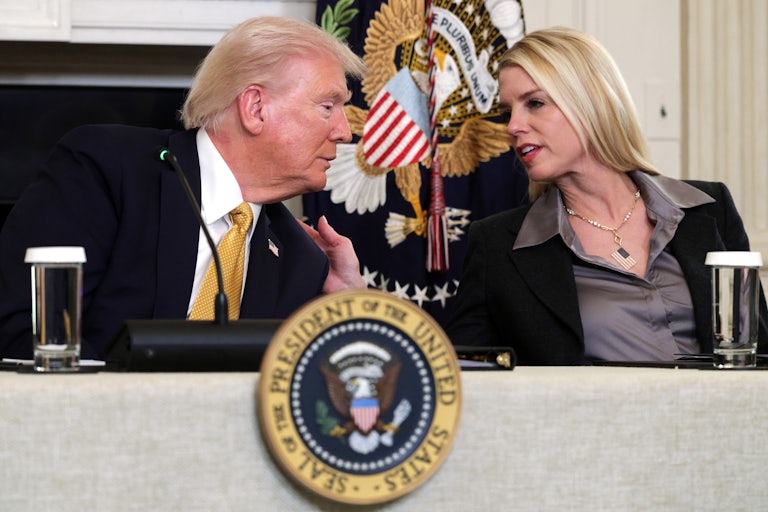
Attorney General Pam Bondi leans over to speak with Donald Trump, placing a hand on his shoulder.
Alex Wong/Getty Images

The Justice Department is dredging up the 2020 presidential election conspiracy.

Attorney General Pam Bondi sued Fulton County officials in Georgia Friday to obtain ballots that were cast in the election. The suit demands that Fulton County turn over “all used and void ballots, stubs of all ballots, signature envelopes, and corresponding envelope digital files.”

The suit was filed the same day as the DOJ announced legal action against four more states—Colorado, Hawaii, Massachusetts, and Nevada—in a sweeping national effort to access sensitive voter data. So far this year, the Trump administration has targeted 18 states, most of them Democratic-led.

It’s the first such instance in which the Justice Department has requested physical ballots. A pro-voting group described the initiative to Democracy Docket as a “terrible overstep of power.”

Since Trump first planted the seeds of doubt about the results of the 2020 election, a litany of his allies have continued to tend and water the theory—so much so that within a handful of years, refusing to admit that Trump ever lost to Joe Biden had become a fealty test for MAGA membership.

But there is no doubt—Trump lost that election by a landslide, coming up short by 38 electoral votes. More evidence that Trump did not win includes the fact that he was not inaugurated in 2021, and did not serve a day as president until he succeeded in 2024.

But for anyone still in doubt, know that the theory has been thoroughly debunked by the president’s own appointees. Trump’s last attorney general, Bill Barr, announced in 2022 that despite an intensive, multi-agency investigation, no evidence of widespread fraud had been discovered that supported the president’s wild claims.

But the theory—and Trump’s innumerable cadre of yes-men—persist.

“At this Department of Justice, we will not permit states to jeopardize the integrity and effectiveness of elections by refusing to abide by our federal elections laws,” Assistant Attorney General for Civil Rights Harmeet Dhillon said in a statement. “If states will not fulfill their duty to protect the integrity of the ballot, we will.”

Republicans Announce Their Next Targets After Indiana Crash and Burn

Fresh off their gerrymandering disaster in Indiana, Republicans are plotting their next moves.

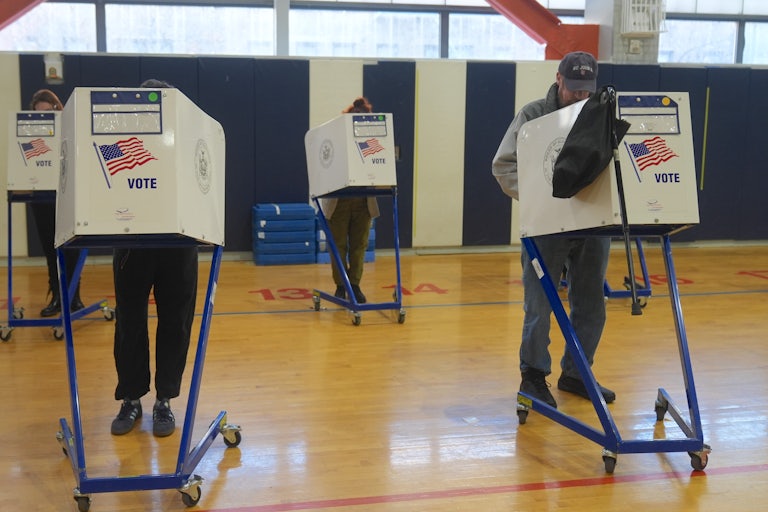
Voters cast their ballots at the polls.
Selcuk Acar/Anadolu/Getty Images

Republicans are scrambling for a next move after President Donald Trump’s humiliating failure to bully Indiana lawmakers into bending to the president’s gerrymandering scheme.

On Thursday, Indiana lawmakers rejected the president’s push for midcycle redistricting in the Hoosier State to ensure Republican victory in the 2026 midterms. Indiana Lieutenant Governor Micah Beckwith claimed that the Trump administration had even threatened to withhold federal funding if they refused—but lawmakers wouldn’t budge.

With the midterms fast approaching and the Republican Party’s prospects looking increasingly grim, Trump’s allies have started to discuss where to turn up the heat next.

“Nebraska and Kansas are two top targets,” wrote Tyler Bowyer, chief operating officer of Turning Point Action, the advocacy arm of Charlie Kirk’s organization, in a post on X Friday.

But even he had to admit that Republicans faced some challenges in those states. “Nebraska did not help the President by passing winner-take-all last year. Not a great sign for redistricting. Kansas is controlled by the Koch HQ,” Bowyer wrote.

In Nebraska, the unicameral legislature requires the support of every Republican to advance redistricting, but 83-year-old state Senator Merv Riepe is not buying in. He previously blocked Trump’s 2024 effort to reshape the state’s split Electoral College vote into a winner-takes-all state, and seems similarly uninterested in supporting his gerrymandering this time around.

“I don’t think it’s a necessity for us,” Riepe said in October.

In Kansas, Republicans haven’t seemed all that anxious to get on board the president’s push for redistricting, either. Republicans will need a two-thirds majority to redraw the maps and override an expected veto from Governor Laura Kelly.

Meanwhile, the Heritage Foundation, the far-right think tank behind Project 2025, this week published a report that listed ending ranked-choice voting as a policy priority in 2026. Michigan is currently the only state circulating a ranked-choice ballot petition, meaning that Republicans are likely to target efforts to impose a new voting system there.

Trump’s Own RNC Chair Warns Party Faces “Almost Certain Defeat”

The head of the Republican National Committee has given a particularly blunt interview on his party’s future.

RNC Chair Joe Gruters speaks at a lectern in front of U.S. flags.
ELIJAH NOUVELAGE/AFP/Getty Images
RNC Chair Joe Gruters

The chair of the Republican National Committee is issuing a dire warning to Republicans: Anticipate losing next November.

The president’s handpicked RNC leader, Joe Gruters, has been preaching the caucus’s impending doom ahead of the 2026 midterms in a transparent attempt to lower expectations. Gruters joined several right-wing podcasts and Christian television networks to spread the word that the GOP is coming up against a “looming disaster.”

“The chances are Republicans will go down and will go down hard,” Gruters said.

“This is an absolute disaster. No matter what party is in power, they usually get crushed in the midterms,” Gruters told Salem News Channel, a new media entity co-owned by Trump’s son Don Jr.

Republicans have had a trifecta in Washington since Donald Trump returned to office, white-knuckling every branch of the federal government. If history is any indicator, that won’t bode well for the party come next year: In a typical midterm cycle, the presidential party loses grounds via midterms, a phenomenon known as the “presidential penalty.” Those are the basic odds, even before Trump’s devastating tariffs and wildly controversial immigration agenda are taken into account.

But early indicators—such as a healthy dose of special elections in the last year—suggest that the national backlash to Trump’s second-term agenda could be worse for the party than usual. Democrats have seen surprising gains in unexpected areas of the country, including in Tennessee, Georgia, New Jersey, Virginia, and Pennsylvania.

Meanwhile, Republicans seem to be on the verge of panic. Anxious about midterms, the White House has spent months trying to pressure red states to gerrymander their congressional lines to turn a handful of seats in Congress. But so far, the pressure campaign has backfired: On Thursday, Indiana state senators overwhelmingly voted against the effort, citing Trump’s open threats and his crass mouth as their rationale.

Gruters’s comments have similarly raised a stir. The conservative news site, Townhall, blasted The Bulwark for first publishing Gruters’s opinion, claiming that the “story is FAKE” because the publication had edited out Gruters’s words to eliminate his alleged faith in the caucus.* But in doing so, Townhall cut out Gruters’s conclusion: “We are facing almost certain defeat,” he said.

* This piece originally misidentified the owner of Townhall.

Trump Hit With Massive Lawsuit Over His Tacky Ballroom

Donald Trump is being sued for destroying the White House to build his gaudy ballroom.

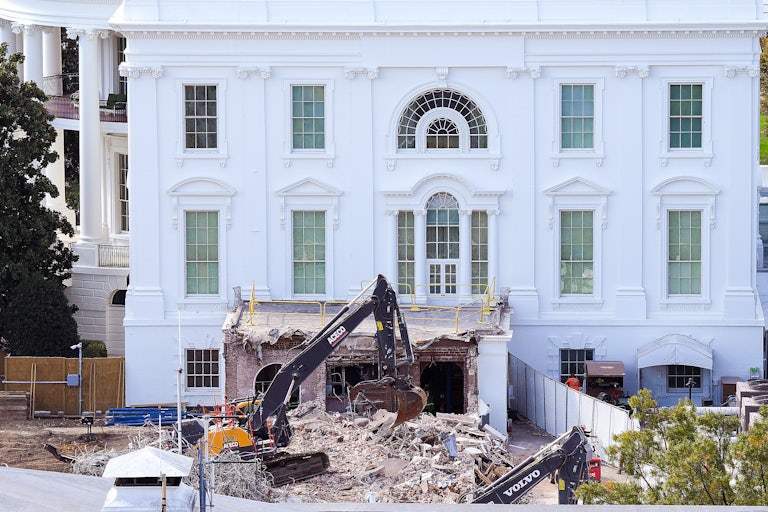
A bulldozer tears down part of the White House.
Eric Lee/Getty Images

President Donald Trump just got hit with a lawsuit over his enormous $300 million ballroom that would dwarf the White House.

In a 65-page complaint filed Friday, the National Trust for Historic Preservation, a nonprofit organization working to save America’s historic places, argued that Trump did not have the constitutional authority to fast-track construction for a project of this scale, and has violated the Administrative Procedures Act and the National Environmental Policy Act.

The lawsuit also notes that Congress is required to approve any construction on federal land, and the White House is located at the White House and President’s Park, a national park.

In October, Trump fired all six members of the Commission on Fine Arts, which is charged with advising the federal government on the art, design, and architectural development of Washington, seeming to clear the way for him to make any changes he likes to the nation’s monuments. A Trump official said the members would be replaced by those who were “more aligned with President Trump’s ‘America First’ policies,” but two months later, the seats still remain empty.

The legal challenge is just the latest issue to complicate Trump’s plans for a behemoth ballroom. Trump has reportedly had a falling-out with his architect, James McCrery II, who argued that the 90,000-square-foot blueprint would overshadow the 55,000-square-foot White House mansion, violating basic architectural principles.

Trump has repeatedly misled the public about the construction process, claiming that the original structure of the White House wouldn’t be touched—before razing the entire East Wing. He also claimed that the project would only cost $200 million, but that number has since ballooned to $300 million.

The privately funded ballroom has presented a golden opportunity for the country’s wealthiest families and biggest corporations to make good with the Trump administration—and a few defense companies like Lockheed Martin and Palantir have also tossed the president some cash for his vanity project.

Trump has repeatedly turned his attention away from actually governing to the destruction of American landmarks. Trump has redone the Oval Office in the gaudy gold style of Mar-a-Lago, added stupid signs and white marble bathrooms to the White House, paved over the Rose Garden, pitched an “Arc de Trump” monument, and the builder in chief recently declared his intention to “fix” the 100-year-old Reflecting Pool on the National Mall in Washington. Fix what, exactly? Your guess is as good as ours.