Breaking News
Breaking News
from Washington and beyond

ICE Barbie Kristi Noem Spirals Under Intense White House Pressure

Trump’s DHS head is melting down and blaming people right and left, according to a new report.

DHS Head Kristi Noem speaks in a hearing.
Win McNamee/Getty Images

Kristi Noem is scrambling to shift blame to her subordinates for not meeting deportation quotas as the Department of Homeland Security descends into an atmosphere of chaos and finger-pointing, according to a new report.

Noem and her right-hand man (and alleged boyfriend) Corey Lewandowski have been playing the blame game, two DHS officials with direct knowledge of the matter told NBC News, setting up acting ICE Director Todd Lyons and Customs and Border Protection Commissioner Rodney Scott to take the fall.

Scott had been excluded from strategic conversations as well as social gatherings, and that department leaders told him he may soon be out of a job, the sources said. Scott was reportedly even worried that Lewandowski was reading his emails.

He’s not the only one with reason to be afraid: The White House is reportedly growing tired with Noem’s brash leadership, especially her relationship with Lewandowski. DHS officials told The Bulwark in early December that she could be out “really soon.”

As the agency leading President Donald Trump’s hallmark deportation campaign, DHS is under a lot of scrutiny. And despite Noem’s efforts to boost numbers by cruelly grabbing people off the street at random, immigrants or not, she’s way behind where the president wants her to be.

Far from Stephen Miller’s brutal goal of 3,000 deportations per day, ICE is reportedly arresting fewer than 1,000 people each day on average. And contrary to Noem’s and Trump’s promises, they are not just going after the “worst of the worst”: More than a third of the people arrested so far have no criminal history at all.
Read more about Kristi Noem:

Trump Admin Is Secretly Giving Names of All Air Travelers to ICE

It’s just the latest evidence we’re living in a dystopia.

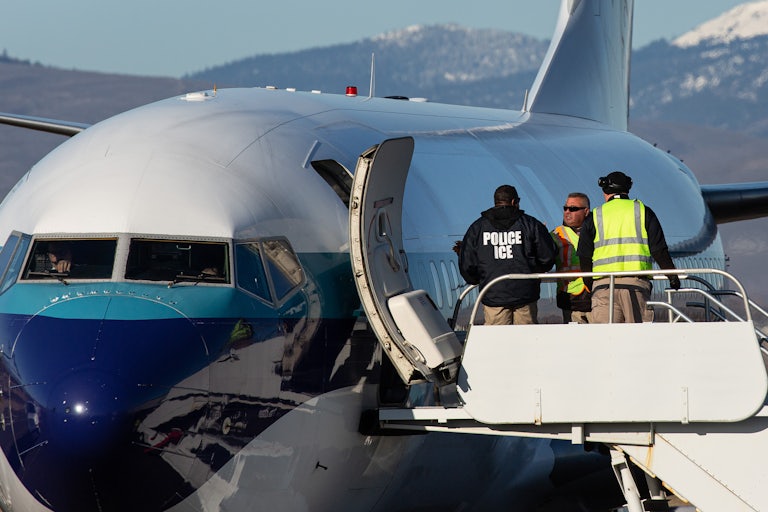
U.S. Immigration and Customs Enforcement agents prepare to board a charter flight in Yakima, Washington.
David Ryder/Getty Images

The Transportation Security Administration is now sharing passenger data with ICE to enable Trump’s mass deportation campaign.

Before Trump, ICE didn’t get involved with domestic travel—and the TSA didn’t concern itself with immigration matters. But since March, according to a new report by The New York Times, the two agencies have quietly been working together to apprehend people at the airport at the command of the Trump administration.

According to the Times, it’s not clear how many arrests have been made so far. But the paper obtained documents that show the program led to the arrest of 19-year-old Any Lucía López Belloza, who was picked up at Boston Logan Airport when trying to visit her family in Texas for Thanksgiving. Two days later, López was deported to Honduras, where she had not been since she was 7 years old.

According to former ICE officials interviewed by the Times, the program can help the agency meet its high deportation quotas—plus, it allows agents to quickly deport those caught, like López.

“The administration has turned routine travel into a force multiplier for removals, potentially identifying thousands who thought they could evade the law simply by boarding a plane,” said former deputy head of ICE in New York City, Scott Mechkowski.

Since Trump took office in January, many in the U.S. have been living in fear. Trump’s deportation campaign has led to the arrest and detention of immigrants and citizens alike. People have been grabbed by ICE off the street, from their apartments, from their places of work. Now the airport is another place that’s no longer safe.

Tricia McLaughlin, a spokesperson for the Department of Homeland Security, expressed no remorse for the position she’s put people in. “The message to those in the country illegally is clear: The only reason you should be flying is to self-deport home,” she said.

“Total Loser”: Sleepless Trump Slams Indiana Republicans

The president is enraged that GOP members didn’t respond to his pressure campaign.

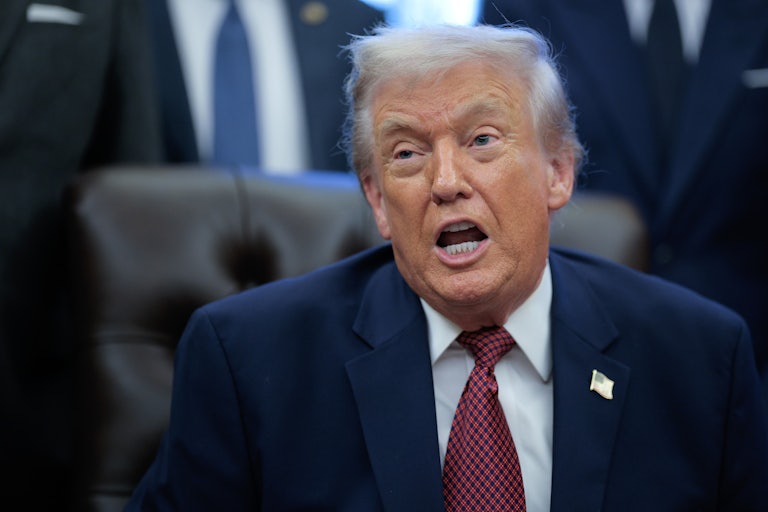
Donald Trump speaks in a meeting at the Oval Office.
Chip Somodevilla/Getty Images

In the wee hours of Saturday morning, the president laid into Republicans who voted against his gerrymandering campaign in Indiana. Perhaps unable to sleep due to the crushing sting of defeat, Donald Trump took to Truth Social close to 1 a.m. to mock and threaten the state’s legislators.

“Republicans in the Indiana State Senate, who voted against a Majority in the U.S. House of Representatives, should be ashamed of themselves,” Trump wrote. “Headed by a total loser named Rod Bray, every one of these people should be “primaried,” and I will be there to help! Indiana, which I won big, is the only state in the Union to do this!”

On Thursday, Indiana lawmakers voted down Trump’s midcycle redistricting push, choosing to keep election maps the same rather than gerrymander them to Republicans’ advantage. For weeks leading up to the vote, the president had been bullying the Hoosier state’s lawmakers in an attempt to shore up support.

After the vote, Trump turned his fury on state Senate President Pro Tempore Rodric Bray, the main opponent to redistricting. Bray believes the state should instead work on flipping a preexisting district rather than blowing up the whole map—a risky move that would narrow Republicans’ margins in the new districts, and could even result in a loss of seats, he told Politico.

Trump has made it clear that if a Republican is unwilling to follow his agenda to the letter, he’ll put his weight behind a primary challenger. Hours before the vote Thursday, he posted, “Rod Bray and his friends won’t be in Politics for long, and I will do everything within my power to make sure that they will not hurt the Republican Party, and our Country, again.”

Read more about Trump’s redistricting fight:

Trump’s DOJ Sues Fulton County and Four States to Seize Voter Ballots

The Justice Department is expanding its effort to gain access to sensitive voter data in key states.

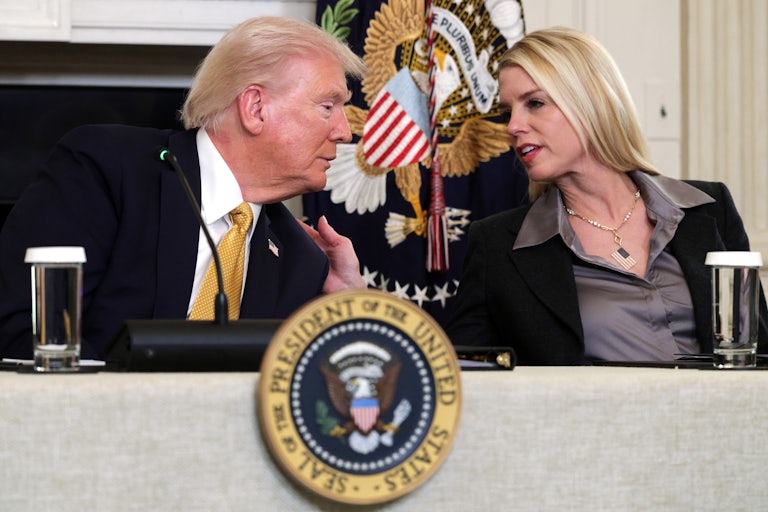
Attorney General Pam Bondi leans over to speak with Donald Trump, placing a hand on his shoulder.
Alex Wong/Getty Images

The Justice Department is dredging up the 2020 presidential election conspiracy.

Attorney General Pam Bondi sued Fulton County officials in Georgia Friday to obtain ballots that were cast in the election. The suit demands that Fulton County turn over “all used and void ballots, stubs of all ballots, signature envelopes, and corresponding envelope digital files.”

The suit was filed the same day as the DOJ announced legal action against four more states—Colorado, Hawaii, Massachusetts, and Nevada—in a sweeping national effort to access sensitive voter data. So far this year, the Trump administration has targeted 18 states, most of them Democratic-led.

It’s the first such instance in which the Justice Department has requested physical ballots. A pro-voting group described the initiative to Democracy Docket as a “terrible overstep of power.”

Since Trump first planted the seeds of doubt about the results of the 2020 election, a litany of his allies have continued to tend and water the theory—so much so that within a handful of years, refusing to admit that Trump ever lost to Joe Biden had become a fealty test for MAGA membership.

But there is no doubt—Trump lost that election by a landslide, coming up short by 38 electoral votes. More evidence that Trump did not win includes the fact that he was not inaugurated in 2021, and did not serve a day as president until he succeeded in 2024.

But for anyone still in doubt, know that the theory has been thoroughly debunked by the president’s own appointees. Trump’s last attorney general, Bill Barr, announced in 2022 that despite an intensive, multi-agency investigation, no evidence of widespread fraud had been discovered that supported the president’s wild claims.

But the theory—and Trump’s innumerable cadre of yes-men—persist.

“At this Department of Justice, we will not permit states to jeopardize the integrity and effectiveness of elections by refusing to abide by our federal elections laws,” Assistant Attorney General for Civil Rights Harmeet Dhillon said in a statement. “If states will not fulfill their duty to protect the integrity of the ballot, we will.”

Republicans Announce Their Next Targets After Indiana Crash and Burn

Fresh off their gerrymandering disaster in Indiana, Republicans are plotting their next moves.

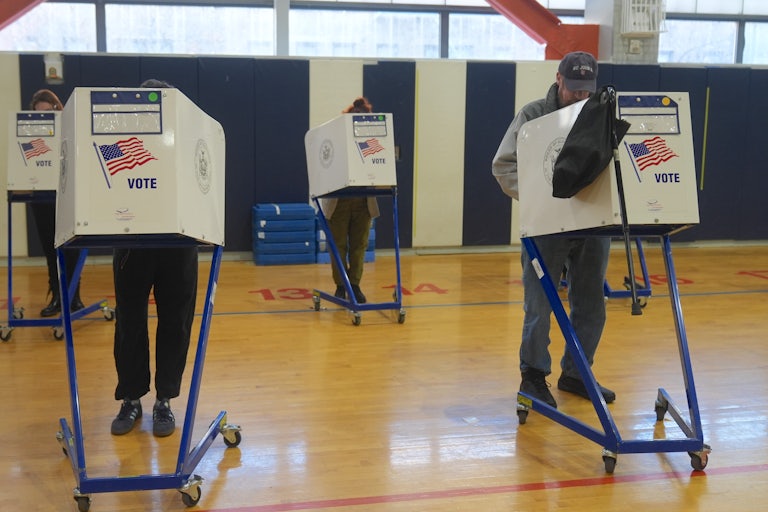
Voters cast their ballots at the polls.
Selcuk Acar/Anadolu/Getty Images

Republicans are scrambling for a next move after President Donald Trump’s humiliating failure to bully Indiana lawmakers into bending to the president’s gerrymandering scheme.

On Thursday, Indiana lawmakers rejected the president’s push for midcycle redistricting in the Hoosier State to ensure Republican victory in the 2026 midterms. Indiana Lieutenant Governor Micah Beckwith claimed that the Trump administration had even threatened to withhold federal funding if they refused—but lawmakers wouldn’t budge.

With the midterms fast approaching and the Republican Party’s prospects looking increasingly grim, Trump’s allies have started to discuss where to turn up the heat next.

“Nebraska and Kansas are two top targets,” wrote Tyler Bowyer, chief operating officer of Turning Point Action, the advocacy arm of Charlie Kirk’s organization, in a post on X Friday.

But even he had to admit that Republicans faced some challenges in those states. “Nebraska did not help the President by passing winner-take-all last year. Not a great sign for redistricting. Kansas is controlled by the Koch HQ,” Bowyer wrote.

In Nebraska, the unicameral legislature requires the support of every Republican to advance redistricting, but 83-year-old state Senator Merv Riepe is not buying in. He previously blocked Trump’s 2024 effort to reshape the state’s split Electoral College vote into a winner-takes-all state, and seems similarly uninterested in supporting his gerrymandering this time around.

“I don’t think it’s a necessity for us,” Riepe said in October.

In Kansas, Republicans haven’t seemed all that anxious to get on board the president’s push for redistricting, either. Republicans will need a two-thirds majority to redraw the maps and override an expected veto from Governor Laura Kelly.

Meanwhile, the Heritage Foundation, the far-right think tank behind Project 2025, this week published a report that listed ending ranked-choice voting as a policy priority in 2026. Michigan is currently the only state circulating a ranked-choice ballot petition, meaning that Republicans are likely to target efforts to impose a new voting system there.