Breaking News
Breaking News
from Washington and beyond

Billionaire Trump Donor Closing U.S. Plant and Moving Work to China

“They’re not answering or returning anyone’s calls,” said the local union leader.

John Paulson, Alina de Almeida, Melania Trump, and Donald Trump smile and pose for photo in front of a pair of large open doors..
Alon Skuy/Getty Images
Donald Trump and Melania Trump arrive at the home of John Paulson with Alina de Almeida on April 6, 2024, in Palm Beach, Florida.

One of President Trump’s oldest donors is closing a manufacturing plant in Ohio and moving it to China, a slap in the face to the American workers he claimed to be fighting for.

Hedge fund billionaire John Paulson plans to offshore the East Lake, Ohio, plant of Conn Selmer, the largest U.S. manufacturer of brass and orchestra instruments.

“We can’t have American producers closing American factories and offshoring. We need to protect American jobs and protect American manufacturing,” Paulson said just last year.

“We came in with a full proposal, fully prepared to bargain, and they started off with a presentation of telling us how bad we were doing,” said UAW Local 2359 president and plant worker Robert Hines. “To go publicly on CNBC to support the Trump administration’s positive views on tariffs and all that stuff, and then you turn around and [say you] want to go send the work right over to China … it’s a slap in our face.”

Paulson raised $50.5 million for Trump during his 2024 presidential campaign. And like Trump, he’s pushed pro–domestic worker rhetoric while leaving those same workers out to dry.

“It’s going to take a lot of money out of East Lake,” Hines said. “We’ve had people come out [and] show love to try to keep the place open, and the company just isn’t open to it. They’re not answering or returning anyone’s calls.”
New Evidence Torpedoes Pam Bondi’s Claim About Trump and Epstein

A DOJ slideshow suggests that the FBI spoke with an Epstein victim who accused President Trump of assault.

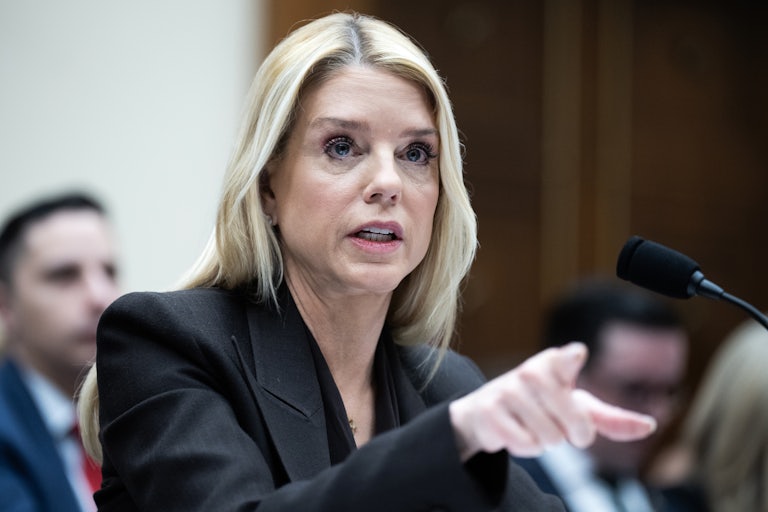
Attorney General Pam Bondi testifies in Congress.
Tom Williams/CQ-Roll Call, Inc/Getty Images
Attorney General Pam Bondi testifies during the House Judiciary Committee hearing titled “Oversight of the U.S. Department of Justice,” on February 11.

Newly uncovered details in the Epstein files reveal that the FBI spoke with a victim who accused Donald Trump of sexual assault, despite Attorney General Pam Bondi’s vehement denial that the Justice Department had any such evidence, as of last week.

Agents apparently spoke with a victim of Jeffrey Epstein who also accused Trump of sexually and violently assaulting her. It is unclear what happened with the investigation, though the government deemed her to be a “credible accuser,” according to independent journalist Roger Sollenberger. A woman with identical biological details sued Epstein’s estate and won a settlement in 2021.

The investigation into the accuser is made apparent on a page titled “prominent names” in an internal, 21-page slideshow cataloguing the Justice Department’s various investigations into Epstein and his longtime criminal associate, Ghislaine Maxwell. Trump’s name is listed in the document, along with two allegations against the sitting president.

“[REDACTED] stated Epstein introduced her to Trump who subsequently forced her head down to his exposed penis which she subsequently bit. In response, Trump punched her in the head and kicked her out,” reads the first entry, noting that the victim would have been between 13 and 15 years old and that the incident took place sometime between 1983 and 1985.

But the second accusation against the president, which involves Trump agreeing with Epstein that a 14-year-old victim was a “good one,” carries a different kind of credibility inside the DOJ, since the person who provided the statement was also used as a key government witness to convict Maxwell, according to the files.

“[REDACTED] remembered Epstein introduced her to Trump saying ‘This is a good one, huh’ and Trump responded ‘Yes’. (date range roughly 1984, [REDACTED] would have been 14),” the slide reads.

Trump was mentioned more than 38,000 times in the latest batch of Epstein files, and was flagged in more than 5,300 files in the document cache.

Yet the White House has continued to vehemently deny that Trump did anything wrong while he was close pals with the child sex trafficker—even as evidence emerges to the contrary.

On Wednesday, Bondi went so far as to claim the Justice Department had no evidence that underage girls were at parties attended by the president. California Representative Ted Lieu then accused Bondi of lying under oath, referring to a document from the FBI’s National Threat Operation Center that illustrated a witness had called the bureau to report such a case in 1995.

ICE Is Gearing Up to Build “Mega” Jails

ICE is planning on spending $38 billion on the project.

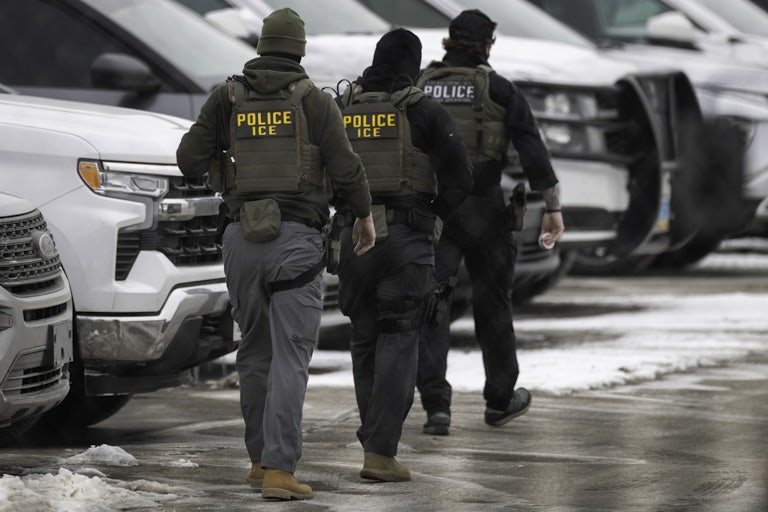
Federal immigration agents walk in a parking lot in Minneapolis, Minnesota
John Moore/Getty Images

Immigration and Customs Enforcement is planning to spend tens of billions of dollars on mega-prisons where the agency can disappear thousands of people.

In a memo shared with New Hampshire Governor Kelly Ayotte, ICE outlined its $38.3 billion plan to launch a “new detention center model” that would expand the agency’s detention capacity by 92,600 beds by the end of FY26.

“This effort aims to meet the growing demand for bedspace and streamline the detention and removal process, focusing on non-traditional facilities built specifically to support ICE’s needs,” the memo said. “This model includes the acquisition and renovation of eight large-scale detention centers and 16 processing sites, as well as the acquisition of 10 existing ‘turnkey’ facilities where ICE ERO already operates.”

The large-scale processing centers, also called “mega-centers,” would house between 7,000 and 10,000 detainees for “periods averaging less than 60 days,” and serve as the site of international removals. Other processing facilities would house between 1,000 and 1,500 detainees for between three and seven days.

Currently, the country’s largest immigration detention facility is Camp East Montana, a 5,000-bed short-term tent facility built at Fort Bliss in El Paso, Texas. Within the first 50 days of operation, the facility had already racked up 60 federal code violations. The facility had failed to provide detainees with regular access to working toilets and showers, substantive meals, or legal assistance, and failed to take mandatory and proper health screenings.

Now Donald Trump wants to build eight more Camp East Montanas—and make them even bigger.

The number of immigrants in U.S. detention has already reached record high levels, surpassing 73,000 detainees in January as a result of the government targeting children, families, immigrants without criminal records, and lawful asylum-seekers. The Trump administration has said it aims to detain 100,000 people at any given time.

More prisons wouldn’t solve the problem of disappearing detainees, address the horrific conditions and lack of health care access at many of these facilities, or ease the steadily climbing number of detainee deaths—they would only provide ICE more cover to move immigrants from state to state in order to skirt legal challenges. An attorney in Minnesota would have to act quickly to stop the deportation of their client from Texas or Florida or someplace else—if they could even figure out where their client got sent.

The memo was sent to Ayotte as part of ongoing talks to open one of these mega prisons in Merrimack, New Hampshire—sparking concerns from state and local leaders.

Alex Pretti Died Defending an EMT. ICE Wouldn’t Let Her Treat Him.

The woman Alex Pretti defended from ICE reveals heartbreaking new details about his killing.

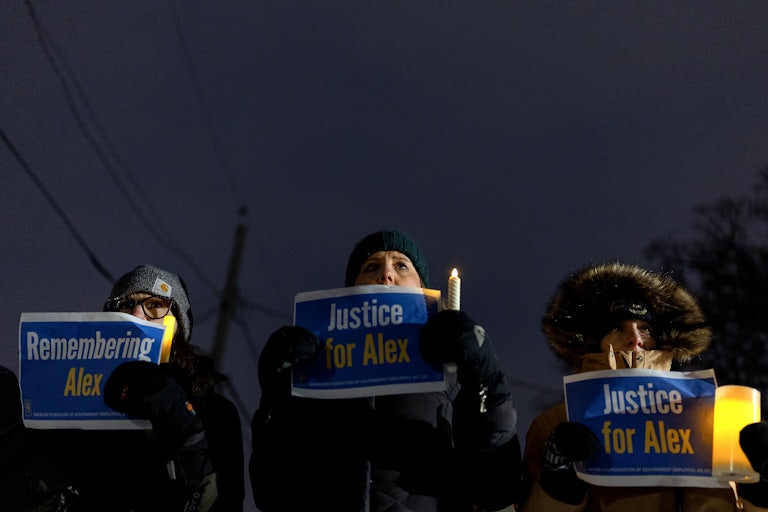
Three people hold up signs in memory of Alex Pretti during a vigil for him in Minneapolis, Minnesota
Carlos Gonzalez/The Minnesota Star Tribune/Getty Images

ICU nurse Alex Pretti was shot and killed by a swarm of ICE agents in Minneapolis moments after he assisted a couple of women. One of them, according to new reports, was also a health care professional—who was denied the chance to help Pretti in his final moments.

In an exclusive interview with The Intercept, the emergency medical technician—whose credentials were reviewed by the outlet but who remained unidentified due to fear of retaliation by the government—claimed she tried to perform CPR on Pretti but was thwarted by a masked ICE agent who restrained her.

“I could tell the second that I laid eyes on him that he was horrifically injured,” the EMT said. “I immediately said, ‘I’m an EMT! He has a brain injury! He has a serious brain injury! I need to help him right now.’”

Moments before Pretti’s death, video captured from onlookers at multiple angles depicted the 37-year-old filming ICE activity before intervening between another protester and an agent who had violently shoved her to the ground. The two protesters were then sprayed with a chemical irritant, and Pretti was ripped away from the other demonstrator while she continued to slip on a mound of snow.

At least seven officers were on top of Pretti, wrestling him to the ground, when one of them, standing above the situation and seemingly supporting the other agents, grabbed his gun and shot Pretti. Video footage captured the sound of 10 gunshots ringing out.

Footage of the seconds that followed capture the EMT’s voice on audio, ringing out that Pretti was suffering “decorticate posturing,” a phenomenon in which the hands and legs curl into the body as a result of brain trauma.

“I was literally begging the agent who was holding me back to let me do CPR,” she recalled. “Because I knew that if he wasn’t pulseless at that point already, he was going to become pulseless very, very soon.”

Then Pretti died. His death was later ruled a homicide by the Hennepin County medical examiner.

The government is constitutionally required to keep people safe once they are in custody. The legal principle is tied to due process, outlined in the Fifth and Fourteenth Amendments. Parameters established by the Department of Justice also stipulate that officers are not allowed to ignore serious medical conditions or risk of harm, such as assault, that could jeopardize an individual’s life. Unfortunately, in Pretti’s case, agents appeared to ignore both of those tenets.

“The responsibility of the government is to make sure that the person in their custody is cared for and alive,” Xavier de Janon, the director of mass defense at the National Lawyers Guild, told The Intercept. “If government agencies fail to keep someone alive and there is proof that it’s their fault, they could be liable for their actions.”

Trump Is Totally Unbothered by El Paso Airspace Closing for a Balloon

Multiple federal departments have lied about why the airspace closed.

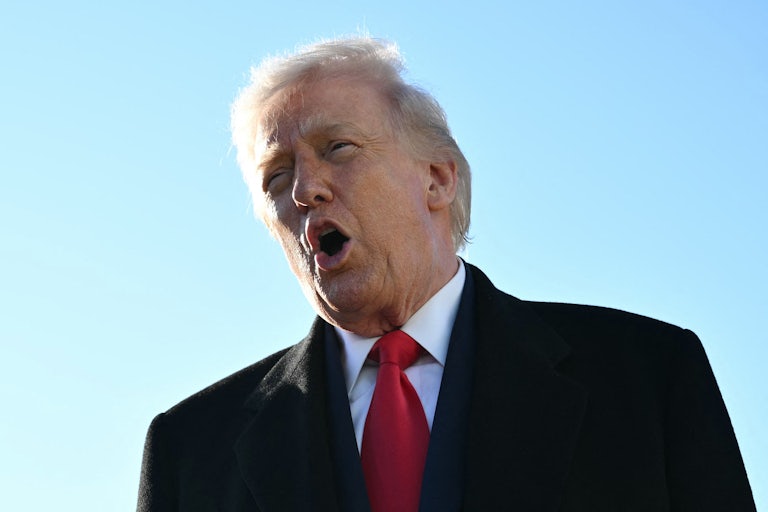
Donald Trump speaks
Mandel NGAN/AFP/Getty Images

President Donald Trump doesn’t seem the slightest bit bothered by the buffoonery that closed the airspace over El Paso, Texas, earlier this week. 

CNN’s DJ Judd asked Trump if he was “pleased” with Transportation Secretary Sean Duffy’s handling of a humiliating incident, in which the Federal Aviation Administration briefly closed the airspace near the southern U.S. border because the military used a high-powered laser to shoot down what ultimately turned out to be a party balloon

“You mean the way it happened?” Trump pressed, and then splayed out his hands in a wide shrug. 

“People learn,” the president sighed. “People learn.” 

On Tuesday, FAA Administrator Bryan Bedford closed El Paso’s airspace “for special security reasons” without telling the White House, the Department of Defense, or the Department of Homeland Security—causing chaos in the surrounding area.

Duffy, along with White House and Pentagon officials, claimed Wednesday that drones dispatched by a Mexican cartel had breached U.S. airspace. The same day, two officials briefed by the Trump administration said the airport had been shut down over security concerns related to DOD’s use of counter-drone technology. 

As it turned out, the Pentagon had sought to expedite testing for an anti-drone laser at Fort Bliss, which is next to El Paso International Airport—and reportedly ended up targeting a rogue balloon instead of an unmanned aircraft. After initially saying that airspace would be closed for 10 days, the agency reversed the decision and reopened the next day.  

“The FAA and DOW acted swiftly to address a cartel drone incursion. The threat has been neutralized, and there is no danger to commercial travel in the region,” Duffy wrote on X Wednesday. “The restrictions have been lifted and normal flights are resuming.”

Duffy has yet to acknowledge that this statement was not actually true. But Trump’s laissez-faire attitude seemed to say it all: He messed up. 

What could Duffy possibly have learned from this incident? I guess he learned not to do it again—if he even knows what he did.