Breaking News
Breaking News
from Washington and beyond

Kristi Noem Is Leaving a “Giant Sh*t Show” Behind at DHS

We may not know the full extent of it until there’s a major disaster in the U.S.

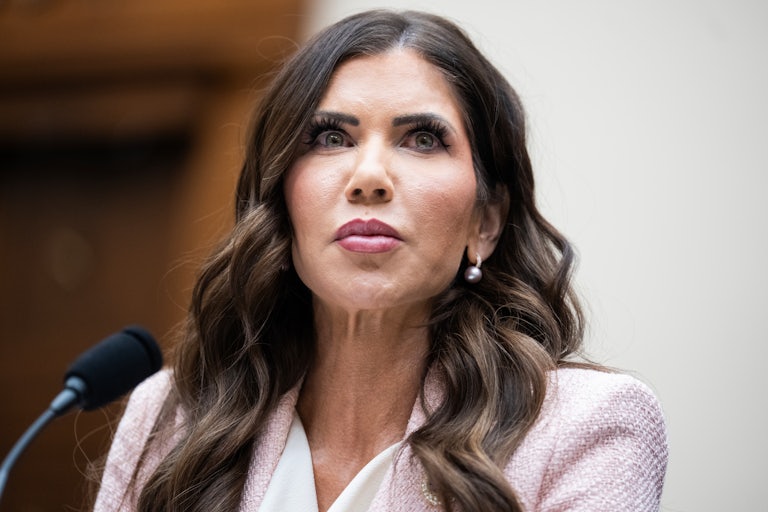
Outgoing Homeland Security Secretary Kristi Noem speaks during a House committee hearing
Heather Diehl/Getty Images

Whoever replaces Kristi Noem is going to have to deal with the mountain of paperwork she’s left behind, as multiple vendors await payments from the Department of Homeland Security, Axios reported Wednesday.

“There’s a mountain of backed-up contracts and invoices on her desk that the new guy will just have to deal with,” a source familiar with the situation at DHS told Axios.

The backlog on Noem’s desk predated the ongoing partial government shutdown, as the result of the outgoing secretary’s policy to personally approve all expenditures above $100,000. Those disruptions are now exacerbated by the shutdown.

Under Noem’s tenure, multiple contracts with immigration detention facilities across the country have lapsed, according to Axios. Camp East Montana, the country’s largest immigration detention facility, had a contract with DHS that expired at the end of February. A contract with a family detention center in Dilley, Texas—which holds dozens of immigrant children—expired at the beginning of March. New Jersey’s Delaney Hall is also operating without a contract, and many small county jails are similarly awaiting payments.

Noem has also delayed distribution of disaster relief funds through the Federal Emergency Management Agency.

A source familiar with FEMA’s delays told Axios that DHS’s front office was a “giant shit-show.”

“The ramifications of her tenure are going to be felt for years and years and years and years,” the source said. “We’re not really going to know exactly how bad it is until we have a major hurricane that unfortunately impacts someplace in the United States.”

Another source familiar with the situation at DHS told Axios that even if Noem’s review policy was reversed and “everything goes back to the way it was … it’s going to take weeks, if not months, of constant work” to restore funding to DHS vendors.

DHS adviser Corey Lewandowski told Axios that the government shutdown limited certain spending, and he insisted that all possible funding had been distributed.

DHS Tries to Seize Massive Government Database With Americans’ Info

The Department of Homeland Security wants access to a database that contains sensitive information on children and domestic violence victims.

U.S. Department of Homeland Security logo
Tom Williams/CQ-Roll Call, Inc/Getty Images

The Department of Homeland Security wants access to the Federal Parent Locator Service, which is considered to be the government’s largest, most detailed database, ProPublica reports.

The database, which Bethanne Barnes of the Administration for Children and Families called “the most powerful people-finder system that the U.S. government has,” exists so that the government can locate parents who owe child support if they move states or change their employment status. It holds the name, Social Security number, address, and pay of every single employed person in the country.

The Locator Service also holds the names of every single child involved in a child support case, along with their gender, birth date, Social Security number, and family members. It also notes if they or their mother have experienced domestic violence—something that potential abusers within law enforcement would be able to see if given access to the database.

Child support workers at the state level have expressed concern that employers will no longer report new hire information to them out of fear of DHS retribution, which in turn will bog down the child support system and hurt children and their parents in the process.

“And if we’re not learning from employers when a parent who owes child support gets a new job, who loses in that situation?” said Kate Cooper Richardson, Oregon’s former child support program lead. “The one in five U.S. children who rely on consistent and regular child support.”

It’s up to the Department of Health and Human Services to approve this access request. It has yet to comment.

Pam Bondi Flees to U.S. Military Base After Reported Spike in Threats

The attorney general has left her apartment and moved into U.S. military housing.

Attorney General Pam Bondi testifies in Congress
ANDREW CABALLERO-REYNOLDS/AFP/Getty Images

Attorney General Pam Bondi has left her apartment in Washington, D.C., and moved to a military base in the area after reportedly facing threats from drug cartels and critics of her handling of the Jeffrey Epstein case.

The New York Times, citing unnamed sources, reports that the move took place within the last month and that federal law enforcement saw an uptick in criticism and threats against Bondi. These threats increased after Venezuelan President Nicolás Maduro was abducted in January. Bondi joins other Trump administration officials who have moved to military housing, including Stephen Miller, Marco Rubio, Kristi Noem, Pete Hegseth, Army Secretary Daniel P. Driscoll, and Navy Secretary John Phelan.

The Trump administration has not disclosed whether any of these officials are paying for their new accommodations, although a spokesperson for Noem, the outgoing Homeland Security secretary, told the Times last year that she was paying “fair-market rent.”

Many of these officials were targeted by protesters upset with the Trump administration’s policies. At his previous residence in Arlington, Virginia, Miller was met with organized protests from a group called Arlington Neighbors United, which put up posters with his address alleging he’d committed “crimes against humanity” and wrote chalk messages on the sidewalk in front of his house saying that “Miller is preying on families.”

These moves to military bases are a hefty cost to taxpayers. Hegseth’s home on “Generals’ Row” at Fort McNair reportedly needed more than $137,000 in renovations before he could move in. Plus, military resources have to be expended to keep political appointees protected on the bases, while taking away homes from service members. If these Trump officials have angered the public enough that they can’t live among them, perhaps they should reexamine whether the administration’s policies are actually welcomed by the people they are supposed to be serving.

Trump Insists Strait of Hormuz Is Safe as Iran Begins Laying Mines

Donald Trump’s claim comes months after the U.S. decommissioned its primary mine-hunting ships in the region.

Donald Trump holds his hand above his eyes and turns and looks to his right
Roberto Schmidt/Getty Images

Iran was laying mines in the Strait of Hormuz while Donald Trump declared he was thinking of taking it over.

At least two people familiar with U.S. intelligence told CNN Tuesday that Iran began laying mines in recent days, but noted that the operation is still in an early phase. They estimated that Iran has so far only laid a few dozen mines and still retains upward of 80 percent to 90 percent of its mine layers, allowing for potentially hundreds of more mine placements within the bottleneck waterway, reported CNN.

The news broke hours after Trump told CBS News that he felt the war was “very complete” and was “thinking about taking [the Strait of Hormuz] over” as a result.

The president’s tune changed very quickly after reports on Iran’s mine operation began to circulate.

“If Iran has put out any mines in the Hormuz Strait, and we have no reports of them doing so, we want them removed, IMMEDIATELY!” Trump wrote on Truth Social. “If for any reason mines were placed, and they are not removed forthwith, the Military consequences to Iran will be at a level never seen before. If, on the other hand, they remove what may have been placed, it will be a giant step in the right direction!”

Minutes later, Trump issued another statement declaring that U.S. forces had “hit and completely destroyed” 10 inactive mine-laying boats in the area.

Situated between Iran and the United Arab Emirates, the Strait of Hormuz is the single most important energy transit point in the world, funneling approximately one-fifth of all crude oil shipments. Tehran has long threatened to close off the strait if Iran were under attack, effectively sealing the only sea passage from the Persian Gulf and the Gulf of Oman to the rest of the open ocean.

The U.S. could be caught in a difficult position if Iran chooses to escalate its mine-laying operation. In January, the Navy decommissioned four Avengers-class mine countermeasures ships that were stationed in the Persian Gulf, reported The War Zone at the time. Despite plans to scrap the boats, the vessels were transported to Philadelphia via a heavy-lift vessel. It was not clear why they were not retained and broken down in the region.

The Navy has deferred the responsibility of mine hunting to a trio of Independence-class littoral combat ships, or LCSs, commonly referred to as “little crappy ships.” Three littoral combat ships, the USS Santa Barbara, the USS Canberra, and the USS Tulsa, are operating near the strait.

The LCSs were constructed for coastal support and combat, but proved neither dependable enough nor strong enough for that mission, lacking adequate firepower. They were also slated for retirement before the war began, Task and Purpose reported in February.

It remains to be seen if the LCSs are capable of countering Iran’s mine operation. The two ship classes are constructed entirely differently: The newer ones feature a metal hull, while the older ships were built with fiberglass-coated wooden hulls to reduce vulnerability. And two of the three LCSs were fitted with operational mine countermeasure packages just last year “after more than a decade of fits, starts, and failed systems,” reported USNI News.

Democrats Launch Probe Into 8-Day-Old Company Behind Kristi Noem’s Ads

The ads are likely the straw that broke the camel’s back on Noem’s tenure at the Department of Homeland Security.

Outgoing Homeland Security Secretary Kristi Noem sits in a House Judiciary Committee hearing
Tom Williams/CQ-Roll Call, Inc/Getty Images

Democratic lawmakers are demanding answers about how Kristi Noem’s Department of Homeland Security awarded a multimillion-dollar contract to an eight-day-old media company.

In a series of letters Tuesday, Senators Richard Blumenthal and Peter Welch requested information and documents from three companies with ties to Noem’s inner circle. The organizations had received a total of $220 million to make a slate of anti-immigrant ads, the backlash to which likely contributed to Noem’s firing earlier this month.

The first letter was to Safe America Media, a company that received a $143 million no-bid contract to produce a number of advertisements for DHS. It was later reported that the company had only been formed eight days before it won the nine-figure government contract.

“As far as we can tell, Safe America Media has no office, no website, and no social media presence,” the lawmakers wrote to Michael McElwain, a veteran Republican operative who appeared to own the property associated with the company.

The second letter was to the Strategy Group, which received a subcontract to work on Safe America Media’s ad campaign, receiving a total of $226,137 for five film shoots, 45 video, and six radio ad spots.

Strategy Group CEO Benjamin Yoho is married to Tricia McLaughlin, a former spokesperson for DHS who departed her role earlier this year. Yoho has a long-standing relationship with Noem, having produced advertisements for her 2022 gubernatorial campaign and beyond. The outgoing secretary was reportedly put in touch with the agency by her alleged paramour and chief adviser, Corey Lewandowski.

McLaughlin claimed on social media that neither Yoho nor the Strategy Group “have ever had a contract with DHS.” But in their letter, Welch and Blumenthal noted that the Strategy Group admitted that it had indeed received a subcontract.

The third letter was to Jay Connaughton, the managing partner at People Who Think, a marketing consulting firm that received a $77 million no-bid contract to produce the same slate of ads. Connaughton is also connected to Lewandowski; the two worked together on Louisiana Governor Jeff Landy’s 2023 campaign.

The lawmakers requested copies of contracts, subcontracts, and invoices, as well as all correspondence between the companies and DHS.

DOGE Goon Took Social Security Data With Him, Whistleblower Says

The Social Security data of millions of Americans could be at risk.

Someone holds a phone with the SSA logo in front of a U.S. flag on another screen.
Marcin Golba/NurPhoto/Getty Images

An employee at Elon Musk’s Department of Government Efficiency may have taken Social Security data with him to a new job, in what would be a major security breach.

The Washington Post reports that the Social Security Administration’s inspector general is looking into a whistleblower complaint that a former DOGE software engineer claimed he had access to two sensitive SSA databases and was planning to share the information with a private employer. Seventy million Americans rely on the SSA, but hundreds of millions are alleged to be affected.

The inspector general told Congress and the Government Accountability Office about the investigation, and the whistleblower spoke with the Post anonymously out of fear of retaliation. The complaint reportedly states that the former DOGE employee worked at the SSA last year before moving to a government contractor in October. He allegedly told several of his co-workers that he had two restricted databases containing U.S. citizens’ private information, with at least one on a thumb drive.

The databases, named “Numident” and the “Master Death File,” contain the Social Security numbers, places and dates of birth, citizenship, race and ethnicity, and parents’ names of over 500 million living and dead Americans. The complaint doesn’t specifically state when the engineer told his co-workers about the databases, but one alleged event took place in January, when the complaint was filed with the inspector general.

The engineer allegedly told the whistleblower that he needed help transferring data from the thumb drive to a personal computer to “sanitize” the data before using it at the company. He then told colleagues that once personal details were scrubbed, he wanted to upload it to his company’s systems. He said to a colleague, who refused to help him out of legal concerns, that he expected a pardon from President Trump if his actions were illegal.

The SSA and the engineer’s company, when contacted by the Post, hadn’t heard of the complaint. They then reportedly looked into the allegations but didn’t find any supporting evidence.

Congressional Democrats informed about the whistleblower complaint were alarmed at the security implications of such a massive data breach.

“Not only has an ex-DOGE bro been accused of running around with the Social Security information of every American on a flash drive, he also may have the ability to edit and manipulate data at the Social Security Administration at will,” said Representative Robert Garcia, the ranking member of the House Committee on Oversight and Government Reform, in a statement. “This is dangerous and outrageous, and Oversight Committee Democrats will fight for transparency and accountability.”

Last year, DOGE employees gained alarming access to sensitive information across government agencies, not just in the SSA. That information could be used for terrifying purposes, including by corporations and foreign actors. If this whistleblower complaint is accurate, the entire country could be at risk.

Leavitt Admits SAVE Act Will Make It Harder for Married Women to Vote

Karoline Leavitt accidentally admitted what opponents of the act have long warned against.

White House press secretary Karoline Leavitt presses her lips together while standing during a press briefing
Alex Wong/Getty Images

Married women will need to update their identification documentation in order to vote if the SAVE America Act passes Congress, according to White House press secretary Karoline Leavitt.

Responding to a reporter’s question Tuesday in the White House briefing room, Leavitt argued that the act—if realized—would not prevent married women from voting. Seconds later, she admitted that the bill actually would require married women and anyone else who has changed their name to re-register before they vote.

“The Democrats have created this myth.… Let me be very clear: The SAVE America Act does not prohibit anyone from voting, with the exception of illegal aliens,” Leavitt said. “As far as married women who have changed their name, if they’ve already registered to vote, they’re entirely unaffected by the SAVE Act. For the small fraction of individuals who have changed their name or their address, they can still register to vote, of course. They just have to go through their state processes to update that documentation.

“This is something that the American people, married women, and minorities—people all across this country who the Democrats are insultingly saying cannot do this—they’re already doing it every day. Going to the Social Security office, going to the DMV. I think it’s frankly insulting,” Leavitt said.

The SAVE America Act suggests numerous amendments to the National Voter Registration Act of 1993, including line items that would abolish mail-in voting, require voters to bring proof of citizenship and proof of residency to register to vote, require voter ID, and mandate voter roll purges every 30 days, an enormous bureaucratic task that would place undue burdens on local election officials.

“This is popular and rooted in common sense,” Leavitt said while outlining the proposed changes, repeating that the alterations were “simple.”

But the act doesn’t stop there. It would also sprinkle in a couple other superficially unrelated regulations, including a federal law to prevent men from competing in women’s sports and a ban on “transgender mutilation surgery.”

“Passing the SAVE America Act is the most important thing that Republicans and, frankly, Democrats can do to strengthen election integrity and protect our democracy,” Leavitt insisted.

Yet the SAVE Act has been anything but popular: Republicans’ first effort to pass the SAVE Act failed in late 2025 under enormous nationwide opposition. Previous versions included demands that Americans bring proof of citizenship to the polls every time they vote, though that stipulation has since been erased.

Donald Trump ordered House Republicans on Monday to pass another revised version of the voter ID bill, even though a previously passed iteration already awaits a Senate vote. The president spent roughly 13 minutes of an hours-long speech on the topic while speaking to conservative lawmakers at his Doral resort, insisting the SAVE America bill should be the party’s “number one priority.”

“It will guarantee the midterms,” Trump said. “If you don’t get it, big trouble, my opinion.”

It is not clear how barring undocumented immigrants—who, along with legal noncitizen residents, already cannot vote—could “guarantee” the outcome of the election. It is far easier to imagine, however, how crowds of perfectly eligible voters could be sent away from the polls due to insufficient documentation. More than half of all Americans do not have a passport, according to a 2023 YouGov survey, and requesting official birth certificate copies can take significant time. What’s more, acquiring passports or copies of a birth certificate costs money that some Americans may not be able to afford.

Further still, it is easy to imagine how state agencies such as the DMV or Social Security offices, which already notoriously feature grueling wait times, could buckle under the stress of millions of Americans suddenly needing to register—particularly as the Trump administration plans to decrease SSA field office visitors by as much as 50 percent.

Addressing the GOP caucus, Trump said that failure is not an option, and underscored that he would not sign any legislation until it passes. In a phone call with NBC News last week, Trump said he would “close government over” the issue.

“I don’t think we should approve anything until this is approved,” Trump said at the Republican retreat.

Trump already tried and failed to implement voter ID in June. At the time, a federal judge excoriated the president’s efforts, arguing that adding layers of difficulty to the voting process would only serve to harm eligible voters by adding significant barriers before they can cast their ballots.

Critics argue that restrictions on the front end of the electoral process—such as one-day voting, mail-in ballots, and requiring day-of voter ID—would minimize voter turnout and limit American democracy’s ability to represent its constituents. This would especially be true in high-density areas such as the nation’s biggest cities, where those stipulations would significantly drain resources (such as the number of volunteers required at voting stations) and require more time to process, potentially leading to more delays that Republicans could weaponize to further restrict voter access.

Trump Energy Sec. Deletes Claim That Navy Is Escorting Oil Tankers

The U.S. Navy has not escorted any tankers through the Strait of Hormuz.

Energy Secretary Chris Wright wears a hard hat and eye protection glasses. He gestures with both hands while speaking at a podium.
Chet Strange/Bloomberg/Getty Images

Energy Secretary Chris Wright deleted a social media post Tuesday claiming that the U.S. Navy had begun escorting oil tankers through the Strait of Hormuz, where hundreds of ships have been stopped amid Donald Trump’s illegal war in Iran. Apparently, it wasn’t true.

Wright’s now-deleted post claimed that the U.S. Navy escorted a ship “to ensure oil remains flowing to global markets.” But no U.S. assets had escorted oil tankers through the Persian Gulf’s essential passageway, military sources told Fox News’s Jen Griffin.

At a White House press briefing Tuesday afternoon, press secretary Karoline Leavitt claimed she hadn’t had a chance to speak with Wright about the post.

“I know the post was taken down pretty quickly, and I can confirm that the U.S. Navy has not escorted a tanker or a vessel at this time,” she said. When pressed on whether there would be consequences for the errant announcement, Leavitt deferred questions to the Department of Energy.

Last week, Trump offered to send the U.S. Navy to escort ships through the essential passageway, but the surplus of stopped ships is likely too great for American assets to assist. On Sunday, more than 1,000 vessels waited to sail through, according to The Wall Street Journal.

Wright pledged on Sunday that “energy will flow soon” through the Strait of Hormuz, and that energy prices were only rising out of concerns that the conflict could become a “drawn-out crisis.”

But the Trump administration has done little to assuage those fears. It’s still unclear how long Trump intends to keep his military campaign going, with Defense Secretary Pete Hegseth saying that the bombing could last up to eight weeks, while U.S. Central Command has been preparing for a campaign that lasts until September. Hegseth announced that Tuesday “will be the most intense day of strikes,” just hours after Trump claimed the war “was very complete.”

Top Democrat Leaves Iran Briefing Worried About Ground Invasion

Senator Richard Blumenthal warned that the U.S. is headed toward putting boots on the ground in Iran.

Senator Richard Blumenthal
Heather Diehl/Getty Images

Democratic Senator Richard Blumenthal offered an alarming message regarding the growing likelihood of U.S. boots on the ground in Iran and the looming prospect of yet another forever war in the Middle East.

“I emerged from this briefing as dissatisfied and angry, frankly, as I have from any past briefing in my 15 years in the Senate,” Blumenthal said after a Senate Armed Services Committee hearing on Tuesday. “I am left with more questions than answers, especially about the cost of the war. My questions have been unanswered, and I will demand answers because the American people deserve to know.”

“I am most concerned about the threat to American lives, of potentially deploying our sons and daughters on the ground in Iran,” he continued. “We seem to be on a path toward deploying American troops on the ground in Iran, to accomplish any of the potential objectives here. And there is also—as disturbingly as anything else—the specter of active, Russian aid to Iran, putting in danger American lives. Literally, Russia seems to be aiding our enemy actively and intensively with intelligence.” Blumenthal alleged that China was helping Iran, as well.

This is the most compelling warning from a government official to date, and directly contradicts President Trump’s claim on Monday that he was “nowhere near” a boots on the ground invasion of Iran. But that statement also pushes back on White House press secretary Karoline Leavitt’s assertion that Trump “does not remove options off of the table” regarding U.S. military presence in Iran.

This war is already incredibly unpopular, and Americans across the political spectrum are questioning what the actual aims and plan of action are here, if not just blatant regime change. If what Blumenthal says is true, national disapproval for the Trump administration could skyrocket.

Trump’s Iran War Is Already Weakening Military Operations Elsewhere

The U.S. military has a limited amount of resources.

A fighter jet touches down on the flight deck of the USS Abraham Lincoln in support of Operation Epic Fury in Iran on February 28.
U.S. Navy/Getty Images
A fighter jet touches down on the flight deck of the USS Abraham Lincoln in support of Operation Epic Fury in Iran, on February 28.

Donald Trump’s war in Iran is weakening U.S. military resources and weapons surpluses around the world.

The Washington Post reports that military assets are being rerouted to the Middle East, including from East Asia, where high-end weapons systems are typically kept to defend against possible action from China and North Korea. Parts of a Terminal High Altitude Area Defense, or THAAD, system are now being moved from South Korea, and Patriot missile interceptors are also being moved from East Asia to defend against Iranian ballistic missiles and drones.

An unnamed official told the Post that the moves were precautionary to defend against a possible increase in Iranian retaliatory attacks, and not due to an immediate weapons shortage in the Middle East. But this puts the U.S. at risk in the places now missing these air defense systems, which are considered the most advanced in the world.

“The more THAADs and Patriots you shoot, the more risk you assume in the Indo-Pacific and in Ukraine,” Mark Cancian, who monitors American weapons inventories at the Center for Strategic and International Studies, told the Post.

Last year, during Israel’s 12-day war with Iran, the U.S. used about 25 percent of its THAAD interceptors, as well as large amounts of ship-borne interceptors. A THAAD battery usually needs 95 soldiers, six truck-mounted launchers, 48 interceptors (eight for each launcher), one radar system, and a fire control and communications component. As of the middle of last year, there were only nine active THAAD batteries worldwide. One of them costs anywhere from $1 billion to $1.8 billion.

Gen. Dan Caine, chairman of the Joint Chiefs of Staff, warned the president last month that a protracted war with Iran could deplete U.S. weapons stockpiles, especially considering other U.S. military actions in at least seven countries, as well as U.S. support for Ukraine. If the U.S. runs low on these systems and needs to buy more, it will cost taxpayers billions of dollars and put national security at risk. It’s abundantly clear that Trump didn’t factor this into his decision to go to war.