Breaking News
Breaking News
from Washington and beyond

Federal Judge Shuts Down DOJ’s “Fishing Expedition” for Voter Data

The Department of Justice is on a losing streak in its quest to seize voter data from states.

Vote Here / Vote Aqui sign
Lane Turner/The Boston Globe/Getty Images

A Trump-appointed federal judge handed down another loss to the Justice Department on Friday, striking down the department’s demand for personal voter information in Rhode Island. 

U.S. District Judge Mary S. McElroy said the DOJ lacked the authority “to conduct the kind of fishing expedition it seeks here.”

“In its September 8, 2025, letter to Secretary Amore (the ‘Demand Letter’), DOJ stated that the purpose of its demand for an unredacted copy of Rhode Island’s statewide voter registration list was ‘to ascertain Rhode Island’s compliance with the list maintenance requirements of the [National Voter Registration Act] and the [Help America Vote Act],’” McElroy wrote in her dismissal of the DOJ lawsuit. “The Demand Letter did not identify any facts suggesting that Rhode Island has not complied with the NVRA and HAVA, and it did not otherwise expressly identify any factual basis for DOJ’s demand.”

The DOJ initially filed the lawsuit as part of its effort to continue Trump’s immigration crackdown and weaponize voter registration information in deep-blue states. But now Rhode Island has become the fifth state—along with California, Michigan, Massachusetts, and Orgeon—to reject Trump’s meddling. 

“Neither the NVRA nor HAVA authorize DOJ to conduct the kind of fishing expedition it seeks here,” McElroy concluded. “As such, for the foregoing reasons, the Court DENIES the United States’ Motion to Compel Production and GRANTS Defendants’ Motions to Dismiss.”  

That leaves Assistant Attorney General Harmeet Dhillon with zero wins and five losses on her voting records lawsuits, with 25 states still waiting on decisions. 
Trump Begs Everyone to Praise Him on Iran in Massive Crashout

Donald Trump posted eight times in less than an hour about how great he is.

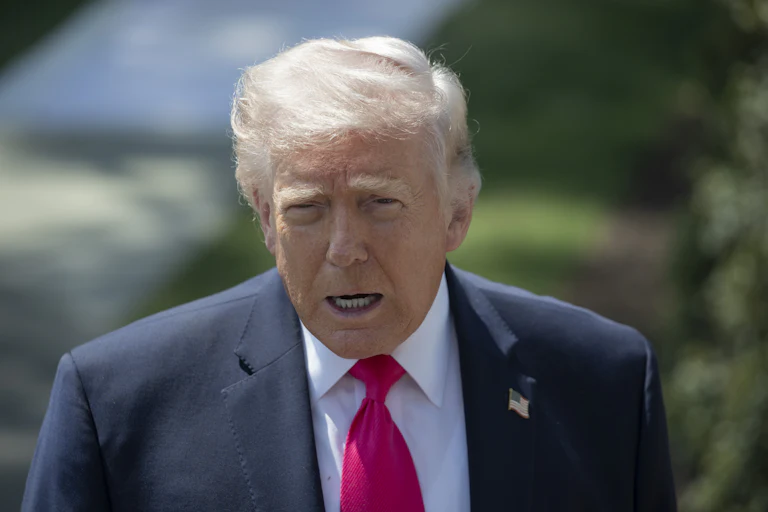
Donald Trump speaks to reporters outside the White House
Celal Gunes/Anadolu/Getty Images

Iran reopened the Strait of Hormuz on Friday, marking the end of a multi-week trade embargo that massively exacerbated oil and gas costs around the globe.

Donald Trump, however, was not happy.

The president went on a social media bender as the news came in, complaining that he had not received enough credit for his handling of the war (that he started) while optimistically suggesting that the war was already over, despite lacking a concrete peace deal.

“The Failing New York Times, FAKE NEWS CNN, and others, just don’t know what to do,” Trump wrote on Truth Social. “They are desperately looking for a reason to criticize President Donald J. Trump on the Iran situation, but just can’t find it. Why don’t they just say, at the right time, JOB WELL DONE, MR. PRESIDENT, and start to gain back their credibility???”

In a series of posts, Trump incorrectly referred to the vital waterway as the “STRAIT OF IRAN,” and declared that the U.S. blockade on the strait would “REMAIN IN FULL FORCE AND EFFECT AS IT PERTAINS TO IRAN, ONLY, UNTIL SUCH TIME AS OUR TRANSACTION WITH IRAN IS 100% COMPLETE.”

“Iran has agreed to never close the Strait of Hormuz again,” Trump declared in a separate post. “It will no longer be used as a weapon against the World!”

Trump thanked Saudi Arabia, the United Arab Emirates, and Qatar for their involvement in the peace negotiations, and stated that while any potential peace deal will not pertain to Lebanon, he would eventually “MAKE LEBANON GREAT AGAIN.” At the same time, the president slammed America’s NATO allies, claiming in a separate post that the coalition had called to offer help in the region in the wake of the strait’s reopening.

“I TOLD THEM TO STAY AWAY, UNLESS THEY JUST WANT TO LOAD UP THEIR SHIPS WITH OIL. They were useless when needed, a Paper Tiger!” Trump said.

Earlier this week, France and the U.K. agreed to cohost a summit with more than 40 nations to “restore freedom of navigation” along the waterway. Its results, however, were dependent on a peace deal, according to British Prime Minister Keir Starmer.

The war in Iran has thrust the entire world into an energy crisis, spiking oil and gas prices, stalling movement, and tanking economies. At the time of publication, Brent crude—a global oil benchmark—had dropped to around $89 per barrel. Last month, the cost reached a high of $108 per barrel—a dramatic increase from before the war started in late February, when Brent crude cost around $65 a barrel.

It is not clear exactly what the war in Iran has accomplished. Together, the U.S. and Israel have killed thousands of Iranian civilians and obliterated Iranian civilian infrastructure. Meanwhile, 13 U.S. soldiers have died. The war also spiked the cost of living for people around the world, agitated international relations—particularly between the U.S. and longtime allies in the Western hemisphere—cost American taxpayers over $50 billion, and sparked a political rejection of MAGA ideology across the U.S.

Trump has previously stated that his primary objective in the war was to erase Iran’s nuclear capabilities—but his administration’s battle assessments have stood in contrast to other attacks they boasted about as recently as last year.

Prior to the war—which never obtained congressional approval—Trump ordered strikes on three of Iran’s nuclear sites, hitting Fordo, Natanz, and Isfahan on June 22, 2025. At the time, the Trump administration claimed that the one-off air raid had set Iran’s program back by “years.”

Photo of Mystery Meat on U.S. Warships Goes Viral as Supplies Dwindle

Photos of the meals being served to service members are sparking concerns about rationing in the U.S. military.

U.S. Navy aircraft carrier USS Gerald R. Ford
ELVIS BARUKCIC/AFP/Getty Images
U.S. Navy aircraft carrier USS Gerald R. Ford

U.S. soldiers stationed in the Middle East are getting fed mystery meat and single tortillas because of the U.S.-Israeli war on Iran and Lebanon.

The Military Postal Service Agency and USPS have indefinitely suspended all mail to U.S. warships and zip codes in the Middle East. Family members of two service members—one aboard the USS Tripoli and another aboard the USS Abraham Lincolnshared photos with USA Today showing what that suspension was forcing them to eat while warring on Iran—even as their families sent them packages filled with homemade desserts, candy, and clothes.

One image shows a single dreary tortilla alongside a lump of what looks to be pulled pork or chicken. The other shows two horrid-looking slabs of meat alongside a pile of sliced carrots.

And the food is starting to run low. Dan F., a former Marine whose daughter is serving aboard the USS Tripoli, told USA Today that his daughter reported no fresh produce, low stock of hygiene products, and rationing of all non-perishable food.

X screenshot OSINTdefender @sentdefender Pictures published by USA Today show meals served recently to Sailors onboard the Nimitz-class aircraft carrier, USS Abraham Lincoln (CVN-72), as well as Marines serving on the USS Tripoli (LHA-7), an America-class amphibious assault ship, both of which are currently deployed to the Arabian Sea in order to enforce the ongoing naval blockade against coastal areas of Iran. (photos)

“The food is tasteless and there’s not nearly enough and they’re hungry all the time,” said Karen Erskine-Valentine of West Virginia, a pastor whose congregation member has a son on the USS Abraham Lincoln. “That kind of breaks your heart.”

“We have the strongest military in the world. You shouldn’t be running out of food, and you shouldn’t not be able to get mail on the ship,” Dan F. said. “The one thing we had over our adversaries [was] we fed our people.”

USPS and the Military Postal Service Agency announced the suspension earlier this month due to “airspace closures and other logistical impacts from the ongoing conflict,” according to Army spokesperson Major Travis Shaw. “Resumption of mail service is contingent upon the reopening of airspace by civil authorities, and the area commander’s evaluation of regional transportation and distribution stability.”

Trump Fumes Over Report He’s Considering Giving Iran $20 Billion

A jaw-dropping report reveals Trump is willing to give Iran billions as part of a nuclear deal.

Donald Trump speaks with reporters outside the White House
Anna Moneymaker/Getty Images

Donald Trump doesn’t want anyone to think that he’s giving Iran money.

The president posted on his Truth Social account Friday about a plan to end the war between the U.S. and Iran, and stressed that “no money will exchange hands in any way, shape, or form.”

That’s despite a report from Axios that the U.S. is considering releasing $20 billion in frozen Iranian assets in exchange for the country’s stockpile of enriched uranium.

The report states that the two countries are discussing a three-page plan, and could send negotiators to Pakistan this weekend to try and finalize it. Iran reportedly has close to 2,000 kilograms of enriched uranium buried in underground nuclear facilities. The talks concern what specifically will happen to the uranium, and how many Iranian assets will be unfrozen.

In earlier discussions, the U.S. was willing to release $6 billion to Iran for humanitarian relief, while the Iranians wanted $27 billion, according to Axios. The White House also wanted Iran to send its uranium to the U.S., while Iran sought to instead lower its enrichment through a process called downblending. Now, the two sides are considering a compromise in which some uranium would be sent to a third country while the rest would be downblended with international supervision.

If the U.S. does agree to release Iranian assets, Trump would be in effect doing what he and other Republicans criticized former President Barack Obama for: unfreezing Iranian money as part of an international agreement. As part of the nuclear deal Obama reached with Iran during his presidency, the U.S. lifted sanctions that froze Iranian government funds held in foreign banks and sent $1.7 billion to settle decades-old failed contracts between the two countries.

Back then, Trump and other Republicans made unfounded and fantastical claims that the U.S. was bribing Iran because the country was releasing American prisoners at the same time. If Iranian assets end up being unfrozen now, Trump and the GOP will make all kinds of excuses about how it’s different this time.

Trump, 79, Forgets Who Was President Last Year

Donald Trump accidentally insulted himself when discussing the 2025 economy.

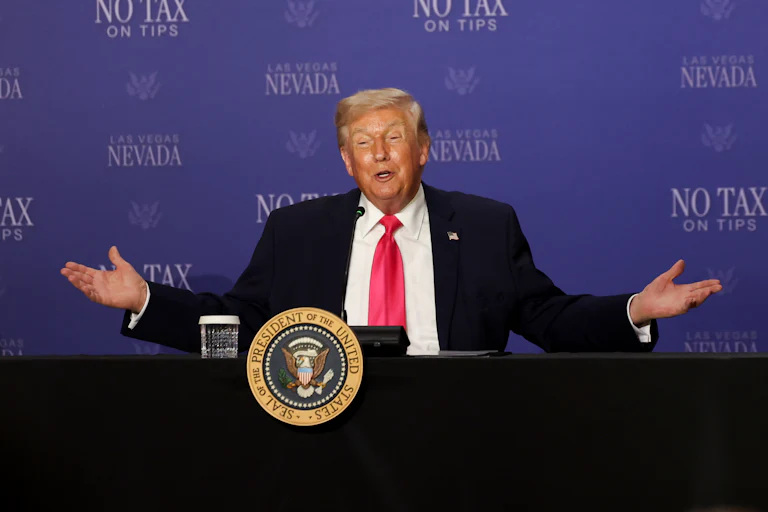
Donald Trump holds his arms out to the side while sitting at a table
Ian Maule/Bloomberg/Getty Images

Donald Trump had several gripes while speaking at his “no tax on tips” event in Las Vegas Thursday evening. Yet in an incredible mental lapse, one of Trump’s points of frustration was about who the president was in 2025.

“A year ago, our country was an embarrassment,” Trump said. “All over the world, they laughed at us. And they don’t laugh anymore, they are not laughing.”

It’s just the latest indication that something could be seriously wrong with the president’s brain. Over the first year and change of his second term, Trump’s speeches have become more disjointed and incoherent, and his behavior has grown increasingly erratic, sparking concerns across the country about his health and aptitude for the country’s biggest job.

Just last week, Trump attacked several of his longest allies, claimed via a social media post that he would completely annihilate Iranian civilization, and started beef with Pope Leo XIV, claiming that the Catholic pontiff was “weak on crime.”

This week, Trump forgot when Supreme Court Justice Ruth Bader Ginsburg died, and that one of his most fervent GOP critics—North Carolina Republican Thom Tillis—is still in the Senate. Trump also opted to go to a UFC tournament instead of overseeing his administration’s peace talks with Iran, and DoorDashed McDonalds to the Oval Office in a PR stunt that even he retroactively admitted was “tacky.”

HIs behavior has elicited a cultural shift on the ideological left and right. A group of MAGA thought leaders—including Alex Jones, Candace Owens, Tucker Carlson, and Megyn Kelly—have denounced Trump’s recent behavior as it relates to the war in Iran, as well as his mass disavowal of his own political acolytes.

Liberal lawmakers, meanwhile, have invoked the Twenty-Fifth Amendment to formally challenge Trump’s mental acuity. Fifty House Democrats filed legislation on Wednesday to create a commission that could shove Trump out of power and install Vice President JD Vance as his replacement.

Other Democrats have called for the president to have his brain tested by the end of the month. House Judiciary Committee ranking member Jamie Raskin last week demanded that Trump undergo another cognitive test by April 25, citing Trump’s escalating aggression toward Iran.

House Judiciary Investigates Kushner: “Pawn of the Saudi Monarchy”

House Committee Democrats are investigating Jared Kushner for his obvious corruption.

Jared Kushner
Ludovic MARIN/AFP/Getty Images
Jared Kushner

Democrats on the House Judiciary Committee are investigating Jared Kushner over conflicts of interest between his business activities and his work as a peace negotiator for the Trump administration.

Representative Jamie Raskin, the ranking member of the committee, sent a letter to Kushner arguing his job managing the private equity firm Affinity Partners and his diplomatic work for the president—who happens to be his father-in-law—have “been haunting American foreign policy since President Trump returned to Washington in 2025.”

“You cannot both be a diplomat and a financial pawn of the Saudi monarchy at the same time; you cannot faithfully represent the United States with billions of dollars in Saudi and Emirati cash burning a hole in every pocket of every suit you own,” Raskin wrote, referring to Affinity Partners’s extensive investments from “Saudi Arabia and other Gulf oil autocracies.”

“Your clients Saudi Arabia and the Royal Crown Prince Mohammed Bin Salman have unique and significant strategic, economic and political interests that are certain to diverge sharply from the strategic, economic and political interests of the American people,” Raskin’s letter states.

“When you approach negotiations related to the catastrophic Iran War, the prospect of prolonged military conflict there, the rights of women and religious minorities in the Middle East or the closure of the Strait of Hormuz, are you representing 100% the interests of your business partners in Saudi Arabia and other Gulf oil autocracies or are you representing 100% the interests of the American people?”

Kushner secured $2 billion in funding for his firm from the Saudi Public Investment Fund six months after Trump’s first term ended. The firm is also bankrolled by Qatar and the United Arab Emirates. At the same time, he has served as a negotiator between Ukraine and Russia and in U.S.-Iran talks, while also being involved in Trump’s “Board of Peace” in Gaza. Still, Kushner has no official government position, which means he can claim that he isn’t subject to legal requirements about his financial interests.

In his letter, Raskin requested extensive records from Kushner, including his business dealings, his communications on behalf of the Trump administration, corporate information about his investment firm, and communications with foreign governments. Kushner is not likely to comply, especially considering that Democrats don’t have control of Congress. But come November, that could change, giving Raskin and other Democrats stronger investigative and subpoena powers.

Late-Night Republican Revolt Derails Trump’s FISA Surveillance Plan

Republican infighting is preventing them from renewing the controversial surveillance law.

House Speaker Mike Johnson speaking
Samuel Corum/Getty Images
House Speaker Mike Johnson

GOP leadership tried and failed to force President Trump’s long-term Foreign Intelligence Surveillance Act (FISA) extension through the House in the dead of night on Friday, as 20 Republicans joined Democrats to derail both the five-year and 18-month renewal plans for the contentious spying program. Instead, after back-to-back failed votes, they agreed to a mere 10-day extension shortly after 2 a.m.

“We just defeated [Speaker Mike] Johnson’s efforts to sneak through a five-year FISA authorization tonight,” Democratic Representative Ro Khanna said. “Now, they will have to fight in daylight.”

Four Democrats, including Jim Hines, broke with the party to try and help Johnson force the original FISA plans through. Not only did they fail, they drew even more attention to the surveillance bill that has been criticized by both the left and right for years.

“Speaker Johnson (R-LA) and Rep. Jim Himes (‘D’-CT), in EXTREMELY poor form and bad faith, tried to sneak through a FISA reauthorization missing key privacy protections at 2am last night,” Drop Site News’s Julian Andreone wrote on X. “This was a deliberate and bipartisan attempt to subvert the democratic will of the American people, turning over mass surveillance powers to Trump, including the ability to monitor your emails, search history, online dating matches, and even buy your commercial data.”

The vote now heads to the Senate, even as the program expires on Monday.

Progressive Democrat Wins Special Election in Huge Rejection of AIPAC

Analilia Mejia was backed by Senator Bernie Sanders and Representative Alexandria Ocasio-Cortez.

Analilia Mejia raises her arms and smiles with her mouth open while walking on stage. She holds a piece of paper in one hand.
Adam Gray/Bloomberg/Getty Images
Analilia Mejia

Voters in New Jersey were hungry for change—so they elected a progressive Democrat.

Analilia Mejia won in a landslide in New Jersey’s 11th congressional district Thursday, beating out her Republican opponent Joe Hathaway to serve the remainder of former Representative Mikie Sherrill’s term. Sherrill’s seat was left suddenly vacant after she won the state’s gubernatorial election.

The daughter of Colombian and Dominican immigrants, Mejia ran on an adamantly anti–Donald Trump message and secured a whopping 70 percent of the vote as a result. The Associated Press called her victory shortly after the votes started rolling in.

Mejia, a co-director of the nonprofit progressive advocacy group Center for Popular Democracy, had previously served as the national political director of Senator Bernie Sanders’s 2020 presidential campaign—a detail that Republicans cited ahead of the election to claim that the 47-year-old activist was too extreme and too left. Voters in the northern New Jersey district did not agree.

“I think we’ve been tilting a little bit more to the right lately, which worries me,” Saran Cunningham, an 86-year-old retired special educator in the area, told The Guardian before the results rolled in. “I think that we need people in Congress who will fight for things that will help people as opposed to hurting them.”

Mejia was endorsed by Sanders, as well as New York Representative Alexandria Ocasio-Cortez and Massachusetts Senator Elizabeth Warren.

The progressive Democrat’s positions echo several of the policies that made Sanders a national phenomenon, including support for universal health care coverage, tuition-free college, student loan forgiveness programs, and strengthening unions and expanding labor protections in order to bolster America’s middle class.

But she believes that it’s some of her more independent views that have made her stand out to voters. In February, ahead of the primary election, Mejia credited her ardent opposition to ICE and the agency’s violent “overreach” as a defining policy point that connected with voters.

Mejia has also been vocal in her criticism of Israel, publicly denouncing the state’s war on Palestine as a genocide. That caught the attention of the American Israel Public Affairs Committee, which funneled money into the race to bolster her opponents. In the end, the pro-Israel lobby’s efforts may have been one of the reasons that voters in New Jersey sent Mejia to Congress.

In a fiery victory speech Thursday, Mejia told a cheering crowd that her election was the beginning of a crusade against power that has a ​​“stranglehold over every aspect of our lives.”

Mejia does not yet have a concrete date for when she will start her term.

Trump, 79, Insists He’s Never Heard of a “Corner Store” Before

Donald Trump made the bizarre and out-of-touch remark during an event about affordability.

Donald Trump stands with his fist raised and his mouth open
Ian Maule/Bloomberg/Getty Images

Does President Donald Trump really not know what a corner store is?

Speaking about taxes Thursday in Las Vegas, Trump’s apparent contempt for even discussing affordability was on full display, as he joked he had no idea what a corner store was.

“The Great Big Beautiful Bill also slashed taxes on millions of American small businesses, including restaurants, dry cleaners, corner stores—what is a corner store? I’ve never heard that term,” he said.

“I know what a corner store is, but I’ve never heard it described. A corner store. Who the hell wrote that, please?”

Like Trump’s campaign remark that groceries are an “old-fashioned” thing, his latest comment demonstrates just how far removed he is from Americans’ everyday lives.

That’s how he’s able to claim with a straight face that the U.S. economy is in good shape, even as Americans struggle to pay for gas, suffering through heightened inflation and a jobless boom.

Trump’s manner of reading speeches for the first time, struggling to understand or even pronounce the words, is also concerning for the oldest person to be elected president. Trump, who grew up in New York City, can’t possibly claim to not know what a corner store is—unless he actually forgot.

Trump Dodges Key Question on Strait of Hormuz Blockade

Who knows how long the blockade will last?

Donald Trump speaks to reporters outside the White House
Anna Moneymaker/Getty Images

The U.S. seems ready to block Iran’s primary oil tradeway “indefinitely.”

Donald Trump dodged questions Thursday about a lack of progress at the Strait of Hormuz, instead claiming that “no ship” was passing the blockade that the U.S. had imposed on the waterway at the beginning of the week.

“How long can you sustain the blockade on the Strait of Hormuz?” asked a reporter.

“We’re doing very well with the blockade, it’s very routine for us, the Navy is incredible. And I think the blockade is doing very well. No ship is even thinking about entering, no ship is going past our Navy,” said Trump.

But that’s not true. Data obtained by Reuters indicated that the president’s blockade hardly affected traffic on the waterway the first day it was imposed, and at least one U.S.-sanctioned Chinese tanker sailed right by.

White House deputy chief of staff Stephen Miller told Fox News earlier in the week that America’s military could keep up the pressure campaign forever.

“This embargo is squeezing the economic life out of the Iranian regime. The United States has the capacity to continue this indefinitely if Iran chooses the wrong path,” Miller said Wednesday night, further claiming that Trump had made energy costs a priority ahead of the war in Iran.

Meanwhile, Americans and their wallets are hurting. Gas prices across the U.S. have surged beyond $4 a gallon. In five states—California, Hawaii, Nevada, Oregon, and Washington—gas has risen above an average of $5 a gallon. The soaring price has driven up the cost of practically everything else, as inflated transportation and shipping prices get offloaded to customers. Trump warned Tuesday that the cost of gas “could be the same or maybe a little bit higher” come midterm season.

As Trump’s two-week ceasefire in Iran comes to a close, it’s becoming less and less clear as to when exactly the war will end, and whether the U.S. has made any meaningful progress in its peace negotiations. Trump has repeated that the “war can be over very soon,” though talks to end it have so far fallen apart.