Breaking News
Breaking News
from Washington and beyond

Democratic Congressman, 80, Dies in Office After Announcing Reelection

Democratic Representative David Scott had a terrible habit of not voting in elections.

Representative David Scott speaks in a congressional hearing.
Bill Clark/CQ-Roll Call, Inc/Getty Images
Representative David Scott in 2025

Democratic Representative David Scott of Georgia has passed away at the age of 80.

Scott has spent 50 years in politics, and was set to run for a 13th term in George’s 13th congressional district this year, the Atlanta Journal-Constitution reports, despite a visible decline in his mental acuity.

One of his primary opponents, Georgia state Representative Dr. Jasmine Clark, discovered last November through a public records request that Scott has not voted in the past six consecutive elections, including the 2024 presidential election.

“Our right to vote is sacred and constantly under attack. I cannot fathom any elected official asking his constituents for their votes every two years without even bothering to go vote himself,” Clark posted on X at the time, claiming that Scott wasn’t even a resident of the district.

There have been other signs of concern. In February of last year, Scott gave a long, incoherent speech about tariffs on the House floor before his microphone was cut off. In December 2024, just after he was reelected, Scott cursed at a photographer for taking his picture while being pushed in a wheelchair outside of the Capitol.

Scott’s mental and physical state was well-known on Capitol Hill, and his decision to run again in 2024 shocked colleagues, staff, and lobbyists. Many of them told Politico in February of that year that the then-ranking member of the House Agriculture Committee had issues with detailed conversations and often had to rely on a script.

Scott is the fourth Democratic member of Congress to pass away since the beginning of Trump’s term, joining Representatives Gerry Connolly, Sylvester Turner, and Raúl Grijalva. All of them were over the age of 70 representing safe Democratic districts.

This story has been updated.
Trump Plans to Bail Out Spirit Airlines With Your Taxpayer Dollars

The Trump administration is considering a massive rescue package for the budget airline.

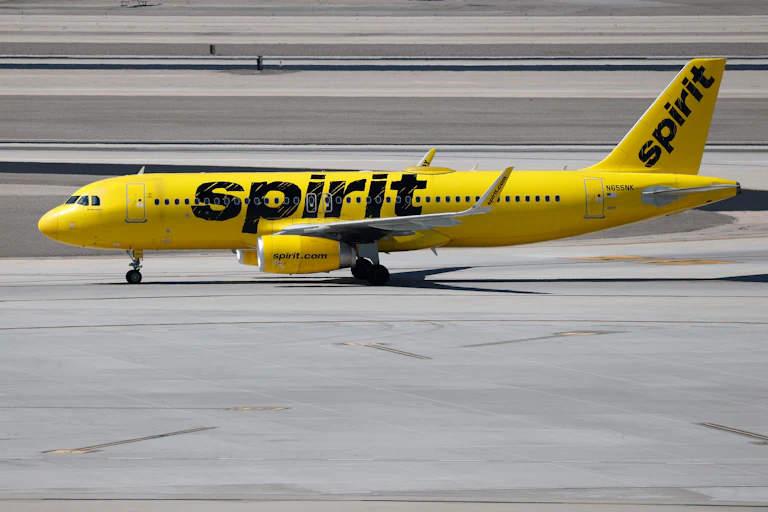
Spirit Airlines plane
Kevin Carter/Getty Images

The Trump administration is considering a bailout for Spirit Airlines, which could be a loan worth as much as $500 million.

The Wall Street Journal reported Wednesday that the proposed deal could give the federal government warrants for a large stake in the company, and that the Transportation Department and Commerce Department are part of the discussions. Nothing has been finalized yet.

The budget airline, known (and frequently mocked) for its bare-bones offerings, has been struggling after declaring its second bankruptcy in less than a year. Last week, CNBC reported that Spirit could be liquidated in less than a week, with skyrocketing fuel prices adding to the company’s woes. The airline never recovered from the Covid-19 pandemic, as wages and costs shot up.

The airline was also hurt as the domestic flight industry became oversaturated, and a 2023 engine recall for its Airbus planes only made things worse. A merger with JetBlue Airways was blocked in 2024, and the company lost $257 million between March 2025, when it exited its first bankruptcy, and the end of June that year. The company then filed for bankruptcy a second time.

On Tuesday, President Trump lamented the airline’s woes, floating a bailout in an interview with CNBC.

“You know, Spirit’s in trouble, and I’d love somebody to buy Spirit. It’s 14,000 jobs, and maybe the federal government should help that one out. I told my people,” Trump said.

But why should American taxpayers bail out an airline? The last time the government intervened to help air carriers was after the Covid-19 pandemic; before that, it was following the 9/11 attacks. Both of those interventions were for companies across the industry, not one singular airline. On Tuesday, Transportation Secretary Sean Duffy expressed reservations about the proposed bailout.

“What we don’t want to do is put good money after bad, and there’s been a lot of money thrown at Spirit, and they haven’t found their way into profitability,” Duffy told Reuters. “And so would we just ​forestall the inevitable and then own that?”

Duffy seems to have been overruled in the past day, raising questions about the administration’s motive for seeking to save Spirit. Does Trump, one of his business allies, or even his fellow Republicans have a stake in keeping the south Florida–based company afloat?

Kash Patel Snaps When He’s Fact-Checked About Own Lawsuit to His Face

Patel’s lawsuit against The Atlantic states he was temporarily locked out of his government computer.

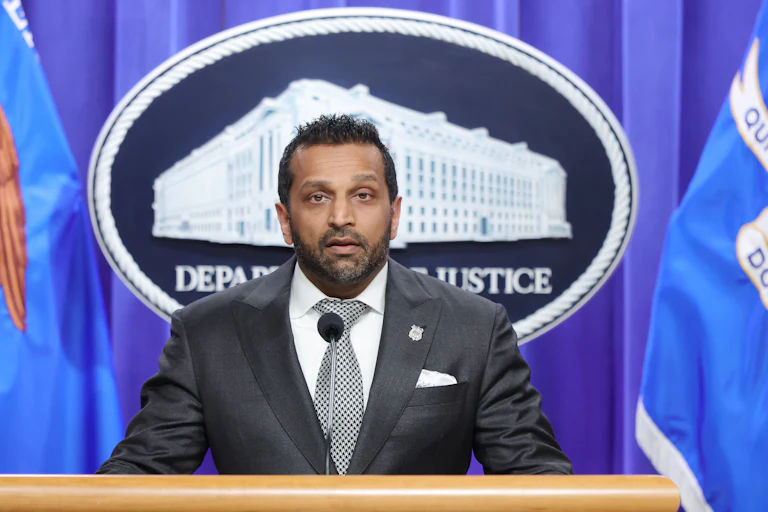
FBI Director Kash Patel speaks at a podium
Anna Moneymaker/Getty Images

FBI Director Kash Patel appeared to lie to reporters Tuesday about having a major meltdown over IT problems—contradicting his own $250 million defamation lawsuit in the process.

The Atlantic reported over the weekend that Patel lost his cool earlier this month when, unable to log into his work computer in the morning, he made a number of frantic phone calls claiming he’d been fired.

In his lawsuit against the publication, filed Monday, lawyers for Patel claimed the assertion he “engaged in a ‘freak out’” was false. “Director Patel had a routine technical problem logging into a government system, which was quickly fixed,” the lawsuit said.

But speaking to reporters Tuesday evening, Patel fell apart at the simplest question about the article, and claimed that he was “never locked out” of his computer in the first place.

“Your lawsuit contends that you were not able to log in to the system. What did you think after you were unable to log in to the system?” one reporter asked.

“Let’s have a survey: How many of you people believe that’s true?” Patel asked the crowd. The same reporter then asked Patel whether he communicated to anyone that he believed he was fired, and pressed him to answer the “straightforward question.”

“The problem with you and your baseless reporting is that it is an absolute lie. It was never said. It never happened,” Patel said, but the reporter did not relent.

“The simple answer to your question is you are lying,” Patel said, finally adding: “I’ve answered your question. It’s simply as follows: I was never locked out of my systems.”

The reporter noted that Patel’s own lawsuit said otherwise. “Anybody who says—anyone that says the opposite is lying,” Patel said.

Someone here is lying—but it’s not the reporter who was asking the questions.

Nearly Half of Republicans Hate What Trump Is Doing to the Economy

A new poll shows how Republicans are turning against Trump.

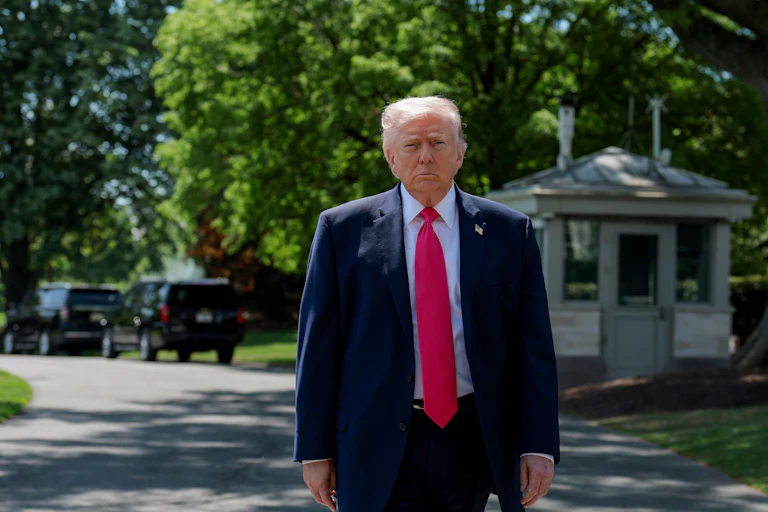
President Donald Trump stands outside the White House
Anna Moneymaker/Getty Images

Brutal new polling from the AP-NORC Center for Public Affairs Research shows that nearly half of Republicans disapprove of President Trump’s handling of the cost of living crisis, one of his major campaign promises. 

While 47 percent of Republicans as a whole disapprove of the cost of living, the numbers split even further by age. Forty percent of older GOP voters disapprove of his affordability handling, while a whopping 60 percent of Republicans under 45 disapprove. All of these numbers are down from recent months, suggesting deep internal disapproval among the people most critical to getting Trump back into office. 

While his overall approval rating is still at 67 percent among Republicans, the frustration with cost of living is still a major warning sign for the party ahead of November’s elections.

Meanwhile, the rest of America is turning on Trump as gas prices rise and a new endless war appears to be underway. The president’s overall approval rating continues to be abysmal, at just 33 percent across the board. His economic job approval is at 30 percent—down eight points from last month—and 68 percent of respondents disapprove of how he’s handled the U.S.-Israeli joint war on Iran and Lebanon.  

While Trump rants about ballrooms and sends the market into whiplash with his Truth Social posts, millions of Americans are struggling to afford basic necessities, and getting tired of it. Midterms are in eight months. 

CDC Blocks Journal From Publishing Study Proving Covid Vaccine Worked

The CDC initially delayed the study, but has now blocked its in-house journal from publishing the study entirely.

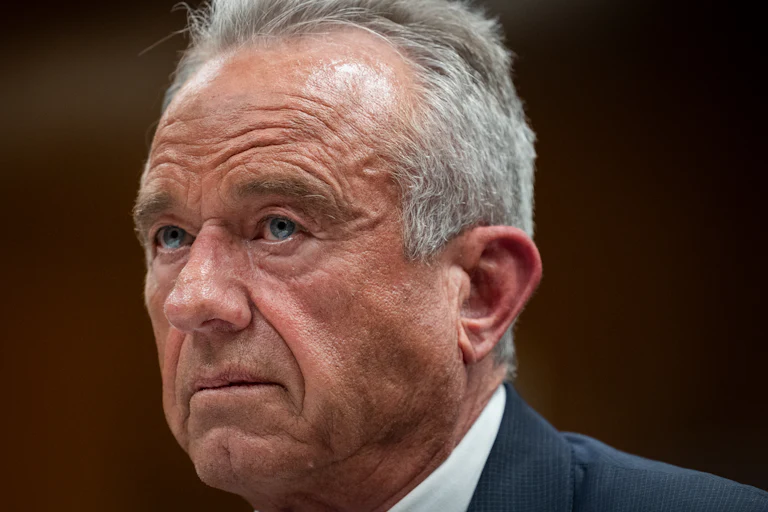
Health and Human Services Secretary Robert F. Kennedy Jr. sits in a congressional hearing
Nathan Posner/Anadolu/Getty Images
Health and Human Services Secretary Robert F. Kennedy Jr. sits in a congressional hearing.

The Covid-19 vaccine significantly reduced emergency room visits and hospitalizations this past winter—but Robert F. Kennedy Jr.’s Department of Health and Human Services doesn’t want the public to know that.

The public health agency blocked the publication of a report on the vaccine’s efficacy from its flagship scientific journal, The Washington Post reported Wednesday.

Acting CDC Director Jay Bhattacharya had previously delayed the publication of the study in the Morbidity and Mortality Weekly Report earlier this month. At the time, Bhattacharya claimed that he was skeptical of the researchers’ methodology, despite the fact that the same methodology is used to evaluate vaccines by numerous medical journals including the New England Journal of Medicine, JAMA Network Open, The Lancet, and Pediatrics.

The decision to nix the report’s publication entirely was made in recent days, according to the Post.

It’s just another example indicating that Kennedy’s anti-vax ideology is spreading across the federal government. During his confirmation hearings last year, Kennedy pledged that he was not against vaccinations and was instead “pro-safety.”

“I believe vaccines have a critical role in health care; all of my kids are vaccinated,” Kennedy said at the time. “In my advocacy I have often disturbed the status quo by asking uncomfortable questions, and I’m not going to apologize for that.”

Yet Kennedy is a leader in a growing movement of anti-vax parents who refuse to provide their children with the same public health advantages that they received in their youth, mostly in fear of thoroughly debunked conspiracy theories that, at one point, falsely linked autism to the jab.

The researcher who sparked that myth with a fraudulent paper lost his medical license and eventually rescinded his opinion. Since then, dozens of studies have proven there’s no correlation between autism and vaccines, including one study that surveyed more than 660,000 children over the course of 11 years.

Since Kennedy took the reins at HHS, though, he has replaced independent medical experts on the CDC’s vaccine advisory panel and replaced them with a hodgepodge of vaccine skeptics. He railed against the use of the MMR vaccine during Texas’s historic measles outbreak, recommending that suffering patients instead take vitamin A. In January, he overhauled the child vaccination schedule without notifying his staffers, potentially affecting vaccine access and insurance coverage for millions of American families in the coming years.

The 72-year-old has a lot to gain from pushing disinformation about the jab: the more doubt and division that Kennedy sows, the more money he’ll make. Ahead of his appointment, Kennedy disclosed that he made roughly $10 million in 2024 from speaking fees and dividends from his anti-vaccine lawsuits. He’s also made cash from merchandising handled by his nonprofit, Children’s Health Defense, which bungled anti-vax messaging in Samoa so badly that it started a 2019 measles outbreak that resulted in the deaths of at least 83 people, the majority of whom were children under the age of five.

As a reminder: Since their invention, vaccines have proven to be one of the greatest accomplishments of modern medicine. The medical shots are so effective at preventing illness that they have effectively eradicated some of the worst diseases from our collective culture, from rabies to polio and smallpox—a fact that has possibly fooled some into believing that the viruses and their complications aren’t a significant threat to the average health-conscious individual.