Breaking News
Breaking News
from Washington and beyond

Kash Patel in Full Meltdown Over Leaked Stories About His Drinking

Patel has ordered at least two dozen staffers to take polygraph tests.

FBI Director Kash Patel speaks at a podium
Daniel Heuer/Bloomberg/Getty Images

FBI Director Kash Patel’s crashout over reports of his erratic behavior is reportedly affecting operations at his agency.

Patel ordered more than two dozen former and current members of his security team, as well as several information technology staffers, to submit to polygraph tests, two people familiar with the matter told MS NOW Thursday. The director was described as entering a “panic mode” in order to save his job after humiliating media reports described Patel’s temper tantrums and disappearing acts.

Speaking to host Nicolle Wallace on MS NOW’s Deadline: White House Thursday, Carol Leonnig, an investigative journalist for the outlet, explained how Patel’s actions had reverberated throughout his agency.

“This is sending a real chill through the FBI,” Leonnig said. “But even more worrisome to them, Nicolle, is the way in which Patel has not agreed to meet with lots and lots of other operational leaders in the bureau.

“This worries people because there’s a regular sort of line of threats and investigations that the bureau director needs to be briefed on, and needs some input on, of course. There are some decision points that he must be involved in, and this is worrying them.”

In response to the reports, Patel has walled himself off from some senior bureau leaders, and refused to meet with operational leaders this week, raising concerns that the director may be out of the loop. A spokesperson for the agency denied that Patel had withdrawn from meetings to MS NOW. He has also sued The Atlantic over the original story about his behavior and is reportedly investigating the journalist who wrote it.

Trump Gives Least Reassuring Answer Possible on Hantavirus Spread

Is the Trump administration prepared to respond to the hantavirus outbreak?

President Donald Trump speaks alongside Secretary of the Interior Doug Burgum and Secretary of Homeland Security Markwayne Mullin, May 7.
Anna Moneymaker/Getty Images
President Donald Trump speaks alongside Secretary of the Interior Doug Burgum (left) and Secretary of Homeland Security Markwayne Mullin, on May 7.

President Trump was asked about the recent outbreak of hantavirus on a cruise ship, and his answer was not reassuring.

Speaking to press outside of the White House Thursday evening, Trump was asked if he had been briefed on the virus, and after calling the ABC News reporter who asked the question “fake news,” he said that yes, he had been. The reporter then asked what the president had learned in those briefings.

“Well, I think you’re going to be told everything, and you already have, uhhh, it’s very much, we hope, under control. There was the ship, and I think we’re gonna make a full report about it tomorrow. We have a lot of people, it’s a lot of great people are studying it. It should be fine, we hope,” Trump said.

The reporter then asked if Americans should be concerned that the virus was going to spread.

“I hope not. I mean, I hope not. We’ll do the best we can,” Trump responded.

Trump’s answer didn’t inspire a lot of confidence, especially considering how badly he handled the Covid-19 pandemic in the last year of his first term as president. His Secretary of Health and Human Services, Robert F. Kennedy Jr., happens to have laid off all of the cruise ship inspectors in the Centers for Disease Control and Prevention’s Vessel Sanitation Program last year. The Trump administration also cut funding to study the hantavirus last year.

Trump has not given any detailed information on how he’s going to handle the recent outbreak. Let’s hope that this virus somehow gets contained, because if it spreads in the U.S., we’ll have an even worse pandemic.

Trump Suffers Two Brutal Court Losses in Less Than 24 Hours

The courts have delivered major blows to two of Trump’s signature policies: tariffs and the “anti-woke” crusade.

Donald Trump speaking at a podium
Kent NISHIMURA/AFP/Getty Images

President Trump suffered two resounding legal losses on Thursday, as two separate federal judges decided that his 10 percent global tariff and DOGE’s anti-woke grant terminations were unlawful.

In a 2–1 decision, the Court of International Trade determined the president’s global tariff—announced in February after the Supreme Court rejected his “Liberation Day” tariffs—is unlawful due to his misrepresenting Section 122 of the Trade Act. Trump tried to claim that the phrase “balance-of-payments deficits” in the law is the same as a “trade deficit.” It is not, the court ruled.

“It is clear that Congress was aware of the differences in the words it chose,” the majority opinion explained. “The Government argues that in today’s world, the current account is the proper component for identifying a balance-of-payments deficit.… Problematically for the Government, and as discussed herein, Congress in 1974 identified the settlement, liquidity, and basic balance deficits as ‘balance-of-payments deficits.’”

It is unclear what the next steps are, although the tariffs were set to expire near the end of July.

Trump’s second loss came as a federal judge stated what we all already knew—that Elon Musk’s DOGE “blatantly used” race, gender, sexuality, and other markers to decide which grants and opportunities to kill.

“Treating Black civil-rights history, Jewish testimony about the Holocaust, the oft-forgotten Asian American experience, the shameful treatment of the children of Native tribes, or the mere mention of a woman as a marker of lack of merit or wastefulness is not lawful,” U.S. District Judge Colleen McMahon wrote. The decision is a win for nonprofit organizations that had been under threat of or had already lost funding due to the DOGE cuts.

Trump has yet to comment on his legal defeats.

WTF Happened With Trump’s Meeting With Brazilian President?

Donald Trump and Lula were supposed to have a public meeting. Instead, we got three hours of radio silence.

Brazilian President Luiz Inácio Lula da Silva (Lula) gestures while speaking at a podium during a press conference
SAUL LOEB/AFP/Getty Images
Brazilian President Luiz Inácio Lula da Silva

Donald Trump was scheduled to meet Brazilian President Luiz Inácio Lula da Silva—usually referred to as Lula—at 11:15 a.m. Thursday in front of the press.

That did not happen, and for three hours, media members stood around wondering where the hell the two leaders of the largest countries in the Western Hemisphere were.

At 2 p.m., NewsNation reported that Lula had left the White House after meeting with Trump for about two hours. “This was a meeting that was supposed to be opened up,” host Nichole Berlie said. “But that did not happen.... We’ll have to see what the White House says.”

NewsNation reporter Kellie Meyer, stationed outside the White House, said it may have been Lula who was responsible for the secrecy.

“The president of Brazil said he wanted to wait until after the two met to then meet with the press in front of the cameras,” Meyer said. “They had lunch, and now we learn that he is leaving. He will speak to the press at the embassy, but he won’t be doing it here alongside President Trump. We do know that the two didn’t quite see eye to eye coming into this meeting, so maybe it is no surprise that they may not be going in front of the cameras.”

Lula is a leftist, and he and Trump have had an unsurprisingly contentious relationship over the years. Trump has repeatedly expressed support for Jair Bolsonaro, the right-wing former Brazilian president who was convicted of planning a coup in order to remain in power.

In July 2025, Trump imposed 50 percent tariffs on Brazil in order to pressure Lula’s administration to drop the charges against Bolsonaro. Lula stuck to his guns, however, and Bolsonaro was sentenced to 27 years in prison in September. The Supreme Court deemed American tariffs against Brazil (and everywhere else, for that matter) unconstitutional in February.

Shortly after Trump implemented the tariffs, Lula decried the weakening American democracy during his address to the U.N. General Assembly.

The drama’s not over, though: Bolsonaro’s son Flavio is running for president this year, and will look to free his fascistic father if he wins. Lula is also running for a second term, despite being 80 years old.

While Trump and his team are often late to their scheduled White House events, having the meeting behind closed doors after telling the press it would be open is significantly stranger.

After an afternoon of silence, Trump released a vague and surprisingly short statement on Truth Social at 2:22 p.m.: “Just concluded my meeting with Luiz Inácio Lula da Silva, the very dynamic President of Brazil. We discussed many topics, including Trade and, specifically, Tariffs. The meeting went very well. Our Representatives are scheduled to get together to discuss certain key elements. Additional meetings will be scheduled over the coming months, as necessary.”

Earlier reports suggested the meeting would be focused on organized crime groups in Latin America. Speaking to reporters in Portuguese at the Brazilian Embassy, Lula said the two men had discussed organized crime, critical minerals, and trade. Lula also said he jokingly told Trump not to reject the visas of any of Brazil’s soccer players before this summer’s World Cup, and that Trump laughed.

Trump Will Revoke Passports for Parents Who Owe Child Support

The State Department plans to revoke the passports of Americans who owe child support. Meanwhile, Republicans are pushing for strict laws where a passport would be necessary.

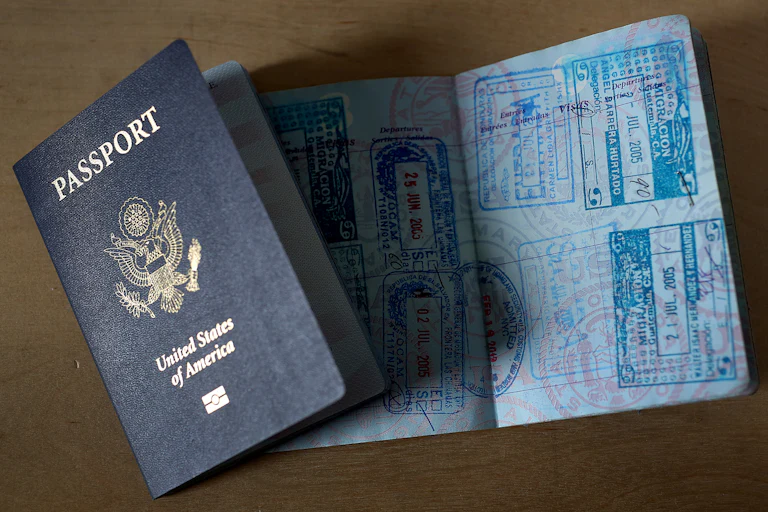
U.S. passports, one open with stamps and one closed
Victor J. Blue/Bloomberg/Getty Images

The State Department plans to start revoking U.S. passports from anyone who owes more than $100,000 in child support, as Republicans nationwide push stringent voter ID laws.

The Associated Press reports that the revocations could begin as early as Friday and would apply to about 2,700 passport holders. The AP first reported about the plan in February. The department plans to expand it in the future to those who owe as little as $2,500 in child support payments. That would increase the number of people who would lose their passports by thousands.

It’s an expansion of an existing policy that applies only to people who renew their passports. Now, the Department of Health and Human Services will notify the State Department of all past-due child support payments of more than $2,500, and anyone in that group will have their passports revoked.

“We are expanding a commonsense practice that has been proven effective at getting those who owe child support to pay their debt,” Assistant Secretary of State for Consular Affairs Mora Namdar told the AP. “Once these parents resolve their debts, they can once again enjoy the privilege of a U.S. passport.”

Anyone who loses their passport under the program will be notified that they can’t travel overseas, and would have to apply for a new passport once their debt is settled. Any American overseas when their passport is revoked will have to get an emergency travel document from a U.S. embassy or consulate.

In February, after the AP first reported on the planned program, the State Department said it had “seen data that hundreds of parents took action and resolved their arrears with state authorities since news broke that the State Department would start proactively revoking passports.”

“While we can’t confirm the causation in all of those cases, we are taking this action precisely to impel these parents to do the right thing by their children and by U.S. law,” the department said.

The program may bring benefits to families who haven’t received child support, but has the added dimension of aiding President Trump’s proposed voter ID law, the Save Act. That bill would require more stringent forms of identification, such as passports and birth certificates, at the polls. Currently, the Save Act is stalled in Congress, but if it passes, many Americans who owe child support could be left without the ability to vote.