Newsletter
Fighting Words
What got me steamed up this week

This Is the Issue That Must Unite Democrats—and It Isn’t Donald Trump

It’s a problem that’s far more enduring than Trump. And any Democrat who isn’t serious about reining it in deserves zero 2028 consideration.

New York City Mayor Zohran Mamdani speaks at a rally in Washington Square Park
Spencer Platt/Getty Images
New York City Mayor Zohran Mamdani speaks at a rally in Washington Square Park on May 1.

The self-pity of some people knows no bounds. Steven Roth, the CEO of Vornado Realty Trust, said this week that the phrase “tax the rich” is hate speech on a par with other well-known slurs. “I must say that I consider the phrase ‘tax the rich’—quote, tax the rich—when spit out with anger and contempt by politicians both here and across the country, to be just as hateful as some disgusting racial slurs and even the phrase, ‘from the river to the sea,’” Mr. Roth said on an earnings call Tuesday, as reported by The New York Times.

Roth was peeved because Mayor Zohran Mamdani filmed a video celebrating Governor Kathy Hochul’s embrace of a tax on pricey second homes in New York in front of a building (developed by Vornado) containing a penthouse owned by hedge-fund billionaire Kenneth Griffin. Griffin bought it in 2019 for (sit down) $238 million, which made it at the time by far the most expensive single residence ever bought in New York.

I could maybe see an argument against Mamdani specifically singling out one person in that video. Griffin himself was quick to point out that Hizzoner “seems to have forgotten that the C.E.O. of another American company was assassinated just blocks from where I live in New York,” referring to Brian Thompson of United Healthcare. There are a lot of wackos out there. Although if God forbid someone shot Griffin tomorrow, it would not be Mamdani’s “fault,” any more than right-wing anti-government rhetoric was responsible for Justin Mohn shooting and then decapitating his federal-worker father in 2024. Only killers pull triggers. You’d think the people who preach at us constantly about personal responsibility would agree with that.

But let’s get back to Roth. What a crybaby. What he refuses to understand, or at least to admit, is: Nobody hates him personally. (a) Nobody cares enough about him to hate him personally, and (b) odds are he’s a relatively nice man and a good father and all that. This has nothing to do with hatred of individuals.

What millions of Americans hate is the extreme concentration of wealth and political power in the United States. Back in March, a New York Times analysis of donations in the 2024 election campaign found that just 300 billionaires and their families made a staggering 19 percent of all contributions to federal campaigns. That was more than $3 billion all told, either directly or through political action committees. The money helped elect Donald Trump, of course, but also new senators like Montana’s Tim Sheehy, who raked in $47 million from billionaires in his win over Democrat Jon Tester.

This is sick. This is not democracy. These people have no sense of limits, no sense that democracy requires that restrictions be placed on their power. Or maybe they do recognize that fact and have contempt for it, in which case it makes them opponents of democracy.

“I have the right to spend whatever I choose to promote what I believe,” David Koch once wrote, criticizing the landmark 1974 law that sought to impose caps on campaign expenditures. Fuck you. No you don’t. I mean, you do, right now, under the current laws of the United States, where the Supreme Court has held that money is speech and as such needs to be as “free” as speech is. You may think I’m referring to the infamous Citizens United decision of 2010, but actually the court initially made this holding in 1976’s Buckley v. Valeo, which came long before campaigns were so awash in lucre. That year, the average Senate race cost $595,000. Adjusted for inflation, that would be around $3.8 million now. In 2020, Senate races averaged around $30 million.

Koch is wrong. Money isn’t speech. Money is money. The difference is easily provable with the observation that all of us can speak equally but we cannot spend equally. If Koch and I are standing in the town square advocating for opposing candidates for mayor, I can speak on behalf of my candidate as endlessly as he can. That’s speech. But his ability to hand his preferred candidate $100 bills is rather more infinite than mine. That isn’t speech. It’s money. It corrupts the process. Someday, this will be obvious to a different Supreme Court.

You’d think these people would be satisfied with the way things are, so heavily stacked in their favor. But they aren’t. They want more. They always want more. This year, billionaires who want to keep AI free of any restrictions or regulations are pouring eye-popping sums into the midterms: Leading the Future, a pro-AI super PAC founded by venture capitalist Marc Andreesson and OpenAI president Greg Brockman, has amassed a war chest of $140 million. Their goal is to defeat candidates like Alex Bores in New York, who vows to lead a charge to regulate AI if he gets to Congress, and to promote candidates who’ll lie back and let them do what they want.

Why are they so hot on AI? Well, it’s pretty simple, isn’t? More AI means fewer human employees, with their oh-so-burdensome salaries and benefits and occasional illnesses. Claude Anthropic can’t agitate for a union. More AI means they get richer. The millions who lose work? Well, that’s progress. If they lose work, it’s what they deserved for not keeping up with the times. (Fancifully, some AI evangelists claim to support universal basic income as a solution to the mass immiseration their products will cause. But we know exactly which side they’ll be on if Congress ever takes up such a measure.)

These people have to be stopped. They need to be taxed at higher rates, of course. And their political power has to be curbed. In fact, that has to be a defining issue in the 2028 Democratic presidential primary race.

Every Democratic candidate needs to be asked: What will you do to rein in the political power of the billionaires? They may not be able to do as much as we’d like, given the Supreme Court, but how they talk about it—whether they’re angry or sanguine, whether they convey alarm or spew out a bunch of stupid happy talk about being able to work with everyone—will tell us a lot about their character and their worldview.

It’s kind of a “price of entry” issue. That is, the price of being taken seriously as a candidate, whatever their other positions, is that they recognize this state of affairs for the five-alarm fire it is. If something isn’t done about this, by 2030, those 300 billionaires will account for 40 percent of all federal campaign spending. Or 50. And what remains of this democracy will be dead.

By the way, the other “price of entry” issue? It’s that the candidates will use every ounce of political capital they have to kill the Senate filibuster if they win control of Washington in 2028. Not reform it. Kill it. The filibuster in any form means continued paralysis, dysfunction, and a certain drubbing in the 2030 midterms that will return control of one or both houses of Congress to the GOP. No filibuster means passing 10 or 15 or 20 bills that make people’s lives better and stop monopolies from being able to rip people off the way they can now. It has the potential to revolutionize politics. Any Democrat who doesn’t see this at this point can’t possibly be taken seriously.

Kvetch away, Steven Roth. But maybe in the meantime, pause and give a little thought to what is required for a healthy democracy to function. Reflect, perhaps, on the fact that this country experienced its greatest growth, its golden era, when a third of the workforce was unionized, when the top marginal tax rate was 90 percent, and when corporations generally understood that they had a commitment not only to shareholders but to community stakeholders.

Finally, as you reflect with justifiable pride on your own success, devote at least a few moments to the elements of public infrastructure—the roads, the rails, the computer networks that were all initially developed by the government—that helped make you so rich. If you and your class don’t want to be hated, stop doing things people hate.
This article first appeared in Fighting Words, a weekly TNR newsletter authored by editor Michael Tomasky. Sign up here.

Latest From Politics

John Roberts Is Either Dumb or Racially Obtuse. And He’s Not Dumb.

After the Supreme Court struck down school integration, guess what happened in the schools? The same thing that’s about to happen with congressional districts.

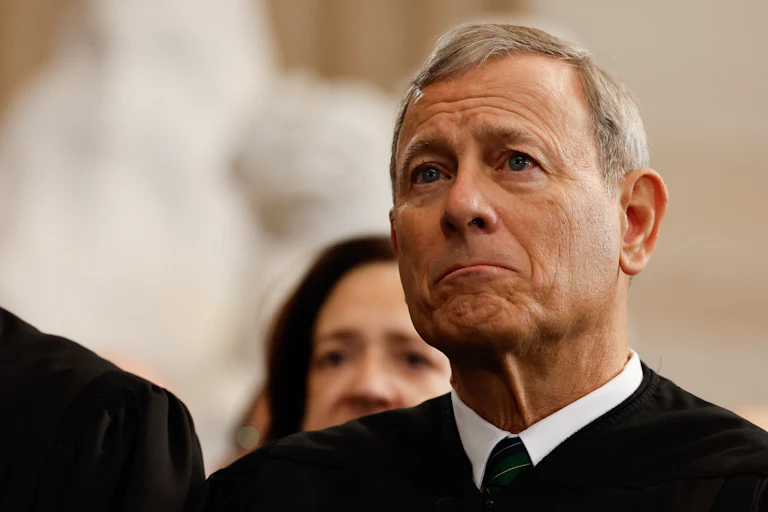
John Roberts
Chip Somodevilla/AFP/Getty Images
Supreme Court Chief Justice John Roberts

If Chief Justice John Roberts has uttered two quotable sentences in his career that will likely appear high up in his New York Times obituary, they are these. The first comes from his 2005 confirmation hearing: “My job is to call balls and strikes and not to pitch or bat.” The line was meant to convey to senators and America that he would be a neutral arbiter of constitutional interpretation, sans ideological agenda. It was later picked up by the entire conservative legal movement and repeated by numerous other right-wing judicial nominees at their confirmation hearings.

It was a lie. He was there, as we have subsequently learned many times, to bat. And not to spray dinky little singles—to swing for the fences. You may recall Jeffrey Toobin’s stunning 2012 article in The New Yorker detailing how painstakingly the chief justice orchestrated the 2010 Citizens United decision to make sure that it went as far as possible in removing limits on the financing of campaigns. The John Roberts of that article was no umpire. He was Mark McGwire juiced up on steroids, trying to smash the ball out onto Clark Avenue.

The subsequent 16 years have shown us the consequences of that decision, which will go down in U.S. history as one of the most corrosive and reactionary holdings of all time—if not right up there with Plessy and Lochner, then awfully close. It has handed our democracy on a silver platter to men who have nothing but contempt for it (Peter Thiel, Elon Musk, etc.).

The other quote is one that I suspect many people will remember, although they may forget the context: “The way to stop discrimination on the basis of race is to stop discriminating on the basis of race.” Ring a bell? He said it early in his tenure, when the Roberts court handed down one of its first major decisions, concerning public school integration efforts in Seattle and Louisville.

The court had already restricted forced integration efforts in a 1991 ruling. Then, in 2007, in two joined cases emanating from the above-named cities, the court went further: It ruled that even voluntary desegregation efforts were out the window. Roberts uttered his famous line while reading his 5–4 majority opinion from the bench.

I remember well the predictions in the decision’s wake. Liberals warned that the public schools would likely resegregate. Conservatives said, Oh pshaw, you delicate little flowers; we’re such a different country from 1954, the year of Brown v. Board of Education. Things will be just fine.

Well, guess what happened? In the 19 years since that ruling, the public schools have resegregated. Not to a mild degree. Not to a “concerning” degree. They have resegregated to a shocking degree.

In 2024, Axios published an article based on two recent academic studies and its own review of official data from 1988 to 2022. In the former year, about 7.4 percent of the nation’s schools were “intensely segregated,” meaning at least 90 percent white. By the latter year, that figure had vaulted to 19.8 percent. In addition, Axios’s Russell Contreras wrote at the time, “several states saw about a 20-percentage point or more increase in intensely segregated schools, from 1988 to 2021.”

Mind you, this happened while the racial demography of the United States went from 67 percent white to 58 percent white. In other words, you might have thought that in an increasingly diverse country, the schools would also become increasingly diverse. Instead, the opposite happened.

Now, fast-forward to this week’s Louisiana v. Callais decision on gerrymandering. Justice Samuel Alito, writing for the 6–3 majority, assures us that there’s nothing to worry about in the evisceration of Section 2 of the Voting Rights Act. We’re a different country. We don’t need it anymore. “Vast social change has occurred throughout the country and particularly in the South,” Alito wrote.

The country has changed for the better in a number of ways, no doubt about that. But has it changed enough that laws to protect minority representation aren’t needed? We’re about to find out.

Consider the following statistics. Mississippi today has a Black population of 38 percent. One of its four congressional districts is majority-minority, for a representation rate of 25 percent. Black Mississippians are ergo underrepresented in Congress. In South Carolina, Blacks make up 25 percent of the population, and one of seven congressional districts was cut for Black representation. That’s 14 percent. So Blacks are underrepresented in that state, as well. And in Tennessee, Blacks are 17 percent of the population but hold zero seats in Congress (0 percent, obviously).

In some other states of the old Confederacy, Black representation is more on par. In Alabama, Blacks are 27 percent of the population and hold two of the state’s seven congressional seats (28 percent). In Louisiana, those population-representation figures are 33 percent and 33 percent (two out of six seats). In North Carolina, they are 21 percent and 21 percent (three out of 14 seats).

Hooray for those three states, I guess. But the question is this: What will those numbers be come 2029, or 2031? It’s hardly going out on a limb to guess that Alabama, Louisiana, and North Carolina will reduce or even possibly eliminate their majority-minority seats. They probably can’t quite get away with that right now in North Carolina, where there’s a Democratic governor. But Alabama and Louisiana, where the GOP controls the governor’s mansion and dominates both legislatures? Louisiana is already licking its chops: After this week’s SCOTUS ruling, its governor announced he was suspending the House primaries on May 16 so the legislature can redraw districts more favorable to the Republicans. It’s hard to believe they’d really have the gall to cut them down to zero. Then again, a lot of things have been happening lately in this country that once seemed hard to believe.

Speaking of which, I find it kind of hard to believe that Roberts, Alito, and other conservative justices this week did not think back to the aftermath of their fateful 2007 decision on school integration. Can they possibly be unaware that schools aggressively resegregated in the wake of that ruling? That seems impossible. And if I’m right, that leaves only one explanation for this week’s decision. They understand the potential consequences quite fully. They just don’t care. Mark McGwire has hit another one, and the bleak outcome, similar to the one liberals predicted in 2007, awaits us.

This article previously misstated the percentage of North Carolina congresspeople who are Black, the number its congressional seats, and which party controls the state Senate.

This article first appeared in Fighting Words, a weekly TNR newsletter authored by editor Michael Tomasky. Sign up here.

Latest From Politics

Let’s Hope America’s Dumbest War Doesn’t Become Its Most Tragic

Almost nine weeks in, let’s remind ourselves: Trump strengthened Iran and then came back and told us Iran was too strong!

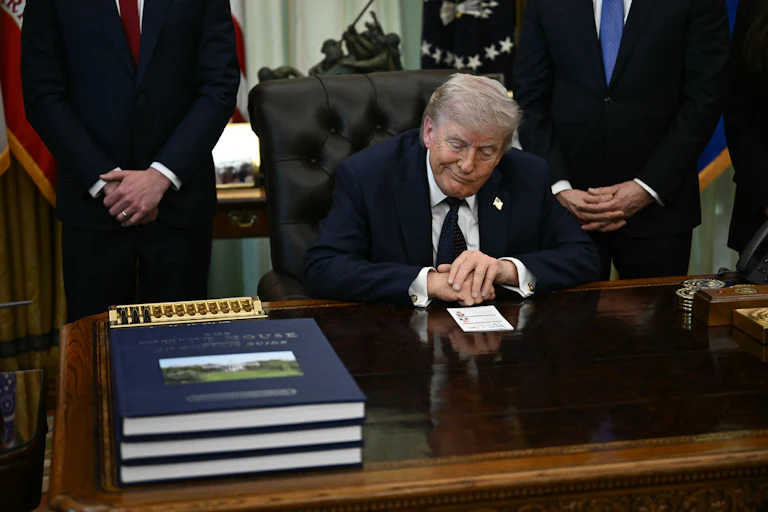
Trump in Oval Office
SMIALOWSKI/AFP/Getty Images

As we barrel toward the ninth week of this two- or three-week war, virtually all of the reporting and most of the commentary is focused on the strategery of the moment: who really controls the Strait of Hormuz, when the ceasefire might actually end, what Donald Trump might do next. That’s all understandable. But it also means that this is a good time to take a step back and summarize exactly what Trump has done here, because if we look at it from 30,000 feet, we see exactly what so many of us knew was dangerous about putting this unstable and petty and frankly stupid man back in the Oval Office.

To put it in a phrase: He and he alone created the conditions that made war possible. He and he alone created the chaos that, he then told the American people and the world, made war necessary. Imagine the mayor of a town where there were acute ethnic or racial tensions taking office and inheriting a fragile but holding truce between the antagonistic parties. He then annuls that truce, calling it weak and fraudulent. Tensions, predictably, flare up again. And the mayor sends in armed agents to disarm the minority. And while he’s doing it, he threatens to destroy their entire culture and compares himself to Jesus, while the man in charge of the military operations constantly invokes God and Jesus as being on his side.

That’s what has happened here. Trump backed out of the Joint Comprehensive Plan of Action that Barack Obama and five other nations had negotiated with Iran. Was it perfect? Of course not. It was a compromise, with an enemy that hates the United States. But it capped uranium enrichment at 3.67 percent—far, far short of the level required to make nuclear arms—until 2030. Most provisions expired in 10 years (2025). Still, that’s not nothing. Experts agreed that it was working, and Iran was abiding by its terms, and it left it for a future administration to pick up the baton.

Trump, far from picking the baton up, threw it in the incinerator. The JCPOA ran to around 160 pages. The chance that Trump actually read it is zero. In fact, the agreement, minus the annexes, was only 18 pages. And still, we know to a 99.55 percent certainty that the chance Trump read even those 18 pages is zero. Those 18 pages were agreed to by Obama. That was all Trump needed to know. So he withdrew from the agreement in May 2018. He imposed stricter sanctions and announced a policy of “maximum pressure.” Oooh, tough! Amurka, baby!

But what happened? The other signatory nations tried to hold things together, but without the United States, everyone knew that was a joke. Iran very quickly increased its enrichment. By 2020, outlets were reporting that “Iran is now enriching more uranium than it did before it agreed to the landmark nuclear deal with world powers in 2015, President Hassan Rouhani said Thursday.” It went from 3.67 percent to 60 percent.

In other words: Trump made this problem. Entirely and solely. By pulling out of the JCPOA in 2018, he ensured that Iran would start breaking the terms of the deal. He’s the one who made Iran strong. Then, eight years later, he comes back to us and says, Bad Iran! They broke the terms of the deal! They’re too strong. We must invade them.

But it’s actually even worse than that. Because we didn’t invade Iran because they broke the terms of the deal. We invaded Iran because Trump, having conquered (in his mind) America, needed to conquer farther reaches. Venezuela got him thinking, Hey, this war stuff is kinda fun. So he figured he’d be the guy who toppled the hated regime. A few bombs. Easy-peasy.

It was only when it became clear that it wasn’t easy that Trump settled on his current rationale for the war (that Iran must not be allowed to have a nuclear weapon). Because at first, the rationale was regime change. And we took out the supreme leader, and Trump probably thought well, that was that. But that just handed everything to the supreme leader’s son, who is more radical, and whose father, wife, and son were killed by U.S. bombs. So when it became clear even to Trump that the regime wasn’t going to change, he settled on the rationale about nuclear weapons. And he’s actually been reasonably consistent about it over the last, oh, three weeks or so; shown far more discipline on this one point than he’s ever shown on anything.

It’s a fine rationale. I agree with it, in fact. But there’s a little problem with it. Namely, that Iran is today a hell of a lot closer to nuclear weapons than it was in 2015, after Obama’s deal. So Trump, who created this problem, now tells us that he may have to solve it by eliminating Persian civilization, one of the great civilizations in the history of humanity (these last 47 years, not even a blink of an eye in human history, notwithstanding).

The United States has fought a lot of dumb and unnecessary wars. And it’s fought a lot of wars that cost more lives than this one has so far. But this one has to be the most unnecessary war of all. And now here we sit, the whole world nervously watching the president of the United States, whom everyone in every capital around the globe knows to be impulsive and ignorant and concerned mainly with his vanity, wondering what he’ll do next—hoping that America’s most unnecessary war doesn’t also become its most tragic.

This article first appeared in Fighting Words, a weekly TNR newsletter authored by editor Michael Tomasky. Sign up here.

Latest From Politics

Trump’s Sycophants Just Approved the Tackiest Monument to Him Yet

The Arc de Trump isn’t about America. It’s about one man. It must die.

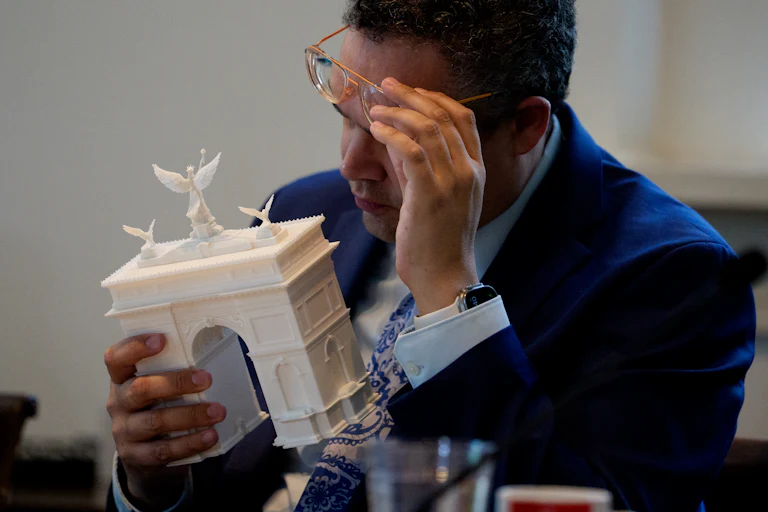
Matthew Taylor, a member of the Commission of Fine Arts, inspects a model of Trump’s proposed triumphal arch
Andrew Harnik/Getty Images
Matthew Taylor, a member of the Commission of Fine Arts, inspects a model of Trump’s proposed triumphal arch on Thursday

The Great Sphinx of Giza stands 66 feet tall. The Leaning Tower of Pisa is around 180 feet. Paris’s Arc de Triomphe, 164 feet. The Sydney Opera House soars to 220 feet. But all would be dwarfed by the Arc de Trump, whose golden (of course) statues would rise to 250 feet above the entrance to the Arlington National Cemetery, the final resting place for 430,000 soldiers who gave their lives for this country. You know them; they’re the ones Donald Trump called “suckers.”

Trump says the arch will commemorate America’s 250th birthday, but let’s be honest: It will commemorate Donald Trump. If this monstrosity ever gets built, no one driving or cycling by it along the George Washington Memorial Parkway will look at it and think of the Declaration of Independence or Ben Franklin or John Hancock. They’ll think of one man. And that’s exactly how he wants it.

The federal Commission of Fine Arts officially gave its approval to the project on Thursday. We’ll come back to that commission—who they are, and the testimony they took before casting their votes. But first, for those of you who live outside Washington, I want to describe this place physically so people understand why this arch would land in Memorial Circle with all the grace of a walrus hogging an ice floe.

On many warm-weather weekends, I go for longish bike rides. Washington is one of America’s great bike-riding cities—it has copious bike lanes and the downtown area is mostly flat and incredibly scenic, with the monuments and all the lovely waterfront parks. (Trump also, by the way, wants to steal East Potomac Park, home to an admittedly down-at-heel but historic public golf course as well as gorgeous picnic and fishing areas, from the people and convert it into, you guessed it, a “world-class” private country club.) Most times, I drive down from my home in Maryland and park (for free, and there’s always a space) at the U.S. Marine Corps War Memorial, better known as the Iwo Jima Memorial, which is right next to Arlington Cemetery. I circle the memorial and go past the Netherlands Carillon, the modernist bell tower (127 feet high, incidentally) given by the people of that country to the United States for the latter’s role in liberating them from the Nazis.

I then zip across the Memorial Bridge, generally regarded as the city’s most beautiful, with its neoclassical arches, its martial yet tasteful statuary, and its wide pebbled sidewalks, and find myself face to face with the glorious Lincoln Memorial, the reflecting pool, and all the rest. I never, ever do this without feeling grateful to live here and to be able to do something so pedestrian (so to speak) as take a bike ride while being among these and so many other treasures.

I should add a few words about the graceful entrance to Arlington Cemetery. The National Park Service, which owns the land, calls this the Memorial Avenue Corridor. It was designed in the early twentieth century by none other than America’s most famous architectural firm, McKim, Mead, and White, under project architect William Mitchell Kendall, who also worked on the Washington Square Arch (75 feet tall), the Low Memorial Library at Columbia University, and the main New York post office building, now in use as the wonderful Moynihan Station.

When you cross Memorial Bridge from Washington into Virginia, the traffic merges into the GW Parkway via a traffic circle, which is the Memorial Circle where Trump wants to plant his arch. It sits on an island, Columbia Island, which, though closer to Virginia, is actually part of the District of Columbia. Behind the circle, in a straight line from the bridge, is Memorial Avenue, a broad boulevard about 500 feet long that leads to the cemetery entrance. Its distinguishing feature is something the NPS calls the Hemicycle, a half-circle, Beaux-Arts style retaining wall designed in the early 1930s by the McKim firm. It’s all graceful and understated; it announces itself with a humility that is appropriate to so solemn a space. In the words of a 2004 NPS document I fished out: “Arlington Memorial Bridge and its features were intended to be both a monumental entry to the federal city and a formal, processional route to Arlington National Cemetery.”

I should add a word or two on the size of Memorial Circle, which in the coverage I’ve read has gone largely undiscussed. Trump’s arch, at 250 feet (the arch itself would be 190 feet, topped by a 60-foot golden statue of an angel, alongside two shorter statues of golden eagles), would be about as tall as a 20-story office or residential building. For perspective, there is in D.C. no such thing because of its stringent height restrictions. The city’s tallest commercial building is Franklin Square at 13th and K Streets, which is 12 stories and, with its spires, rises to 210 feet. (Its tallest residential building is The Cairo near Dupont Circle, at 164 feet, which was completed in 1894—and caused public backlash that led to the height restrictions that are still in place today.)

A 20-story building requires a certain footprint for the scale to be right. I searched the web in vain to find the exact square footage of Memorial Circle, but it’s small. If you go to Google Maps and move your cursor around, you’ll see that it’s clearly smaller than Dupont Circle; smaller than the circle that surrounds the Lincoln Memorial (99 feet high); much smaller than The Ellipse on the White House grounds; and not large enough to fit, say, the National Air and Space Museum, or the National Gallery of Art.

So to summarize, what Trump wants: would be far too large for the space; would undoubtedly tangle traffic because its mere overwhelming presence would force motorists to slow down; would dwarf everything around it; and would utterly disrupt the “formal, processional route” to the national cemetery.

Those are undoubtedly some of the reasons why the 1,000-odd comments received by the Commission of Fine Arts ran literally 100 percent against the arch, according to The Washington Post. This did not prevent the seven commissioners—all appointed by Trump back in January—from approving the project and heaping the usual sycophantic praise on it (one commissioner did suggest ditching the statues). Here, for the record, are their names. Only one is known to me: Roger Kimball, the longtime editor of The New Criterion. An intelligent and literary fellow, but stridently right wing and MAGA to his core.

It’s a disgrace. Again—whatever they’re billing it as, it’s a monument to Trump, just like he’s trying to turn the Kennedy Center into a monument to Trump (just wait: Today, he shares billing with JFK; there’s no doubt in my mind that plans are afoot to erase JFK from the center entirely). On that now-sad venue, read the blistering piece posted this week at The Atlantic by a former curator there.

God willing, the next president is a Democrat. He or she will have a lot of work to do and much damage to undo. But he or she absolutely must say on day one: We’re tearing down this arch; we’re razing Trump’s ballroom and rebuilding the East Wing mostly as it was; and the Kennedy Center will go back to being the Kennedy Center. Any Democratic president who fails to do these things deserves the nation’s scorn. Washington ceremonial architecture, like the government itself, must be returned to the purpose for which it exists—to promote democracy, not the demented, bruised ego of one sick man.

Latest From Politics

Donald Trump Is Losing What Little Mind He Has Left

A small-d democratic leader would notice the public’s outrage and tap on the brakes. But the president of the United States thinks instead like a dictator.

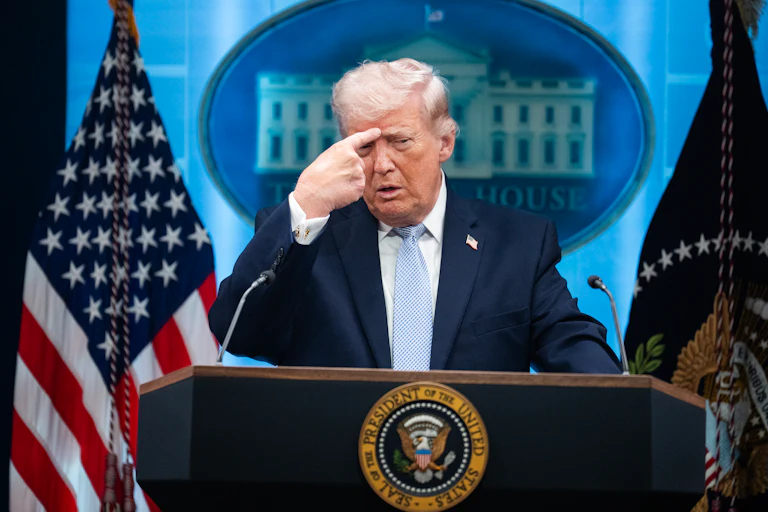
Trump points at forehead
Tom Williams/CQ-Roll Call, Inc/Getty Images

Hey, Donald Trump, you just launched a war that you’re losing, that’s costing you millions of supporters, that’s tanking your standing among even Republicans, that has the likes of Alex Jones accusing you of contemplating “genocide” and Tucker Carlson labeling your comments “vile on every level.” What are you going to do for an encore?

Hey, I know. How about breaking up NATO and trying for regime change in Cuba?

He may, he may not. Who ever knows with this guy? But both are live possibilities. Trump threw a tantrum about NATO this week, issuing an “ultimatum” to European countries to help reopen the Strait of Hormuz and bellyaching about their general lack of support for his war. Cuba is largely under a U.S. blockade that has resulted in massive energy shortages. A month ago, before the reality of Iran had quite set in, Trump bragged that Cuba was next, saying, “Cuba is going to fall pretty soon, by the way.” Just yesterday, Cuban President Miguel Diaz-Canel said he wasn’t going anywhere.

Here’s the important thing to understand about Trump at this particular point in time. He does not think like a democrat (small d). He thinks like a dictator. A democrat who understood his obligations in a democratic system to the voters who put him in office would stop and think: Gee, the people don’t approve of what I’m doing. Maybe I should pull back a little. And who knows—maybe he will. There are peace talks with Iran this weekend in Pakistan, even though Iran is walking into them with a 10-point plan that Trump (and Benjamin Netanyahu) want no part of. But there actually is precedent for Trump seeing that what he was doing was unpopular—the ICE disaster in Minneapolis, most notably—and making a course correction.

Granted, I’m pretty hard-pressed to think of other situations in which he’s responded to public opinion. America doesn’t like anything he’s doing, except on sealing the border. Otherwise, he’s in the tank. And by the way, I alluded above to his weak numbers among Republicans: In one recent poll, he’s down to 81 percent among Republicans. That may sound high, but in fact, for that particular category, it’s low. A president’s support within his own party ought to be close to or above 90. Here’s a little context. The 1988 presidential election between George H.W. Bush and Michael Dukakis was a blowout, right? Right. Dukakis got 83 percent of Democrats’ votes. And he got shellacked. That’s what 80-ish percent among your party leads to.

But even as the walls close in on him, Trump is no more likely to think like a democrat. He will think like the dictator he imagines himself to be. He will think, as dictators do, about three things: To the extent that he cares what the public thinks, he will focus his thoughts on how best to distract their attention and get them thinking about something else; he will think about ways to clamp down on dissent (and more specifically in this case, leakers); and finally, and never to be forgotten with this grubby mountebank, how to make a buck off the current mess.

Let’s break these down. The first thought is the one that will carry Trump to try something with Cuba, or to try to bust out of NATO. He needs headlines that aren’t about Iran. But he also needs headlines that start “Trump moves to” and “Trump declares.”

That’s what matters. It scarcely makes any difference whether these moves are popular. Busting up NATO would of course be monstrously unpopular (and the president cannot simply leave NATO, though laws haven’t stopped him before). Toppling the Cuban regime might in fact be somewhat popular, depending on how it goes. But again, we’ll need to see what China and Russia have to say about that before the final verdict is in. It is liable to be more complicated than Trump imagines, simply because these things usually are.

The second thought is one to take very seriously right now. Zeteo’s Asawin Subsaeng reported this week that Trump is directing a furious hunt for people who leaked info to The New York Times’ Maggie Haberman and Jonathan Swan for that huge piece about how Trump decided to start this war. The piece is actually an excerpt from their upcoming book, which is expected to contain still more embarrassing details about the Trump regime. “In conversations with close aides and advisers, President Trump has loudly demanded to know who in his Cabinet or his team blabbed” to the reporters, Swin wrote. This is the sort of thing that obsesses dictators.

And finally, never forget that Trump is always on the lookout for his next swindle. Coming up on April 25 is a luncheon at Mar-a-Lago billed as “the most exclusive crypto & business conference in the world.” The announcement of the luncheon jacked up the price of the $Trump meme coin for a minute. It’s not 100 percent certain Trump will be there. But where else would he be? Maybe the golf course.

Consider this week in full. The abominable Easter Sunday social media post that dropped the f-bomb and mocked Islam. The far more abominable post two days later about destroying one of history’s most accomplished civilizations. The complete and utter backing down from it hours later. The phantom ceasefire, which Netanyahu obviously intentionally wrecked. The phony peace plan, on which the belligerent nations are miles apart. Anemic economic growth (0.5 percent, and yes, that’s point-five). Inflation above 3 percent.

And perhaps most of all, Trump’s wife appearing to throw him under the bus. Not that she’s any hero. But she’s pretty clearly preparing for the day when the Epstein files are made public and she may have to cut bait, depending on what’s in them.

To any other president, this would be the time to straighten up and fly right. To this one, it’s the perfect time to blow up the most important and durable military alliance in the history of the human race.

This article first appeared in Fighting Words, a weekly TNR newsletter authored by editor Michael Tomasky. Sign up here.

Latest From Politics