Breaking News
Breaking News
from Washington and beyond

Trump Makes His Most Deranged Threat to Iran Yet

Donald Trump warned that a “whole civilization will die” unless Iran agrees to a deal.

Donald Trump attends the White House Easter egg roll
Tom Williams/CQ-Roll Call, Inc/Getty Images

Donald Trump has hatched a heinous plan for Iran.

The president hinted at the scale of devastation that awaits the Middle Eastern nation via Truth Social post Tuesday morning, promising to completely annihilate one of the world’s oldest continuous civilizations if Iran’s leaders refuse to give him what he wants.

“A whole civilization will die tonight, never to be brought back again,” Trump wrote. “I don’t want that to happen, but it probably will.”

“However, now that we have Complete and Total Regime Change, where different, smarter, and less radicalized minds prevail, maybe something revolutionarily wonderful can happen, WHO KNOWS?” he continued. “We will find out tonight, one of the most important moments in the long and complex history of the World. 47 years of extortion, corruption, and death, will finally end. God Bless the Great People of Iran!”

Trump has repeatedly escalated his threats against Iran since Sunday, demanding that the country’s leadership either reopen the Strait of Hormuz—a vital tradeway in the region that only closed because of Trump’s intervention—or face total annihilation, highlighting various possible strike targets such as Iran’s power plants and bridges. The president said this despite the fact that doing so would constitute a war crime.

Targeting non-combatants such as civilians and civilian infrastructure is a blatant violation of International Humanitarian Law. Exterminating a “whole civilization” would break several components of the Geneva Conventions, which the U.S. played a foundational role in creating.

Trump pledged on social media that Iran had the opportunity to act until Tuesday 8 p.m., but the president appears to have jumped his own timeline. By Tuesday morning, bombs were already raining on the nation’s railways.

Iranian media responded just after 9 a.m. EST, announcing through diplomatic channels that talks with the U.S. had stalled in the wake of Trump’s explicit threats.

Vice President JD Vance backed Trump’s response Tuesday morning, telling an assembly in Budapest that he hopes Iran makes the “right response,” highlighting America’s needs for free flowing oil.

“They’ve got to know, we’ve got tools in our toolkit that we so far haven’t decided to use,” Vance said. “The president of the United States can decide to use them, and he will decide to use them if the Iranians don’t change their course of conduct.”

It was not clear exactly which “tools,” capable of erasing an entire civilization, Vance was referring to.

The flow of oil through the Strait of Hormuz was not an issue until Israel and the U.S. jointly attacked Iran in late February. In the weeks that followed, Iran sealed off the waterway, which funnels approximately one-fifth of all global crude oil shipments.

The ramifications of closing the chokepoint have been felt around the world. In the U.S., the price per oil barrel has exploded due to the strait’s closure, pushing gas over $4 per gallon in most states (in some areas of California, gas has leapt past $7 a gallon). Diesel shot up by 20 cents over the last week alone.

Trump has waffled on the strait’s significance to American markets. Last week, the president rapidly cycled through his opinions on the transit point, claiming in succession that he didn’t care if the strait remained closed, and that he needed it reopened.

The pressure to reopen the strait likely comes from his own party, which has become increasingly anxious over the economic fallout of the war. Republicans—particularly in vulnerable districts—have stressed that the war could wreak havoc on their election results come November.

That alone has amped up enough pressure on the White House to seek a near-immediate conclusion to the war, though it does not appear that Trump will have it.

The U.S. military, meanwhile, is already bolstering itself for another grinding Middle East conflict: last month, Politico reported that military strategists in U.S. Central Command requested the Pentagon supply support for their operations in Iran through at least September.

This story has been updated.
Trump Call to Artemis II Astronauts Hit With Longest Awkward Silence

Trump tried to blame the pause on a technical glitch. The connection was just fine.

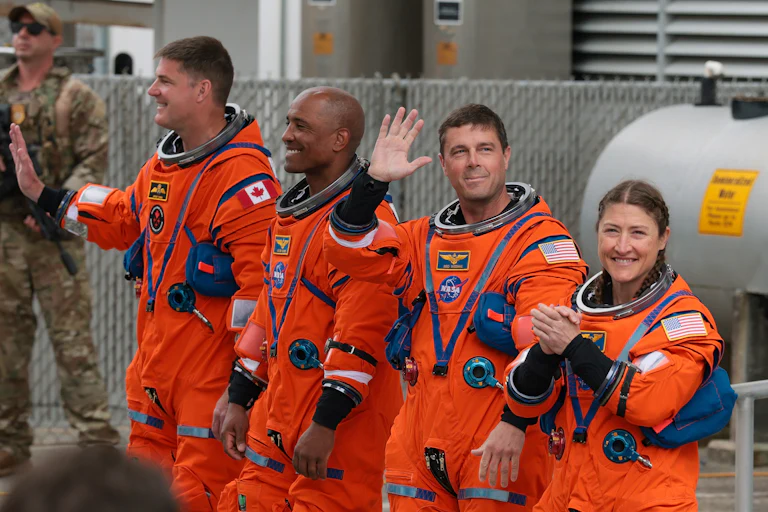
Artemis II astronauts wave while wearing their suits
Joe Raedle/Getty Images
From left: Mission specialist Jeremy Hansen of the Canadian Space Agency, pilot Victor Glover, commander Reid Wiseman, and mission specialist Christina Koch boarded Artemis II to travel around the moon and back.

President Trump reached out to the crew of the Artemis II spacecraft Monday night, but ended up having a call that was so awkward it quickly went viral. 

“America is a frontier nation, and the four brave astronauts of Artemis II are a modern-day, you really are modern-day pioneers, all of you,” Trump said, starting out with a congratulatory message. But then, he made things weird for one crew member. 

“And one of them happens to be a neighbor, you know who that is, right? You have a special person over there, a neighbor, and uh, we like our neighbor,” Trump continued

The “neighbor” in question happened to be Canadian astronaut Jeremy Hansen, a member of the Canadian Space Agency. Trump can’t seem to be able to hide his feelings about the country, which he has antagonized by saying it should be the fifty-first U.S. state. Perhaps that’s why he couldn’t even bring himself to say the word “Canada,” even with a large Canadian flag clearly visible in the video feed from the crew alongside an American flag. 

Trump said he spoke to Canadian ice hockey legend Wayne Gretzky, whom he called a “very special person,” and Prime Minister Mark Carney, and only then did he even say “Canada,” claiming to have many friends there.  

“You have a lot of courage doing what you do, a lot of bravery, and a lot of genius. But they are very, very proud of you,” Trump said.

But after that, Trump went silent and the astronauts sat awkwardly during more than a full moment of silence.

“Yeah, I think we might have gotten cut off. It is a long distance.… Reception has been great,” the president said.

In the midst of an unnecessary war, a poor economy, and high gas prices, people around the world are looking at the Artemis II mission, which has brought humans further in space than ever before, as a source of inspiration. Does Trump see it that way, as well? 

U.S. Begins Dropping Bombs on Iran’s Bridges Ahead of Trump Deadline

The U.S. and Israel are now bombing bridges in Iran—and a key island—ahead of Trump’s supposed deadline.

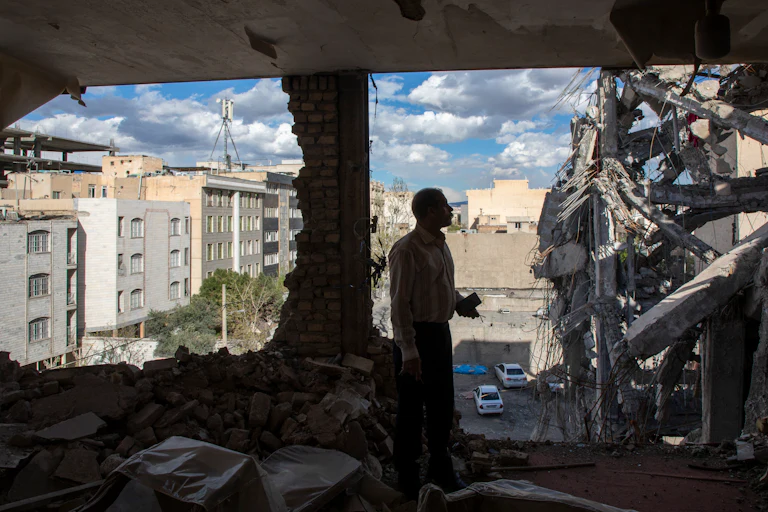
A man stands in a destroyed building in Tehran observing the damage.
Majid Saeedi/Getty Images
A man walks in a building in Tehran, Iran, destroyed in a joint attack by Israel and the United States, on April 6.

The Israel Defense Forces are ordering Iranian civilians not to use the trains, warning that their lives would be at risk if they do so even ahead of President Trump’s 8 p.m. E.T. “deadline.”

“Urgent Warning to Users and Train Passengers in the Country of Iran. Dear Citizens, for the sake of your security, we kindly request that from this moment until 21:00 Iran time, you refrain from using and traveling by train throughout Iran,” the IDF Farsi account posted on X. “Your presence on trains and near railway lines endangers your life.”

Trump warned on Easter Sunday—and on the following day—that all bridges and power plants in Iran would be bombed if the country did not make a deal and reopen the Strait of Hormuz by Tuesday evening. But it appears that deadline wasn’t so firm, as bridges across the country are already being targeted. So far, bridges near the Qom, Kashan, and the Tabriz-Zanjan highway have all been struck.

The U.S. also bombed Kharg Island, a key oil export hub for Iran, overnight.

Now, according to the IDF, civilians can’t even take the train to travel within their own country. Remember when these people wanted to liberate Iranians?

Trump Suggests Gutting TSA After Blaming Shutdown on Democrats

Donald Trump seemed pretty pro-TSA when he was able to use it as a political talking point.

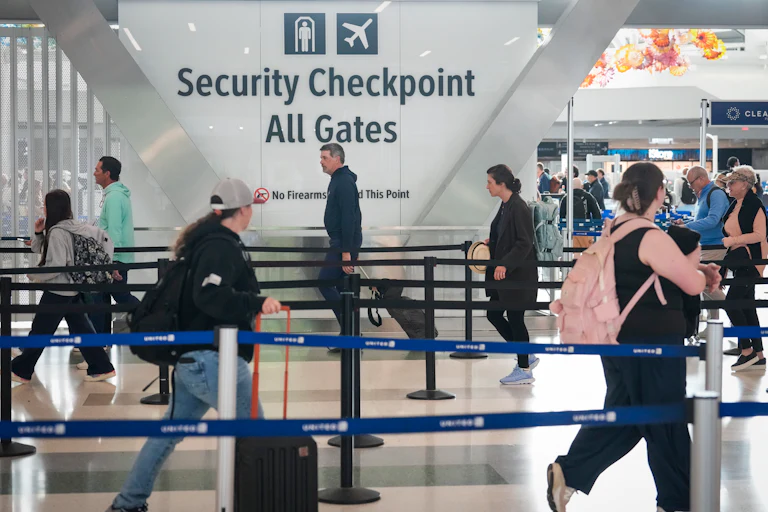
People walk in the TSA line at the George Bush Intercontinental Airport in Houston, Texas.
Brett Coomer/Houston Chronicle/Getty Images
The TSA line at the George Bush Intercontinental Airport in Houston

President Donald Trump wants to cut more than $1.5 billion—and thousands of jobs—from the Transportation Security Administration’s budget after subjecting its employees to weeks without pay. 

The Trump administration wants to gut 9,400 workers from the 60,000-person agency, according to budget documents reviewed Monday by Reuters

The 2027 White House budget suggests small airports rely on private security screeners, instead of the TSA, and claims this change would cut 4,500 jobs.

“The airports that already use this program have demonstrated savings compared to Federal screening operations,” the White House budget documents stated. “The move would yield cost savings compared to Federal screening and begin reform of a troubled Federal agency.”

 Airports that used privatized security avoided longer lines caused by the partial government shutdown, but using private companies risks compromising traveler safety and has been condemned by union leaders. 

“It’s very important that people understand what privatization is,” Johnny Jones, secretary treasurer for AFGE TSA Council 100, told CNN.  “It has nothing to do with your security or your safety. It has everything to do with somebody making a profit.”

The Department of Homeland Security has also pitched ending staffing at exit lanes, which would cut another 4,800 jobs. 

Last month, Trump rejected a plan to pay TSA workers amid a partial government shutdown, because Democrats wouldn’t agree to fund the president’s reckless federal immigration enforcement. Republican lawmakers had also made efforts to stall funding TSA in order to continue the fight over immigration funding. 

Finally, last week, Trump signed an executive order to pay workers at the TSA, which has been hemorrhaging employees as paycheck after paycheck has gone unpaid, causing severe disruptions at airports across the country. 

DeSantis Signs Vague Anti-Terrorism Law Masquerading as “Anti-Sharia”

Florida Governor Ron DeSantis has given himself the power to designate “domestic terrorist” groups.

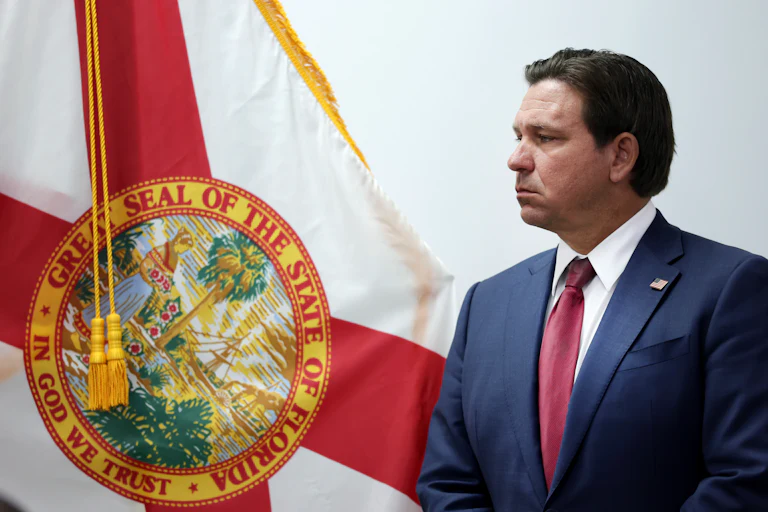
Ron DeSantis stands in front of the Florida state flag
Joe Raedle/Getty Images
Florida Governor Ron DeSantis in 2025

Florida Governor Ron DeSantis signed a vague law Monday that gives a handful of state officials—including him—the ability to denote groups as terrorist organizations and revoke their nonprofit status. Any college student who supports said terrorist organization can be expelled under the new law.

Florida’s House Bill 1471 appears to be targeted at Muslim organizations in the state, and DeSantis said as much in a press conference before signing the bill, calling it a means to protect against “sharia law” and boost “public safety, our culture, and our security.”

“We don’t want money flowing to these groups that are appendages of terrorist groups,” DeSantis added, mentioning the Muslim Brotherhood and the Council on American-Islamic Relations by name. “We’ll do millions for public safety, millions for education but never one red cent for jihad.”

CAIR is an organization whose mission is to protect the civil rights of American Muslims, and is headquartered in Washington, D.C., with chapters in states all across the country. In a statement, the executive director of CAIR-Florida, Hiba Rahim, called out DeSantis for having “falsely labeled CAIR as terrorists without lawful authority or evidence” four months before in a different bill that was later blocked in court.

“This is not just about CAIR. This expanded and deeply flawed framework can attack any organization that dares to dissent,” Rahim said about the new law. “As Floridians, together, we’ll watch how this unprecedented law is enforced, and whether it is used or abused.”

References to sharia law in the bill could also prevent Muslim schools from receiving state vouchers if they are determined to be affiliated with a group labeled a terrorist organization. Conspiracy theories over sharia law have been a right-wing fixation for decades, with conservatives falsely claiming that Muslims are trying to set up a religious legal system.

The bill doesn’t include any method for oversight of how groups would be designated as terrorist organizations, either by the courts or by Florida’s legislature.

“There is no requirement for legislative approval,” Representative Rita Harris, a Democrat, said while the bill was being debated. “There is no independent judicial finding before the designation takes effect. There is no built-in meaningful oversight mechanism to ensure transparency or review. In our system of government, we do not place sweeping, labeling authority in the hands of a few executive officials without guardrails.”

The bill will likely face legal challenges over violations of the rights to freedom of speech and religion enshrined in the First Amendment, and may not survive in court. Islamophobia, on the other hand, seems to persist in American political discourse even as its mouthpieces are consistently exposed as bigots.