Breaking News
Breaking News
from Washington and beyond

Ivanka Trump’s Private Island Dream Faces Massive Blowback

Albania has opened a corruption probe as thousands of people protest the development.

Ivanka Trump, with her husband Jared Kushner behind her
Stefano Mazzola/GC Images
Ivanka Trump, with her husband Jared Kushner behind her

Ivanka Trump and Jared Kushner want to plop down a luxury resort off the coast of Albania, and the locals aren’t too happy about it.

Trump’s daughter said she and her sleazy husband fell in love with an uninhabited island called Sazan while on a sailing trip.

“We were on a friend’s boat, and we stopped for a swim—effectively, that’s how we found it,” Ivanka gushed on David Senra’s podcast. “We swam to the island. We went on a hike, barefoot all the way up to the top, and we were just captivated.”

And what do you do when awestruck by the beauty of untouched nature? Bulldoze it for a luxury resort, of course!

To be fair, the island isn’t totally empty of infrastructure; it’s actually a designated military exclusion zone, with a few bases and bunkers still lying around. A grand total of two soldiers were apparently deployed there as of 2017—one wonders what they think of all this.

Sazan contains lots of plant and animal life, as does a part of Albania’s southern coast where the Kushners want to literally cut through a wildlife reserve to build hotels, apartments, and a marina.

“Since late May, excavators and other heavy machinery have entered the area,” reports the Associated Press, “opening access routes, digging into the sand, clearing land among pine trees and installing fencing.”

While Albania has an extensive and largely underutilized coastline, a MAGA luxury resort doesn’t seem like the best solution, especially in one of the country’s most important ecological areas.

Pink flamingos and other migratory birds could be threatened by the projects, which have inspired groups of demonstrators to hold up cardboard flamingos at rallies in Albania’s capital, Tirana. One local environmental group told the AP that the coastal habitats are being “irreversibly destroyed.”

For now, Kushner’s investment firm has been given the go-ahead by national authorities, including Prime Minister Edi Rama, who has been in office for over 12 years and expressed public support for the project. But the development may still face roadblocks; the country’s anti-corruption agency launched an investigation into it on Monday.
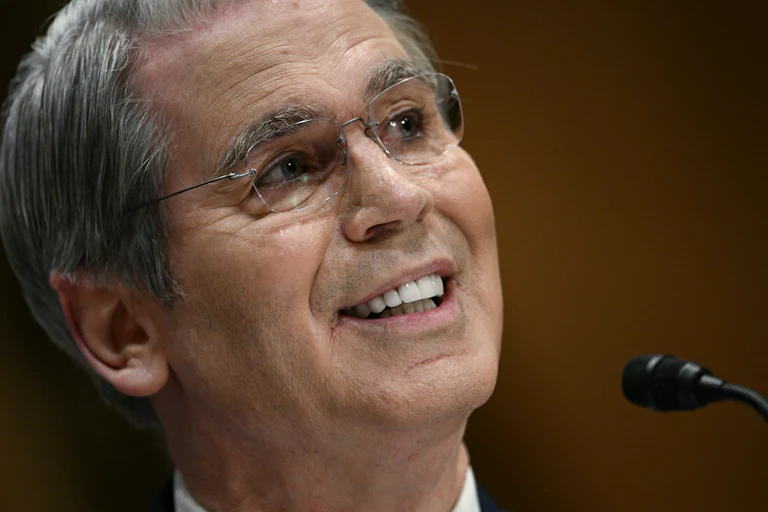
Treasury Sec. Forgets Own Job in Rush to Dodge Democrat’s Questions

Scott Bessent was stunned into silence when he was asked who the treasury secretary is.

Treasury Secretary Scott Bessent smiles while testifying in a House committee
Brendan SMIALOWSKI/AFP/Getty Images

Treasury Secretary Scott Bessent became so engrossed Wednesday in providing nonanswers about the president’s $1.8 billion “anti-weaponization” fund that he accidentally dodged a question about his own employment.

Bessent’s appearance before the Senate Finance Committee was nothing short of contentious. It was his first time speaking before the committee since Trump settled his fragile $10 billion lawsuit over the 2019–2020 leak of his tax returns with his own administration, and created an enormous DOJ-backed slush fund out of its ashes. Yet the secretary was not so keen to provide answers regarding the honeypot, or the myriad legal allowances—such as future audit immunity—that have been afforded to Trump as a result.

Instead, Bessent spent a significant chunk of his time before the committee skirting and dodging critical questions about the fund, claiming that he could not comment on any component of the proposal due to “ongoing litigation” while deferring questions to the Justice Department.

But in one particularly heated exchange with Texas Senator Ben Ray Luján, Bessent’s default answer became so routine that he failed to notice when he was asked a question about his own job that he very much could answer.

“Are you the secretary of Treasury?” asked Luján.

But Bessent was silent.

“Yes, is the answer,” Luján responded, incredulous.

“Mr. Secretary, Scott—are you the secretary of Treasury for the United States government?” asked Luján again.

“Yes,” Bessent said.

“Appreciate that. The Department of Justice represents the IRS and the Department of Treasury in this lawsuit. Correct?” continued Luján.

“Correct,” said Bessent.

“You’re telling me that the DOJ gave the president this—without you knowing about it?” Luján asked, raising a piece of paper that assumedly related to the Treasury’s joint agreement with the DOJ over the settled suit. “That’s not how the law works.”

Oregon Senator Ron Wyden, the committee’s ranking member, derided the DOJ agreement as “an abuse of the IRS that goes way beyond anything we’ve seen in the past.”

Whether or not the slush fund is still alive is currently in doubt. Bessent told the Senate Finance Committee earlier Wednesday that the federal financial department intended to comply with a DOJ directive to shutter the fund. The evening before, during a House Appropriations subcommittee hearing, acting Attorney General Todd Blanche said that the fund was dead in the water and that his agency would not “ever” move forward with the payments.

But Trump has since defied both of them, standing by the far-right reparations effort while speaking with the New York Post Wednesday morning.

60 Minutes’ Scott Pelley Exposes CBS Chief’s Lies About His Firing

60 Minutes correspondent Scott Pelley says Bari Weiss is lying about everything that went down.

Scott Pelley stands at a podium
Jamie McCarthy/WireImage
Scott Pelley in 2011

Ousted 60 Minutes correspondent Scott Pelley disputed the words of CBS editor in chief Bari Weiss, claiming that what she told the network’s employees about his firing in an editorial call Wednesday was “not true.”

In a written statement first obtained by The New York Times’ Ben Mulllin, Pelley said, “In the meeting on Tuesday in which I was effectively fired, there was no effort of any kind to ‘find a way back,’” contrary to Weiss’s account.

“At no point did anyone in the Tuesday meeting suggest there could be steps taken by either side that would lead to a resolution,” Pelley wrote in his statement. “Weiss and [CBS News president] Tom Cibrowski were openly hostile from the start. ‘Firing’ was raised by Cibrowski in the first 15 seconds. No CBS executive, at any time, suggested ‘a way back.’ To say so now is disingenuous. And they know it.”

Weiss reportedly said, in the editorial meeting, “Despite our attempts to engage with Scott Pelley and to find a way back, unfortunately we weren’t able to do so, and so we had to part ways. We did not want that to happen, but that’s the path that he chose.”

Pelley was fired after he called out Weiss in an earlier staff meeting Monday that she didn’t attend. He criticized her changes to the network and her changes to CBS’s flagship news program, 60 Minutes, accusing her of “murdering” the program. The meeting was meant to introduce the new executive producer for the program, Nick Bilton, who was personally chosen by Weiss despite having no broadcast journalism experience.

Pelley was openly hostile to Bilton, and brought up the firing of several veteran 60 Minutes staffers, including correspondent Sharyn Alfonsi, correspondent Cecilia Vega, executive producer Tanya Simon, and executive editor Draggan Mihailovich.

“You come into our house and expect to be welcome?” Pelley asked Bilton while openly questioning his credentials. “Why was Tanya Simon fired? Why was Sharyn fired? Why was Cecilia fired? Why Draggan? Do you know the names of the people that were fired?”

Pelley was fired the next day, and then accused Weiss and CBS’s management of enforcing political bias. Weiss’s attempts to save face by saying Pelley rejected overtures to return don’t hold up next to the words of Pelley and the other veteran journalists she has forced out of CBS.

Senate Republicans Refuse to Fund Trump’s Ballroom in Spending Bill

Republican senators are refusing to include funding for Trump’s pet project in the spending bill.

Senate Majority Leader John Thune
Anna Moneymaker/Getty Images
Senate Majority Leader John Thune

Senate Republicans decided not to allocate federal funds to Donald Trump’s ballroom project in the latest draft of their budget reconciliation bill on Wednesday, in a blow to the president’s architectural takeover of the nation’s capital.

Before the $1.8 billion “Anti-Weaponization Fund” overshadowed it, Trump’s ballroom project was the clearest example of how his solipsism was hurting American taxpayers.

The White House said the ballroom was needed for security purposes, and initially claimed it would be funded with approximately $200 million from Trump and “other patriot donors.”

That number later doubled to $400 million, before ballooning to a $1 billion funding request for White House security—part of which would go toward the ballroom.

Despite badgering by Trump that the ballroom was especially needed after a gunman attempted to sprint through a security checkpoint at the White House Correspondents Association dinner at the Washington Hilton in April, using taxpayer money on a ballroom was deemed unnecessary by nonpartisan Senate parliamentarian Elizabeth MacDonough in May.

Trump then tried to get MacDonough fired, while his administration submitted court documents claiming the ballroom was somehow “under budget.”

Four Republican senators—Bill Cassidy of Louisiana, Susan Collins of Maine, Lisa Murkowski of Alaska, and Thom Tillis of North Carolina—publicly voiced opposition to public money going to the vanity project in May. A larger group inside the GOP was privately against the ballroom, according to five anonymous insiders who spoke with Politico. And most GOP senators were likely worried Democrats would put them on the record about whether they supported public funds going to the ballroom during the filibuster process.

Trump’s “Anti-Weaponization Fund” has also recently been discarded after he faced public pressure and legal challenges to it.

The Senate began voting to begin discussing the reconciliation bill Wednesday at 2:15 p.m. Eastern Time. The bill’s primary impact would be to fully fund the Department of Homeland Security through the end of Trump’s second term.

Marco Rubio Dodges Key Question on Cuba

Rubio ran out the clock rather than answer.

Secretary of State Marco Rubio raises a finger while speaking during a House subcommittee hearing
Anna Moneymaker/Getty Images

Marco Rubio just refused to provide a clear answer regarding the administration’s plans for Cuba.

The state secretary appeared before Congress Wednesday for the second day in a row as part of the executive branch’s efforts to defend its $2.2 trillion budget request for 2027. But Rubio’s seemingly endless talking points abruptly ended when he was asked a yes or no question by Representative Jonathan Jackson about whether the White House will invade Cuba.

“In closing, I’d like to ask you, will you invade Cuba?” asked Jackson.

“Well, I have one second to answer. What do I do?” mused Rubio.

“Will you invade Cuba?” pressed Jackson.

“That’s not the only thing you said,” Rubio said, before committee Chairman Brian Mast took the reins of the exchange.

Rubio never provided a deeper explanation on the president’s aims for Cuba, but attacking America’s Communist Caribbean neighbor is apparently not off the table.

Donald Trump told reporters at the White House in March—while Cuba was struggling with an unprecedented economic crisis made worse by America’s Venezuelan oil blockade—that he expected to have the “honor” of “taking Cuba in some form.”

“I do believe I’ll be … having the honor ​of taking Cuba. That’s a big honor. Taking Cuba in some form,” Trump said at the time. “I ​mean, whether I free it, take it. Think I can do anything I want with it. You want to know the truth.”

Months later, in May, White House officials told Politico that what had originated as mild musings had since morphed into a genuine interest inside the Oval Office.

“The mood has definitely changed,” the person familiar with the White House’s discussions said. “The initial idea on Cuba was that the leadership was weak and that the combination of stepped-up sanctions enforcement, really an oil blockade, and clear U.S. military wins in Venezuela and Iran would scare the Cubans into making a deal. Now Iran has gone sideways, and the Cubans are proving much tougher than originally thought. So now military action is on the table in a way that it wasn’t before.”

The conversations took place around the same time that the Justice Department indicted Cuba’s former President Raúl Castro, sparking concerns that the Trump administration would extract and abduct him as it did former Venezuelan leader Nicolás Maduro.