Breaking News
Breaking News
from Washington and beyond

MAGA Erupts in Fury as Full Text of Trump’s Iran Deal Is Revealed

Some of Trump’s biggest allies are outraged by the agreement he made with Iran.

President Donald Trump, Vice President JD Vance, and Defense Secretary Pete Hegseth stand side by side, looking down.
Kent NISHIMURA/AFP/Getty Images
President Donald Trump, Vice President JD Vance, and Defense Secretary Pete Hegseth arrive for a wreath-laying ceremony at Arlington National Cemetery on Memorial Day, May 25.

The right is seething over the details of President Trump’s memorandum of understanding with Iran, seeing the decision as a massive capitulation to the Islamic Revolutionary Guard Corps.

The full text of the 14-point agreement was released Wednesday, revealing the United States will end its blockade of the Strait of Hormuz, work with other countries to give Iran access to $300 billion to rebuild its infrastructure, and cease sanctions, among other concessions.

“I’ve heard from the president. I have tremendous respect for him. I’d like to hear from Marco Rubio, and I’d really like to hear from John Lee Ratcliffe on the intelligence of whether or not Iran thinks they got the better of us. Because I guarantee, we got the best intelligence community in the world. I’d be really interested in what [Iran’s] reaction to this MOU is. It might be. ‘I can’t believe we got this, because we were losing,’” former Republican Representative Trey Gowdy said on Fox News after the MOU was released. “We had an economic stranglehold on that country. So, when you go back to the status quo ante before the blockade, how are we better off? What did we get?”

Gowdy then claimed the pressures of low approval ratings and incoming midterm elections may have gotten to the president.

“Don’t we have midterms coming up? Are gas prices high? I mean, I hate to be cynical, but I don’t think it’s a national security document,” he said.

“Make no mistake: This MOU is a capitulation to the Iranian terrorist regime, potentially more dangerous than Obama’s JCPOA,” wrote Joel Griffith, a senior fellow at the conservative American Advancing Freedom and co-chair of Young Jewish Conservatives. “This will rejuvenate a terrorist regime with nuclear ambitions committed to global ideological domination through terrorism.”

“This is an American surrender,” MAGA commentator Erick Erickson said.

“This MOU with Iran does smack of the kind of appeasement that our administration rejected in the Obama-Iran nuclear deal and also when Joe Biden attempted to return to the politics of appeasement during his administration,” Trump’s former vice president, Mike Pence, posited. “I would urge the President to take a step back, continue the blockade and pursue a negotiated settlement that commits Iran to dismantling their nuclear program, dismantling this missile program, ends support for terrorist proxies and opens the strait. Failing that, we should let our Armed Forces finish the job on our terms.”

“Reagan is rolling over in his grave,” Louisiana Senator Bill Cassidy wrote. “Iran’s nuclear ambitions were not curbed, and they have learned that threatening the Strait of Hormuz works and will undoubtedly leverage it in the future.… Before the war, the strait was open, Iran was being crushed by sanctions, and 13 service members were still alive. Now, 13 Americans are dead, families have paid billions at the pump, sanctions will be lifted, and the bombing has stopped. This is the worst foreign policy blunder in decades.”

“This MOU appears to be … a disaster that does not achieve any of the actual signal goals that were set by the administration at the beginning,” commentator Ben Shapiro said on Fox News. “There are effectively five goals that were set by the administration at the beginning. One was ending the nuclear program: not just nuclear weapons; no nuclear enrichment, zero enrichment, that is not in the deal. Ballistic missiles ended, that is not in the deal.… In my opinion, the vice president of the United States, the chief negotiator on this particular project, has not well served the president.”

Trump Says There Will Be No Consequences for Strike on Iran School

Instead, Trump punted to Defense Secretary Pete Hegseth.

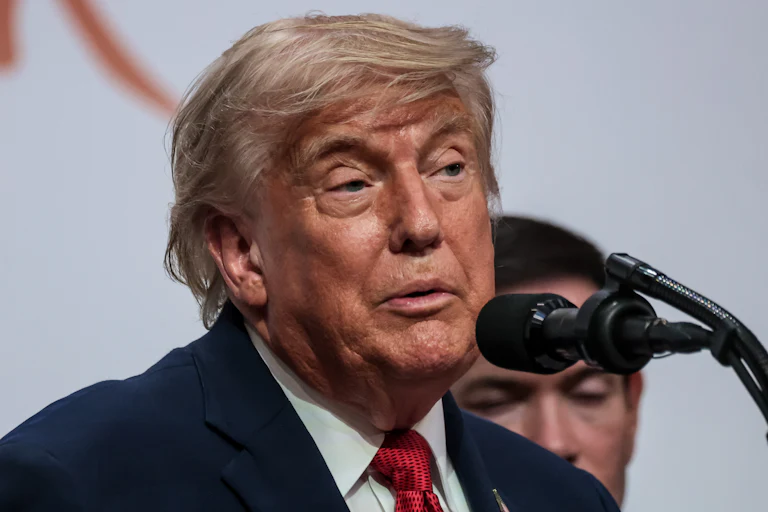
Donald Trump speaks into a microphone during a press conference at the G7 summit
Dominika Zarzycka/NurPhoto/Getty Images

President Donald Trump refused to mete out consequences for the horrific U.S. missile strike in Iran that killed more than 175 people, most of them children.

During a press conference Wednesday at the G7 summit, Trump was asked whether he planned to hold anyone accountable for the attack on a girls primary school in Minab that killed dozens of young girls between the ages of seven and 12.

“No, if it was a fault—and as you know that’s under investigation—it’s such a strange question to be asked at this state because we’re talking about a long time ago,” Trump said. “Nobody did that on purpose.”

A preliminary inquiry found that the strike was the result of using outdated intelligence. Trump seemed to suggest that because the strike had been made in error, there was no reason to punish anyone.

Clearly, a deadly mistake warrants a response, and failing to respond in a timely manner is not in itself an excuse for doing nothing. If Trump were a real leader who valued human life, this would be unacceptable.

Instead, Trump insisted that one would have to examine how many soldiers Iranians had killed and chalked it all up to the cost of doing business.

“No mistakes are made. Yeah, war is nasty. But I know it’s under investigation, I could have a report for you tomorrow,” Trump said, adding that the question would be better directed to Defense Secretary Pete Hegseth.

More than 100 days after the strike in Minab, the DOD’s investigation is now complete and awaiting sign-off, military officials told The New York Times Tuesday. The report became delayed as a result of the slow-moving bureaucratic review process, the Pentagon’s efforts to save its own skin, and intelligence and targeting agencies that couldn’t believe their data could possibly be wrong.

After Months of War, Trump Says Iran Has Right to Nuclear Program

Trump now says it’s just “common sense” for Iran to have a nuclear program.

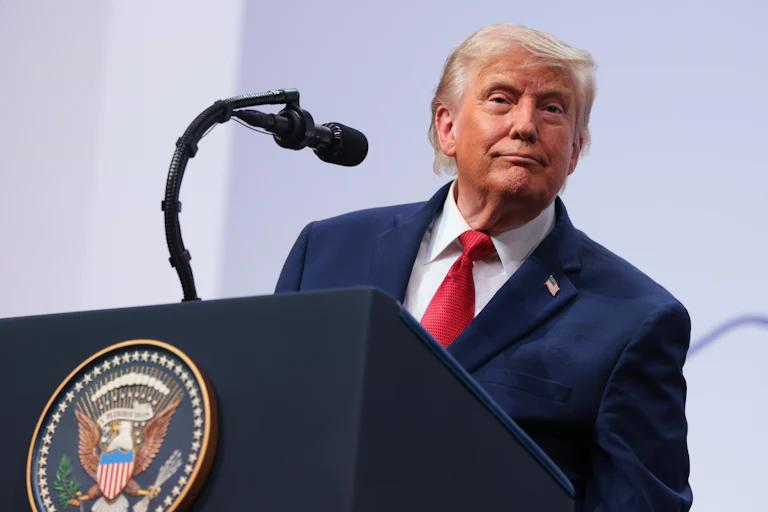
Donald Trump smiles while speaking at the G7 summit.
Anna Moneymaker/Getty Images
Donald Trump speaks at the G7 summit on June 17.

President Trump said Wednesday that Iran could have its own nuclear program.

“It is a little hard that when you say that somebody wants it, other people have it, other adjoining states have it, and you’re not letting them have it for purposes of electricity and things like that. It’s always a little tough. You have to use a little common sense,” Trump said at the G7 summit in France, alongside Secretary of State Marco Rubio, Treasury Secretary Scott Bessent, and Commerce Secretary Howard Lutnick.

It seems to be a sharp departure from Trump’s previous claims during the war. After months of insisting that the purpose of the war was to get rid of any nuclear capability, demanding “zero enrichment,” Trump is now saying that the country can use nuclear power for electricity.

One wonders what Republicans in Congress—let alone the international community—will think of Trump’s latest concession. If a final peace deal between Iran and the U.S. doesn’t have any restrictions on the country’s nuclear program, it will be effectively worse than the 2015 JCPOA agreement with Iran.

That agreement was drafted not only between the U.S. and Iran, but the other members of the U.N. Security Council, including China, Russia, the U.K., and the European Union. This deal was negotiated without Congress even being aware of the details. Iran will likely be receiving $300 billion in reconstruction funds, and now they might have a nuclear program too. What did the Trump administration accomplish?

Trump Admits He Caved on One of His Biggest Demands in Iran War

Trump’s deal with Iran leaves out his biggest demands at the start of the war.

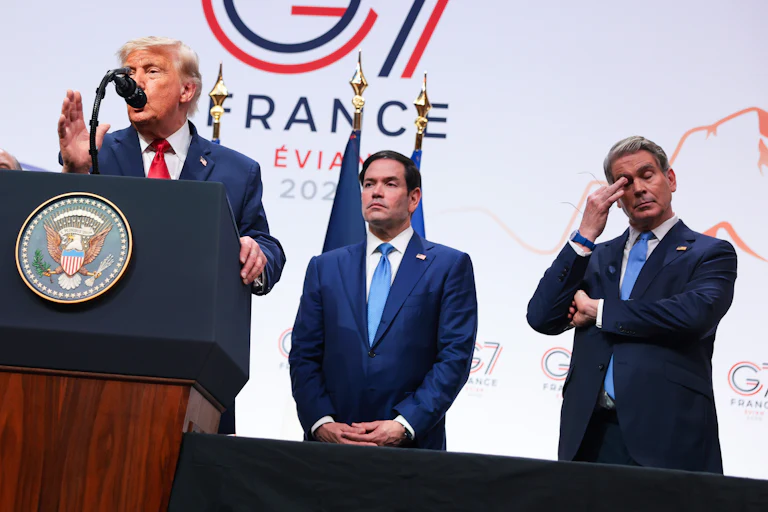
Secretary of State Marco Rubio and Treasury Secretary Scott Bessent look on as President Donald Trump speaks at the G7 summit
Anna Moneymaker/Getty Images
Secretary of State Marco Rubio and Treasury Secretary Scott Bessent look on as President Donald Trump speaks at the G7 summit in France on June 17.

President Trump has given up his efforts to destroy Iran’s ballistic missile stockpile, reneging on one of his central aims in “Operation Epic Fury.”

“We’ll be working on a parallel effort with the Gulf nations to address nonnuclear issues, such as [Iran’s] conventional ballistic missiles,” Trump said at the G7 summit on Wednesday. “I mean, they have to have some. Because other people have some. You gotta have some. Somebody said ‘You shouldn’t give them more … sir, you shouldn’t let them have any missile.’ … What am I gonna do? I’m gonna let Saudi Arabia have missiles, but they can’t have them?

“It doesn’t work that way,” Trump continued. “Missiles, they hurt a little location. But they don’t blow up the planet.”

“One of the goals of Epic Fury, you said going into it, was to destroy Iran’s ballistic missiles and its capabilities to build more,” a reporter asked Trump moments later. “Why is it acceptable to you now that they keep some of that capability?”

“What are they keeping? They have less than other nations now. We knocked out probably 84, 85 percent of their missiles. The rest of them are underground; they can’t even get ’em out,” Trump replied. “They’re gonna have a hard time rebuilding.”

Trump’s memorandum of understanding with Iran secures virtually nothing he sought at the beginning of this war. The Strait of Hormuz was already open, and Iran wasn’t anywhere close to obtaining a nuclear bomb. Now, even as the Strait of Hormuz is set to reopen, it appears that the president is back at square one—all while allowing Iran to retain their missile stock that he claimed to have destroyed.

Swing State Republicans Deliver Trump Huge Blow on Stealing Seats

Governor Brian Kemp had called a special session to vote on new maps.

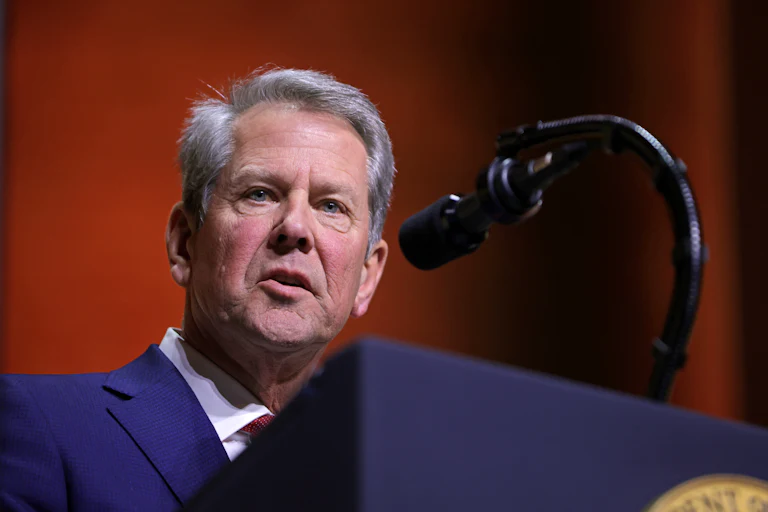
Georgia Governor Brian Kemp speaks at a podium
SAMUEL CORUM/AFP/Getty Images
Georgia Governor Brian Kemp

Georgia Republicans have decided not to redistrict their state after all.

The decision came Wednesday after Governor Brian Kemp called the legislature into a special session to do so ahead of the 2028 election. But Peach State lawmakers flouted Kemp’s demands, arguing that the executive had not given them enough time to shift the state’s voting maps.

“When the House learned that it was placed on the call for a special session, we knew it was not the right path forward for our state at this time. We believe that it is important to do things the Georgia way—responsibly, transparently, and with ample opportunity for public input,” said House Speaker Jon Burns during a press conference at the state Capitol.

In a letter to Kemp, Georgia House Republicans wrote that they would entertain changes to the state’s voting maps “only when members of the General Assembly and citizens have been given ample opportunity to gather the facts, provide input, and engage in meaningful discussion.”

The discussion does not seem to be dead in the water. Instead, state lawmakers are expected to revisit redistricting further down the road, according to Republican state Senate President Pro Tempore Larry Walker III.

“Because any changes to our current congressional or legislative districts would not go into effect until 2028, we believe it is prudent to take the appropriate and necessary time to do this important duty the right way and not to rush through it,” said Walker.

Kemp pressed the issue in the wake of the Supreme Court’s Louisiana v. Callais decision, which struck down Louisiana’s maps on the charge that they were racially gerrymandered.

The Georgia legislature’s conclusion is a rejection of a national GOP movement, spearheaded by Donald Trump, to redistrict their locales in an attempt to carve out as many Republican seats in the House of Representatives as possible.

Several red states have already caved to the White House’s demands: Alabama, Florida, Louisiana, and Tennessee redrew their maps in time to affect the results of the 2026 midterm elections.

Yet not everyone has uniformly complied. Republican lawmakers in South Carolina and Indiana balked at the prospect, earning the president’s ire in the process.