Breaking News
Breaking News
from Washington and beyond

Trump’s New Intel Chief Launches Firing Purge as He Takes Over

Bill Pulte is officially firing people at the Office of the Director of National Intelligence.

Bill Pulte at a podium
Eric Lee/Bloomberg/Getty Images
Bill Pulte

President Donald Trump’s acting Director of National Intelligence, Bill Pulte, has wasted no time purging staff members from his new office.

Pulte, a housing regulator with no experience working in intelligence, has already begun implementing sweeping personnel changes in the intelligence community.

“The deep state firings have begun,” a source familiar with the matter told NBC News. Pulte formally assumed his new post on Friday, and the firings reportedly began Monday.

These are significant changes made by a temporary lackey. Pulte has none of the military or intelligence background necessary to lead ODNI, instead making his name by targeting the president’s political enemies while leading the Federal Housing Finance Agency.

The day before Pulte started at his new post, he directed ODNI staff members to identify 400 employees to be fired from the National Counterterrorism Center in the coming weeks, another source told NBC News. The agency was previously headed by Joe Kent, who abruptly resigned earlier this year in opposition to Trump’s war in Iran. CNN reported that Pulte had requested a list of every employee at ODNI so he could determine who to purge.

Earlier this month, Trump selected Pulte’s permanent replacement: Jay Clayton, the U.S. attorney for the Southern District of New York responsible for the shoddy redactions in the government’s files on Jeffrey Epstein. The president then upended Clayton’s Senate confirmation hearing, messing up Republicans’ chances at renewing a key spy bill.
Eli Lilly Approved Obesity Drug for Mystery 79-Year-Old Patient

Questions are swirling over Donald Trump’s health after a bombshell report revealed a mystery man was getting unprecedented access to a weight-loss drug.

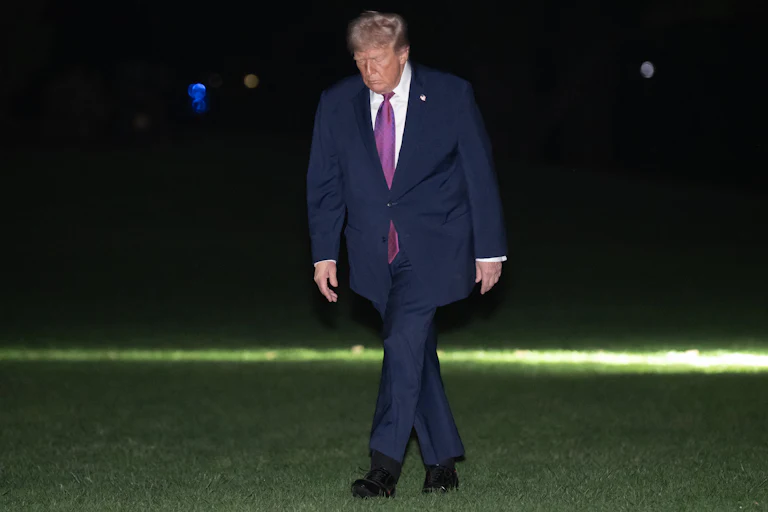
Donald Trump walking on the South Lawn of the White House
SAUL LOEB/AFP/Getty Images

A special 79-year-old man has received unparalleled access to Eli Lilly’s obesity drug.

Millions of Americans are eagerly awaiting access to retatrutide, a powerful new drug from the pharmaceutical company. But one unidentified person has been able to gain premature access to the drug via the Food and Drug Administration’s “compassionate use” program, STAT reported Tuesday.

The FDA program is designed to prioritize access to experimental drugs for patients with grave or life-threatening medical issues. And while the name of the individual is not known, several signs indicate that they are likely very well connected.

A senior clinician at the National Institutes of Health, Ranganath Muniyappa, requested access to the drug for the unnamed patient in April. Muniyappa cited a diagnosis of refractory obesity with obstructive sleep apnea and pulmonary hypertension, a potentially life-threatening disease characterized by high blood pressure in the lungs. The request reportedly drew the attention of top health officials, which STAT noted was indicative of the patient’s influence.

Based on the vague parameters of the patient’s identity, STAT reached out to the White House to see if the recipient could possibly be Donald Trump, who similarly suffers from obesity and has publicly expressed interest in obesity drugs. The White House did not explicitly deny the patient was Trump.

When asked if Trump was the 79-year-old man in question, White House spokesperson Kush Desai did not say no, and instead referred STAT to the Department of Health and Human Services. When asked if Trump had obstructive sleep apnea and pulmonary hypertension, Desai offered Trump’s latest medical evaluation as a counter, which he falsely claimed “covers this,” according to STAT. It does not—the memo makes no mention of either disease.

HHS did not address the issue of the retatrutide application or the patient’s identity.

“The FDA supports expanded access programs that can provide patients with serious or life-threatening conditions access to investigational treatments when no comparable or satisfying approved therapies are available,” HHS spokesperson Emily Hilliard told STAT. “Each request is reviewed on a case-by-case basis based on the clinical circumstances and applicable statutory and regulatory requirements.”

Whoever the patient is, they had been previously treated with other obesity drugs, such as tirzepatide, though sources who spoke with STAT indicated the patient experienced only moderate weight loss as a result. Muniyappa reportedly recommended against bariatric surgery because of the patient’s age and co-morbidities.

Trump’s DOJ Backs Off After Trying to Drag Reporters to Court

Subpoenas were issued to national security reporters at two newspapers, but then quickly withdrawn.

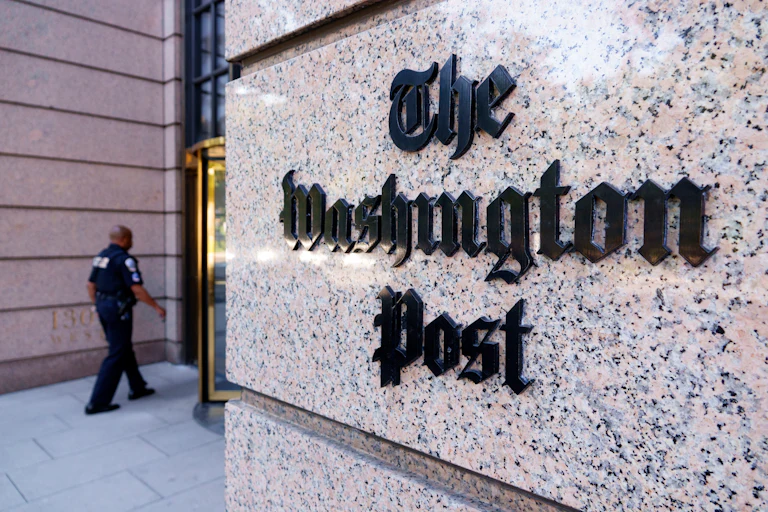
A marble pillar showing The Washington Post logo, with a security guard walking towards a revolving door behind it.
Kevin Carter/Getty Images
The Washington Post’s editorial headquarters in Washington, D.C.

The Trump Justice Department planned to subpoena journalists at The Washington Post and The Wall Street Journal, attempting to force them to testify before a grand jury for vague national security concerns. The subpoenas were eventually withdrawn this month without any explanation after news organizations pushed back.

This was an extremely unprecedented decision that follows the all-too-familiar trend of weaponizing the DOJ against whomever President Trump is upset by that day.

Washington Post reporter Ellen Nakashima—who covers the security and intelligence community, including the war on Iran—was subpoenaed this spring. The Post was in the process of fighting Nakashima’s subpoena before the DOJ suddenly rescinded it.

“The unwarranted subpoena of our reporter Ellen Nakashima — a clear violation of constitutionally guaranteed press freedom — was another sign of the government seeking to compel journalists to become instruments of its investigations,” a Post spokesperson said. “We will continue to stand fully behind the journalism of The Washington Post and fight all efforts by any administration that violate our First Amendment rights.”

Three Wall Street Journal reporters covering national security issues also received grand jury subpoenas from the DOJ, according to the Post. In May, the DOJ also subpoenaed the Journal’s reporters over leaks from the Department of Defense related to the Iran war.

The DOJ has yet to comment on or explain its decisions to file and rescind the grand jury subpoenas.

“The potential of the government intruding into the newsgathering process is even greater when you are in the grand jury than it is for a subpoena for documents,” said Gabe Rottman, vice president of policy at the Reporters Committee for Freedom of the Press. “The administration has taken a number of extremely aggressive steps in respect to the press.… These are all aggressive attempts to target journalists reporting on the actions of the Trump administration. They are a dangerous intrusion of the independence of the press.”

New Book Reveals Trump’s Wild Sleep Habits

The president’s aides don’t know when he’s going to wake up each morning.

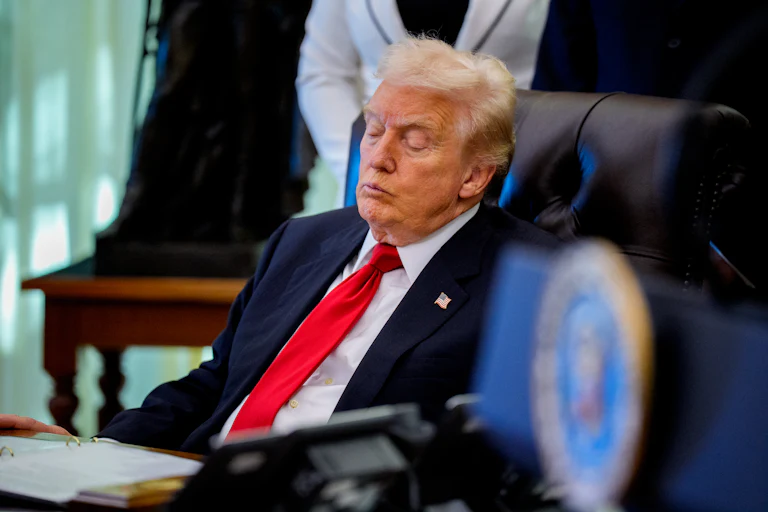
Donald Trump, wearing a blue suit and red tie, sits in side profile on a black leather chair with his eyes closed. In front of him is a desk with an open binder.
Andrew Harnik/Getty Images
President Trump with his eyes closed at a White House event in November

After watching President Donald Trump nod off during meetings over and over and over again, we may finally have some answer as to why.

In Regime Change: Inside the Imperial Presidency of Donald Trump, a new book by New York Times writers Maggie Haberman and Jonathan Swan, Trump’s bizarre sleep schedule has been exposed, reports The Daily Beast.

According to the new book, the octogenarian reportedly barely sleeps at all. He goes on Truth Social posting sprees at all hours of the night—something we’ve all had the misfortune of witnessing—and stays up late watching TV.

The president has grown even more erratic since his last term in office.

More than just gilding fireplaces and building ballrooms, the authors describe how Trump has fundamentally changed “the rhythms and structures and operations” of the White House. Where the president used to arrive predictably by 10:30 or 11 a.m., now it’s anybody’s guess. Sometimes he’s up in the morning making phone calls, and other times White House staff find him still asleep between 8 and 10 a.m.—a sign that he probably stayed up all night watching TV and scrolling.

Privately, aides told Swan and Haberman that, for the first time, Trump was “beginning to seem old.”

“Those who spent time with him could see the signs—the moments of fatigue, the cupped hand behind the ear.… The repeated bouts of drowsiness during mid-afternoon public events,” the authors write.

Regime Change also revealed that the president and his wife, Melania, sleep (or in Trump’s case, don’t sleep) in different bedrooms.

Trump Spirals as Iran Exposes His Lies About the Deal

Trump and his team keep claiming the agreement with Iran includes details it definitely doesn’t.

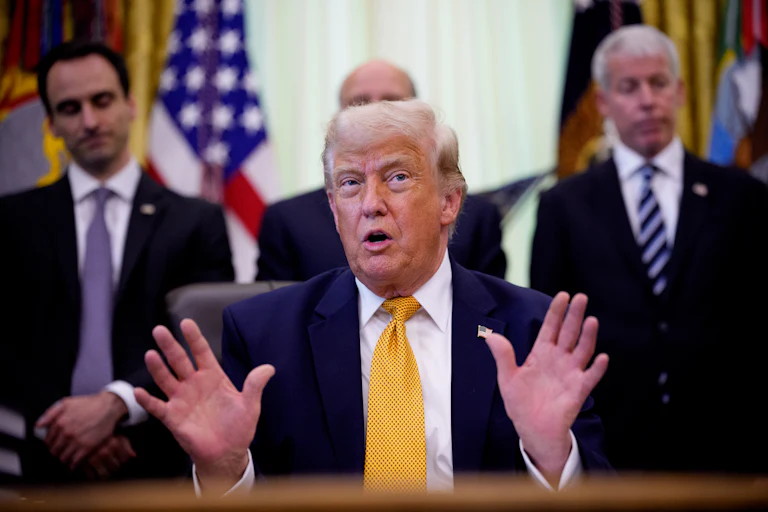
Donald Trump speaking at his desk in the Oval Office of the White House, while others stand behind him.
Andrew Harnik/Getty Images

Donald Trump began his Tuesday morning by melting down over the status of his agreement with Iran.

“Despite their protestations and false statements to the contrary, coupled with the drumbeat of the Fake News, which is doing everything possible to make the U.S. Victory as small and insignificant as possible, Iran has fully and completely agreed to highest level Nuclear inspections long into the future (Infinity!!!). This will insure ‘Nuclear Honesty,’” he wrote on Truth Social. “If they did not agree to this, there would be no further negotiations!”

Well, Mr. President, I have some bad news …

Speaking at a press briefing Tuesday, Iran’s Foreign Ministry spokesperson Esmaeil Baqaei denied the Trump administration’s claim that the country would allow inspectors from the International Atomic Energy Agency (IAEA) to visit its nuclear bombed sites.

“We have not had a meeting with the director general of the IAEA, nor do we have any plans for the agency to inspect Iran’s nuclear facilities damaged by the US and Zionist military aggression,” Baqaei said.

That also contradicts Vice President JD Vance’s claim on Monday that Iran had agreed to allow IAEA inspectors, who could visit Iran “this week, maybe as soon as today.”

The vice president did not offer specifics on what kind of access IAEA inspectors would be granted, or how frequently their inspections would take place. Last week, U.S. envoy Steve Witkoff reportedly assured U.S. lawmakers that in agreeing to the MOU, Tehran had drafted a letter inviting IAEA Director General Rafael Mariano Grossi to bring inspectors into the country.

In the 14-point memorandum of understanding, Iran has only agreed to commit to “down-blending” its enriched nuclear material under the supervision of IAEA inspectors. In return for that commitment, the U.S. has offered Iran unprecedented waivers allowing them to sell their previously sanctioned oil.

Trump also claimed that any “Money and/or Sanctions” released by the Treasury Department would be tightly controlled by the U.S. and used to purchase “food and medical supplies, exclusively from the United States, including Corn, Wheat, and Soybeans from our great American Farmers.” But Iran denied that too.

“Regarding Iran’s released assets, previously illegally blocked by the U.S., WE will decide how to utilize them as we deem fit; there are NO restrictions in this regard,” Baqaei said.

This story has been updated.