Breaking News
Breaking News
from Washington and beyond

Federal Judge Blocks Trump Attempt to Make Voting Harder Than Ever

A federal judge has banned Trump’s executive order requiring proof of citizenship and changing the rules on mail-in voting.

Voters cast their ballots in New York’s election
John Lamparski/Bloomberg/Getty Images
Voters cast their ballots in New York’s election, on June 23

A federal judge has killed most of President Donald Trump’s first executive order changing election rules.

U.S. District Court Judge Denise Casper permanently banned the administration Wednesday from implementing most components of the president’s 2025 order, which required individuals to provide “documentary proof of U.S. citizenship” before they registered to vote. In addition to lifting that requirement, the ruling also bans the president from requiring all mail ballots to be received by Election Day, even if they were postmarked by then.

Under Trump’s order, states that refused to comply would have been punished by having their federal funding withheld.

The government had argued that Democratic challenges to Trump’s executive order were premature and therefore illegitimate since the changes had not yet been implemented—but the Boston-based judge wasn’t having it. Instead, she noted that Trump’s office had effectively violated the necessary separation of powers, as only states and Congress are permitted to regulate elections.

The Constitution “does not grant the President any specific powers over elections,” Casper wrote.

Trump officials responded quickly to Casper’s decision, hinting online that the ruling would be appealed.

“I hope the Chief Justice understands the path these rogue judges have charted for the judiciary,” deputy Chief of Staff Stephen Miller wrote on X.

Meanwhile, Trump has worked overtime to force his unpopular election reform proposals through the legislature, throwing confirmation hearings and bipartisan bill signings to the wayside while demanding Republicans prioritize passing the SAVE America Act.

The backlash to the bill—which was introduced months ago on Capitol Hill—has been grave, so much so that it gummed up efforts to fund Homeland Security for several months. Republicans eventually had to bail on the package to end the congressional gridlock.

Since he lost the 2020 election, Trump and his allies have amped up their base over contrived claims of voter fraud, a statistical nonissue in U.S. elections. For instance, a statewide audit out of Georgia, the epicenter of Trump’s baseless theory, revealed in 2024 that just 20 non-citizens out of 8.2 million residents existed on the state’s voter roll, just 0.00024 percent of the state’s voting population. Out of those 20, only nine participated in elections years ago, before ID was required as a part of the voter verification process. The other 11 individuals were registered but never actually voted, according to Secretary of State Brad Raffensperger.

This story has been updated.
Democratic Senator Demands Trump Pay for Reflecting Pool Disaster

The president should refund taxpayers out of his own pocket, Senator John Hickenlooper says.

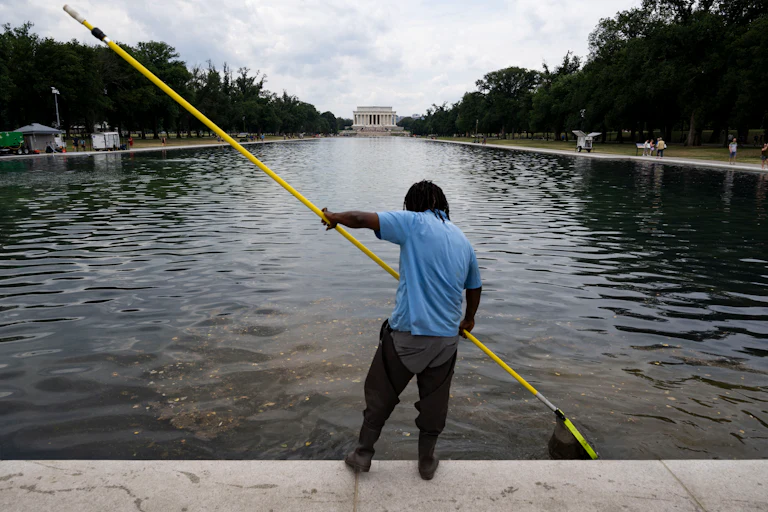
A man in a blue shirt and dark pants uses a long yellow pole to clean the Lincoln Memorial Reflecting Pool, with the memorial building visible in the background.
Kent Nishimura/AFP/Getty Images
A worker cleans the waters of the Lincoln Memorial Reflecting Pool on June 22.

Democratic Senator John Hickenlooper is calling for President Donald Trump to refund taxpayers out of his own pocket for the millions spent on the Lincoln Memorial Reflecting Pool, HuffPost reports.

“For weeks, Americans have watched a national embarrassment unfold on the National Mall,” Hickenlooper wrote in a letter to the president obtained by HuffPost. “Under the guise of an ‘emergency,’ your Administration bypassed competitive bidding processes to rush a renovation of the iconic Reflecting Pool.… Today, the Reflecting Pool is a fluorescent green swamp of algae, and the expensive blue sealant is already peeling off the bottom in sheets.”

Though Trump blamed “vandals” for the pool’s problems, it’s more likely that shoddy workmanship is the issue: Trump rushed the painting of the pool so that it would be “American Flag Blue” by July 4, and awarded no-bid contracts worth millions of dollars—one to Greenwater Services, the ironically named company of a longtime Trump donor and Mar-a-Lago neighbor.

Even if mysterious assailants did take a knife to the reflecting pool’s peeling blue paint—something Trump has declined to provide any evidence of—that wouldn’t explain how the reflecting pool became a bright green, algae-filled swamp.

“This was not a result of vandalism, but your administration’s incompetence,” Hickenlooper wrote in his letter. “The bill for this fiasco should only belong to you, Mr. President.”

In order to fix what it broke, the administration is planning to spend even more money to re-drain the pool and conduct repairs. Trump’s promise to “drain the swamp” is starting to sound a lot more literal.

Republicans Scramble After Trump Refuses to Sign Landmark Housing Bill

The president abruptly canceled a public signing ceremony of the bill—leaving his own party in the lurch.

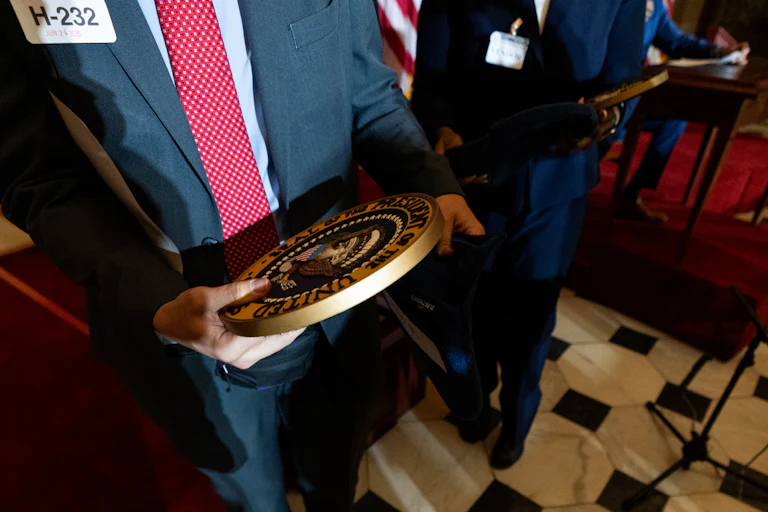
Someone holds the presidential seal in their hands
Bill Clark/CQ-Roll Call, Inc/Getty Images
The presidential seal from the podium is packed away after President Trump abruptly canceled the housing bill signing event at the U.S. Capitol, on June 24.

Republicans can’t catch a break at the minute, and it’s all due to their mad, senile king.

On Wednesday, President Donald Trump refused to sign a bipartisan housing bill, the 21st Century ROAD to Housing Act, which passed both the House and Senate with flying colors—catching members of his own party off guard.

The bill would create new homes and limit corporate investors’ ability to buy single-family residences. Members of the GOP have used it as an example of their concern for working people ahead of the November midterms.

The stage was quite literally set for the signing in the Capitol before Trump threw his hissy fit. With little over an hour before the public signing ceremony, the president said he wants to push through the SAVE Act, Republicans’ faulty voter ID bill, before doing anything about housing.

Republicans then rushed to remove the presidential seal from the podium, as Democrats began using the stage as a backdrop to highlight the president’s sudden flip-flop.

Following Trump’s public refusal, House Speaker Mike Johnson attempted some damage control in a press conference.

“The president, when we go through the details of the bill, he’s gonna understand that it’s a good product, and certainly something that fulfills his promises,” Johnson said.

The SAVE Act has passed in the House but does not currently have the votes to pass the Senate. Nor should it—the bill will make it tougher for anyone lacking a paper copy of their birth certificate or passport to vote.

“The SAVE Act will make it exceedingly and unacceptably difficult for hundreds of thousands, if not millions of Americans, to be heard,” Democratic Senator Raphael Warnock told Politico. “If all the people in the election can’t be heard, who are eligible to vote, then that’s something other than democracy.”

“I don’t think the American public knows what is in store for them if [the SAVE ACT] passes,” Democratic Senator Mazie Hirono added. “Millions of people are going to need to re-register.”

Kyle Griffin of MS NOW said the legislation was “designed to help rig elections.”

Despite the president’s refusal to sign the housing bill, it could still become law in 10 days if Congress remains in session.

Trump Puts Pregnant Dem Congresswoman on Trial for ICE Oversight

She’s been charged with assaulting immigration agents.

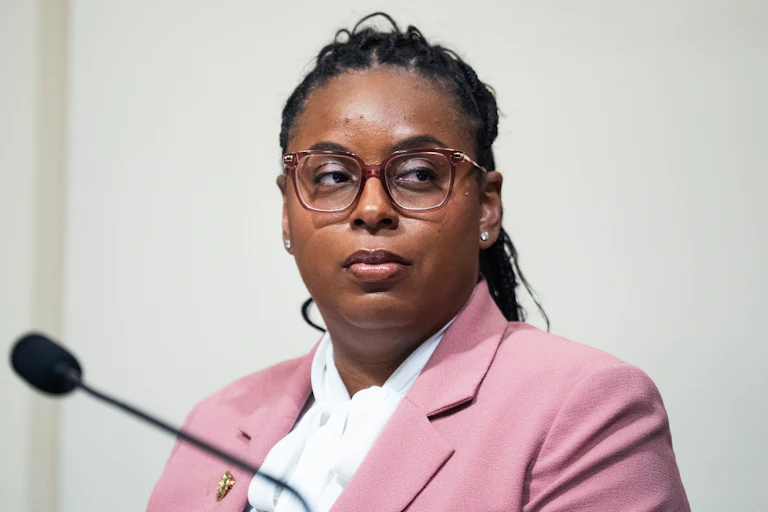
LaMonica McIver is seated, wearing a beige blazer and a white shirt with a microphone in front of her.
Tom Williams/CQ-Roll Call, Inc/Getty Images
Democratic Representative LaMonica McIver, representing New Jersey’s 10th congressional district

U.S. Representative LaMonica McIver could face up to 17 years in prison if the Justice Department gets its way.

McIver, 40, was charged with assaulting immigration agents outside the notorious Delaney Hall immigration detention center in New Jersey last May. On Wednesday, her case will be argued in a federal appellate court, and will be another test of the Trump administration’s power to go after political opponents, The New York Times reports.

Last year, McIver, who is now pregnant with her second child, was at the detention center with other Democratic leaders to conduct an oversight inspection. When agents attempted to arrest Newark Mayor Ras J. Baraka for tresspassing, McIver was allegedly involved in a confrontation where she used her arms to “assault, resist, impede and intimidate” two federal agents, government attorneys say.

No one was injured in the altercation. McIver’s lawyers argue that the DOJ is coming after her because of her political views, citing the many pardons that the Trump administration gave to the January 6 protesters who actually did injure police officers in the 2021 riot.

However, U.S. District Court Judge Jamel K. Semper rejected those arguments in November. McIver appealed the case, and it will be argued before a panel of three appellate judges Wednesday.

A bipartisan group of former members of Congress wrote a letter in support of McIver, arguing that a win for the DOJ would mean that the executive branch would be able to “behave in a more chaotic and unsafe fashion, and create new, unprecedented tools to block legitimate oversight.”

If she is convicted, McIver could face up to 17 years in prison, and $1 million in legal fees. She is currently running for reelection, and her baby is due in the fall.

Republican Rep. Caught Celebrating Housing Bill Trump Refuses to Sign

Representative French Hill didn’t seem to realize the president is refusing to sign this bill.

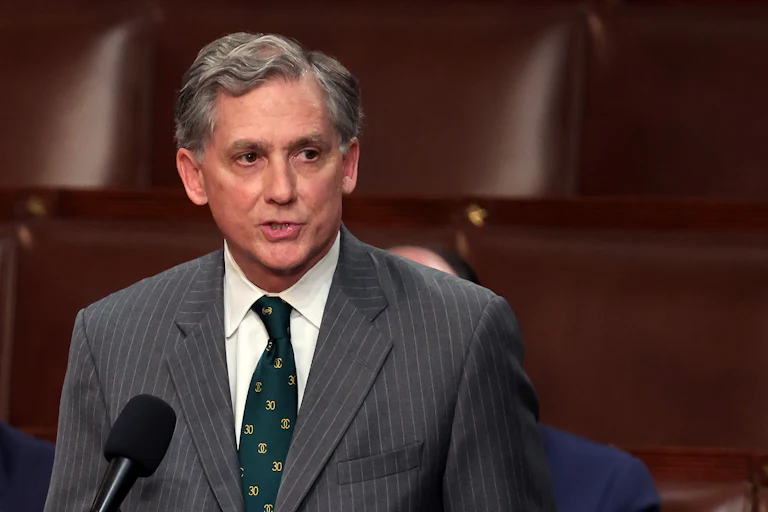
Representative French Hill speaks in Congress
Win McNamee/Getty Images
Representative French Hill in 2023

President Donald Trump abruptly canceled the signing of a bipartisan housing bill Wednesday, insisting that he would not make it law without his voter ID legislation, the SAVE America Act. But not everyone on Capitol Hill got the memo that the housing reform effort was a dud.

Arkansas Representative French Hill was already in a news conference when Trump axed the 21st Century ROAD to Housing Act. Hill unknowingly celebrated a dead proposal that Republicans had hoped would bolster their reelection efforts ahead of November.

Standing beside House Speaker Mike Johnson, Hill said it had been his “top goal” to lower the cost of housing.

“This bill does that, so I’m proud of the work that both chambers have struggled through,” Hill said Wednesday morning. “But it’s successful today, and I’m proud of the work of the House and Senate to get people to ‘yes’.”

The 21st Century ROAD to Housing Act was drafted to address the U.S. housing crisis, which has entailed bottlenecked supply, stalled family growth, and surged home and rental prices across the country. The bill would have funneled resources toward increasing housing supply and streamlined environmental reviews, and would have forced the Department of Housing and Urban Development to address red-tape issues related to zoning and land-use that have historically posed barriers to housing development.

“This is a very rare occurrence to have successive bipartisan votes across both chambers on versions of this bill, and it finally seems to be reaching the finish line,” Francis Torres, housing and infrastructure director at the Bipartisan Policy Center, told TIME earlier this week. “This bill is the most serious that Congress has gotten about housing reforms in a generation.”

The House passed the bill by a vote of 358–32 on Tuesday. The day before, the Senate had passed it by a measure of 85–5. It only needed the president’s signature to become law—but that apparently won’t happen unless Congress caves to his unpopular voter ID demands.

The Save America Act sparked nationwide controversy earlier this year, particularly over a detail in the bill that would have made it more difficult for married women to vote. The backlash on Capitol Hill was grave, so much so that it gummed up efforts to fund Homeland Security for several months. Republicans eventually had to bail on the package to end the congressional gridlock.

The Save America Act suggests numerous amendments to the National Voter Registration Act of 1993, including line items that would abolish mail-in voting, require voters to bring proof of citizenship and proof of residency to register to vote, require voter ID, and mandate voter roll purges every 30 days, an enormous bureaucratic task that would place undue burdens on local election officials. The measure would also add a federal law to prevent men from competing in women’s sports and a ban on “transgender mutilation surgery.”