Breaking News
Breaking News
from Washington and beyond

Pete Hegseth Is Pissed There Are Still “Beardos” in the Military

Hegseth banned beards on troops during an unprecedented speech in 2025.

Defense Secretary Pete Hegseth stands on stage during Donald Trump’s press conference at the NATO summit in Turkey
Beata Zawrzel/NurPhoto/Getty Images

Nine months after delivering his widely mocked “beardo” speech, Defense Secretary Pete Hegseth is still fuming about the military’s (according to him) lax attitude toward grooming standards.

Hegseth has recently complained in private about seeing service members with facial hair, going so far as to suggest that the military’s senior leadership has not fully embraced his new appearance and hygiene requirements, according to U.S. officials that spoke with CBS News Friday.

One unidentified official told the network that Hegseth was frustrated that his speech last year did not produce immediate results.

Pentagon spokesman Sean Parnell attributed Hegseth’s anger to his high expectations.

“Secretary Hegseth maintains the highest expectations for our service members to uphold the professional standards of appearance, fitness, and discipline that define our warfighting force, and he continues to emphasize consistent enforcement of hair, weight, and grooming standards across all ranks,” Parnell said in a statement to CBS News.

“Commanders at every level are expected to lead by example by meeting these standards, implementing these requirements, and they will be held accountable for delivering results as the Department works to restore a culture of excellence and readiness,” Parnell continued. “Our Armed Forces are stronger when every service member meets and exceeds these expectations.”

Last September, Hegseth ordered hundreds of America’s top military commanders to leave their international posts to attend a mandatory in-person assembly in Quantico, Virginia, during which the hairphobic ex–Fox News host unveiled his agenda to de-woke the country’s armed forces.

The plan involved snipping away shaving waivers, despite the disproportionate impact that the requirement would have on Black service members, who are more frequently diagnosed with pseudofolliculitis barbae—or chronic razor bumps—due to the curl pattern of the hair and the subsequent injurious effects of frequently shaving their faces. The painful inflammatory condition has been estimated to affect somewhere between 45 percent to 83 percent of the Black male population in the U.S.

“No more beardos,” Hegseth said during his address. “Calling someone to shave, or work hard, is exactly the kind of workforce we want.”

“The era of rampant and ridiculous shaving profiles is done,” Hegseth noted at the time, adding that anyone unwilling to comply should look for a “new position or a new profession.”

Branches of the military have distributed their own internal guidance per the new grooming mandate, revealing that even those with medical exemptions will not be allowed to receive accommodations past 12 consecutive months.

Trump Plans to Fence in Historic Space for Political Protests

Trump is moving to shut down all protests outside the White House.

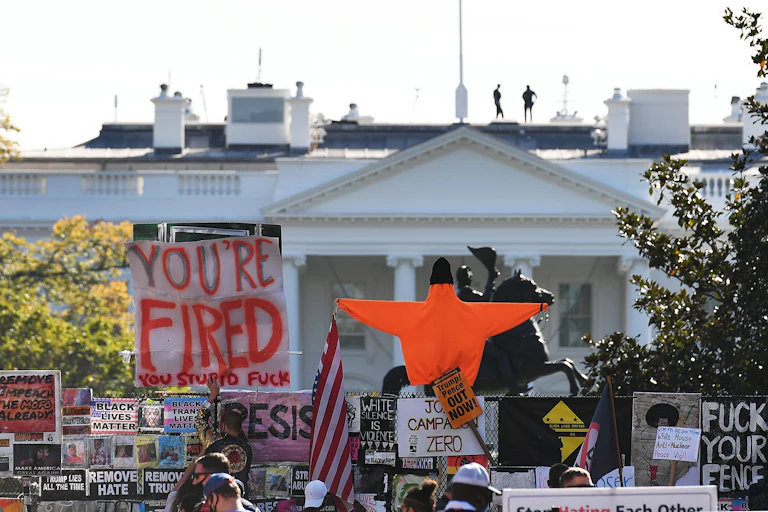
Placards decorate a fence surrounding Lafayette Square in front of the White House on November 6, 2020.
MANDEL NGAN/AFP/Getty Images
Lafayette Square in front of the White House on November 6, 2020

The Trump administration wants to fence off parts of Pennsylvania Avenue outside of the White House, shutting down a historic space for political protests.

The Washington Post reports that the administration and Secret Service plan to put fences where Pennsylvania Avenue crosses 15th and 17th Streets NW, allowing them to close pedestrian access if they decide there are security risks.

Multiple presidential administrations have used temporary barriers on Pennsylvania Avenue, but the Secret Service’s suggestion to erect permanent fences there has faced pushback as a clear attempt to restrict public access to the White House. The Trump administration is also planning to put up permanent fencing around Lafayette Square, a public park across from the White House and another historic protest space.

The fences on Pennsylvania Avenue would affect multiple organizations that are located on the street, including the Smithsonian American Art Museum’s Renwick Gallery and the Milken Center for Advancing the American Dream. And new fencing could cut off the public’s view of the White House and deter, if not outright bar, pedestrians from getting through.

Protesters gather outside the White House on July 27, 2025, to demand an end to Israel's blockade of the Gaza Strip.
Protesters outside the White House on July 27, 2025, demand an end to Israel’s blockade of the Gaza Strip.
MEHMET ESER/Middle East Images/AFP/Getty Images

“This would mean that residents and tourists alike would be unable to see the White House from any reasonable distance, especially if Trump plants more trees in the Park,” said Michael McGill, a former General Services Administration official who also served on the Capitol Planning Commission, in an email to the Post, referring to Trump’s other plan to plant 47 trees in Lafayette Park.

In May, parts of Pennsylvania Avenue between the White House and Lafayette Square were painted with yellow lines to allow cars to park during special events over the summer, including President Trump’s “UFC Freedom 250” birthday fight and fan festival at the Ellipse. Trump has gone out of his way to remake the White House (like his ballroom) and the parts of Washington near it without any regard for public opinion.

Every Witness to ICE Killing in Houston Says the Same Thing: ICE Lied

The three men in Lorenzo Salgado Araujo’s vehicle were interviewed separately. They all said ICE’s version of events isn’t true.

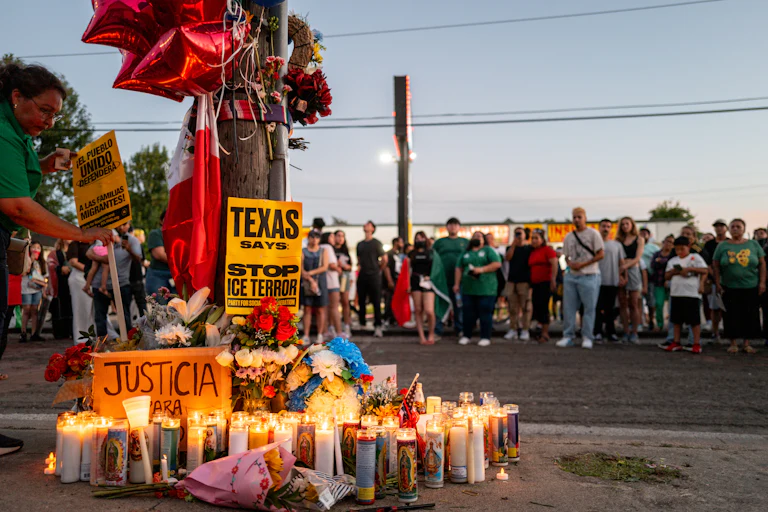
People pay their respects during a candlelight vigil at the site where Lorenzo Salgado Araujo was killed in Houston on July 8.
Brandon Bell/Getty Images
A candlelight vigil at the site where Lorenzo Salgado Araujo was killed in Houston on July 8.

The men who were in Lorenzo Salgado Araujo’s vehicle when an Immigration and Customs Enforcement agent shot and killed him on Tuesday say he did not try ram the immigration agents’ unmarked car—directly contradicting ICE’s version of events.

The agents stated that Salgado Araujo, a Mexican immigrant and father of three who was on his way to work, had ignored their verbal commands, “weaponized his vehicle,” and tried to run over one of them. The agent shot him and claimed self-defense.

“That is a lie,” Jose Trinidad Rojas, 51, said in a handwritten statement offered to The Washington Post by his lawyer, Hugo Balderas-Ibarra. “It is impossible for them to say that they were going to get run over.... There were no officers in front of or behind the vehicle. They were on the sides.... Lorenzo thought we had lost them but suddenly they surrounded us.”

Balderas-Ibarra said he spoke to Rojas and the two other passengers—Daniel Tirado Pantoja and Victor Salgado, Salgado Araujo’s brother—separately, and each stated that ICE lied about Salgado Araujo’s violent intent. Victor also said that agents began firing from their vehicle’s passenger side, striking his brother in the abdomen and then mocking him while he bled out, saying, “You wanted to escape, right?”

All four men in the car had been in the United States for at least two decades. They were arrested and taken into custody shortly after the shooting.

Not only do these witnesses say ICE is lying, the footage of the incident suggests they were too. Video obtained by local outlet KHOU 11 shows the agents tried to box Salgado Araujo’s car in with their unmarked black SUV, initiating the conflict. When Salgado Araujo made a U-turn and fled in the other direction, the agents (who could have been anyone to him, as they were in an unmarked vehicle) followed him. Even worse, The New York Times reported that Salgado Araujo wasn’t even the intended target—they were hunting two immigrants from Guatemala. Now Salgado Araujo is dead for no reason. He is the tenth person to be fatally shot by federal immigration agents since President Trump returned to office.


Trump Moves to Gain Unprecedented Control Over Federal Funding

The Trump administration is prepared to cancel any federal grants that don’t fit its agenda.

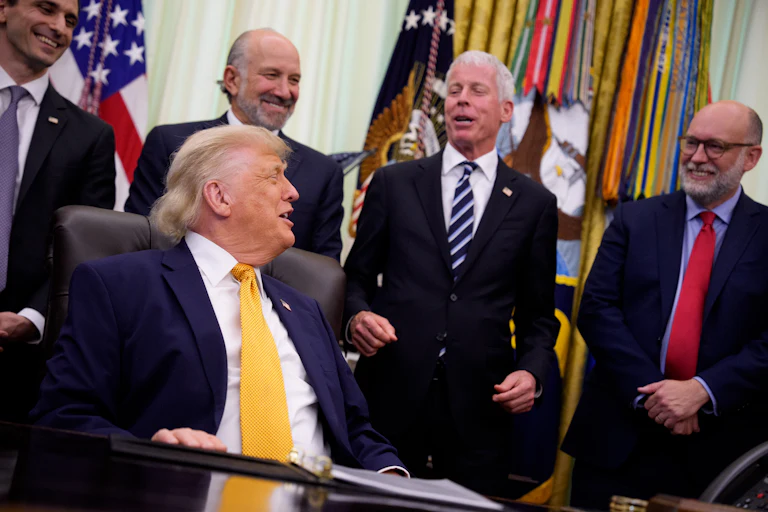
President Donald Trump laughs while seated at his desk in the Oval Office of the White House, while Office of Management and Budget Director Russell Vought, Energy Secretary Chris Wright, Commerce Secretary Howard Lutnick, and White House Office of Science and Technology Policy Director Michael Kratsios stand behind him.
Andrew Harnik/Getty Images
President Donald Trump with (from right to left): Office of Management and Budget Director Russell Vought, Energy Secretary Chris Wright, Commerce Secretary Howard Lutnick, and White House Office of Science and Technology Policy Director Michael Kratsios, at an event in the Oval Office, on June 22

The White House Office of Budget and Management is planning massive changes to the way federal grants are handed out, making it so that government funding can only be spent on programs that are “aligned with administration policies and priorities.”

If passed, the new rules would also allow President Trump’s political appointees to supersede federal agencies’ merit-based decisions in order to ensure the grants “demonstrably advance the President’s policy priorities.” There is also a portion of the proposal that bans the use of “theories of disparate-impact liability”—a legal concept that helps determine when a policy is disproportionately discriminatory.

Experts argue that the change would give Trump’s political appointees, most of whom are not experts, undue control over what kind of research gets funded. 

“This touches all parts of American life,” Veterans Administration psychiatrist Dr. Eric Rafla-Yuan told the Los Angeles Times in an article published Friday. “Control of how all of the federal grants and programs are funded will fall under a small group of highly partisan individuals who would have very few limits on how they spend these billions of taxpayer dollars.… If there’s a specific age range that is at higher risk for suicide, and we want to figure out, well, what’s going on with people that are aged 14 to 19 … we can’t do that under the wording in this rule.”

A massive group of various experts in fields ranging from cancer research to public housing have come out against the proposal, and there are over 100,000 comments on it. OMB published the proposed rule in the federal register in May, and the comment period ends July 13.

“A significant number of the provisions in this proposal would in fact increase administrative complexity, create uncertainty for grant recipients, reduce transparency in funding decisions, and undermine the merit-based processes that have effectively guided federal research investments,” the American Association for Cancer Research said in a statement. “This OMB proposal is reckless and does not meet the high U.S. standards required for a meritorious, impactful research grant program.”

The Planetary Society wrote in its own statement, “Science is the backbone of the American economy, generating a 3-to-1 return on the taxpayer’s investment. Our nation has always relied on merit-based, independent scientific review to select the best ideas and new technologies for development. The proposed rule changes would all but end the use of scientific merit in the selection of grants and programs across the government.”

Even Republican Senator Susan Collins expressed her concern, writing that it would “inject uncertainty into the Federal award process, especially for awards that span multiple years and phases and make these awards more costly.” She also noted that the “termination of clinical trials would leave patients without treatment and could well result in significant scientific and financial losses to both the recipient and the Federal government.” 

The OMB, led by Project 2025 architect Russell Vought, has been one of the president’s most favored tools of administrative destruction, as it’s helped him do everything from slashing crucial programs like U.S. Agency for International Development to shifting money toward his White House ballroom.  

Trump Has Pointless Temper Tantrum Over Housing Bill

Donald Trump basically gave his own party the middle finger over the measure.

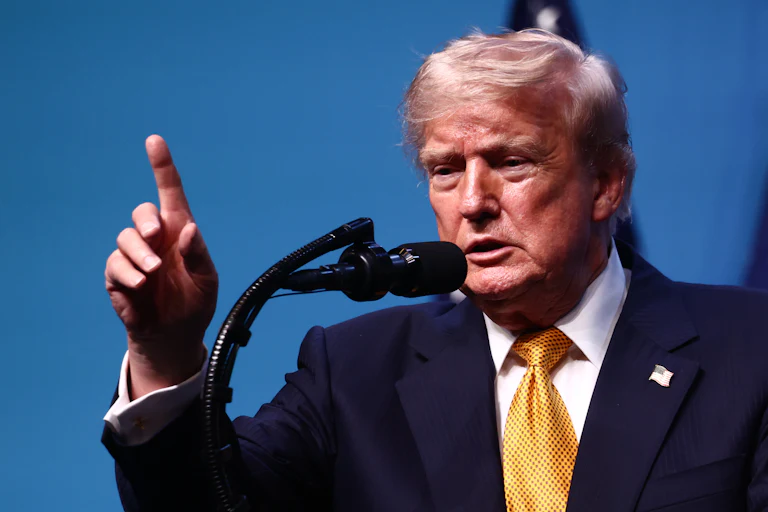
Donald Trump raises a finger while speaking into a microphone.
Jakub Porzycki/NurPhoto/Getty Images

Donald Trump is pitching a fit over a potential bipartisan legislative win in a futile attempt to advance the SAVE America Act.

“I will not sign the Housing Bill, which has been fully approved by Congress and sent to the White House, in PROTEST over the fact that the United States Senate is not capable of passing THE SAVE AMERICA ACT, which is polling at 97 percent with the Republican Party, and very high with the non-politician Dumocrats,” Trump posted on Truth Social Friday morning.

But Trump’s protest is pointless: the Constitution states that bills automatically become law after 10 days if the president neither signs nor vetoes them. The housing affordability measure passed both chambers of Congress with overwhelming bipartisan support, and Trump has not indicated that he will issue a last-minute veto of the measure. It is currently scheduled to become law at midnight.

The SAVE America Act, on the other hand, sparked nationwide controversy earlier this year, particularly over a detail in the first version of the bill that would have made it more difficult for married women to vote. Backlash over the bill has been so severe that, in the months since Trump insisted it should be Congress’s top priority, dispute over the voter ID bill has gummed up efforts to fund the Department of Homeland Security, stalled attempts to pass the National Defense Authorization Act, and upended Trump’s own cabinet nominations.

The original SAVE America Act suggested numerous amendments to the National Voter Registration Act of 1993, including line items that would abolish mail-in voting, require voters to bring proof of citizenship and proof of residency to register to vote, require voter ID, and mandate voter roll purges every 30 days.

But the bill has been radically pared down since then, in large part due to the improbability of passing it in whole. House Speaker Mike Johnson has claimed that the current iteration of the act proposed by the lower chamber preserves the “backbone” of what Trump is pushing to pass in the Senate.

That includes requirements to provide proof of citizenship when registering to vote—such as a birth certificate or a U.S. passport (which only half of the population currently possesses)—and a mandate to present photo identification when casting a ballot. Trump has also insisted that the bill ban mail-in voting, describing the procedure as “crooked” and “corrupt” despite the fact that he himself has cast several mail-in ballots.

“THE SAVE AMERICA ACT’S non-passage is CRAZY, and a serious threat to any politician who votes against it!” Trump continued in his Friday post. “If the Dumocrats, or any RINO (or worse!) working with them, do not allow a positive Vote on SAVE AMERICA, TERMINATE THE FILIBUSTER, and pass this, and every other Bill that true Republicans have ever dreamt of (In addition to the upcoming Budget BOMB and the 1929 catastrophic style DEBT CEILING BILL!)”

But Republicans simply do not have the votes to end the filibuster or pass Trump’s unpopular voter ID bill, Senate Majority Leader John Thune told The Hill last month.

Meanwhile, the 21st Century ROAD to Housing Act is an immediate necessity to free up America’s housing market. It was drafted to address the American housing crisis, which has suffered from bottlenecked supply, stalled family growth, and surged home and rental prices across the country. The bill will funnel resources towards increasing housing supply, streamlined environmental reviews, and force the Department of Housing and Urban Development to address red-tape issues related to zoning and land-use that have historically posed barriers to housing development.

In June, Trump described the bill as “a yawn.”

Trump’s intention to detach himself from the effort comes on the heels of a bombshell report by the National Association of Realtors that indicated national home prices in June rose to the highest level on record.

“Republicans would rather make it harder to vote than easier to afford a home,” House Minority Leader Hakeem Jeffries wrote on X, responding to Trump. “When people show you who they are, believe them.”

This story has been updated.