Breaking News
Breaking News
from Washington and beyond

New Docs Reveal Trump Spending Even More on Giant Banners of Himself

Democratic Senator Adam Schiff points to new government documents that show how much money is going toward those massive MAGA banners across the nation’s capital.

A large banner showing a picture of President Trump on the U.S. Department of Agriculture building reads "USDA Growing America Since 1862."
Kevin Carter/Getty Images
The U.S. Department of Agriculture building in Washington, D.C., on June 3, 2025

President Trump is spending taxpayer funds worth thousands of dollars to make and hang more large banners with his face on them all over federal buildings in Washington, D.C.

Democratic Senator Adam Schiff shared newly discovered federal contracts with MeidasTouch News that show government agencies putting their own budgets toward “America First” banners, which include ones of the president’s face.

The Department of the Interior made a $39,000 contract for “America First” banners with Trump’s portrait, while the Federal Aviation Administration awarded a $114,000 contract for “Freedom 250” banners. Both contracts went to a Maryland-based graphic design agency called Grafik Industries.

Using taxpayer dollars to fund government propaganda and self-promotion by public officials isn’t allowed, Schiff says.

“The Trump administration is spending hundreds of thousands of your tax dollars to glorify and pay tribute to a sitting U.S. President and his political agenda,” Schiff said in a statement. “Not only is this a terrible waste of Americans’ hard-earned money, it is clearly against the law. Congress has long outlawed spending tax dollars on propaganda and self-aggrandizement and an eight-story high Donald Trump head certainly qualifies as propaganda.”

In September, Schiff issued a report showing that Trump had spent at least $56,000 on promotional banners with his face that were later hung on government buildings, including the Department of Labor, Department of Agriculture, and Department of Health and Human Services headquarters. This is part of a pattern of Trump wanting to put his name and face on as many things as possible in Washington, D.C. and remake the city in his own image.

No matter how much money Trump wastes on his propaganda art, it won’t change the fact that his popularity is plummeting and that federal workers in the nation’s capital hate him.


Another Person Dies in Fatal ICE Shooting—a Week After the Last One

ICE has fatally shot a person in Biddeford, Maine.

The back of an ICE agent's head, wearing a camo-patterned ICE baseball cap and a thick gold chain
Michael M. Santiago/Getty Images
An ICE agent

A young man was shot and killed Monday morning by an Immigration and Customs Enforcement agent in Biddeford, Maine, according to reports by local media outlets and authorities.

“This morning a shooting occurred in Biddeford,” Maine House Speaker Ryan Fecteau wrote in a Facebook post. “A person was killed. ICE was involved. State Police and the Department of Public Safety are now on scene to gather details and would expect the FBI to investigate as well.”

The victim, who appears to have been shot while operating a car, was a 26-year-old Colombian man “who was authorized to work in the United States and had been issued a Social Security number,” according to two immigrants rights groups, Maine Immigrants’ Rights Coalition and Presente! Maine.

“A 26-year-old man came to Maine to live and work, and now his family is mourning his death following an incident involving ICE,” the groups said in a statement. “This is devastating, enraging, and unacceptable. His loved ones deserve answers, and the public deserves a full and transparent account of what happened.”

At a press conference Senator Angus King said the FBI would investigate the incident. King also said the agents involved were not wearing body cameras and that Homeland Security Secretary Markwayne Mullin had told him the victim was the target of an immigration operation “based on his immigration status.”

But hours later, King amended the latter point, stating that the Homeland Security secretary had since informed him the victim was actually “not the target of the warrant.”

According to King, Mullin alleged the man “weaponized” his vehicle against an agent—recalling accusations ICE has made dubiously against other victims of high-profile fatal incidents involving the agency in the past.

A statement from the Maine Attorney General’s Office, citing “initial statements,” says the man “attempted to flee in a vehicle in the direction of the officer and was fatally shot.”

Footage of the aftermath appears to show ICE agents standing around the deceased man in an intersection, beside a white Kia sedan whose windshield bore several bullet holes.

A witness told the Portland Press Herald that he heard gunshots, then saw an SUV attempting to “ram a small white car in the intersection” before agents in vests stopped the white car and pulled the man from the vehicle. Before he died, the victim was “bleeding profusely from the head,” that witness said. “He was talking. He said, ‘I tried to stop.’”

Another witness told the Press Herald that the victim’s family was apparently at the scene of the shooting. As the man lay on the street, an “older woman” was present “with a distressed family,” including a toddler—a little girl in Bluey pajamas. “You took her dad, you took her dad!” the woman yelled.

This is at least the eleventh fatal ICE shooting since Donald Trump returned to office—and the second in less than a week, coming just days after ICE shot and killed Lorenzo Salgado Araujo in Houston, Texas, on July 7.

Members of the community protested the fatal shooting Monday morning and afternoon.

At one such protest, City Councilor Abigail Woods told the Biddeford Gazette, a local news source, that friends of hers had witnessed the incident. “It’s unacceptable to have one of our own residents in the city of Biddeford be murdered by ICE,” Woods said.

This story has been updated.

FBI Forced to Reveal New Details on How It Redacted Epstein Files

A bombshell FOIA request revealed how the FBI and Department of Justice trained agents.

Two computer screens show the Department of Justice's library of files on Jeffrey Epstein and a photograph of his face.
Véronique Tournier/Hans Lucas/AFP/Getty Images
The Department of Justice’s library of files on Jefferey Epstein

Last spring, it was rumored that agents with the FBI were trained to redact portions of the Epstein files before the documents became public. On Sunday, agency officials admitted to the scheme.

It took independent journalist and award-winning podcaster Allison Gill a year, a Freedom of Information Act request, and a subsequent lawsuit against the government to obtain evidence that the bureau had specifically trained its investigators to scrub the Epstein files clean. On Sunday, Gill received a stunning admission from the FBI confirming that the training videos—which were never released as part of the legal mandate—do in fact exist.

Numerous federal agents from both the FBI and the Justice Department have shared their experiences of participating in the censorship effort, recounting how they would sometimes be locked in the building for 24- or 48-hour shifts to review hundreds of thousands of files, videos, and photos related to Jeffrey Epstein’s child sex-trafficking ring. One of the things agents were reportedly instructed to redact was mentions of Donald Trump’s name.

“They confided in me that there existed an unclassified share point site where a Powerpoint deck lived, and that the Powerpoint deck had training videos embedded in it, instructing them on how to find and log and mark Trump’s name and other information for redaction,” Gill said in a video report.

The bureau’s information management division was predominantly tasked with censoring the documents, despite the fact that the unit has not historically been used to scrub documents for publication. So the FBI had to create specialized training videos for the agents, instructing them how to “use an Excel spreadsheet to log Trump’s name, the page number, and the document,” reported Gill.

Even still, Trump was mentioned more than 38,000 times in the initial release of the Epstein files. His name also appeared in an FBI tip sheet listing abuse allegations, including one in which an unknown source accuses Trump of forcing one of Epstein’s victims, presumed to be 13 or 14 years old at the time, to perform oral sex on him “approximately 35 years ago” in New Jersey.

Trump Uses Lindsey Graham’s Death to Dodge Key Questions on Iran

Donald Trump is already using Graham’s death to his benefit.

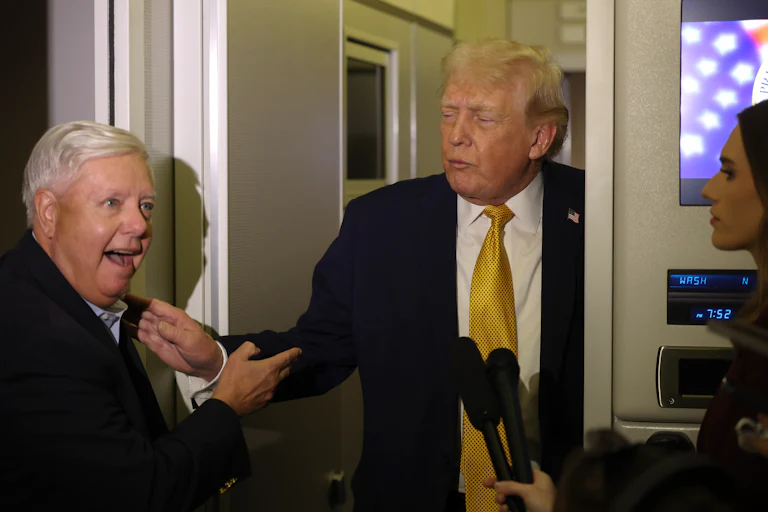
President Trump and Senator Lindsey Graham aboard Air Force One in January
Joe Raedle/Getty Images
Senator Lindsey Graham and President Trump speak to reporters on Air Force One.

In a Sunday talk show appearance, President Donald Trump used the death of Senator Lindsey Graham the day prior as a get-out-of-answering-questions-free card.

The weekend saw the unexpected death of the Republican senator at age 71. It also saw the United States and Iran trade fire in the Middle East, reaffirming the apparent collapse of the June memorandum of understanding between the two countries.

When CNN’s State of the Union host Jake Tapper queried Trump about the latter development, the president used the former as an excuse not to answer.

“Are we back at war, and who controls the Strait of the Hormuz?” Tapper asked.

Before he had even finished the question, the president was dodging it: “Well I don’t want to—out of respect for Lindsey, I’m not talking about that. We hit ’em very hard last night, so I don’t want to talk about it, but I will say we hit ’em very hard last night.”

The president went on to allege that Iran’s leaders had been “giving up everything” during talks on Saturday before they turned on a dime, hitting “a ship with a drone.” Such rhetoric is consistent with Trump’s past attempts to portray Iran, despite the evidence to the contrary, as desperate and on the verge of surrender.

“These people, there’s something wrong with them,” Trump said of Iran, “but I’m talking about a man who had nothing wrong with him, and that’s Lindsey Graham.”

Later in the interview, Tapper tried again to get information about the war out of Trump, asking if the Strait of Hormuz is closed as Iran has claimed. But his luck was no better this time, with the president responding, “It’s open as far as we’re concerned. Don’t talk about it. Talk about the reason that you asked me to speak.”

Come Monday morning, Iran and the U.S. were both claiming to be in control of the strait.

Graham’s Death Throws Major Hurdle in Upcoming Republican Votes

Republicans are going to have a very tough time without Senator Lindsey Graham—especially when it comes to President Trump’s nominees.

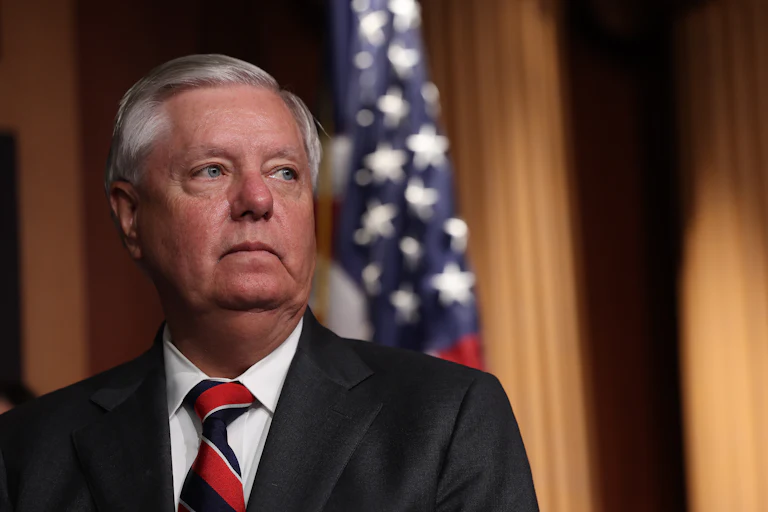
Senator Lindsey Graham
Kevin Dietsch/Getty Images
Senator Lindsey Graham

The sudden death of Senator Lindsey Graham over the weekend makes things tougher for his fellow Republicans.

Several Senate votes loom in the coming weeks, including the confirmations of acting Attorney General Todd Blanche, Jay Clayton for director of national intelligence, Erica Schwartz for the Centers for Disease Control and Prevention, Keith Sonderling for secretary of labor, and David Cummins to lead the Transportation Security Administration. On top of that, votes for the National Defense Authorization Act, the main funding bill for the military, are coming up this week.

Graham was also chair of the Senate Budget Committee, and a new reconciliation bill is coming up, with potential tax changes.

“The last time he and I sat down, we talked about doing the third reconciliation bill and having another big tax cut,” said Club for Growth president David McIntosh to Politico. “Lindsey was all for that.”

Other big votes on Senate Majority Leader John Thune’s agenda include a new Russia sanctions bill and an attempt to renew the Foreign Intelligence Surveillance Act. President Trump, meanwhile, is still pushing for his voter suppression bill, the SAVE Act.

Graham also was a key intermediary between the Senate and the White House, and Trump is going to have to find someone new to fill that void who is respected in the chamber. Trump likes Senator Rick Scott, but he isn’t well respected in the chamber, one White House official told Politico, adding that “I could see [Alabama Senator] Katie Britt trying to fill that void.”

A few candidates have popped up to fill Graham’s South Carolina Senate seat, including former Representative Troy Gowdy and the state’s lieutenant governor, Pamela Evette. Gowdy has the support of South Carolina’s other senator, Tim Scott, who has reportedly been making calls around the state on his behalf. Evette is reportedly favored by Governor Henry McMaster, who under state law can appoint a successor to fill out the rest of Graham’s term. A quick primary will be held in the coming weeks to name a new Republican nominee for the November general election.

Treasury Secretary Scott Bessent has also emerged as a possible new senator, reportedly receiving calls to put his name forward, and Graham’s sister, Darline Graham Nordone, has been brought up by some Republicans. It will be interesting to see whether McMaster goes for a caretaker pick, or a long-term appointment. Trump could also weigh in and endorse a candidate. For now, though, Trump and Thune will want the vote of that immediate appointee as soon as possible.