Breaking News
Breaking News
from Washington and beyond

New Video Raises Questions About ICE’s Story on Deadly Maine Shooting

A young man is dead following another fatal ICE shooting. Video footage shows what happened in the moments after.

An FBI official places an evidence card on Pool Street in Biddeford, Maine, where a man was fatally shot by ICE agents on July 13.
Gregory Rec/Portland Press Herald
An FBI official at the scene on Pool Street in Biddeford, Maine, where a man was fatally shot by ICE agents on July 13

New footage from ICE’s fatal shooting in Maine Monday morning shows the victim’s car still running in circles after they shot him at the wheel.

The Portland Press Herald released footage from immediately after the shooting in Biddeford, Maine, showing ICE agents attempting to stop the small white car. When the agents finally succeeded in opening the car door, they let the man’s body slump to the ground before putting him in handcuffs.

It’s a gruesome scene, and an eyewitness told the Press Herald that he saw agents pull the man from the car, “bleeding profusely from the head.”

“He was talking. He said, ‘I tried to stop,’” the witness said. Other footage appeared to show agents surrounding the man on the ground in an intersection, with the car sporting several bullet holes. A young child, reportedly the victim’s daughter and no older than three years old, was at the scene crying in her Bluey pajamas, according to another witness who spoke with the Press Herald.

Immigration advocates say the man, who has only been identified as a 26-year-old from Colombia, was authorized to work in the United States and had a Social Security number. One eyewitness told Reuters that the ICE officer who shot the man said the victim tried to ram him, a story similar to those that ICE has told in previous violent confrontations.

Maine Representative Chellie Pingree and Senator Angus King said Monday afternoon that the ICE agents were not wearing body cameras at the time of the shooting. The incident has touched off protests against ICE in Biddeford, with the town’s residents marching around the city and reaching Republican Senator Susan Collins’s local office, where they chanted “vote her out.”

Last week, ICE shot and killed Lorenzo Salgado Araujo in Houston, and claimed that he tried to ram and kill ICE agents with his car, contradicting witnesses who said ICE agents boxed in his car.

How Trump Commemorated Lindsey Graham in First Speech Since Death

Graham died unexpectedly Saturday night.

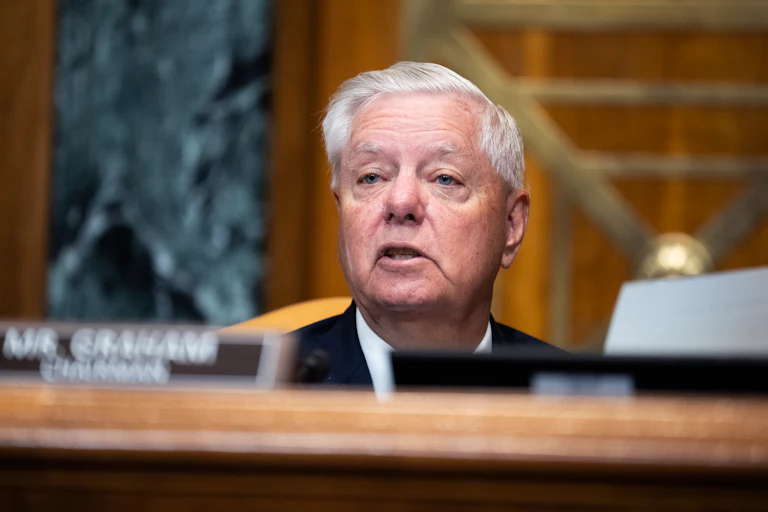
Senator Lindsey Graham speaks during a Senate committee hearing.
Tom Williams/CQ-Roll Call, Inc/Getty Images
Senator Lindsey Graham during a Senate committee hearing

Donald Trump’s first speech after Lindsey Graham’s passing didn’t include one word about the prominent South Carolina Republican’s shocking death. Instead, the president opted to use his time before the American public to stump for an upcoming IndyCar race.

Trump didn’t seem out of sorts in the slightest Monday as he advertised the two-day August race, slated to take place on the National Mall to celebrate America’s 250th anniversary. Instead, he ribbed Transportation Secretary Sean Duffy for being named a three-time world champion in the 90-foot lumberjack speed climb, and joked with the CEO of Fox Sports, Eric Shanks, about what he predicted would be “big ratings.”

“It will be an awesome display of American patriotism and raw horsepower, ingenuity. You’re going to see cars at the level that they’ve never been at before, with cars racing more than 190 miles and even higher than that down Pennsylvania Avenue,” Trump said, pegging the event as a spiritual successor to his UFC 250 fight.

“It wasn’t exactly designed for that, but what Sean Duffy has done with these incredible, brilliant people is really amazing,” he continued. “It’s going to be a sight for the ages.”

Graham passed away on Saturday night after what his office described as a “brief and sudden illness.” The next morning, a preliminary medical report found that Graham had died from a tear in his aorta due to the hardening of his arteries.

Speaking in several interviews Sunday, Trump described Graham as “like a member of the family,” and said that his death was “very tough.” In an interview with NBC’s Meet the Press, Trump recalled that he had spoken with Graham on Saturday night after the senator returned from his trip to Ukraine, and said that, at the time, Graham had “sounded a little bit tired, but perfect.”

“It’s devastating. I thought he was fine. He called me last night,” Trump told CNN. “What a terrible loss it is. He was a great politician. He was a natural. There are very few of them.”

The president also lauded what he considered some of Graham’s finest moments as a senator, including his impassioned defense of Brett Kavanaugh when he was nominated to the Supreme Court in 2018.

“I think it was a top ten, maybe a top five, moment in the history of the Senate,” Trump told CNN. “It was an incredible display, and he did it from the heart. He felt strongly about Brett, and he did it from the heart—and it turned that whole thing around.”

But Trump was far less effusive about Graham’s legacy by Monday morning when he called in to Fox News, boiling down Graham’s 23-year Senate career to his political flip-flop after the January 6 insurrection.

“He had one bad moment, and that was on the Jan. 6 thing when he stood up [and said], ‘All right, now I’ve had it. That’s it. I can’t do it anymore,’” Trump recalled, laughing. “Then he called me like about 40 minutes later, and he said, ‘Did I really say that? I can’t believe it.’ And he took it back. So I give him a 99 instead of a 100, ‘cause most people, a lot of people are at 100, but he did have that one little moment and it was sorta funny.”

At the time, Graham said “enough is enough,” regarding Trump’s 2020 presidential election conspiracy. He quickly changed his mind when Trump returned to power.

But that was practically all Trump had to say on the matter. Fox’s hosts could barely get a word in edgewise as they tried to steer the president back towards his thoughts on Graham’s death. Instead, the president was fixated on his wildly unpopular SAVE America Act, opting to spend the remainder of his time on the broadcast complaining about mail-in ballots and California’s supposedly rigged elections.

12 Blue States Defy DOJ and Sue to Stop Paramount-Warner Bros. Merger

A group of Democratic states is challenging Trump’s Department of Justice to block Paramount’s takeover.

The Paramount Skydance Corporation logo is seen on a smartphone with the Warner Bros. logo in the background.
Pavlo Gonchar/SOPA Images/LightRocket/Getty Images

Twelve Democratic-led states on Monday sued to stop Paramount Skydance’s $110 billion purchase of Warner Bros. Discovery, arguing that a merger of two of the country’s largest media companies would hurt American consumers.

The attorneys general of Arizona, California, Colorado, Connecticut, Massachusetts, Minnesota, Nevada, New Jersey, New Mexico, New York, Oregon, and Washington joined together to file the lawsuit in the U.S. District Court for the Northern District of California. The lawsuit argues that the merger will hurt the market for film distribution and give the new company too much power over the market for distributing basic cable channels.

“The unlawful merger of these two entertainment behemoths would lead to higher prices, lower quality, and less content for film and television, harming movie theaters, basic cable distributors, and ultimately, audiences on every sofa and movie theater seat in the U.S.,” California Attorney General Rob Bonta said in a statement.

If Paramount’s acquisition of Warner Bros. is successful, the company would own two major news networks in CNN and CBS News, the movie studio Warner Bros., and the streaming service HBO Max. Larry Ellison and his son David Ellison, staunch supporters of President Trump, own Paramount Skydance, and would effectively have their own conservative media empire.

The merger has also raised concerns that CNN would be overhauled to reflect the conservative political views of the Ellisons. The two Trump allies have already steered Paramount’s CBS News to the right, causing its ratings to plummet and, in the process, an employee exodus from its flagship 60 Minutes program.

Trump is very much in favor of the merger, holding a longtime vendetta against CNN over its critical coverage of him, and has discussed who he wants to be fired at the network once the takeover is complete. Other officials in the Trump administration, such as Secretary of Defense Pete Hegseth, have openly cheered on pro-Trump changes at CNN.

The Department of Justice said last month that it would not challenge Paramount’s move, saying it was “not likely to harm competition or American consumers.” Now that decision will go to federal court, where a judge will determine if the damage to the public breaks the law.

Federal Judge Nullifies Trump’s Entire January 6 Slush Fund

She also referred his attorney for possible professional discipline.

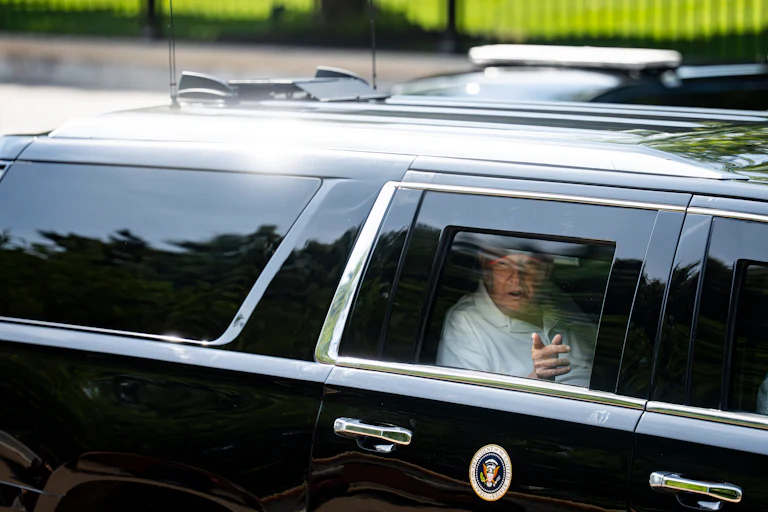
Donald Trump points out the car window as he rides in his motorcade
Al Drago/Getty Images

A federal judge just nixed the settlement underlying Donald Trump’s nearly $1.8 billion slush fund.

The fund was the result of an unprecedented deal that Trump made with himself after he dropped his $10 billion lawsuit against the Internal Revenue Service for the unlawful leak of his tax returns in 2019. The honey pot payments were pitched as reparations, paid for by U.S. taxpayers through the Department of Justice, to virtually any right-winger that felt targeted by the previous presidential administration.

“The nature of the suit itself and the conduct of the Parties and counsel from its filing make plain that this was an attempt to use the Court to provide some legitimacy to an agreement to confer immunity to people and entities affiliated with the President and to earmark billions of dollars from American taxpayers to redress grievances not defined in the law,” wrote U.S. District Judge Kathleen Williams in a 56-page order Monday.

Williams ruled that any entities affiliated with the slush fund settlement—including the president, the Treasury Department, and the IRS—were “prohibited” from using the details of the arrangement in any official capacity. She also referred Trump’s attorney, Alejandro Brito, to the Florida bar for possible professional discipline.

She noted that while Trump had the right to pursue legal action over the unauthorized publication of his tax returns, he chose not to do so while he was still a private citizen. Instead, Trump did not bring the charges until he had returned to the White House and subsequently appointed his former lawyer, Todd Blanche, atop the Justice Department.

“These officials then negotiated on behalf of the United States, with his current lawyers, including his former White House Counsel, to reach a ‘settlement,’” Williams assessed. “It is risible to suggest that there was ever adverseness between the Parties.”

The settlement between Trump and his government also included a curious addendum from Blanche that immunized Trump from further federal prosecution. The government of the United States, Blanche wrote, would be “forever barred and precluded” from pursuing “any and all claims” against Trump, his family, or his business.

But as Williams observed, the jaw-dropping components of the case—such as the billions of dollars in taxpayer funds proposed for undefined grievances, or the blanket immunities offered to Trump—were not put before the court. Instead, the question underlying the legality of the president’s slush fund centered around whether the entities engaged in the settlement arrangement, from government representatives to Trump’s personal attorneys, ever represented different parties while they pretended to engage in a legitimate court proceeding.

“The answer is a resounding ‘no’: the Lead Plaintiff and the Government are one, a fully realized unitary interest,” Williams wrote.

That was evidenced before the nation in June, when Blanche testified before the House of Representatives that the Anti-Weaponization Fund would not be moving forward. That slip of the tongue showcased Blanche’s confidence that he could speak for, and bind, both sides of the matter, according to the judge.

“In sum, the facts before this Court demonstrate there was never adverseness between the Parties; there was never a case or controversy; and there was never a question as to who would prevail,” Williams concluded.

This story has been updated.

Trump’s Sons Are Making Billions on Defense Department Contracts

Don Jr. and Eric have found a new cash cow.

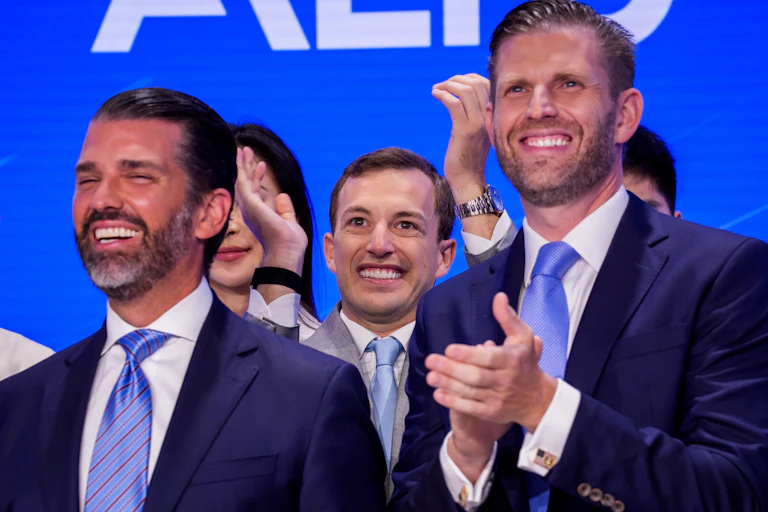
Donald Trump Jr. and Eric Trump smile and clap after ringing the Nasdaq opening bell.
Adam Gray/Bloomberg/Getty Images
Donald Trump Jr. and Eric Trump after ringing the Nasdaq opening bell

In the latest instance of Donald Trump’s family lining their pockets during his time in the White House, the president’s sons are cashing in on the administration’s military spending strategy with investments in defense technology.

A new analysis from The Washington Post found that investment funds associated with Donald Trump Jr. and Eric Trump have “invested in more than a dozen defense tech companies and other firms seeking businesses from the Pentagon and federal agencies.”

Since the brothers’ investments, those firms have secured at least $3.2 billion in federal contracts in total, as well as $3.1 billion in future contract options. Some have even gained entry to exclusive preapproved contractor shortlists and, with that, the opportunity to “bid exclusively on up to nearly $200 billion in future work.”

The companies are benefiting from a ramped-up approach to military spending, which started under Joe Biden but escalated significantly under Trump, reports the Post.

Unsurprisingly, in statements to the newspaper, spokespeople for the administration, the Trump brothers, and the defense contractors have dismissed the plain conflict-of-interest concerns raised by the story. They insist that the contracts have been awarded solely on merit and that there is no corruption afoot.

Read more about the Trump family’s profits: