Breaking News
Breaking News
from Washington and beyond

Modeling Scout Named Thousands of Times in Epstein Files Found Dead

Daniel Siad, a modeling scout who sent young women to Jeffrey Epstein, was found dead at his home.

A small car parked in front of a gated home
Xavier Galiana/AFP/Getty Images
The residence of modeling agent Daniel Siad in Colombes, France, a Paris suburb, on July 22

Daniel Siad, the French modeling agent who allegedly introduced dozens of young women and girls to sexual predator Jeffrey Epstein, was found dead in his Paris home on Monday. He was 69. 

Siad was one of many friends and associates that Epstein had in France, and was under investigation in the country for rape and human trafficking. 

Siad is mentioned in the Epstein files released by the Department of Justice more than 2,000 times. Some of the most disturbing conversations between him and Epstein, occurring over a decade, involve him sending pictures and descriptions of young women to the convicted sex offender

“Hello Jeffrey I just found an amizinng One she is 20 years old but she looks younger from Latvia 5’8 She just Did a world campaign For Nivea Last weeck and she will be Doing an other campaign for Garnnier this week willing to sign with me as a personal agent. I am traveling with here to Paris this week let me know if you think it will be good to take here To Next and also what Agency you thing is apropriate for here in The US she said that she meet Jean luck once in Danemark wile she was there with Scoop Models . because a girl like this is future star we need to make here a good contract world wide” Siad wrote in one email in 2009, referring to another modeling agent, Epstein friend, and alleged sex trafficker, Jean-Luc Brunel—who died by suicide in his jail cell in 2022.

“The Russian girl as canceled her fly . I wanted to make for you a great surprise ,it didn’t work this time ,I really hope that it work next time . In This busyness I feel like fisherman some time I cache quick , some time no fish,” he wrote in another 2015 email to Epstein. “I really did good work for scouting in Scandinavia most of them will be ready to start with 2morrow at list 5 of them sixteen and seventeen will be ready for next year .But I can’t send you there pictures as know.”

“The French her name is [REDACTED] she is fifteen her parents checked me out and they are very happy there daughter to start modelin,” he continued. “I am going back to Stockholm then Gotland for what we call Stockholm week all the girls from sweden gather there for five days non stop Parties .to through my hooks.”  

These emails sound like Epstein commissioned Siad to go around and find women and girls to funnel to him for over a decade. Siad has denied all allegations against him, telling CNN just last month that he had no idea Epstein was abusing the girls he sent his way. 

“I never doubt that because I never heard anything from anyone who I introduced [to Epstein] who came back to me that they had a bad—a bad situation with him,” Siad said. “He was such a powerful person. And how can I not trust him?”

Siad was originally from Algeria and moved to Sweden in the 1980s before settling in Paris, where he likely met Epstein through Brunel, although it’s unclear when. 

Epstein spent a lot of time in Paris, particularly after his first conviction. Conductor Frédéric Chaslin and diplomat Fabrice Aidan are two of the other most prominent Frenchmen mentioned in the files along with Siad and Brunel. 
Read The TNR Blue Book, our new newsletter on the Democratic Party:

Even Republicans Want Nothing to Do With Trump’s Canada Tariffs

Republican senators are trying to distance themselves from Trump’s newest tariffs.

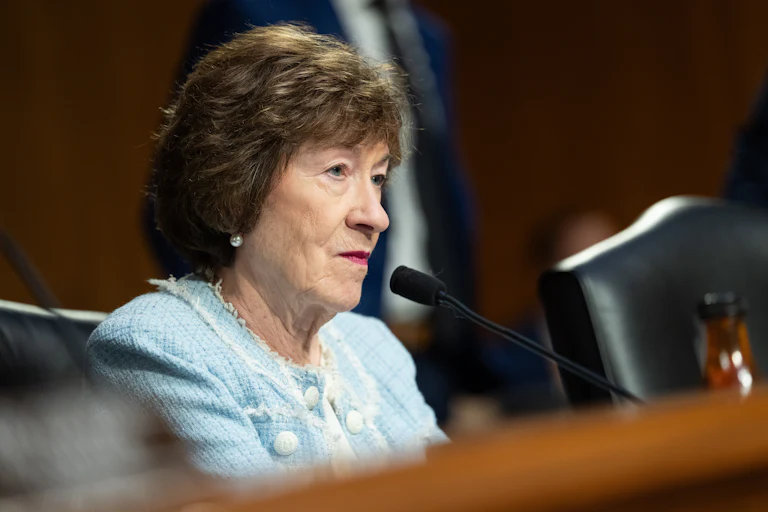
Senator Susan Collins sits in a congressional hearing.
Aaron Schwartz/Getty Images
Senator Susan Collins

President Trump’s new tariffs on Canada are drawing a backlash from lawmakers in his own party. 

Republicans in the Senate are skeptical of Trump’s 50 percent tariffs on most Canadian goods, excluding energy products, potash, fish, and critical minerals. Senate Majority Leader John Thune told The Hill that he was skeptical and needed more information. 

“I’m not a huge fan of tariffs as a general rule, unless there’s a specific purpose behind it, in most cases, creating a more level playing field for America’s businesses and our economy,” Thune said. “But I don’t, I haven’t heard the rationale for this one just yet.”

Senator Mike Rounds was concerned about the Trump administration’s legal rationale for the tariffs, considering that the Supreme Court struck down Trump’s previous tariffs months ago. 

“My initial concern on it was what the purpose of it was, what the expectation is for, you know, considering a result a success,” Rounds told The Hill. “What is the goal of the tariffs? And I haven’t seen which provision within the law he’s utilizing.”

Trump announced a fresh round of tariffs on Canada Monday, defending his move as a response to trade “discrimination” from Canada on cars, alcohol, and dairy products. Trump is using Section 338 of the 1930 Trade Act as legal justification, the Associated Press reports, citing an anonymous administration official. The tariffs apply to goods that the recently expired United States-Mexico-Canada Agreement used to cover. 

Rounds said that the tariffs could also affect the price of goods and hurt American consumers. 

“The affordability side of this thing is something that we should all be concerned with,” Rounds told The Hill. “Right now inflation is not as low as it was; it is up. Fuel prices are very important that we try to maintain, bring down. International issues going on have caused it to come back up again. We need to get the price of gasoline back down again for the American consumer.”

“Tariffs of that magnitude will translate into higher prices for the American consumer,” agreed Senator Bill Cassidy, who is leaving Congress at the end of the year. 

Senator Susan Collins, who is in a tough reelection campaign in Maine, told Politico Tuesday that she has “voted repeatedly against the Canadian tariffs.”  

“Maine and Canada’s economies are very intertwined. A lot of our blueberries, our potatoes, our lobster, our lumber are harvested in Maine, processed in Canada and then come back. I don’t want to see the tariffs on the books,” Collins said. 

Businesses sued the government over Trump’s previous tariffs and they were eventually overturned, with refunds doled out to companies that applied for relief through U.S. Customs and Border Protection. But every time those tariffs were put to a vote in Congress, Republicans refused to overturn them. With the midterms looming, will that be the case again? 

Trump Prepares to Attack Eighth Country of His Second Term

Donald Trump can’t stop intervening in other countries.

Donald Trump stands during the dignified transfer of soldiers in Delaware.
Daniel Heuer/Bloomberg/Getty Images
Donald Trump during the dignified transfer of soldiers in Delaware

Weeks after a preliminary peace deal with Iran fell apart, Donald Trump has turned his attention toward his next military conquest.

The Trump administration is reportedly considering taking military action against an  Al Qaeda-affiliated group in Mali known as JNIM, according to several current and former U.S. officials that spoke with The Washington Post Wednesday. 

Doing so would add to the president’s warmongering tally, marking the eighth nation he has ordered strikes on since he began his second term as president.

The other affected countries are Yemen, Somalia, Syria, Iran, Iraq, Nigeria, and Venezuela. Trump has also ordered 66 strikes against small watercraft in the Caribbean and eastern Pacific in an admittedly futile attempt to interrupt drug smuggling into the U.S., killing at least 221 people in the process.

One of the administration’s top proponents for using brute force in Mali is Sebastian Gorka, the National Security Council’s senior director for counterterrorism. The London-born Hungarian has been a fixture in Trump’s inner circle since 2017, though his appointment to Trump’s first administration came as a surprise to many in his field. Gorka had previously been known for his extremist, Islamophobic views, which relegated him to the fringes of Washington and his position as an editor at Breitbart.  

But specialists in the region disagree with the violent approach.

Wassim Nasr, a senior research fellow at the Soufan Center, which focuses on the Sahel region, said that America’s influence would be better used in “conflict resolution” by forcing Mali’s stratocracy into talks with JNIM. Otherwise, the White House could be squaring up for another major loss.

“Opting for the military solution one more time won’t get things resolved,” Nasr told the Post. “The French tried that for 10 years. The Russians have been trying for five years. The situation has only gotten worse and worse.”

Justice Department Lawyers Reportedly Afraid to Put Things in Writing

DOJ lawyers appear to have made a stunning admission in a case against a Minneapolis journalist covering an anti-ICE protest.

Dozens of signs reading "ICE Out Now" decorate the front of a Minneapolis home
Scott Olson/Getty Images
Anti-ICE signs decorate the front of a home in Minneapolis, on January 29.

Lawyers working at the Department of Justice are refusing to put certain information in writing out of fear that it could be used against them.

The DOJ is prosecuting two journalists over their coverage of an anti-ICE protest at Cities Church in Minnesota in January, and one of them, Georgia Ellyse Fort, is charged with three felonies, including a hate crime. Fort’s defense counsel is accusing the government of spying on her, and a judge barred the government from using toll records and cell phone simulators that include Fort’s phone activity.

A Homeland Security Investigations agent, Timothy Gerber, allegedly began using customs summonses to get information about Fort, whose lawyers said that the prosecutors would not say whether the government was continuing to use those summonses. The prosecution is supposed to turn over its evidence to defense counsel in any legal case, but only described the cell phone data from Fort’s phone without turning over the data itself.

In a letter to DOJ prosecutors, first flagged by independent journalist Mary Wheeler, Fort’s lawyers referred to a phone call with DOJ lawyer Ned Hedley in which they got the indication that “the government does not intend to respond to our correspondence in writing, out of the concern expressed on the call that what it represents to us could be put before the Court and/or otherwise used against it.”

It’s an astounding thing for government lawyers to say, especially considering that documenting conversations is a basic requirement in the legal profession. Hedley’s words seem to indicate that the Trump administration is trying to hide something, or knows that its activities might not be legal.

Fort was arrested alongside journalists Don Lemon and Michael Beute—and the case against all of them is weak. The three are accused of rioting and protesting, while they say they were merely covering the event. Refusing to put certain things in writing would seem to undermine the government’s case.

Read The TNR Blue Book, our new newsletter on the Democratic Party:

Trump BBC Defamation Lawsuit Backfires Big-Time—With Subpoenas Coming

Trump will also have to hand over all his financial information, a judge ruled.

Donald Trump
SAUL LOEB/AFP/Getty Images

President Trump’s $10 billion defamation lawsuit against the British Broadcasting Company is backfiring in his face, as a judge has greenlit the subpoenaing of his inner circle.

Trump last year filed a lawsuit against the BBC over a 2024 episode of Panorama titled “Trump, a Second Chance.” Trump claims the episode was defamatory because it edited together two sections of his January 6, 2021 speech, highlighting his line calling on his supporters to “fight like hell,” while omitting a section in which he told them to peacefully protest. The BBC apologized after Trump threatened them with legal action last year but refused to pay up.

But on Tuesday, U.S. Magistrate Judge Enjoliqué Lett said the BBC can proceed with subpoenas for Trump’s closest advisers and confidants—including his family members, Stephen Miller, and Steve Bannon—to make the case on what Trump’s actual goals were on January 6.

Lett also ruled that Trump must hand over hundreds of financial records, as Trump argued in his lawsuit that the episode hurt his many businesses.

“All of President Trump’s brand, properties and businesses are impugned or said to have been impugned. Reputational, economic damages, all of that is now at issue in this case,” Lett said, allowing the BBC to investigate the more than 400 companies owned by Trump’s family trust.

The president’s wanton spitefulness, which has earned him a payoff in cases against CBS and ABC, may now be the chief reason he’s finally exposed.

Read The TNR Blue Book, our new newsletter on the Democratic Party: